
In this guide
A radio teleswitch tariff is an off-peak electricity tariff, most often Economy 7, Economy 10 or Total Heat Total Control, whose cheap and expensive periods are switched by a radio signal rather than a clock in the meter. That signal is now being withdrawn. Ofgem states plainly that "Support for RTS meters has now ended"1. Energy UK reports that the phase-out of the Radio Teleswitch Service (RTS) was completed on 30 June 2026, as the technology reached the end of its life, and that there was no single mass switch-off on 30 June 2025 as first planned2. The Centre for Sustainable Energy describes a slow, gradual transition, targeted by postcode and continuing in stages through 20263.
The numbers affected are large. According to Ofgem, around 800,000 RTS meters across Great Britain need to be replaced, and the Energy Saving Trust puts the total at almost 1 million homes4. Energy UK estimated in 2024 that about 900,000 households and businesses were involved, typically in areas with no mains gas5. The Scottish Government has recorded that the switch-off affects more than 200,000 households in Scotland with electric heating6.
What the household loses without a new meter is control over when storage heaters and hot water come on, and potentially the night rate itself: a household that takes no action can be put automatically onto a standard tariff and charged the day rate at all times7. What it keeps is the choice of tariff. Home Energy Scotland states that a tariff supporting heating and hot water will still be available after the meter is replaced, though it may differ from the current one8.
The RTS switch-off has begun, and support for RTS meters has now ended
The official position is short. Ofgem's guidance says support for RTS meters has ended, that any RTS meter still in use "may no longer work as expected", and that "The equipment's age also means any problems will be harder to fix"1. The reason is the transmission equipment rather than the meters in homes: the equipment that produces the radio signal "could not be adequately maintained anymore"2.
The timetable has shifted, and the documents give different dates. Which? states that the signal began to be switched off on 30 June 202512. Age UK13 and Electricity North West14 both give 30 June 2025 as the date the service would end. Energy UK, updated in July 2026, says there was no mass switch-off on that date and that the phase-out was completed on 30 June 20262. Which?, writing about time-of-use tariffs, reports Ofgem's expectation that the service would be switched off by the end of 202615. These dates are not reconciled in the guidance: the earlier ones describe the original plan, the later ones the phased approach that replaced it.
That change of approach was deliberate. The Energy Action Scotland describes the service as "being gradually retired" and urges anyone with an RTS meter to contact their supplier urgently16. The British Gas Energy Trust reported in September 2025 that the government had introduced "a new phased approach to the switch"17. The Centre for Sustainable Energy explains that the phasing is being done "slowly and gradually, targeted by postcode"3, so two neighbouring streets may have lost the signal at different times.
For independence, the lesson is that an RTS home was always dependent on an external broadcast it did not control. When that broadcast ends, the heating schedule ends with it.
What the Radio Teleswitch Service does
The radio teleswitch is, in the words of the Energy Networks Association, "a device which lets electricity suppliers switch large numbers of electricity meters between different tariff rates"18. The British Gas Energy Trust describes the service as "a form of radio communication between some electricity meters and their energy suppliers" that tells the meters when to swap between peak and off-peak rates19. It has been in use since the 1980s19, and National Energy Action notes that it is also known as the Dynamic Teleswitch Service (DTS)20.
The signal did two jobs at once. It moved the meter between the expensive "day" or "domestic" rate and the cheaper "night" or "control" rate8, and it switched the circuits that feed storage heaters and hot water cylinders. Each teleswitching message carries 50 bits of data, and in Economy 7 systems the teleswitch replaced the time clock that would otherwise decide when the cheap period starts18. Because the switching was centralised, suppliers could shift a household's cheap hours without visiting the property.
Home Energy Scotland lists the homes that commonly rely on it: those with electric storage heaters, panel heaters, wet electric heating and immersion heaters21. The Welsh Government's Rent Smart Wales service describes RTS as used "by some older electricity meters to control electric heating and hot water, often linked to tariffs such as Economy 7 or Economy 10"22. On a storage heater system, the Energy Saving Trust explains, "Your meter or a timer switch controls when the off-peak circuit is live. The heater charges automatically during these cheaper hours."23
How to tell if you have an RTS meter
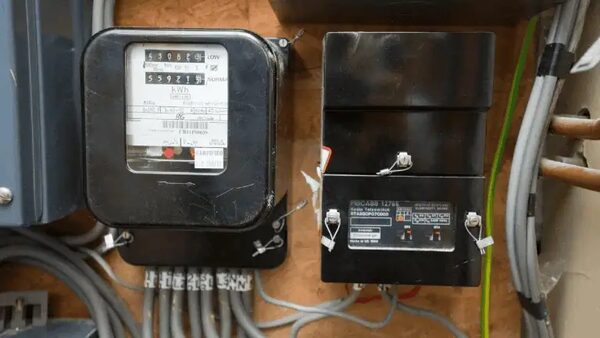
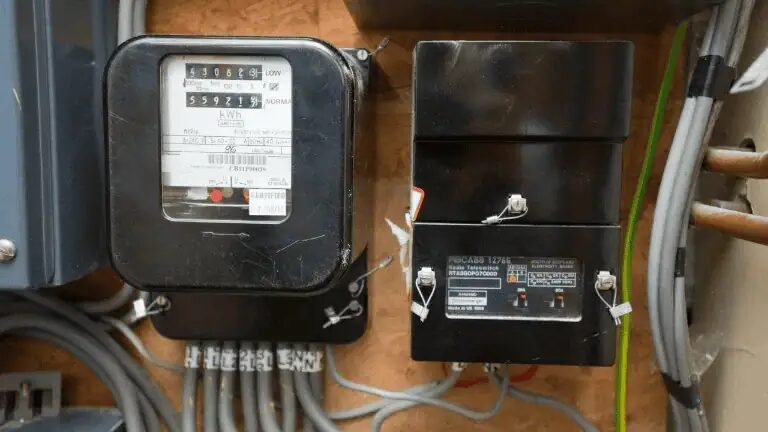
Several consumer bodies publish the same checklist. Smart Energy GB states that a property matching any of these criteria may have an RTS meter24:
- a separate switch box near the meter, often labelled "Radio Teleswitch";
- heating by electricity or storage heaters;
- no gas supply to the area, which includes many rural areas and high-rise flats;
- a tariff called Economy 7, Economy 10 or Total Heat Total Control.
Age UK13, Energy UK2 and National Energy Action25 give matching lists. The Centre for Sustainable Energy describes the box as a black box next to the meter with "radio teleswitch" written on it, and adds that a letter about getting a new meter is another sign3. Action with Communities in Rural England (Acton Energy) notes the meter "might have the words 'Radio Teleswitching Service' on it" and should show two readings, one for daytime and one for night-time7.
The bill is the second check. If it shows two different rates for day and night, or names Economy 7 or Economy 10 as the tariff type, an RTS meter is possible7. Two rates alone do not prove it: Smart Energy GB points out that some older Economy 7 meters use RTS, but not all do24. In Scotland Economy 7 meters are often called "white meters", because the meters supplied by energy companies were white26. For a fuller check on tariff type, see whether you are on Economy 7 and which tariffs your meter allows.
Without the signal: heating, hot water and bills
The failure is not a clean stop. Electricity North West warns that without the RTS signal "systems may become unpredictable, potentially not working or turning on or off at incorrect times"14. Energy UK and National Energy Action describe the same pattern: heating or hot water continually left on or off, charging at the wrong time of day, and a supplier unable to confirm what was used at peak or off-peak, which could mean electricity costs "much higher than before"2. SSEN confirms the switch-off may mean heating and hot water stop functioning as normal27.
There are three separate effects:
| What goes wrong | Why it matters |
|---|---|
| Storage heaters charge at the wrong time or not at all | Home cold, or heat released when not wanted |
| Immersion heater stuck on or off | No hot water, or constant heating at day rates |
| Supplier cannot confirm peak or off-peak use | Readings may be billed at the day rate |
Acton Energy goes further: a household that does not act "will automatically be put onto a standard tariff", losing the cheaper night rate and being charged the day rate at all times, which it says could double or even triple the cost of night-time electricity7.
The risk falls on homes with fewest alternatives. Households using RTS are typically in areas without mains gas5, and time-of-use electricity tariffs do not affect gas bills in any case28. A home with only electric heating has nothing to fall back on when the heating schedule fails. For older people, Age UK flags the same heating and hot water risks13.
Replacing an RTS meter: the phased switch-off and smart meter upgrade
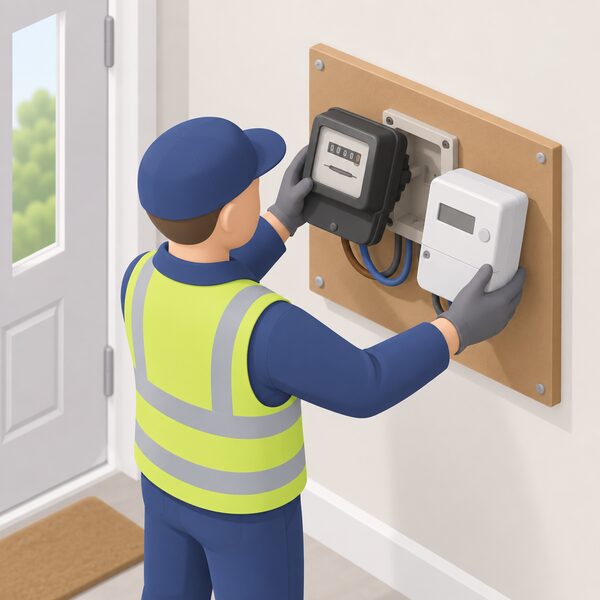
The standard replacement is a smart meter. National Energy Action says smart meters are a technical replacement for RTS meters "because they can be programmed to deliver a similar service"20, and the British Gas Energy Trust reports that in most cases a smart meter will be fitted17. Radio teleswitches are being replaced as part of the smart meter rollout18.
The Energy Saving Trust states: "You don't pay anything to change your meter." and "Your supplier should upgrade you to a smart meter for free."4 The Centre for Sustainable Energy adds a caveat: in most cases there is no cost, but on rare occasions, for example where there is an asbestos board or no room for a new meter, a cost may arise3. Smart Energy GB states that the unit rate will not change when a smart meter is fitted unless the tariff is changed at the same time29.
The process, as the guidance sets it out:
- Check for the signs of an RTS meter listed above.
- Contact the electricity supplier using the number on the bill7. If the supplier is unknown, call 105 to reach the local network operator, which can say who the supplier is8.
- Book the installation. Smart Energy GB states that anyone with an RTS meter "need[s] to book a new meter installation now"24.
- Agree the tariff and heating times with the supplier, since the new tariff may differ from the old one8.
"The equipment's age also means any problems will be harder to fix."
Suppliers were required to contact RTS customers proactively about the switch-off date and the need to upgrade14. The Energy Saving Trust notes that the system is being phased out in stages, with replacement arranged through the supplier30.
A smart meter changes the kind of dependence rather than removing it. The household gains access to more flexible tariffs, including dual-rate tariffs31, and the switching is programmed into the meter instead of broadcast by radio. It remains reliant on the supplier's settings and, for a communicating meter, on the smart meter network. More on the options is in time-of-use tariffs and Economy 7 with a smart meter.
Economy 7 rates: about 15p at night against about 34p by day
Economy 7 charges a cheaper rate for seven hours a day, usually at night, and a higher rate for the other 1710. The Centre for Sustainable Energy assumed Economy 7 prices of 34.38p per kWh on-peak and 15.43p per kWh off-peak in June 20269. Which? gives 15.43p per kWh as the average Economy 7 off-peak rate in January 202612. For comparison, Uswitch reports that most suppliers charge around 26.3p per kWh on single-rate standard variable tariffs in the South Wales region10.
| Rate | Figure | Period |
|---|---|---|
| Economy 7 on-peak (assumed) | 34.38p per kWh9 | June 2026 |
| Economy 7 off-peak (assumed) | 15.43p per kWh9 | June 2026 |
| Economy 7 average off-peak | 15.43p per kWh12 | January 2026 |
| Single-rate standard variable, South Wales | around 26.3p per kWh10 | September 2026 |
The gap between the two assumed rates is 18.95p per kWh (34.38p minus 15.43p). Energy Helpline warns that "some Economy 7 tariffs charge almost double the night rate during the day"11, and at the assumed figures the day rate is indeed a little over twice the night rate.
The hours. The cheap period usually runs from midnight to 7am but varies by supplier15. Uswitch states it runs for seven hours at some point between 11pm and 8am, with the regional network operator setting a window of between 7 and 9 hours10. Some energy companies offer extra hours in winter15, and some variations offer 8.5 or 10 hours33. Economy 10 and Total Heat Total Control were also RTS tariffs25; see Economy 10 and restricted meter tariffs.
These tariffs have not always tracked other prices. In January 2023 End Fuel Poverty Coalition reported that Economy 7 users were paying 46% more than other electricity tariffs, citing a BBC figure of 2.5m households on them34. That is an old figure, but it shows that the day rate can erode the saving.
Whether Economy 7 still makes sense for your home
Economy 7 has not been withdrawn. Uswitch states it "remains on offer as a tariff from most energy suppliers"10. Whether it suits a particular home turns on how much electricity is used in the cheap hours, and the thresholds published differ:
| Source | Night-time share needed |
|---|---|
| Which? | at least 30%15 |
| Uswitch | more than 35%10 |
| Energy Helpline | more than 40%11 |
| National Energy Action | at least 40%35 |
The figures differ because each rests on different assumed day and night prices; the wider the spread, the lower the share at which the tariff pays. Cenex notes the Economy 7 price spread can be only 7p36, which leaves little margin for daytime use. Smart Energy GB describes Economy 7 as mainly intended for homes with electric heating using storage heaters37, and the Centre for Sustainable Energy ties night storage heaters to an Economy 7 tariff9. Which? says Economy 7 is only available for electricity-heated homes without a gas supply15, while the Energy Saving Trust says it is typically used with storage heaters "but they're available to anyone"28; the guidance differs on eligibility.
For households with a battery but no solar, the Energy Saving Trust names either a dynamic tariff or Economy 7 as the fit28. A battery charged at night and used by day raises the night share, which is the variable that decides the outcome. That is where a two-rate tariff contributes most to independence: it rewards storing energy, whether as heat in a storage heater or electricity in a battery. See Economy 7 for storage heaters and a home battery on a time-of-use tariff.
Households that have already left Economy 7 or Economy 10 face no rush: the Centre for Sustainable Energy says their meter will continue to function normally and, providing all electricity is on one circuit, they should see no difference, though it still recommends a smart meter3.
Where a smart meter is not possible
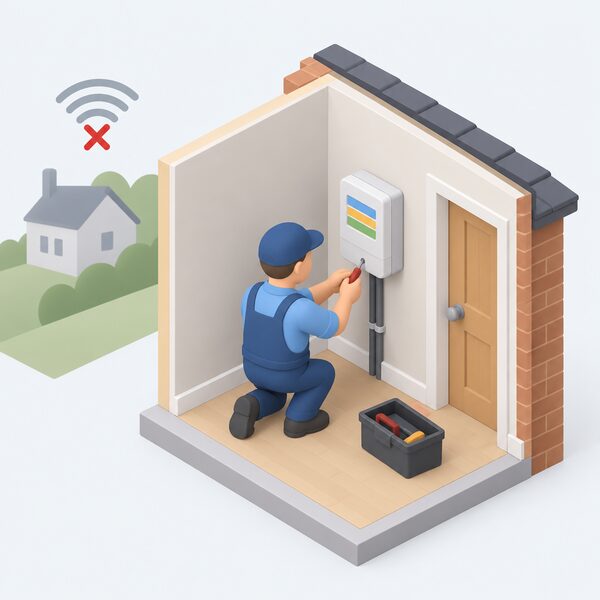
Some homes cannot have a working smart meter, usually because of poor signal, and some households refuse one. The replacement still has to happen: the Energy Saving Trust states that "If you can't have a smart meter, it still has to replace your RTS meter with a suitable alternative."4
The Centre for Sustainable Energy lists the options: a smart meter; a non-smart meter on request; or, where there is no signal, a non-communicating smart meter preset to switch between tariffs3. Home Energy Scotland describes the fallback for both poor signal and refusal: the supplier may fit a meter with the tariff pre-programmed, "You'll need to send in manual readings, and you won't get the full benefits of a smart meter, but your heating will continue to work"8. Acton Energy adds that the meter a supplier installs instead varies between suppliers7. National Energy Action notes that some customers cannot yet be offered an upgrade appointment and that the supplier will get in touch when ready25.
The rules on refusal:
- It is the customer's right to refuse a smart meter, though the Energy Ombudsman notes options may be limited where a traditional meter is faulty or unsafe38.
- Smart DCC states that smart meters are fitted at no extra cost, but that refusing one can mean missing cheaper tariffs available only with a smart meter39.
- The Welsh Government states that smart meters are optional40.
- Smart Energy GB notes some suppliers may charge to fit a traditional meter that urgently needs replacing, whereas a smart meter replacement is free29.
A pre-programmed non-communicating meter is, in one sense, the most self-contained option: it switches on its own clock and needs no radio or network signal. The price of that is manual readings and a fixed schedule that the household cannot easily change. For the wider picture on control and dependence, see tariffs and energy independence and the full energy tariffs guide.
Sources40 cited
- Get help with your smart meter, Ofgem, 2026-09-17
- The Radio Teleswitch Service switch-off: what you need to know, Energy UK, 2026-07-01
- Important reminder for Economy 7 and 10 meters, Centre for Sustainable Energy, 2026-06
- RTS meter switch-off, Energy Saving Trust, 2026-05-08
- Energy UK explains the Radio Teleswitch Service, Energy UK, 2024-05-22
- Tackling fuel poverty in Scotland: periodic report engagement responses, Scottish Government, 2025-04-22
- RTS: what you need to know, Act On Energy, 2026
- RTS switch-off, Home Energy Scotland, 2026-09-20
- Electric heating advice, Centre for Sustainable Energy, 2026-06
- Economy 7 guide, Uswitch, 2026-09-08
- What is Economy 7, Energy Helpline, 2026-09-20
- Storage heaters, Which?, 2026-06-01
- Radio Teleswitch Service switch-off, Age UK, 2026-08-26
- Radio Teleswitch Service, Electricity North West, 2026-09-19
- Time-of-use tariffs explained, Which?, 2026-04-23
- Radio Teleswitch, Energy Action Scotland, 2025-12-22
- RTS switch-off slowed to ensure smooth transition, British Gas Energy Trust, 2025-09-02
- Radio teleswitch, Energy Networks Association, 2026-09-17
- The Radio Teleswitch Service switch-off, British Gas Energy Trust, 2025-05-06
- Radio Teleswitch Service switch-off, National Energy Action, 2026-07-29
- Closure of Radio Teleswitch explained, Home Energy Scotland, 2025-02
- Act now: RTS switch-off could affect heating and hot water, Rent Smart Wales, 2026-06-15
- A guide to using electric storage heater controls, Energy Saving Trust, 2026-05-21
- The Radio Teleswitch Service switch-off, Smart Energy GB, 2026-04-24
- RTS meters, National Energy Action, 2026-07-08
- What is Economy 7, Confused.com, 2025-08-20
- Smart meters, SSEN, 2026-09-19
- Tariffs for renewable technology, Energy Saving Trust, 2026-08-12
- Do smart meters cost more, Smart Energy GB, 2026-03-16
- Electric heating, Energy Saving Trust, 2026-07-01
- Get help with your smart meter, Ofgem, 2026
- Types of energy tariff, Confused.com, 2025-11-03
- Should I switch to a time-of-use tariff, Energy Saving Trust, 2026-01-23
- Millions of energy customers hit by 7.6% hidden price hike, End Fuel Poverty Coalition, 2023-01-20
- Getting the most from Economy 7, National Energy Action, 2026-09-10
- V2GB: Vehicle to Grid Britain, Cenex, 2026-09-17
- What is Economy 7, Smart Energy GB, 2026-04-07
- Smart meters, Energy Ombudsman, 2026-09-20
- Do you have to have a smart meter by law, Smart DCC, 2026
- Smart meters, Welsh Government, 2026
 Economy 7 and TariffsHow off-peak and time-of-use electricity tariffs work for heating, including Economy 7, Economy 10, Scottish white meter arrangements and the end of the Radio Teleswitch Service.
 Heat Pump Electricity TariffsA heat pump tariff gives you cheaper electricity for part of the day, so running your heating costs less than on a standard rate.
 Meters and Time-of-Use TariffsDo you need a smart meter for a time-of-use tariff, and does it have to send readings every half an hour?
 Controls and Time-of-Use TariffsCheaper electricity at night only saves money if your heating actually uses it then.
 SMETS1 and SMETS2 MetersIs your smart meter an old first generation model or a newer one, and does it matter?
 Time-of-Use Tariffs ExplainedCan you pay less for electricity by using it at different times of day?