
In this guide
Scotland's electricity tariffs are shaped by two things that set it apart from the rest of Great Britain: a much higher share of homes heated by electricity, and a distribution network whose costs are highest in the north of the country. Ofgem's price cap publishes separate figures for Southern Scotland and Northern Scotland, and the northern region carries the higher standing charges and unit rates. For the cap period running 1 July to 30 September 2026, the Northern Scotland single-rate figure at 2,500 kWh is £829.05 a year with a £200.04 standing charge, against £838.48 and £223.08 in Southern Scotland1.
The cap itself is a limit on unit rates and standing charges for a typical household, not a ceiling on any individual bill. Ofgem has announced that the cap rises by 4% on 1 October 2026, taking the average household's cost of energy to £1,723 a year, roughly £60 more than the previous quarter2. From the same date, VAT on domestic electricity in Great Britain falls from 5% to 0%3.
For a Scottish household, the practical questions are usually narrower than the national headline: whether a restricted meter such as Economy 7 still suits the heating in the home, whether an ageing Radio Teleswitch meter will be replaced in time, and where to go for advice that is independent of any supplier. This page sets out the tariff position in Scotland, region by region, and the support and advice routes that exist.
What the price cap means in Scotland: 4% up to £1,723 a year
The price cap is set by Ofgem and limits what a supplier can charge per unit and per day for a standard variable tariff. It is expressed as an annual figure for a household using a set amount of electricity, and Ofgem publishes it separately for each distribution region. Scotland has two: Southern Scotland and Northern Scotland.
For 1 July to 30 September 2026, the Southern Scotland figures are £223.08 standing charge and £838.48 annual bill at 2,500 kWh on single-rate metering, and £224.90 standing charge with £1,008.38 at 3,400 kWh on multi-rate metering. Northern Scotland is lower on the single-rate line at £200.04 standing charge and £829.05 at 2,500 kWh, and £202.30 with £1,002.90 at 3,400 kWh on multi-rate1. The two regions therefore do not move in a simple north-is-dearer pattern across every consumption band, which is why the published tables matter more than a rule of thumb.
The cap rises by 4% on 1 October 2026, taking the average household's cost of energy to £1,723 a year, about £60 above the July to September period, with new unit rates and standing charges taking effect2. The increase is driven mainly by higher wholesale gas prices, even though the cap in question is the electricity cap, because gas sets the marginal price of generation across the market.
For a household's energy independence, the cap is a form of protection rather than a form of control. It limits what a supplier can charge on a default tariff, but it does not remove dependence on the wholesale market, on the supplier's billing, or on the distribution network. A household on a capped variable tariff is shielded from the sharpest price spikes but still exposed to the direction of the market at each quarterly reset.
VAT on domestic electricity drops to 0%
From 1 October 2026, qualifying supplies of domestic electricity in Great Britain are liable to VAT at 0%, under a temporary zero rate introduced by the UK Government3. The change takes VAT on electricity bills from 5% to 0%, and the government has stated it is funded from the cancelled Digital ID programme2.
The relief is temporary and time-limited. The zero rate applies to qualifying supplies of domestic electricity in Great Britain for the period 1 October 2026 to 31 March 20274. It applies automatically to domestic electricity supply, so a household does not need to apply for it.
A separate relief covers the installation of energy-saving materials. The Value Added Tax (Installation of Energy-Saving Materials) Order 2022 introduced a temporary zero rate of VAT for the installation of qualifying energy-saving materials in residential accommodation in Great Britain, running from 1 April 2022 to 31 March 20275. That relief is about installation work, not about the electricity supplied to the home.
For a Scottish household, the VAT change is one of the few levers that reduces a bill without changing behaviour or equipment. It does not alter the standing charge, the unit rate or the regional distribution cost; it reduces the tax added on top. That makes it a genuine but modest reduction in the cost of dependence on the grid, not a step towards independence from it.
Economy 7: cheaper electricity at night, at a higher day rate
Economy 7 is a restricted meter tariff that offers cheaper prices for 7 hours during the night, balanced by a higher rate during the day6. The meter records consumption in two registers, so the supplier can bill night units at the off-peak rate and day units at the standard rate.
The economics depend entirely on how much consumption can be moved into the seven-hour window. A household that runs storage heaters, an immersion heater or an electric vehicle overnight can shift a large share of its use into the cheap period. A household that heats with gas and uses electricity mainly in the evening will usually find the higher day rate outweighs the cheaper night rate.
The price cap publishes separate figures for single-rate and multi-register metering precisely because the two arrangements have different cost shapes. In the Charge Restriction Period 15b tables, Southern Scotland shows £200.30 standing charge and £899.26 at 2,700 kWh on single-rate metering, and £203.02 with £1,166.70 on multi-register metering. Northern Scotland shows £245.07 and £1,014.80 on single-rate, and £244.72 with £1,303.07 on multi-register7. The multi-register figures are higher because they reflect the consumption profile of a household using a restricted meter, not because the meter itself costs more to read.
For a household considering a move to Economy 7, the meter is the first question. If you do not already have an Economy 7 meter, your chosen supplier will need to install a new one6. That makes the switch a metering decision as much as a tariff decision, and it is worth checking whether the home's heating and hot water can actually use the night window before committing.
Economy 7 in Scotland: 'white meters' and how to tell if you have one
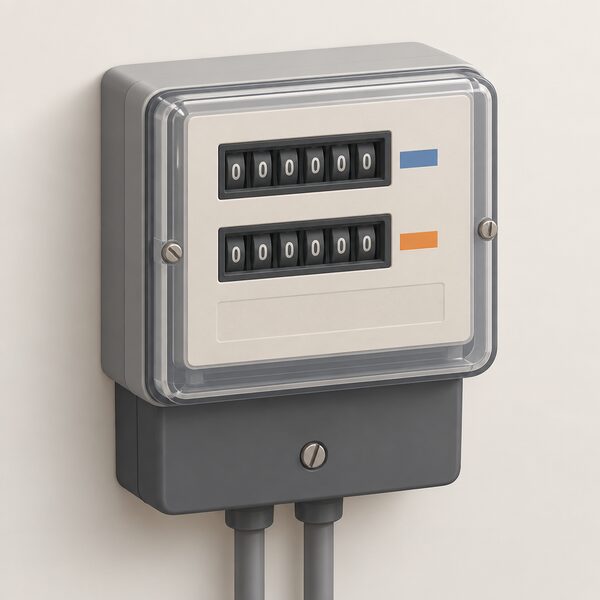
Economy 7 meters are sometimes called white meters, and they are recognisable by their display. The meter has two sets of numbers, one marked "low", which means night, and "normal", which refers to today6. A household that sees two registers on the meter, or two lines of units on the bill, is on a restricted meter arrangement.
Scotland has a particular concentration of these arrangements because of the prevalence of electric heating. Smart meter coverage in Scotland lags the rest of Great Britain: domestic electricity smart meter coverage in Scotland is 13% lower than in England, and 10% lower than Wales8. That gap matters because smart meters are the platform on which most time-of-use tariffs, including newer restricted meter products, are delivered. A household still on an older restricted meter has fewer tariff options than one with a smart meter, and is more likely to be affected by the Radio Teleswitch switch-off described below.
The practical test for a household is straightforward. If the meter has two registers, if the bill shows day and night units, or if the heating and hot water come on automatically at set hours without anyone touching a control, the home is likely to be on a restricted meter tariff. The supplier can confirm the metering arrangement on record, and that confirmation is what determines which tariffs are available.
"The meter has two sets of numbers, one marked "low", which means night and "normal", which refers to today"
RTS meters: why almost a million homes must switch
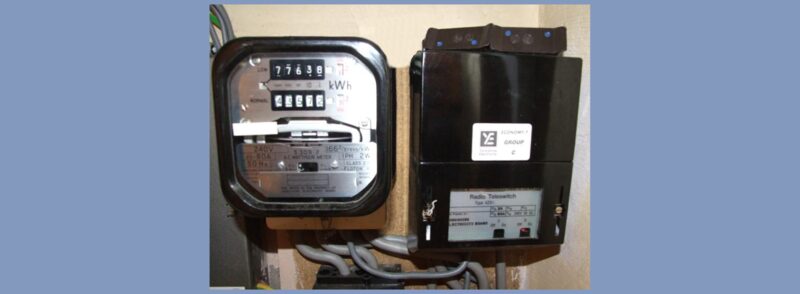
Radio Teleswitch Service meters receive radio signals to switch between different electricity rates or turn certain appliances on or off at specific times9. They are the technology behind many Economy 7 and total heating arrangements, and they are concentrated in areas with high levels of electric heating. According to Ofgem, there are around 800,000 RTS meters across Great Britain that need to be replaced, and a household may be one of the almost 1 million homes that have an RTS meter9.
Scotland carries a disproportionate share of the problem. The imminent radio teleswitch switch-off remains a significant issue affecting more than 200,000 households in Scotland with electric heating10. As of January 2025, there were still 146,302 RTS consumers in Scotland who needed to have their meters replaced4. The gap between the two figures reflects the difference between households affected in principle and those still awaiting a replacement at a given date.
The scale of the wider heat transition in Scotland puts the RTS replacement in context. The heat transition will require around 1.9 million homes and 13,000 public buildings to move to clean heating systems by 204511. Scotland's net zero roadmap requires more than one million homes and 50,000 non-domestic buildings to convert to using zero emission heating systems by the end of this decade12, and over a million households will need to convert to a zero or low emissions heating system by 203013. With around 2.45 million homes in Scotland, all varied in type, use, size, age, construction and energy efficiency14, the RTS replacement is the first step in a much larger change to how Scottish homes are heated.
Where RTS meters leave you if they are not replaced
The obligation to replace the meter sits with the supplier, not the household. Your supplier must replace your meter to make sure there's no disruption to your electricity supply9. That is a firm statement of responsibility: the household does not have to arrange the replacement, and does not have to pay for the meter itself.
For tenants, the position is clearer than many expect. You don't need your landlord's permission to replace the meter, but it's still a good idea to let them know, especially where the meter or heating controls are in a shared or landlord-accessed space9. That applies to tenants who pay energy bills directly and where the account is in their name.
The risk of inaction is concentrated in the functions the RTS signal performs. A meter that switches heating and hot water on and off at set hours, or that moves the home between day and night rates, depends on the signal. If the meter is not replaced before the service ends, those functions can be lost, and a household on a restricted meter tariff can find itself without the off-peak switching it relies on. The concentration of these meters in Scotland, and the number still outstanding, is why the Scottish Government has pressed for protection for energy customers ahead of the switch-off4.
Standing charges and the push for lower-charge tariffs
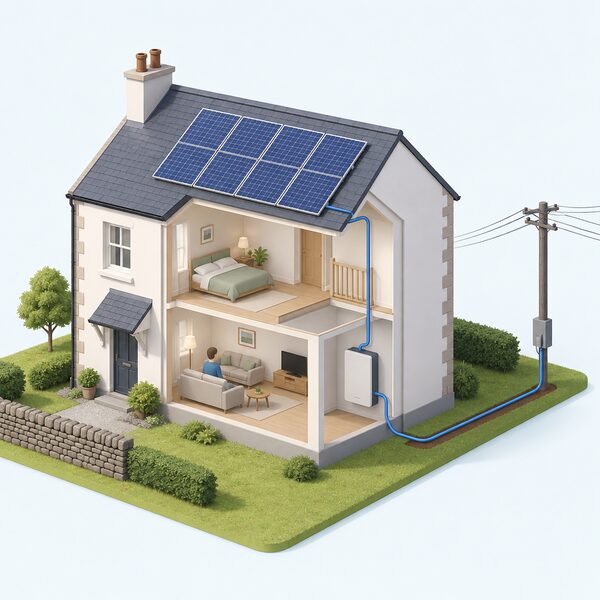
Standing charges are the fixed daily amount a household pays regardless of how much energy it uses, and they fall hardest on low-consumption homes. Ofgem has consulted on a requirement that energy suppliers offer customers at least one tariff with lower standing charges in all regions in England, Scotland and Wales15. The proposal would amend the supply licence conditions to require suppliers to offer a tariff with a standing charge priced £150 below the price cap nil consumption level per annum16.
The proposed reduction is split between fuels. Ofgem proposes a reduction of £65 to £90 for electricity consumers and a reduction of £85 for gas consumers16. For a Scottish household on a restricted meter, the standing charge is a larger share of the bill than for a high-consumption home, because the multi-register standing charge is set separately and the annual consumption figure used in the cap tables is lower.
The lower standing charge proposal matters for energy independence in a specific way. A high standing charge is a fixed cost of being connected, and it cannot be reduced by using less electricity or by generating your own. A household with solar panels and a battery can cut its import units to near zero, but it still pays the standing charge every day. A tariff with a lower standing charge shifts more of the cost onto units, which rewards exactly the behaviour that self-generation and load shifting produce. The proposal is a consultation, not a settled rule, and the figures are proposals rather than published prices.
Distribution costs in northern Scotland: the AAHEDC and its £40 million a year
The north of Scotland has the highest electricity distribution costs in Great Britain, because the network serves a large, sparsely populated area with long distances between customers. Ofgem's benchmark maximum charges show the effect clearly. For Charge Restriction Period 14a, Northern Scotland single-rate metering shows a maximum annual charge of £1,008.37 in the first electricity table and £983.78 in the third, while multi-register metering shows £1,240.45 in the first table and £1,312.42 in the second17.
These regional differences are the reason the price cap is published by region rather than as a single national figure. A household in the north of Scotland is not paying more because its supplier charges more; it is paying more because the cost of moving electricity to the home is higher. The Assistance for Areas with High Electricity Distribution Costs, known as AAHEDC, exists to offset that. The scheme is funded through a levy and supports areas where distribution costs are highest, with the north of Scotland being the principal beneficiary.
The distribution cost is the clearest example of dependence that a household cannot remove by changing tariff or supplier. A home in the north of Scotland can switch supplier, move to a time-of-use tariff, install solar and a battery, and still pay a distribution charge set by the network region it sits in. The AAHEDC reduces the size of that charge but does not remove the underlying geography. For a household thinking about energy independence, the distribution charge is the part of the bill that is genuinely fixed by location.
Warm Home Discount and other bill support
The Warm Home Discount is a scheme that primarily provides support through the provision of £150 energy bill rebates, funded through a levy on all domestic customers18. It applies in Scotland, and the scheme rules are published separately for Scottish households19. The Warm Home Discount (Amendment) Regulations 2025 amend the Warm Home Discount (Scotland) Regulations 2022 to increase suppliers' non-core spending obligation by an amount commensurate to the expected increase in England and Wales20.
Alongside the Warm Home Discount, Warmer Homes Scotland is funded by the Scottish Government and offers funding and support to eligible households struggling to stay warm and keep on top of energy bills21. The two schemes work differently: the Warm Home Discount is a rebate on the bill, while Warmer Homes Scotland is a programme of funding and support for the home.
For a Scottish household, these schemes are the main route by which the cost of electricity is reduced without changing the tariff. They do not affect the standing charge, the unit rate or the distribution cost, and they do not reduce dependence on the grid. What they do is reduce the cash cost of that dependence for households that qualify, which is why the expiry date matters: a rebate that ends is a bill that rises.
Home Energy Scotland: free advice and grants up to £7,500
Home Energy Scotland is a free independent advice and referral scheme23. It is the main public advice route in Scotland for households wanting to improve the energy performance of their home, and it administers grant funding alongside the advice.
The Home Energy Scotland Grant and Loan Scheme offers a maximum of £7,500 for energy efficiency measures for homeowners in Scotland23. The grant is aimed at measures that reduce energy use, such as insulation and heating improvements, and it is administered through the advice service rather than through a supplier.
The service is contactable by phone. Home Energy Scotland can be reached on 0808 808 2282, and phone lines are open Monday to Friday 8am to 8pm, and 9am to 5pm on Saturdays24. The advice is independent of suppliers, which matters for a household trying to work out whether a restricted meter tariff, a heat pump or a fabric improvement is the right next step.
For energy independence, the grant is the most direct form of support: it reduces the capital cost of measures that lower a home's demand for imported energy. It does not remove the standing charge or the distribution cost, and it does not make a home independent of the grid, but it reduces the amount of electricity the home needs to buy. The Scottish Government's wider target is that by 2045 all homes in Scotland must have significantly reduced their energy use25, and median electricity consumption in Scotland decreased by 34% between 2011 and 2024, with a 12% reduction since 202126.
Advice Direct Scotland and Consumer Scotland: where complaints and escalations go

Advice Direct Scotland runs energyadvice.scot, a free service for Scottish citizens with questions about their energy supplier, wanting to understand their supplier's complaints process, or with problems with their energy bills27. The service can be reached on 0808 196 866028.
The distinction between the two main advice routes is worth stating plainly. Home Energy Scotland deals with the home: efficiency, grants, heating and referrals. Advice Direct Scotland deals with the supplier relationship: billing, complaints and disputes. A household with a billing problem that the supplier will not resolve goes to energyadvice.scot; a household wanting to know what grant it can get for insulation goes to Home Energy Scotland.
For heat network consumers in Scotland, the relevant consumer advice bodies are Citizens Advice Scotland and Consumer Scotland, and any related, qualifying consumer advice bodies29. That is a separate route from the supplier complaints process, and it applies to households on heat networks rather than to standard electricity supply.
Ofgem publishes its own guidance on complaining about an energy supplier or network operator, which sets out the escalation route once a supplier's own complaints process has been exhausted27. Ofgem also publishes advice for households on getting help with energy bills28. For a Scottish household, the practical sequence is: raise the issue with the supplier, use energyadvice.scot if it is not resolved, and escalate to the ombudsman route that Ofgem sets out if the dispute remains open.
Sources29 cited
- Energy price cap levels, 1 July to 30 September 2026, Ofgem, 2026
- New PM cuts tax on household electricity bills, GOV.UK, 2026
- Temporary zero rate of VAT for domestic electricity in Great Britain, GOV.UK, 2026
- VAT on fuel and power (Notice 701/19), GOV.UK, 2026
- The Value Added Tax (Installation of Energy-Saving Materials) Order 2022, legislation.gov.uk, 2026
- What is Economy 7?, Energy Helpline, 2026
- Charge Restriction Period 15b cap tables, Ofgem, 2025
- Smart Meter Guaranteed Standard Statutory Consultation, Ofgem, 2025
- RTS meter switch-off, Energy Saving Trust, 2026
- Protection for energy customers ahead of RTS switch-off, Scottish Government, 2025
- Scotland's Climate Change Plan 2026 to 2040, Scottish Government, 2025
- Heat Pump Sector Deal final report, Scottish Government, 2021
- Heat in Buildings Strategy: strategic environmental assessment, Scottish Government, 2021
- Energy efficiency in homes, Scottish Government, 2026
- Requirement to offer lower standing charge tariffs, Ofgem, 2025
- Requirement to offer lower standing charge tariffs: supporting document, Ofgem, 2025
- Benchmark Maximum Charges for the Charge Restriction Period 14a, Ofgem, 2025
- Warm Home Discount, Ofgem, 2026
- The Warm Home Discount Scheme: if you live in Scotland, GOV.UK, 2026
- Warm Home Discount (Amendment) Regulations 2025Regulations2025), Hansard, 2025
- Home energy efficiency advice, Argyll and Bute Council, 2026
- Energy Efficient Scotland: Area Based Schemes, West Lothian Council, 2026
- Heat in Buildings progress report 2025, Scottish Government, 2025
- Energy efficiency in social housing, Scottish Government, 2026
- National Energy Efficiency Data-Framework: need report summary of analysis 2026, GOV.UK, 2026
- Tackling fuel poverty in Scotland: periodic report 2021 to 2024, Scottish Government, 2025
- Complain about your energy supplier or network operator, Ofgem, 2026
- Get help with your energy bills, Ofgem, 2026
- Heat networks regulation: consumer protection guidance decision, Ofgem, 2026
 Energy Supply in ScotlandScotland makes far more low-carbon electricity than it uses and sends the rest south.
 UK Energy Prices vs EuropeWhy does the UK pay so much for electricity when our gas is cheaper than most of Europe?
 The Full Rules and Regulation GuideConfused about who actually decides what you pay for gas and electricity, or why rules differ in Scotland and Wales?
 Unit Rates by RegionWhy do electricity and gas prices differ depending on where you live?
 The Full Scotland, Wales and Northern Ireland GuideWhy a householder in Glasgow, Cardiff or Belfast faces different schemes, standards, targets and markets from one in England.
 Standing ChargesWhy is there a daily charge on a gas or electricity bill even when nothing is used, and what does it actually pay for?