
In this guide
A standing charge is a fixed fee charged for every day a home is supplied with gas or electricity. Ofgem describes it as "a fee you pay each day, even if you do not use any energy on that day"1. The House of Commons Library puts it the same way: a daily charge that energy customers have to pay even if they use no energy2. It sits alongside the unit rate, which is the price paid for each kWh actually used.
Under the price cap that ran from 1 July to 30 September 2026, the average standing charge was 57.19p a day for electricity and 29.04p a day for gas3. For 1 October to 31 December 2026 the averages are 54.83p a day for electricity and 29.68p a day for gas3. The amount depends heavily on where a home is: over the July to September 2026 period the capped electricity standing charge ranged from 44.78p a day in London to 70.76p a day in North Wales and Mersey4.
Over a year, customers in north Wales and Merseyside pay almost £360 in standing charges alone, against £267 in London and a Great Britain average of £3095. Standing charges make up around 19% of the average household's bill6. For energy independence the point is simple: the charge is the price of staying connected, and it is owed for each day of supply whatever a household does to cut its own use.
A standing charge is owed every day, whether or not energy is used
The standing charge does not rise or fall with consumption. Ofgem's own price cap guidance describes it as the charge "which you pay every day even if you do not use any energy on that day"8. The Energy Ombudsman goes further: it is a daily charge covering a range of services, from maintenance to support services, that a customer cannot opt out of or reduce, and it is payable even with no gas or electricity used9. The Energy Saving Trust calls it "a fixed daily amount you have to pay for energy, regardless of how much you use"10, and National Energy Action (NEA) states that it is paid by energy customers regardless of how much energy they use11.
In practice this means the bill has two moving parts. The unit rate multiplies with every kWh; the standing charge multiplies only with the number of days on supply. The standing charge stays the same no matter how much gas and electricity a household uses12, so a household pays the same price for every day (or month) that it has the tariff, even if it uses no fuel at all13.
Three situations show how this works:
- An empty or holiday home still builds up the daily charge on each fuel for every day it is connected and on supply.
- A low-use household pays the same daily charge as a high-use neighbour in the same region on the same tariff, so the charge forms a larger share of its bill.
- A home with its own generation, such as rooftop solar, cuts the units it buys but not the daily charge on its grid connection.
That last point is where standing charges meet energy independence. Efficiency, insulation and self-generation reduce the unit part of a bill, but while a home stays connected to the grid or the gas network, the standing charge remains a fixed cost that no amount of saving can remove. A dual fuel home pays two standing charges; a home that stops using mains gas entirely and has its gas supply closed stops paying the gas one. A fuller breakdown of the rest of the bill is in what makes up an energy bill.
What the daily charge pays for: wires, pipes, metering and policy schemes
The standing charge recovers the fixed costs of supplying a home, the ones a supplier and the networks carry however much or little energy a household uses. The House of Commons Library explains that it recovers "the costs required to provide energy company services, including providing and maintaining the wires, pipes and cables that deliver power to a customer's door, through to the staff and buildings required for the energy business to function"2.
Consumer guides describe the same basket in simpler terms. Uswitch lists network connection, meter readings, maintenance and government initiatives14. Confused.com describes transport costs and administration charges, and notes that gas and electricity standing charges also help pay for government environmental and social schemes15. The British Gas Energy Trust sums it up as the daily fixed costs of supplying gas and electricity to a home16.
| Cost the standing charge helps cover | What it means for a household |
|---|---|
| Networks: wires, pipes and cables to the door | The local grid and gas network that deliver supply2 |
| Metering and meter readings | Providing and reading the meter14 |
| Supplier operating costs | Staff, buildings and administration2 |
| Government schemes | Environmental and social programmes paid through bills15 |
The same idea applies beyond gas and electricity from the big suppliers. Households on a heat network pay a daily fee called a standing charge no matter how much heat they use, covering administration and maintenance costs17. StepChange, the debt charity, describes it plainly as a fixed daily charge18.
The share of these costs that falls on standing charges rather than unit rates is a choice made in regulation, which is why the balance between the two has shifted over time. How the policy element is funded is set out in policy costs and levies on energy bills. For a household, the dependence is clear: these charges pay for shared infrastructure and schemes that the individual home cannot opt out of while it takes supply.
Current cap levels: electricity at 57.19p and gas at 29.04p a day

The price cap sets the most a supplier can charge on a default (standard variable) tariff, and it applies to the standing charge as well as the unit rate. On a price-capped variable tariff, the standing charge counts as part of the price-capped amount19. Standing charges are covered by the cap, which limits how much suppliers can charge, though suppliers are not required to include a standing charge at all20. The cap changes each quarter, so the standing charge on a variable tariff can move every three months. A fixed deal keeps its standing charge for the term14.
| Cap period | Electricity, average a day | Gas, average a day |
|---|---|---|
| 1 Oct to 31 Dec 2025 (Direct Debit, incl. VAT) | not given | 34.03p21 |
| 1 Jan to 31 Mar 2026 | 54.75p | 35.09p22 |
| Apr to Jun 2026 | 57.21p | 29.09p23 |
| 1 Jul to 30 Sep 2026 | 57.19p | 29.04p3 |
| 1 Oct to 31 Dec 2026 | 54.83p | 29.68p3 |
The October to December 2026 gas figure of 29.68p against 29.04p in the previous quarter is confirmed by the Energy Saving Trust24. At the July to September 2026 averages, the electricity standing charge comes to £208.74 a year and the gas standing charge to £106 a year7. Put another way, the gas daily standing charge costs around £10.59 a month15.
Several points follow for a household reading its bill:
- The cap figures are averages across Great Britain. The actual rate depends on region and payment method, covered below.
- The electricity figure is for a single-rate meter; restricted meters such as Economy 7 are priced differently, see Economy 7 and restricted meter billing.
- The cap is a Great Britain measure. Northern Ireland has a separate market, see energy bills in Northern Ireland.
In autumn 2025 Which? reported an electricity standing charge of 53.68p a day for a Direct Debit customer on an average price-capped tariff25. The movements quarter to quarter are modest in pence, but they are fixed costs: when the gas standing charge fell 17.1% from 1 April 20266, every gas household saw the benefit regardless of use. The quarterly history is in price cap history and announcement dates.
Regional variation: from 44.78p in London to 70.76p in North Wales and Mersey
The same connection costs very different amounts across Great Britain. Standing charges vary depending on the supplier, the tariff and where a home is15. Between 1 July and 30 September 2026 the most expensive electricity standing charge was in North Wales and Mersey at 70.76p a day and the cheapest in London at 44.78p a day4. For gas the spread is much narrower: London was highest at 29.52p a day and Southern the lowest at 28.53p a day4.
| Region (Jul to Sep 2026) | Electricity a day | Gas a day |
|---|---|---|
| North Wales and Mersey | 70.76p4 | not given |
| Northern | 64.29p | 29.15p |
| South Western | 57.89p | not given |
| South Wales | 57.84p | 29.30p |
| Northern Scotland | 57.55p | not given |
| South East | 54.45p | 28.63p |
| Eastern | 53.94p | 28.70p |
| East Midlands | 53.60p | 28.78p |
| Southern | 49.70p | 28.53p4 |
| London | 44.78p | 29.52p |
Figures in the table are from Confused.com's regional cap figures15 unless marked otherwise. They show North Wales and Mersey paying 70.76p a day for electricity, against 44.78p a day in London, while gas runs from 28.53p a day in the Southern region to 29.52p a day in London. For October to December 2026, North Wales and Mersey falls to 67.66p a day for electricity, with gas at 30.08p a day26.
The main driver is the cost of the local networks. The Energy Saving Trust notes that the North of Scotland has historically paid higher standing charges and unit costs because transmission and distribution costs there are higher, but argues this reasoning no longer holds, with more renewable energy generated regionally and locally27. The Welsh Government has stated that customers in North Wales pay the highest standing charges in Great Britain28. End Fuel Poverty Coalition analysis gives the Manweb area, covering Merseyside, North Wales and parts of Cheshire, as having the highest electricity standing charge on its figures, at 65.8p a day29.
Over a year the gap is large: almost £360 in north Wales and Merseyside against £267 in London, with Yorkshire, north east England and southern Scotland all paying over £333 and the GB average at £3095. NEA notes that some areas in Great Britain pay much more than others30. For households in the dearer regions, the fixed part of the bill is a larger cost that local action cannot touch. Unit rates by region are in electricity and gas unit rates by region.
Direct Debit, prepayment and Standard Credit: prepayment now matches Direct Debit
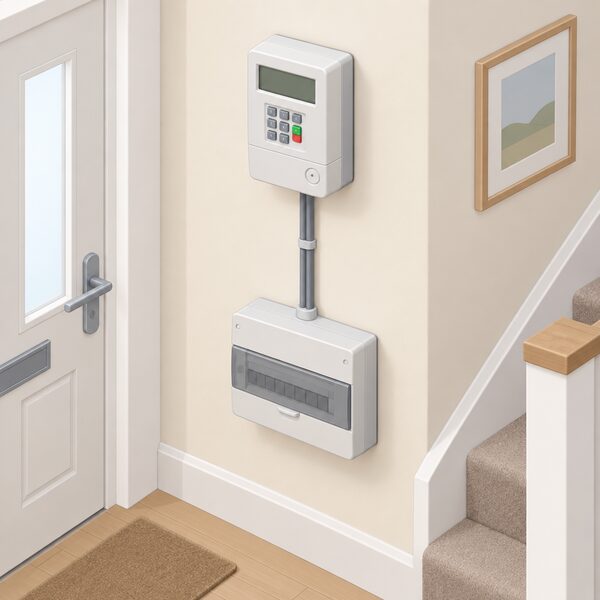
How a bill is paid changes the standing charge. Since April 2024, prepayment and Direct Debit customers under the price cap pay the same standing charge. Ofgem announced its decision on "levelising" standing charges for prepayment and Direct Debit consumers in February 2024, taking effect from April 2024, and states that it has made standing charges for prepayment customers the same as those paid by Direct Debit customers31. Which? reported from 1 April 2024 that daily standing charges on price-capped prepayment tariffs are now the same as Direct Debit, after higher costs had disproportionately affected low-income households32. Uswitch reported that the February 2024 cap announcement included a government discount on prepayment standing charges, making prepayment bills overall comparable to or slightly cheaper than Direct Debit33.
From 1 July 2026, the average prepayment standing charge was 57.19p a day for electricity and 29.04p a day for gas15, the same as the Direct Debit averages.
Standard Credit, paying on receipt of a bill by cash or cheque, costs more. Ofgem's cap summaries give the extra annual cost over Direct Debit for a typical customer:
| Cap period | Standard Credit extra vs Direct Debit (a year) |
|---|---|
| From 1 April 2024 | £10634 |
| 1 April to 30 June 2025 | £12035 |
| 1 July to 30 September 2025 | £13636 |
Those are whole-bill figures, not standing charge alone. On standing charges specifically, the End Fuel Poverty Coalition reported in 2023 that Standard Credit customers faced gas standing charges 18% higher and electricity standing charges 13% higher than Direct Debit37, and in 2026 that standing charges for these customers will be much higher38. Ofgem notes that Standard Credit also becomes the default payment method where a Direct Debit fails, or where prepayment is not an appropriate way for a customer to pay39.
For a household this means the payment arrangement is itself a lever on fixed costs. The comparison in detail is in price cap rates by payment method, standard credit vs direct debit and prepayment vs direct debit.
Why standing charges have risen: failed suppliers, network costs and inflation
Standing charges have been steadily increasing over the past few years as more costs have moved from unit rates to fixed daily charges15. End Fuel Poverty Coalition analysis puts the rise in electricity standing charges at 119% since winter 2020/2129.
NEA sets out the causes: as well as the cost of maintaining infrastructure and delivering many government obligated programmes, much of the rise has paid for transferring the customers of failed suppliers to new ones, and reflects a conscious decision by Ofgem on how to pay for energy networks30. Three strands stand out:
- Supplier failures. A 2022 Early Day Motion recorded in the House of Commons Library stated that much of the increase was the result of the failure of 30 energy suppliers in 2020, with the cost of guaranteeing customers' balances added to the bills of all households40. NEA said in 2022 that standing charges had grown due to the pass through of costs caused by failed suppliers41. What happened to one large failed supplier's customers is covered in Bulb Energy.
- Network costs. The wires and pipes are paid for largely through the standing charge, and the regional cost of running them explains the spread across the country.
- Inflation. Energy UK explains that standing charge rates for electricity distribution are set 15 months in advance, based on the inflation rate at that time20. High inflation feeds into standing charges with a lag, so the fixed charge can stay high after wider prices settle.
Which? reported that Ofgem decided against taking supplier failure costs out of standing charges13.
The effect is that the part of the bill a household can influence by using less has shrunk relative to the part it cannot. For anyone investing in insulation, a heat pump or solar panels, the payback comes from the unit side only.
Zero standing charge tariffs: rare, and usually dearer per unit
There is no general right to opt out of a standing charge; the Energy Ombudsman is clear that it cannot be opted out of or reduced9. What does exist, in small numbers, is a tariff built without one. A no standing charge tariff is one where "you pay for the energy you use but don't pay standing charges"42. The Energy Ombudsman describes such deals as very rare and with catches9.
The main catch is price per unit. Suppliers usually offset the missing standing charge with a higher unit rate for fuel used12, and such tariffs usually charge a higher cost per kWh15. Uswitch notes they typically charge higher unit rates for gas and electricity, which could result in higher energy bills3.
- Where they are described as suited: households using little gas or electricity, and properties left empty for long periods such as holiday homes15.
- Where they are described as costlier: higher-use homes, where the extra per kWh outweighs the daily saving.
- Business customers: zero standing charges are also available on business tariffs and work in the same way3.
Availability has changed over time. Which? reported in 2022 that some suppliers had offered £0 standing charges but these were no longer available in that market13. The Energy Saving Trust notes that tariffs with no standing charge were available in the past and were particularly valuable to vulnerable consumers with low usage27. The amount of standing charge varies by supplier and tariff30, so a fixed deal or a different tariff may carry a different daily rate from the cap.
A comparison of the two structures is in no standing charge tariffs vs standard tariffs, and the policy background in standing charge reform and zero standing charge tariffs.
The fairness debate: low users, and how government and Ofgem are responding
The case against standing charges rests on who bears them. NEA argues that low-income households often spend less on energy, so a higher proportion of what they pay goes towards these inflated standing charges30. The Energy Saving Trust considers there is a good justification for removing standing charges because of the inherent unfairness they can create, noting that they form a disproportionate part of the costs of very low users43.
Public opinion is strongly against them. Ofgem's standing charges call for input received over 30,000 individual responses; over 90% cited standing charges as unfair and almost two-thirds of consumer responses explicitly called for their abolition31. Ofgem's own consumer research found that most customers feel standing charges are unfair and should be lower44, with 63% of Direct Debit, 57% of Standard Credit and 55% of prepayment consumers saying so45.
"Our consumer research has indicated that most customers feel that standing charges are unfair, and that they should be lower than they are currently"
What Ofgem and government are doing
- Ofgem has consulted on a requirement for suppliers to offer lower standing charge tariffs46, and its research drew on domestic consumer research and an online behavioural experiment45.
- British Gas, EDF, E.ON Next and Octopus will offer eligible customers a lower standing charge tariff in an Ofgem pilot3.
- Ofgem invited domestic suppliers to join a trial of a restructured, split standing charge tariff47, and is running collaborative trials on customer appetite for low or zero standing charge tariffs20.
- A government minister has said standing charges are "too expensive" for some and that government is working with Ofgem on how those costs could be recovered more fairly48.
NEA notes that the level of the standing charge is at the discretion of both Ofgem and the UK Government30.
Where consumer bodies disagree
Removing the charge moves costs, it does not delete them. The Energy Saving Trust suggests recovering them through a flat addition to the unit cost, supported by a social tariff or "energy prescriptions" for low-income or vulnerable customers43. Energy Systems Catapult supports Ofgem's intent to improve fairness and choice but sees the proposal as an interim step lacking clarity on risks49. Consumer Scotland responded to the consultation50 and notes that Ofgem's own research shows consumers moderate their wish to scrap the charge once its purpose and the trade-offs are explained51. It also questions a zero standing charge default, warning it would penalise high users and let landlords avoid fixed costs52. Citizens Advice says reforms need more work to protect consumers in vulnerable circumstances, while backing work on minimising fixed costs53. The Energy Ombudsman supports Ofgem's plans for pricing reform, including standing charges54.
The debate matters for independence because the balance between fixed and unit charges decides how much a household can save by its own efforts. Related proposals are covered in a social tariff for energy.
Where standing charges bite hardest: prepayment debt
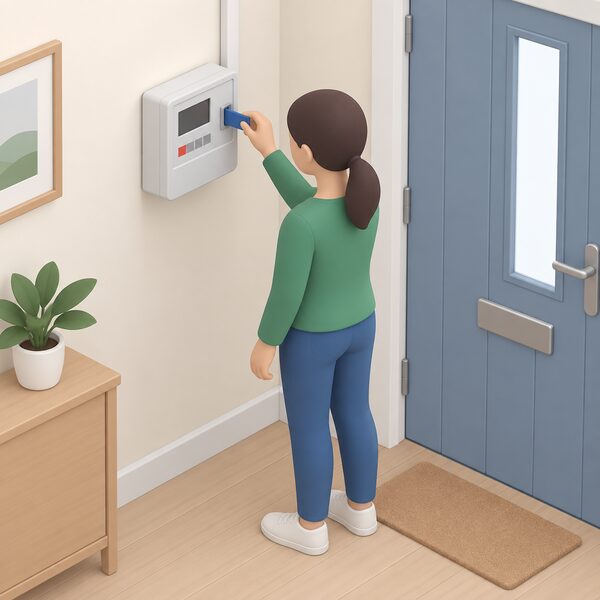
The standing charge does not stop when a prepayment meter runs out of credit. The Centre for Sustainable Energy explains that the standing charge, and any fuel debt, still applies even if the meter runs out of credit and topping up stops, a situation known as self-disconnection55. Confused.com notes that the supplier still charges daily with no credit on the meter, and the amount is taken when the meter is next topped up15.
This is the sharpest example of the charge's fixed nature: a home can be without heat or power and still owe for each day. Help is set out in self-disconnection, repaying energy debt through a prepayment meter and energy debt and repayment plans. For households in credit, Direct Debit payments and credit balances explains how balances work.
Checking the charge on a bill, and who deals with changes
The cost of the standing charge is written on each bill30, shown separately from the unit charges. How to read a gas and electricity bill shows where to find it. On a variable tariff it can change each quarter within the cap; on a fixed deal it stays fixed for the term14.
A question about a charge on a bill goes first to the supplier. Unresolved complaints can go to the Energy Ombudsman, whose guidance on understanding bills covers the standing charge9. Ofgem's Retail Pricing Strategy team has published StandingCharges@ofgem.gov.uk as its contact for standing charge policy work31, not as a route for individual complaints. Wider help is listed in Citizens Advice and energy. For the full picture of how the cap works, see energy bills and the price cap.
Sources55 cited
- Check if you are owed money on your energy bill, Ofgem, 2026
- Standing charges research briefing, House of Commons Library, 2026-09-17
- Should I get a no standing charge tariff?, Uswitch, 2026-08-26
- Regional UK energy prices, Confused.com, 2026-07-01
- News, End Fuel Poverty Coalition, 2026-09-08
- Uswitch responds to April energy price cap announcement, Uswitch, 2026-02-25
- Average gas and electricity bills in the UK, Uswitch, 2026-08-26
- Energy price cap, Ofgem, 2026-09-17
- How to understand your electricity and gas bills, Energy Ombudsman, 2025-04-24
- How to understand your energy bill, Energy Saving Trust, 2024-11-08
- NEA responds to Ofgem's decision not to lower the standing charge, National Energy Action, 2024-12-12
- Your guide to standing charge energy tariffs, Energyhelpline, 2026-09-20
- Ofgem decides against taking supplier failure costs out of standing charges, Which?, 2022-08-18
- Energy standing charges, Uswitch, 2026-08-26
- Gas and electricity standing charges, Confused.com, 2026-07-06
- How to check your energy tariff and switch, British Gas Energy Trust, 2026-07-30
- Struggling to pay your heat network bills, Citizens Advice, 2026-09-17
- Understanding energy bills, StepChange, 2026-09-20
- How to understand your energy bill, Which?, 2022-03-14
- Energy UK explains standing charges, Energy UK, 2025-07-09
- Changes to energy price cap between 1 October and 31 December 2025, Ofgem, 2025
- Energy price cap explained, Welsh Government, 2026
- Grants and schemes, Smart Energy GB, 2026
- What is the energy price cap, Energy Saving Trust, 2026-09-07
- Energy standing charges: what are they and could you pay less?, Which?, 2025-11-11
- Regional energy prices, Uswitch, 2026
- Ofgem standing charges response, Energy Saving Trust, 2025-09-30
- Ofgem call for input on standing charges: Welsh Government response, Welsh Government, 2024-02-15
- Tariff watch, End Fuel Poverty Coalition, 2026-09-20
- Standing charges, National Energy Action, 2026-04-28
- Standing charges: domestic retail options, Ofgem, 2024-08-23
- The best way to pay for energy, Which?, 2024-04-01
- Prepayment meters, Uswitch, 2024
- Default tariff cap letter, 1 April 2024, Ofgem, 2024-02-23
- Summary of changes to energy price cap, 1 April to 30 June 2025, Ofgem, 2025
- Summary of changes to energy price cap, 1 July to 30 September 2025, Ofgem, 2025
- Ofgem price cap change sets sky high energy bills for winter, End Fuel Poverty Coalition, 2023-09-26
- Ofgem confirms soaring gas prices will hit bills in winter 2026, End Fuel Poverty Coalition, 2026-08-26
- Debt strategy update: supporting reduction of energy debt, Ofgem, 2025-11-06
- Early Day Motion 101, 2022 to 23, House of Commons Library, 2022-05-25
- NEA on expected quarterly price cap rise, National Energy Action, 2022-08-03
- Types of energy tariff, Confused.com, 2025-11-03
- Energy bills for domestic consumers: response, Energy Saving Trust, 2025-04-09
- Mandating lower or zero standing charge tariffs: technical working paper, Ofgem, 2025-09-24
- Requirement to offer lower standing charge tariffs: consultation document, Ofgem, 2025-09-24
- Requirement to offer lower standing charge tariffs, Ofgem, 2025-09-24
- Split standing charge tariff trial, Ofgem, 2025-06-20
- Minister hints at more household energy support to come, End Fuel Poverty Coalition, 2026-08-28
- Response to Ofgem's consultation on lower standing charge tariffs, Energy Systems Catapult, 2025-11-10
- Ofgem consultation on requirement to offer lower standing charge tariffs, Consumer Scotland, 2025-11-04
- Response to Ofgem consultation on mandating lower or zero standing charge tariffs, Consumer Scotland, 2025-10-13
- Ofgem consultation on tackling energy debt in the private rented sector, Consumer Scotland, 2026-01-21
- Citizens Advice response to Ofgem's refreshing our consumer vulnerability strategy, Citizens Advice, 2024-11-08
- Ofgem forward work programme 2025/6 consultation, Energy Ombudsman, 2025-02-07
- Prepayment meters, Centre for Sustainable Energy, 2025-08
 The Full Energy Bills and the Price Cap GuideWondering why your bill went up even when you used less power?
 Standing Charge ReformPeople on low usage ask why they pay a daily charge at all, and whether a zero standing charge tariff is really coming.
 Energy Price CapThe price cap sets the most you pay for each unit of gas and electricity, plus the daily standing charge, but not your total bill.
 Wholesale Prices and BillsGas prices around the world keep changing, so why do your bills move so slowly, and why does gas still set what you pay for electricity?
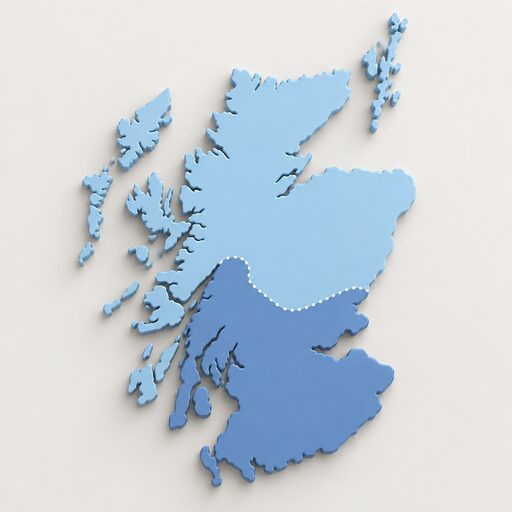 Tariffs in ScotlandWhy do Scottish electricity bills differ from the rest of Great Britain, and why do standing charges cost more in the north?
 Unit Rates by RegionWhy do electricity and gas prices differ depending on where you live?