In this guide
When a domestic energy supplier stops trading in Great Britain, the household does not lose gas or electricity and does not have to find a replacement company. Ofgem runs a bidding process in which other suppliers bid to take on the customer book, and appoints one of them as Supplier of Last Resort. Choosing that supplier can take up to 14 days, and during that time the supply continues uninterrupted1. Credit balances are protected: in every appointment so far, the Supplier of Last Resort has committed to honouring credit owed to customers by the failed company2.
The scale of the 2021 to 2022 wave was without precedent in the retail market. Energy UK records that 31 energy companies ceased trading as a result of the unprecedented wholesale price rises, adding £2.7bn in additional cost to energy bills alongside disruption to many customers3. Which? has described more than 30 supplier failures, many by companies that had tried to win customers with unsustainably cheap tariffs4. That cost was not absorbed by shareholders: it was spread across the whole domestic customer base through bills, which is why supplier failure is a subject for every household and not only for the customers of the firms that went under.
The protections are real but narrow. The tariff does not survive: a fixed rate contract ends at the point of transfer and the account moves to a standard variable tariff, which may be more expensive2. Debt owed to the failed company does not vanish. And the process itself has boundaries: it does not apply to heat networks or the Green Deal, and it does not apply in Northern Ireland at all5.
What happens when a supplier goes bust: the short answer
Two routes exist. The ordinary one is the Supplier of Last Resort appointment, used for the great majority of failures. The exceptional one is an Energy Supply Administration Order, in which an administrator is appointed to run the company of the supplier that has gone out of business. The special administrator runs the company until it is rescued, for example through restructuring, until it is sold, or until its customers are moved to other suppliers1.
Bulb is the case that shows the difference. It was too large for the Supplier of Last Resort system, so it was placed into special administration until its customer base was acquired by Octopus Energy the following year2. Octopus has taken on customers from a range of other suppliers that either ceased trading, as Bulb did, or exited the market voluntarily, as Shell Energy did6. Voluntary exit and failure are not the same event, even though the customer experience of being moved can look similar.
For the household, the instruction from Ofgem in either case is the same: do nothing, wait to be contacted, and take a meter reading1. There is no gap in supply, no need to sign anything, and no need to find a new company. The dependence being exposed here is worth stating plainly: a household on mains gas and electricity depends on a commercial supplier to hold its account, and when that company fails the regulator, not the household, decides who takes over.
Supplier of Last Resort: how Ofgem picks the company that takes over
Ofgem chooses the replacement through a bidding process, in which energy companies bid to take on the new customers1. Ofgem's stated top priority in choosing the Supplier of Last Resort is to ensure that all customers continue to receive supplies of gas and electricity2. If no supplier volunteers to accept the customers of a failed supplier, Ofgem appoints the supplier it deems best suited2.
The regulator reviews the failed supplier's customer profile before appointing. The bidding supplier must show:
- ability to take on the new customers quickly and efficiently, without significantly impacting its existing customers2
- ability to secure enough gas and electricity without significant cost2
- ability to handle issuing bills without delay2
- adequate call centre capability2
- whether it will voluntarily reimburse customers' credit balances2
That last point matters more than it appears. Reimbursement of credit balances is a voluntary commitment offered in the bid, not an automatic entitlement written into the tariff. The Energy Ombudsman's position is that in the past, all Suppliers of Last Resort have committed to honouring the credit balances of customers who were owed money by the former supplier5. A good record, not a guarantee in advance of any individual appointment.
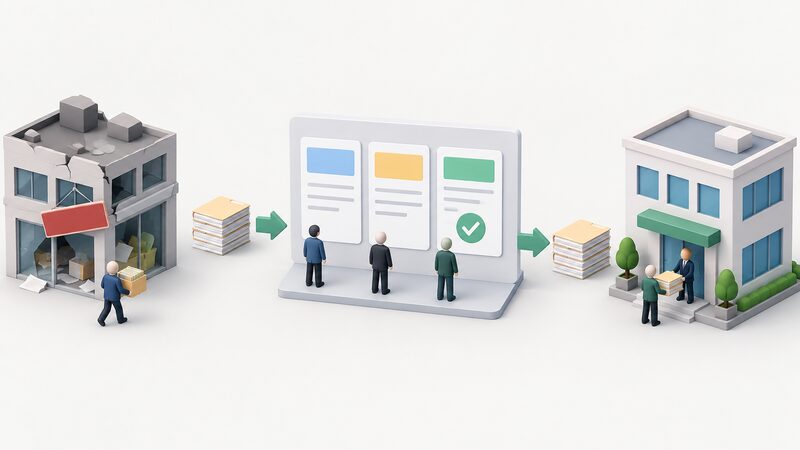
The same appointment mechanism sits behind the pages on Supplier of Last Resort and energy supplier financial resilience rules, which deal with the rules intended to make failures less likely in the first place.
Your supply is never cut off
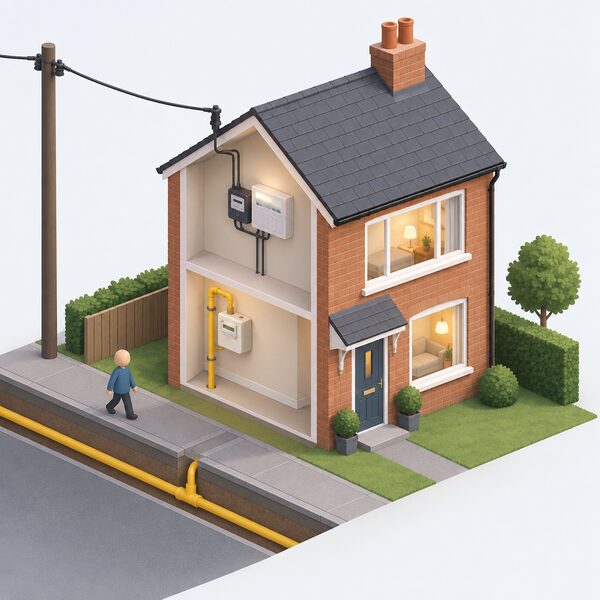
Ofgem is unambiguous on the central point: if an energy supplier goes out of business because of financial problems, electricity and gas will still be supplied to the home or business, and the supply will not be cut off1. Independent guidance confirms the same, that energy will not be cut off at any point in the event a supplier goes out of business2, and that under the Ofgem safety net the customer is automatically switched to a new supplier with supply continuing uninterrupted7.
This is physically straightforward. The supplier is a billing and trading company, not the operator of the pipes and wires. The network operator delivers the energy regardless of which retailer holds the account, which is why a commercial collapse does not interrupt the flow. Disconnection is a separate matter entirely, and one that guidance describes as always a last resort for an energy company, to be discussed with the supplier as soon as difficulty arises8.
Size is not an absolute defence, but it is noted in the market. Independent guidance describes OVO as one of the UK's largest energy suppliers and unlikely to go bust, and Octopus Energy as one of the largest, operating across several countries outside the UK, and very unlikely to go bust2. Bulb's collapse showed that large customer bases can still fail, and that when they do the mechanism used is different.
What happens to your tariff, your credit balance and your debts
The tariff is the loss. A fixed rate contract ends at the time the account is moved to the Supplier of Last Resort, and the customer is placed on a standard variable tariff. It is not guaranteed that the new tariff will match the old one, so the bill can go up. The new tariff carries no early exit fees2.
That places the household in the same position as anyone rolling off a fixed deal: a supplier automatically moves a customer onto the standard variable tariff when a fixed deal ends9, and customers rolling off a fixed tariff are usually rolled onto their supplier's standard variable tariff10. Fixed deals typically run for 12 months11. The wider consequence of default tariffs is why the price cap exists at all: in 2018 the Competition and Markets Authority found 70% of customers of the six largest energy firms were on default tariffs12.
| What you had | What happens on transfer |
|---|---|
| Fixed rate contract | Ends at transfer; replaced by a standard variable tariff2 |
| Exit fee on the new tariff | None2 |
| Credit balance | Honoured by the new supplier under Ofgem's rules2 |
| Energy debt | Does not transfer; may still be payable to the old supplier, and the administrator will make contact2 |
| Feed-in Tariff or Smart Export Guarantee payments | A switch of supplier does not stop export payments being made by the paying supplier11 |
Credit and debt move in opposite directions, which surprises people. Credit follows the customer to the new supplier. Debt stays with the estate of the failed company. In an ordinary switch between trading suppliers, by contrast, the old supplier refunds any credit in the final bill, and compensation may be due if it does not13, and credit can be claimed back from a supplier at any time14. Those routes close when the company ceases trading, which is why the honouring commitment in the bid is the operative protection. Further detail sits on final bills and credit refunds.
Prepayment customers, the Warm Home Discount and mid-switch cases
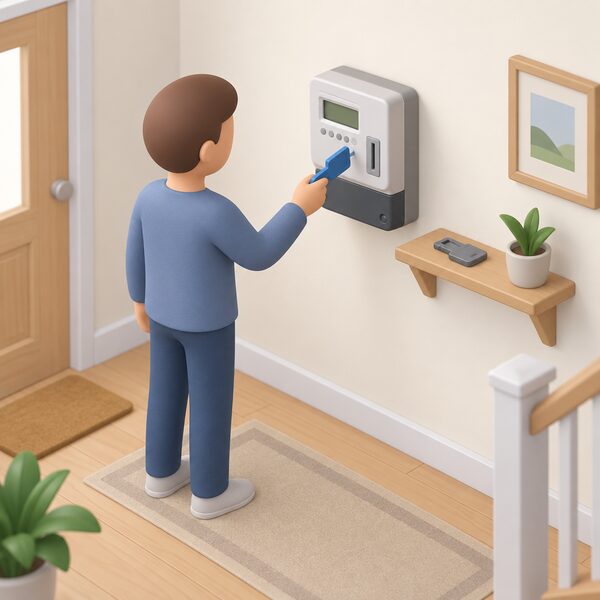
Prepayment credit balances are already protected, and any money loaded onto the meter can be used as normal. The new supplier sends out new keys or equipment as a priority2. In practice this means a prepayment household is not locked out of its own meter while the transfer takes place, although new top-up hardware has to arrive before further credit can be added in the usual way.
The Warm Home Discount should be honoured by the new supplier2. The scheme primarily provides support through £150 energy bill rebates, funded through a levy on all domestic customers15. That levy point matters to the cost discussion below: the scheme, like the failures themselves, is paid for across the customer base. Detail on which companies take part is on the Warm Home Discount and suppliers.
Support has also been targeted at prepayment and low income households in other ways: in September 2023 EDF said it would reduce the standing charge down to pre-crisis levels for approximately 250,000 customers who received the Warm Home Discount the previous year17.
Mid-switch cases follow a rule of their own. If the switch had completed, the customer is transferred to the Supplier of Last Resort for the supplier they had decided to switch to. If it had not completed, they go to the Supplier of Last Resort for the supplier they were leaving2. Where the chosen new supplier is still trading, Ofgem states that a switch already in progress still moves the customer to the supplier they chose1. Erroneous transfers, a different problem, are covered on erroneous transfers.
What to do first: readings and the new account
The single action that protects a household is a meter reading. Ofgem's guidance is to take a reading as soon as possible and keep a record of it, to make sure billing by the new supplier is correct1. Independent guidance says the same: take readings as soon as it is known the supplier has ceased trading, because the new supplier will need them2.
- Take gas and electricity readings on the day the failure is announced, and photograph the meter display as evidence18.
- Wait to be contacted by the appointed supplier rather than starting a switch elsewhere; an account has to exist before it can be moved2.
- Give the readings and any credit balance evidence when the new account is set up18.
- Check the new tariff when billing begins: it is not guaranteed to match the old one and the bill could go up, though the new tariff carries no exit fees13.
Smart meters add a complication. First generation SMETS1 meters could temporarily go "dumb" and lose their ability to send automatic meter readings after a change of supplier19. A household whose meter stops reporting will need to submit manual readings until the new supplier resolves it. The same practical sequence, identifying the supplier, telling them, and submitting an opening reading, applies when moving into a property, where whoever supplied energy to the previous occupants automatically becomes the supplier20. See finding out who supplies your energy and moving home and your energy supplier.
Timing differs between the two situations. A normal switch between trading suppliers must be completed within five working days21, and should take no longer than five working days after the new supplier has received the registration7. Appointment of a Supplier of Last Resort can take up to 14 days1.
The cost of supplier failures: £2.7 billion added to bills
The 31 companies that ceased trading during the price rises added £2.7bn in additional cost to energy bills3. That figure is the reason supplier failure is a policy question rather than a private misfortune. The costs of honouring credit balances and of buying energy at short notice for transferred customers are recovered through the price cap and therefore through everyone's bills.
Which? has attributed much of the wave to business models that could not survive: more than 30 suppliers went bust, many after trying to win customers with unsustainably cheap tariffs4. Citizens Advice reached a similar conclusion about the regulatory environment, finding that previous tweaks to the system enabled many poor quality new entrants who failed in recent years22.
One mechanism introduced in that period has since been withdrawn. The Market Stabilisation Charge allows a customer's old supplier to recoup some of the costs of energy bought in advance for a customer who switches, paid by the new supplier to the previous one, and applies only when the price of energy has fallen significantly below the price used to set the price cap3. Ofgem set out its intention to allow the charge to expire at the end of its current extension period in March 202423.
The household debt picture sits alongside the failure cost rather than being caused by it. The amount customers owe energy suppliers reached £3.7bn, up £400 million in a single quarter, as reported in September 202424. Consumer debt to energy and water companies together totalled £7.2bn in March 202525. These are the conditions in which a supplier's finances come under strain, and in which the consequences of a failure land hardest.
Where the process falls short
The Supplier of Last Resort system is a supply guarantee, not a consumer redress system, and the gaps follow from that.
The clearest is complaints. The Energy Ombudsman will not consider disputes against a supplier that has ceased trading, because that supplier will not be able to participate5. Once a company ceases trading no new cases can be opened against it, although prior disputes are sometimes upheld by the new nominated supplier26. The Supplier of Last Resort has no obligation to take on complaints about the supplier in administration, as it was not involved in them5. An open case is not abandoned: the Ombudsman contacts the customer to discuss next steps, and the new supplier reviews an inherited complaint to check whether it is still relevant or can be closed1.
Where a complaint concerns the new supplier's own handling, the normal route reopens. Suppliers are the first point of contact for late, incorrect or missing bills, back billing, overcharging, a faulty meter, poor customer service, and refusal to refund credit27. If a complaint to the new supplier is unresolved after eight weeks, the consumer can pursue dispute resolution through the Energy Ombudsman5. The Ombudsman can tell suppliers to take practical action such as crediting or cancelling an account or changing a tariff, to make an apology, or to offer a financial award, and may make recommendations to prevent recurrence28. Evidence requirements are strict: a dispute needs a prior complaint to the supplier, sufficient evidence including the date the complaint was raised, and a supplier name matching the account holder's bill29. More detail is on complaining about an energy supplier.
"The SoLR does not have an obligation to take on complaints about the supplier in administration as it was not involved in"
Service quality in the surviving market is a second limit. Ofgem's November 2022 review of how suppliers support customers in vulnerable situations identified Shell among suppliers with moderate weaknesses, and identified severe concerns at five suppliers including Good Energy, Outfox and So Energy30. Citizens Advice has characterised the retail market as showing innovation that is not reaching far enough22, and the Public Accounts Committee has criticised regulators, including on energy, for not doing enough for vulnerable people25. Transfer to a solvent company secures the supply; it does not by itself secure good service. Further material sits on supplier support for vulnerable customers and energy supplier customer service ratings.
What the process does not cover: heat networks, Green Deal and Northern Ireland
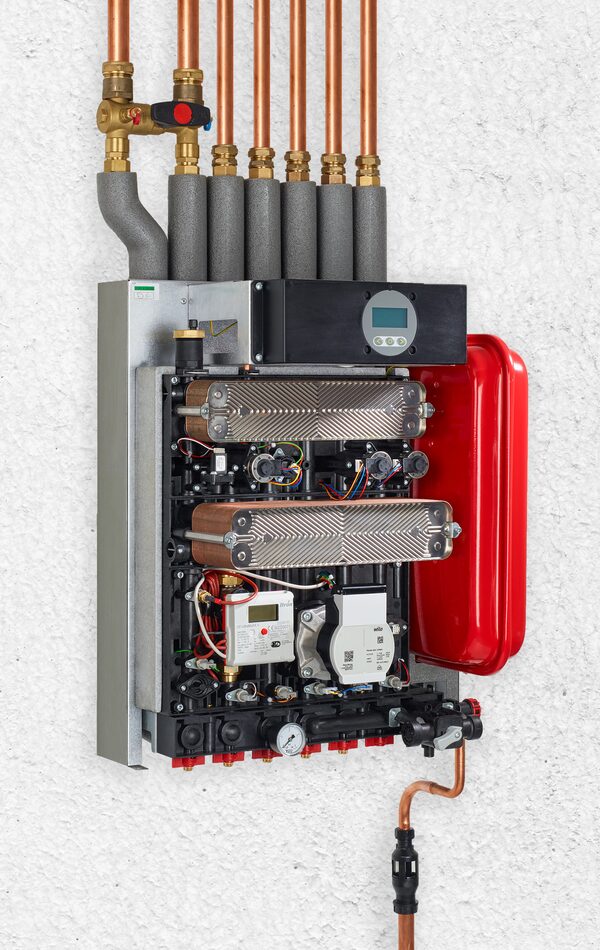
The Supplier of Last Resort standard approach applies to gas and electricity suppliers to residential users in the UK excluding Northern Ireland, and the process does not apply to heat networks or the Green Deal5.
| Situation | Position |
|---|---|
| Mains gas and electricity, Great Britain | Covered by the Supplier of Last Resort process5 |
| Northern Ireland | Outside the process; a separate market5 |
| Heat networks, Great Britain | No official regulator at present; households are not covered by Ofgem31 |
| Heat networks, Northern Ireland | Consumer protection and regulation devolved to the Northern Ireland Assembly31 |
| Green Deal | Excluded from the process5; was not available in Northern Ireland32 |
Heat networks are the largest gap in Great Britain. Unlike gas and electricity, heat networks do not currently have an official regulator in Great Britain31, and households that get their heat delivered through a heat network are not covered by Ofgem. Gas supply to a network is regulated as a commercial supply, but the heat supply to the homes is not33. A household on communal heating therefore has neither the price cap nor the failure safety net that a metered gas customer has. This is covered on heat network suppliers and households.
Northern Ireland has its own market and its own rules, and the exclusion is territorial rather than technical. Not all areas of Northern Ireland are connected to the gas network: urban and suburban areas tend to be well served, whereas many rural and western parts have limited or no access34. Households off the gas network rely on heating oil, for which a separate support route exists in Northern Ireland32. See energy suppliers in Northern Ireland and LPG and heating oil suppliers.
What supplier failure means for household energy independence
The lesson of the failures is about where the dependence actually sits. A household on mains supply depends on the network for delivery, on a retailer for the account, and on the regulator for the safety net that catches the account when the retailer fails. The delivery dependence held through 31 company failures: nobody lost supply3. The account dependence did not: fixed prices were lost, tariffs changed without the customer's choice, and the account moved to a company nobody had selected2.
The financial dependence is the one that cannot be avoided by switching. The £2.7bn cost of the failures was recovered from bills3, including the bills of customers whose own supplier never came close to failing. Choosing a well capitalised supplier protects a household from the disruption of a transfer; it does not protect it from paying a share of other people's transfers. Reducing consumption, and generating on site where the property allows it, is the only route that reduces exposure to both the tariff and the levy. Nor does the transfer itself settle the terms: the new tariff is not guaranteed to be the same as the old one and the bill could go up, although it carries no exit fees13. The related material is on energy suppliers and energy independence and across the suppliers guide.
Sources34 cited
- What happens if your energy supplier goes out of business, Ofgem, 2026
- Energy supplier out of business: guide, Uswitch, 2026-05-29
- Why the price cap is allowing suppliers to recover recent losses, Energy UK, 2024-02-12
- Coalition urges Ofgem not to shut out existing customers from best deals, Which?, 2024-06-29
- Supplier of Last Resort information, Energy Ombudsman, 2026-09-20
- Which energy suppliers are British, Uswitch, 2026-06-26
- Gas only energy supply, Confused.com, 2026
- Help from your energy company, Turn2us, 2026-09-08
- Your gas or electricity supplier has put up its prices, Citizens Advice, 2026-09-17
- Energy tariffs explained, Uswitch, 2026-02-17
- How to switch energy supplier, Confused.com, 2025-12-15
- Energy price caps explained, Ofgem, 2020-12
- How your electricity or gas bill is calculated, Ofgem, 2026
- Understand your electricity and gas bills, Ofgem, 2026
- Warm Home Discount, Ofgem, 2026-09-17
- Which? responds to prepayment meter voucher redemption rates, Which?, 2023-03-04
- Energy costs debate pack, UK Parliament, 2023-09
- Step by step guide to setting up gas and electricity, Energyhelpline, 2026-09-20
- How do you know if you have a smart meter, Smart DCC, 2026
- Moving house energy checklist, Energy Saving Trust, 2026-05-01
- Switch your home energy supplier, Ofgem, 2026
- Ripping off the band-aids, Citizens Advice, 2023-11-24
- Energy price cap wholesale adjustment decision, Ofgem, 2024-02-23
- Any end in sight for soaring energy debts, National Energy Action, 2024-09-26
- Regulators fail to do enough for vulnerable people, Public Accounts Committee, 2025
- Energy Ombudsman FAQs, Energy Ombudsman, 2026-09-19
- Complain about your energy supplier or network operator, Ofgem, 2026
- What to expect from the Energy Ombudsman, Energy Ombudsman, 2026-09-19
- Raise a dispute: Outfox Energy, Energy Ombudsman, 2026-09-19
- Ofgem completes review of how suppliers support customers in vulnerable situations, Ofgem, 2022-11-22
- Heat networks briefing, House of Commons Library, 2026-09-17
- Green Deal and energy efficiency briefing, House of Commons Library, 2026-05-13
- Heat network regulation briefing, House of Commons Library, 2026-09-20
- Continuous Household Survey: heat and insulation, NISRA, 2025-11-11
 Energy Tech Company FailuresRecords UK and overseas home energy technology firms that have failed or withdrawn products, and what happened to installed equipment, warranties and apps.
 Financial Resilience RulesYour supplier going bust raises two questions: who takes over and what happens to your credit balance?
 Supplier Licensing and FailureWhat happens when your energy supplier goes bust?
 When a Manufacturer FailsWhat happens to warranties, spare parts, monitoring apps and cloud services when a manufacturer enters administration, exits the UK or discontinues a platform, and the practical options for owners left without support.
 Challenger and Small SuppliersSmall energy suppliers can be cheaper, but are they safe to switch to?
 Switching and Supplier MarketWhat is the Ofgem price cap and does it limit what you actually pay?