In this guide
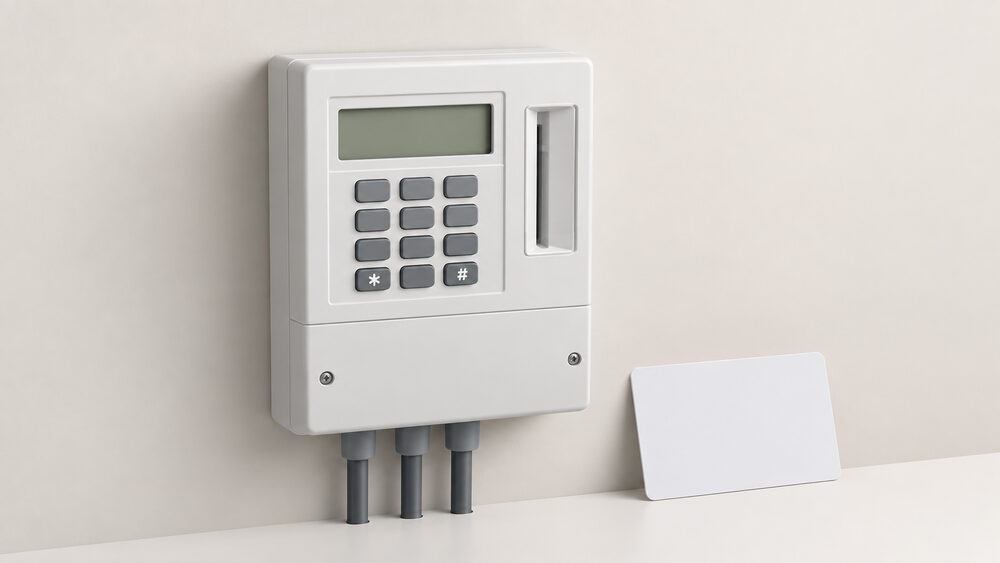
A keypad meter is a pay as you go electricity meter that takes credit in the form of a numeric code rather than a coin, a token or a live connection to a supplier's billing system. The household buys credit, receives a code, and keys that code into the meter using the * and # buttons. The meter then holds the credit and deducts units as electricity is used. Prepaid meters are one of the most common ways of paying for electricity and gas in Northern Ireland, and NIE Networks owns all electricity meters in Northern Ireland, including both credit meters and keypad meters1.
The practical consequence is that a keypad meter is a standalone device. It does not need a broadband connection, a mobile signal or a smart meter network to work, which is why it remains widespread in Northern Ireland while Great Britain moves to smart prepayment. The trade is that the household carries the job of buying credit, entering codes and watching the balance, and that the meter can only be updated by code. When prices change, Power NI issues a special 40 or 60-digit Powercode that must be entered before further top-ups are accepted2.
This page covers what a keypad meter is, who supplies which version, how to top up and enter codes, what the screen messages mean, how emergency credit and arrears recovery work, and what the meter does and does not do for a household's energy independence.
What a keypad meter is and how pay as you go works
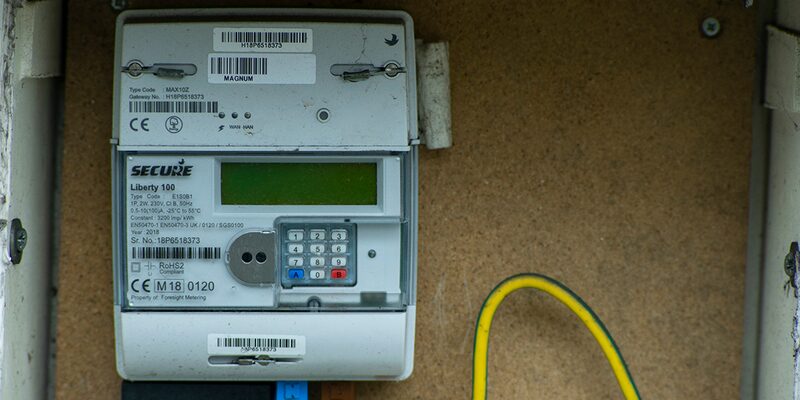
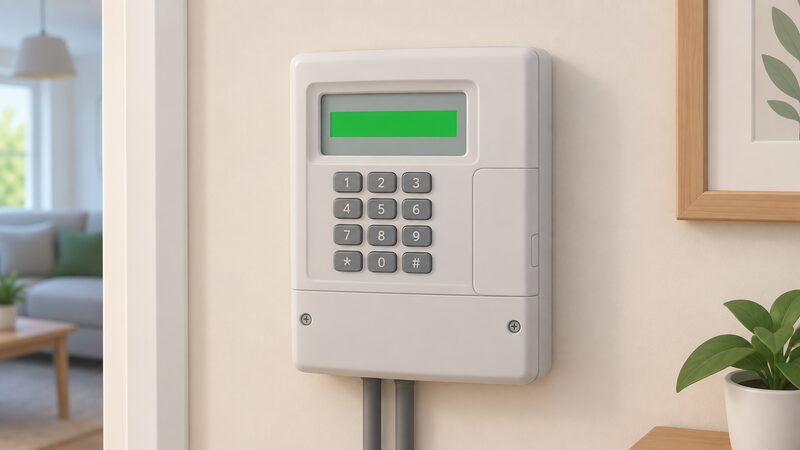
A keypad meter is a prepayment meter with a keypad and a small display. Credit is bought in advance and carried to the meter as a code. The meter holds that credit, subtracts the cost of electricity as it is used, and shows the remaining balance. NIE Networks states that where a household has a pay-as-you-go or keypad meter, the meter information it collects is used to keep the account up to date6.
The display is the household's main window on the account. Pressing 2 shows the cost of usage for the previous day, week and month7. Pressing 9 on the meter or freedom unit displays the reading8. On an export meter, pressing 9 three times brings up IMP Units, the total import units, followed by Exp Units, the export reading9. Most meters store up to 13 months of data, and Share Energy keypad meters show usage in pounds and pence for each of the last 13 months on button 23.
Because the meter is not connected to the supplier, nothing happens automatically. A price change, a change of tariff, a change of supplier or a change to the debt recovery rate all have to be pushed to the meter as a code. That is the defining feature of the technology and the source of most of the messages a household will see.
Power NI Keypad, Share Energy and Keypad+: who supplies which meter
Keypad metering in Northern Ireland is not one product. The meter hardware is owned by NIE Networks, and the code system and account sit with the electricity supplier. There are five electricity suppliers in Northern Ireland: Power NI, SSE Airtricity, Click Energy, Budget Energy and Electric Ireland10. Power NI runs the best documented keypad product, and Share Energy runs its own keypad scheme with its own card and code rules.
| Product | Supplier | Top-up route | Card needed | Notes |
|---|---|---|---|---|
| Power NI Keypad | Power NI | Online, 24-hour helpline, Post Office, PayPoint, app | Yes, or code by hand | 2.5% discount off the standard rate3 |
| Keypad+ | Power NI | Smartphone app over Bluetooth | No | New offering in NI, Power NI customers only3 |
| Share Energy keypad | Share Energy | Card and code entry | Yes | Minimum top-up £104 |
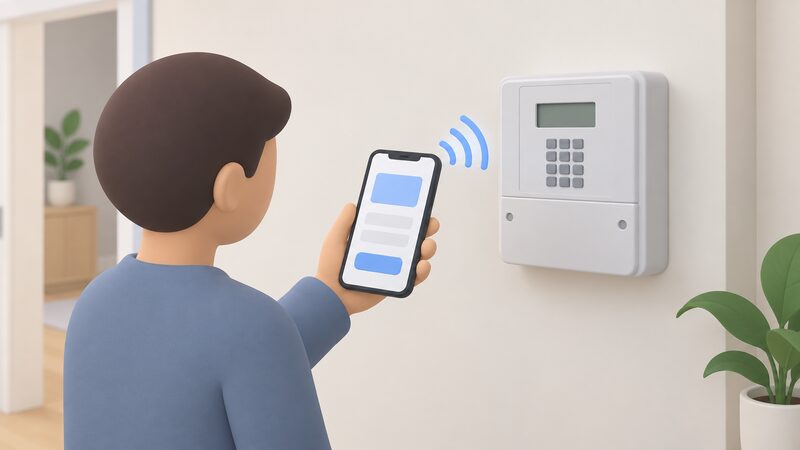
Keypad+ is the notable departure. Power NI describes it as developed using Bluetooth technology to send top-ups straight to the Keypad meter from a smartphone app, and as a new offering in NI available to Power NI customers3. It removes the trip to a shop and the manual code entry, but it also ties the household to a smartphone app and to that supplier's system.
Power NI holds the Inclusive Service Kitemark, a certification covering inclusive service for customers in vulnerable circumstances11. That is a service standard, not a statement about the meter technology.
Getting a keypad meter installed and your final bill
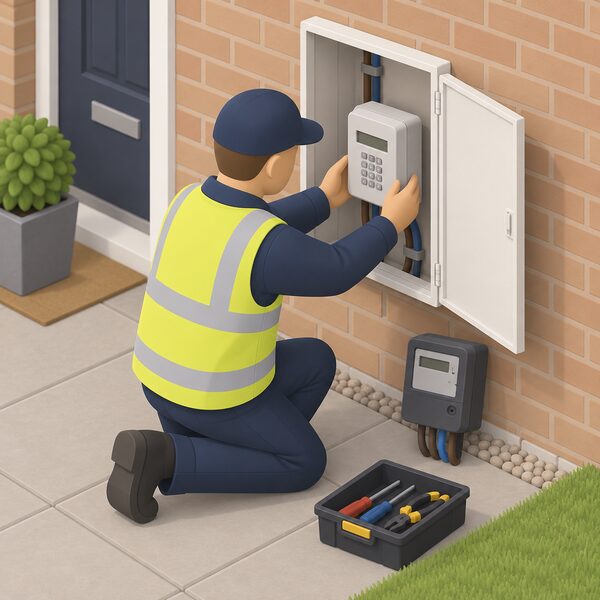
A keypad meter is fitted by NIE Networks, not by the supplier's own engineers. Share Energy describes the process as organising a date and time for an NIE engineer to replace the standard meter with a keypad meter4. NIE Networks states that its metering team fits the meter requested on the application form, and that a household wishing to change to another meter type must contact its electricity supplier, which will arrange it12. The route to a meter change therefore runs through the supplier, even though the work is done by the network operator.
Power NI states that a Keypad meter comes with no rental fee, no security deposit and free installation, and that keypad customers do not receive a quarterly bill3. Instead, credit is bought in advance and the meter holds the balance. Power NI also states that the installation of prepayment meters without express agreement will only be used as a last resort in the debt recovery process3.
On the final bill, the position is the same as for any prepayment account: the meter holds whatever credit has been bought and not yet used, and the account is reconciled when the supply ends. NIE Networks passes the meter read to the customer's electricity supplier, which issues the bill6. For the wider process of closing an account and recovering credit, see final bills and credit refunds.
Topping up: channels, minimum amounts and payment rules
Power NI Keypad credit can be bought online at powerni.co.uk, by the Customer Helpline 24 hours a day, at any Post Office or PayPoint, or through the Power NI app for iPhone and Android3. Share Energy sets a minimum top-up amount of £10 across all of its payment channels4. The Northern Ireland Oil Federation records a minimum payment of £10 per transaction at PayPoint13.
The channels matter because they carry different costs in time and, in some cases, different rewards. Power NI Keypad customers can take a Keypad Reward by topping up online or via the Power NI App, on the basis of buy £50, get £1 free3. The Consumer Council's price comparison table records the same scheme as free electricity from £1 to £4 for top ups between £50 and £175 online or via app14. The two descriptions of the reward differ in detail, and the exact banding for a given top-up is best confirmed with the supplier at the time.
Where a household cannot get to a top-up point, the options narrow. Citizens Advice notes that a supplier might agree to give another way to top up a prepayment meter, for example by text message, a smart meter in prepayment mode that can be topped up online, or a credit meter that lets bills be paid monthly or quarterly15. That guidance is written for England, and the equivalent routes in Northern Ireland depend on the supplier.
Entering a top-up code: the *, # sequence and what the screen messages mean
The entry sequence is short and unforgiving. Share Energy sets it out as pressing the * button, entering the 20-digit top-up code, then pressing #4. Power NI Keypad meters work on the same principle, and the display then reports what happened.
| Message | What it means | What clears it |
|---|---|---|
| Accepted | The top-up code has been accepted | Nothing needed; the meter shows the amount bought, then the word account and the total credit2 |
| Incorrect | The wrong top-up code was entered | Wait for the message to clear, press * and re-enter the number2 |
| Duplicate | This top-up code has already been added | Press * and enter a new code; button 4 shows the last five top-up codes entered2 |
| Error | More than 20 seconds passed between entering each digit | Re-enter the top-up code more quickly2 |
| Rejected | The meter has rejected the top-up code | A message follows saying why; wait for it to clear and start again2 |
| Kblock | The top-up code has been rejected five times in a row | Wait for the message to clear, then re-enter the code2 |
| Credit Hi | Too much credit on the meter, with a maximum limit of £999.99 | Keep the top-up code safe until some credit has been used2 |
| Wrong Tar | The most recent tariff change code has not been entered | Enter the tariff change code, then the last top-up code bought2 |
The pattern behind these messages is that the meter is checking the code against its own stored state. A duplicate is refused because the meter has already seen that code. A wrong tar is refused because the meter is still on an old price set. A kblock follows five rejections in a row, which is a guard against repeated wrong entries rather than a fault.
Price change codes: the 40 to 60 digit Powercode you must enter before top-ups work
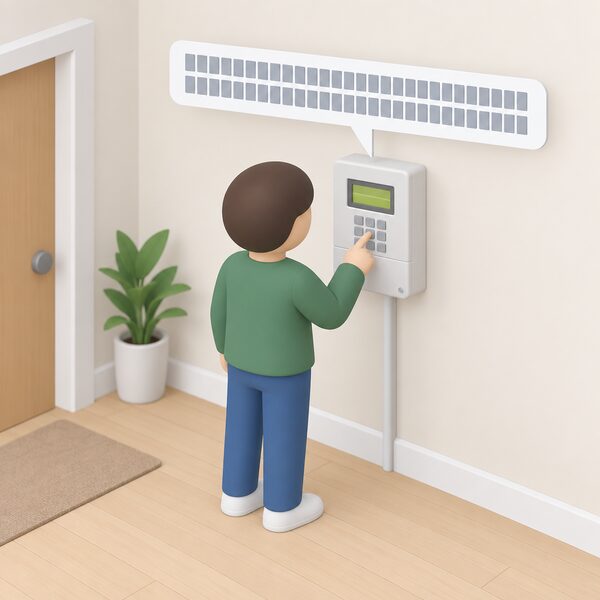
When electricity prices change, the meter has to be told. Power NI states that when a top-up is bought after a change in electricity prices, the customer will be given a special 40 or 60-digit Powercode3. A normal top-up code is usually a 20-digit number3. Share Energy describes the same mechanism: a longer 40 or 60-digit code may be issued if the tariff has changed or the meter needs updating, and that code credits the top-up amount and applies the new unit rate to future usage4.
The sequence matters. Until the price change code is entered, the meter is holding an old price set and will report Wrong Tar when a normal top-up is attempted2. The top-up bought in the meantime is not lost; it sits in the code until it can be entered. Power NI states that it will provide 21 days' notice of any tariff change3.
From 16 June 2026, Power NI prepayment customers buying a top-up receive a 40-to-60 digit price change code that must be entered into the meter before further top-ups are accepted, and Keypad+ customers see that code in the Keypad+ app, sent to the keypad via Bluetooth or entered manually16. That is the clearest recent change to the keypad routine, and it applies to the app-based product as well as the card-based one.
Emergency credit and friendly credit: £3 emergency credit and overnight protection
Emergency credit is a small buffer the meter releases when the balance runs low. Power NI states that when the low-credit warning sound is turned off, the customer automatically gets £3 emergency credit3. Share Energy describes the same trigger: when the low credit chime sounds on the keypad meter, turning it off means a £3 emergency credit is sent automatically, and if the warning sound is not turned off the supply switches off and pressing any button adds the £3 emergency credit4.
The £3 figure is specific to these Northern Ireland keypad products. Guidance for prepayment meters generally puts emergency credit higher: around £10 in one source18, about £10 in another19, and £5 on both electricity and gas meters in a third20. E.ON Next is recorded as giving £10 per fuel for most customers and £5 for some electricity meters21.
Friendly credit is the second buffer, and it is about timing rather than amount. Power NI states that on weekdays, if emergency credit runs out after 4pm Monday to Thursday, the supply stays on until 8am the following day; at weekends, if emergency credit runs out after 4pm on a Friday, the supply stays on until 8am the following Monday3. Friendly Credit does not run out on 1 January, 17 March, 12 July or 25 December, and the supply stays on until 8am the following working day3. The cut-off is 11am with Economy 7 and for other tariffs on request, and all times stated are GMT, with an hour added during Summertime3.
Arrears recovery: how Previous Charges are collected from top-ups
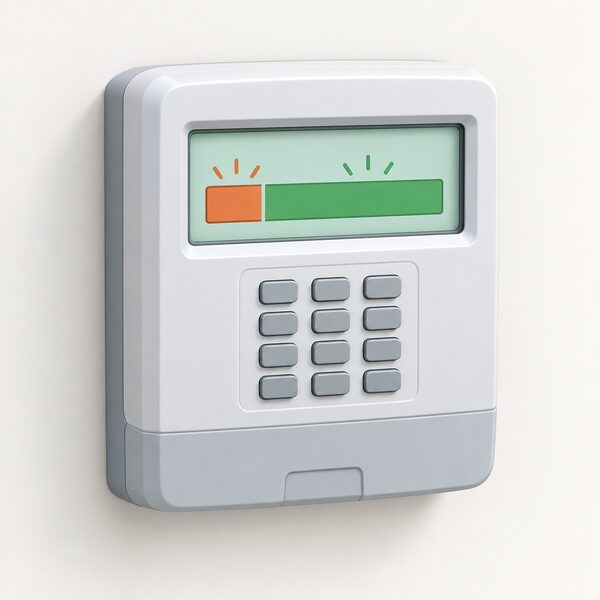
A keypad meter can be set to take a slice of every top-up towards money owed. Power NI states that the meter will be set to collect some of the arrears with each top up made, and that this will not be more than 20% of each top up3. Power NI gives the worked example: if the agreed recovery rate is 20% and a £10 top up is bought, the meter gets £8 credit and £2 is paid off the outstanding balance3.
Independent guidance sets out the same arithmetic in weekly terms: if the debt repayment is set at £6 a week and £10 a week is topped up, £6 goes towards the debt and £4 is added as credit, and missed payments are added up and deducted from the next top up22. The two examples use different periods and different rates, but the mechanism is identical.
The legal basis is wider than a single account. The Electricity (Prepayment Meter) Regulations 2006 provide that a prepayment meter may be used to recover a sum owed to a gas supplier or an electricity supplier by a customer, covering gas supply, electricity supply, gas meter provision or electricity meter provision at premises previously owned or occupied by the customer, and gas meter provision or gas supply at the premises where the meter is installed23. In other words, a keypad meter at one address can carry debt from another.
Power NI states that an annual account statement is sent to customers with arrears, and that installing a prepayment meter without express agreement will only be used as a last resort in the debt recovery process3. For the conduct rules that apply to prepayment debt more broadly, see supplier conduct on prepayment and debt.
Keypad costs and discounts: 2.5% off standard rate and top-up rewards
The headline commercial feature of the Power NI Keypad is a discount. Power NI states a 2.5% discount off the standard rate, described as ongoing3. The Consumer Council's price comparison table records the same term as equivalent to 2.5% off Standard Rate14. Power NI also states that there are no additional charges: no rental fee, no security deposit and free installation3.
The reward scheme sits alongside the discount. Power NI states that Keypad customers can take a Keypad Reward by topping up online or via the Power NI App, on the basis of buy £50, get £1 free3. The Consumer Council records free electricity from £1 to £4 for top ups between £50 and £175 online or via app14. The two accounts of the reward differ on the banding, so the exact reward for a given top-up is best confirmed with the supplier at the time.
| Item | Power NI Keypad position |
|---|---|
| Standing discount | 2.5% off the standard rate3 |
| Rental fee | None3 |
| Security deposit | None3 |
| Installation | Free3 |
| Replacement card | No charge3 |
| Quarterly bill | Not issued3 |
| Tariff change notice | 21 days3 |
The cost picture for a keypad household is therefore not simply the unit rate. It is the unit rate after the discount, plus whatever the household spends in time and travel buying credit, minus any reward. For a household comparing this with a credit meter, the relevant comparison pages are paying your energy supplier and energy suppliers in Northern Ireland.
Meter readings, the keypad buttons and what each display shows
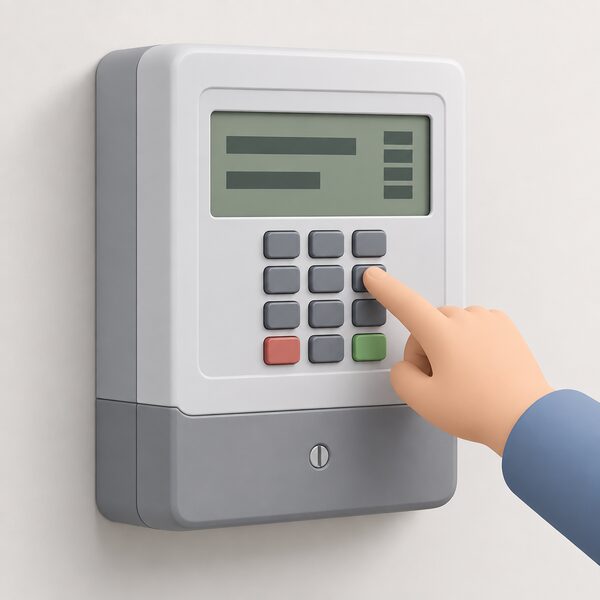
The keypad is also the meter's interface for readings and history. Pressing 2 shows the cost of the previous day's, week's and month's use24. Share Energy keypad meters show usage in pounds and pence each month for the last 13 months on button 2, and pressing 0 shows test, time and date4. Pressing 9 on the meter or freedom unit displays the reading8, and on an export meter pressing 9 three times brings up IMP Units and then Exp Units9.
NIE Networks reads, tests and inspects the meters of all electricity customers in Northern Ireland every three months, even if customers submit their own meter readings5. NIE Networks Meter Readers will read, test and inspect all electricity meters in Northern Ireland, even if customers submit their own meter readings25. For a keypad household, the practical effect is that the network operator keeps its own record of the meter regardless of what the household reports.
| Button | What it shows |
|---|---|
| 0 | Test, time and date4 |
| 2 | Cost of previous day, week and month; monthly usage in pounds and pence for 13 months24 |
| 4 | The last five top up codes entered2 |
| 9 | Meter reading; press three times for IMP Units and Exp Units on an export meter8 |
Where a keypad meter leaves a household dependent
A keypad meter gives a household a form of independence that a credit account does not. There is no quarterly bill, no direct debit and no estimated billing, and the meter keeps working without a broadband line, a mobile signal or a smart meter network. Power NI states that keypad customers do not receive a quarterly bill3. The household sees the cost of the previous day, week and month on the meter itself24.
The dependence that remains is real and worth stating plainly. The household depends on a supplier to issue codes, on a top-up point or a phone line or an app to buy them, and on the meter accepting them. It depends on NIE Networks, which owns all electricity meters in Northern Ireland, including both credit meters and keypad meters1. It depends on the code system being updated when prices change, which is why a 40 or 60-digit Powercode has to be entered before top-ups work again3. And it depends on the meter's own settings, including any arrears recovery rate of up to 20% of each top up3.
There is also a data dimension. Most keypad meters store up to 13 months' data10. That is a record held on the meter itself rather than only by the household, and it sits alongside the supplier's own account records, which is why an annual account statement is sent to customers with arrears10.
The direction of travel is away from keypad metering. The Consumer Council states that consumers do not have to do anything to receive their smart meter, and that NIE Networks and electricity suppliers will contact them when it is time for installation26. All meters are provided by NIE Networks27. For a household weighing up what comes next, the relevant pages are suppliers and smart meter installation and energy suppliers and household energy independence.
Sources27 cited
- Bills and metering, Consumer Council
- I've got a message on my keypad, what does it mean?, Power NI
- Services for prepayment meter customers, Power NI
- Share Energy Keypad, Share Energy
- Meter reading and credit FAQs, NIE Networks
- What will the meter information reading be used for?, NIE Networks
- Preparing for winter, National Energy Action
- Meter guide, NIE Networks
- Import and export meters, NIE Networks
- Emergency power cuts, NIE Networks
- SSE Distribution among the first ever companies to achieve the new Inclusive Service Kitemark, SSEN Distribution
- How can I change my meter type?, NIE Networks
- Home heating oil, Consumer Council
- Electricity price comparison table, Consumer Council
- Problems getting to or topping up your prepayment meter, Citizens Advice
- What if I don't enter the price change code?, Power NI
- I am a Keypad+ customer, how do I enter my price change code?, Power NI
- Change prepayment meter to credit meter, Confused.com
- You can't afford to top up your prepayment meter, Citizens Advice
- How to read your energy bills, National Energy Action
- Is a prepayment energy meter right for you?, Which?
- Energy debt on prepayment meters, Centre for Sustainable Energy
- The Electricity (Prepayment Meter) Regulations 2006, legislation.gov.uk
- NI electrical items cost, National Energy Action
- Why do we need to read your meter, NIE Networks
- Smart meters, Consumer Council
- Smart Electricity Meters fact sheet, Consumer Council
 NIE Networks Meter ReplacementExplains the programme replacing electricity meters across Northern Ireland, who carries out the work and how appointments are made.
 Suppliers in Northern IrelandNorthern Ireland runs its own energy market, with its own regulator, its own suppliers and no price cap.
 Prepayment MetersHow do you top up a prepayment meter for gas or electricity, and what happens when the credit runs out?
 Prepayment and Pay As You GoHow prepayment and pay as you go energy tariffs work in the UK: meter types, top-ups, emergency credit, debt repayment through the meter, price cap treatment and how households move to a credit meter.
 Energy Bills in Northern IrelandNorthern Ireland has no price cap.
 Top Up a Prepayment MeterHow to top up by card, key, app and code, how to enter a vend code by hand and how emergency credit and friendly-hours protection work.