In this guide
A green energy tariff is a supply contract whose environmental claim rests on where the electricity is said to come from, not on anything physically different arriving at the meter. Green tariffs usually promise 100% renewably sourced electricity as a minimum, with some including renewably sourced gas1. The electricity itself still comes through the same grid, mixed with everything else generated in Britain at that moment.
What separates one green tariff from another is the sourcing method behind the claim. A tariff claiming 100% renewable electricity must buy enough Renewable Energy Guarantees of Origin certificates to match what customers on the tariff use over a year2. Some suppliers go further and buy power directly from renewable generators, which is the standard Uswitch applies under its Green Accreditation scheme: 100% of electricity bought directly from renewable generators3.
There is no set definition of what a renewable or green tariff is, and companies take a variety of approaches2. That single fact explains most of the confusion in this market. The sections below set out what the claims mean, how green gas differs from green electricity, what Ecotricity's fixed and variable green tariffs actually commit a household to, and what remains outside a household's control even on the greenest contract available.
What a green energy tariff actually is: sourcing, offsets and funds
Green tariffs make use of both green and renewable energy, and 57% of the electricity that currently comes from CO2-emitting fossil fuel sources is offset under these arrangements8. That offsetting figure is the honest starting point: a green tariff does not remove fossil generation from the grid, it changes who pays for the renewable output and how it is accounted for.
Electricity tariffs are easier to make 100% green than gas tariffs. The energy produced comes from renewable sources such as solar, wind or waves4. Green energy is renewable power from wind, water, sun and biofuels9. Some renewable tariffs pay a proportion of your bill into funds that support renewable energy projects4, which is a different mechanism again: the money supports generation rather than matching the household's own consumption.
Standard tariffs have historically carried additional costs, including the climate change levy, to support ecological initiatives including green energy8. That levy sits on business and non-domestic use; domestic electricity and gas are charged VAT at 5%10. The distinction matters because a household comparing a green tariff with a standard one is comparing two supply contracts, not two different commodities.
The practical test of a green tariff is what the supplier can prove. Independent guidance sets out three requirements for environmental claims on tariffs: show that the environmental gain is because the customer chose the tariff; publish fuel mix and environmental benefit information; and prove where renewable energy came from with enough certificates2. A tariff that meets all three is doing something verifiable. A tariff that meets none of them is a marketing position.
What "100% renewable" means when the electricity comes from the grid
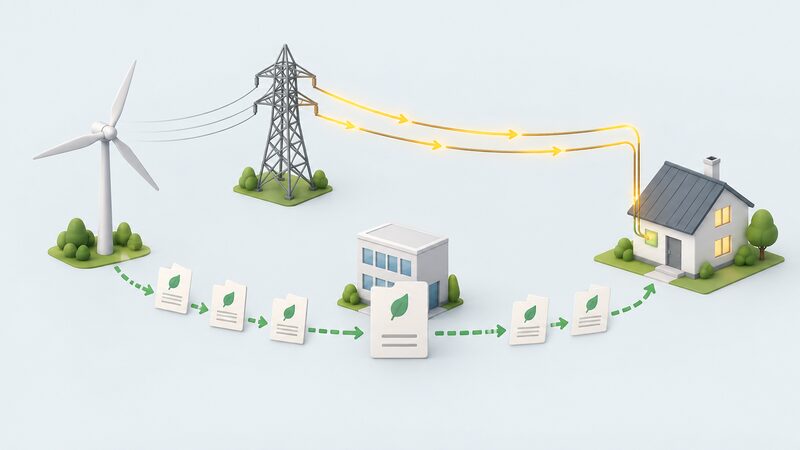
The claim is about certificates and contracts, not electrons. Because every unit of electricity on the network is identical once it reaches the wires, a supplier demonstrates its green credentials by buying renewable output or the certificates that represent it. The certificate mechanism is the Renewable Energy Guarantees of Origin, and the rule is arithmetic: enough REGOs to cover a year of customer consumption on that tariff2.
Suppliers differ in how far they go beyond the minimum. Good Energy's electricity tariffs are powered by 100% renewable energy generated in the UK by independent producers3. EDF Energy's Renewables tariff is powered from 100% renewable sources, while its Zero Carbon tariff is sourced entirely from nuclear energy11. Those are two different claims: renewable and low-carbon are not the same thing, and a household reading a tariff name should check which one is being made.
The counter-example is useful. British Gas non-renewable tariffs are predominantly sourced from nuclear (63%) and natural gas (28%) sources11. That is the mix a household is buying when it chooses a standard tariff from that supplier, and it shows how much of the "green" question is really a question about which contract a household signs.
Uswitch rates the greenest tariffs by certain criteria under the Green Accreditation scheme so customers can see how green a tariff really is1. The scheme's direct-purchase standard is the strictest common benchmark in the market: 100% of electricity bought directly from renewable generators3. A tariff can be 100% renewable on certificates and still fall short of that standard, which is why the two claims are worth separating.
"There is no set definition of what a renewable or green tariff is, and companies take a variety of approaches."
Green gas: why renewable gas is harder to supply than renewable electricity
Green gas is more difficult due to there being little renewable gas produced in the UK4. That is the constraint in one sentence, and it explains why green electricity claims are common while green gas claims are thin.
The market has responded with partial offers rather than full ones. Several suppliers offer green gas tariffs without requiring you to sign up for electricity or dual fuel12. Ecotricity generates a small (1%) amount of green gas for its dual-fuel tariffs3. 100Green offers at least 10% green gas on all tariffs and 100% on its Ekoenergy tariff, and is described as the only UK supplier offering 100% renewable energy across the board, including gas from anaerobic waste2.
Households weighing a gas-only green tariff should note the pricing structure. Most suppliers offer a discount for dual fuel tariffs that make them cheaper than separate gas-only and electricity-only tariffs12. So a household that wants green gas specifically may pay more than one that takes a dual-fuel contract, and the green gas content of that dual-fuel contract may be very small.
The independence point is blunt here. Electricity can be sourced renewably at scale in Britain; gas largely cannot, because the renewable gas volumes do not exist. A household on a green dual-fuel tariff is still burning predominantly fossil gas for heat, and no tariff changes that. Reducing gas dependence means reducing gas use, through insulation, heating system choice or both, not through the sourcing label on the bill.
Fixed or variable: how Ecotricity's EcoFixed and Green Variable tariffs differ
Ecotricity's two domestic green products sit at opposite ends of the commitment spectrum, and the terms are set out in its principal terms documents.
The Domestic EcoFixed 1 Year Green Tariff has fixed charges for 1 year (12 months) from the day you enter the contract or your supply start date5. The Domestic Green Variable Tariff is variable and may change, and it is continuous, which means it will only end when you switch supplier, if Ecotricity chooses to end it, on a new contract, or through a Supplier of Last Resort action13.
| Feature | Domestic EcoFixed 1 Year Green Tariff | Domestic Green Variable Tariff |
|---|---|---|
| Rate type | Fixed for 12 months5 | Variable and may change13 |
| Contract length | 1 year (12 months)5 | Continuous, ends on switching or supplier action13 |
| Exit fee | £75 per fuel if leaving more than 49 days before the end date5 | Not stated in the terms reviewed |
| Smart meter | Required, or agreed within 3 months5 | Not stated as a condition |
| Direct Debit review | Every 6 months5 | At least once a year13 |
| Economy 7 off-peak | Usually 00:00 to 07:00 GMT, varies by meter and location5 | Usually 00:00 to 07:00 GMT, varies by meter and location13 |
The variable tariff's continuity is the key difference for a household thinking about exit. There is no fixed end date to leave before, so the exit fee structure that applies to the fixed product does not arise in the same way. The fixed product trades that flexibility for price certainty over twelve months.
Ecotricity has also launched retention products for existing customers: a Domestic EcoLoyalty 1 year Fixed Tariff for August 2026 with 12 month fixed charges and a £75 per fuel exit fee, and a Domestic EcoLoyalty 2 Year Fixed Tariff for September 2026 with £100 per fuel exit fees and paperless, Direct Debit only conditions. Both are retention-only, for customers coming to the end of an existing fixed tariff.

Contract terms: length, exit fees, renewal and the 14-day cooling-off period
Fixed deals offer peace of mind by locking in the price of your energy for the length of the contract, typically 12 months6. The trade-off is the exit fee. Exit fees are typically £100 or more14, and you may have to pay your previous supplier an exit fee if you were on a fixed rate tariff and chose to leave before it ended7.
Ecotricity's Domestic EcoFixed 1 Year Green Tariff charges £75 per fuel if you end your contract more than 49 days before the contract end date or switch to another supplier5. The 49-day window is the renewal period: where you do not have an outstanding balance, you are free to leave at any time, although if you are outside of the 49-day window the exit fee applies5.
There are two waivers worth knowing. You will not be charged an exit fee if you remain with Ecotricity and switch to a tariff that requires a change in metering setup, for example moving to an EV tariff or switching to or from Economy 75. The exit fee will still apply if you switch between fixed tariffs where the metering setup remains the same5.
The cooling-off period is separate from all of this. The contract can be cancelled within 14 days of the date you entered it by contacting Ecotricity5. More generally, you cannot be charged an exit fee if you switch tariff during the 14-day cooling-off period at the start of the contract6. The Energy Switch Guarantee states that if you change your mind within 14 days, you simply remain with your existing provider or on your existing tariff15, and the cooling-off period runs from the day after you agree to the new contract14.
Eligibility and conditions: smart meters, Direct Debit, credit checks and deposits
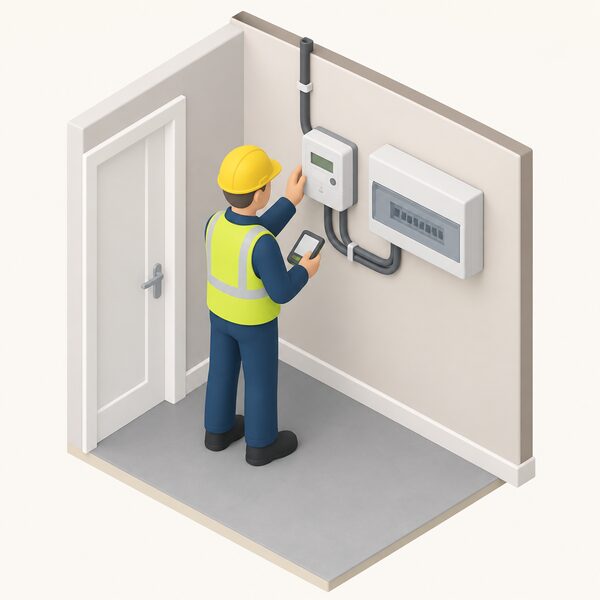
The Domestic EcoFixed 1 Year Green Tariff requires you to either have a smart meter in place or agree to one being installed within the first 3 months of the tariff commencing5. That is a hard condition, not a preference, and it has a consequence attached.
If a meter is not installed or is refused within 3 months, and delays are not due to Ecotricity, the account will revert to the Out of Contract tariff5. A household that declines a smart meter installation on this tariff therefore loses the fixed price it signed up for.
Credit checks apply. Ecotricity states that it will use your information to conduct a credit check for the EcoFixed tariff, that the result will remain on your credit file and that it may impact your credit score5. On the Green Variable Tariff, a credit check is carried out on application, recorded on your credit file and may affect your credit score, and ongoing payment history is reported to credit reference agencies13.
Smart meters are not a universal requirement across the market, but they gate access to some products. Some tariffs are only available to customers with smart meters, or if you agree to have one fitted14. The same logic applies to electric vehicle charging: you do not need a smart meter simply to charge an EV, but without one you may not be able to access some EV-specific tariffs16.
Time of use tariffs are worth flagging for households with generation or storage. They suit homes with green tech such as a heat pump, battery storage or an electric or hybrid car17. Those tariffs are generally cheaper at times when renewable generation is high and demand is low18, which is the closest a household gets to consuming renewable electricity when it is actually being generated.
Payment and billing: Direct Debit reviews, bill timing and standing charges
Customers paying by Direct Debit receive discounted rates on Ecotricity's Green Variable Tariff, while non-Direct Debit customers pay pay on receipt of bill rates which are higher13. The monthly Direct Debit amount is assessed against consumption and reviewed at least once a year to ensure you pay the right amount13. On the Domestic EcoFixed 1 Year Green Tariff, the fixed Direct Debit is reviewed every 6 months5.
Bill composition is standard across suppliers. Costs are calculated based on the type of energy you use, the type of meter installed, and how you pay your bill, for example by Direct Debit19. The wider components include VAT at 5%, wholesale costs, network costs, operating, debt and industry costs, EBIT and policy costs20.
Green levies are a visible part of that stack. These levies make up 16% of the final price of electricity and 5.5% of the final price of gas, as of October to December 202410. The distribution is uneven: low-income households with direct electric heating face the highest burden, exceeding 1.5% of income, while wealthier households carry a smaller share10. VAT is applied at 5% for domestic use and 20% for most businesses10.
For a household thinking about independence, the billing structure is where the limits show. Standing charges and policy costs are payable regardless of how green the tariff is, and they do not fall when a household generates its own power. A green tariff changes the sourcing story on the supply side; it does not change the fixed costs of being connected.
Moving home, switching and what happens if your supplier fails
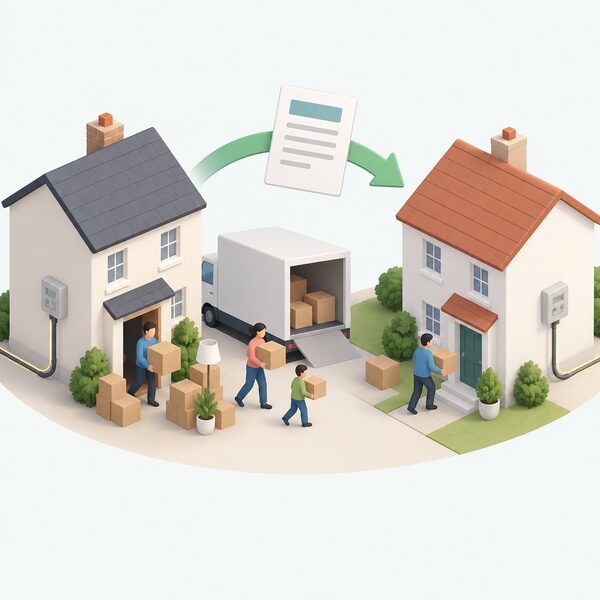
If you pay a supplier directly for the electricity or gas you use at home, you can choose to switch to a different supplier or tariff at any time7. The same applies in rented properties where the tenant pays the bills: if you have to pay your energy bills, you can choose to switch your supplier or tariff at any time7.
Switching is quick. Suppliers must switch your electricity or gas supply from your old supplier to your new supplier within 5 working days7. The Energy Switch Guarantee states customers can switch to a new tariff within five working days, whether changing supplier or tariff with an existing supplier15. Gas switching should take no longer than 5 working days after your new supplier has received your registration12.
Moving home mid-contract has its own rules. Where you move house during your fixed term tariff, you won't be subject to exit fees where you transfer the tariff to the new property, though tariff rates may change dependent on the location of the new property5. A supplier might let you keep the same contract and tariff at your new home without charging you a fee21. If you break your contract, you'll automatically go onto a standard variable tariff in your new home21. On the Green Variable Tariff, Ecotricity asks customers to contact customer service at least two Working Days before the day you move13.
If a supplier fails, the Supplier of Last Resort process applies. Where customers are switched to Ecotricity as a Supplier of Last Resort customer, it will take reasonable steps to fulfil any agreement made with Ofgem, including honouring any credit balance held with the previous supplier5. Credit balances are therefore not automatically written off in a failure, though the process is run by the regulator rather than chosen by the household. More detail sits in Supplier of Last Resort: What Happens When Your Supplier Stops Trading and Energy Supplier Failures: Every Collapse and What Happened to Customers.
A Green Deal loan does not block switching: you can change electricity supplier as long as the new supplier is taking part in the Green Deal scheme22.
Beyond the tariff: the Feed-in Tariffs scheme and what it still pays existing generators
The Feed-in Tariffs scheme is closed to new applications, but installations already accredited under the scheme will continue to receive payments23. Accredited installations that meet their ongoing obligations receive tariff payments for both the amount of renewable electricity they generate and the renewable electricity they export into the national grid24.
The scheme requires participating licensed electricity suppliers to make payments on electricity generated or exported by accredited installations25. Owners of installations accredited to the scheme are called FIT Generators24, and the scheme pays fixed tariffs to qualifying renewable and combined heat and power installations for electricity generated and exported26. The original design was to pay a generation tariff and an export tariff, where applicable, to small-scale low-carbon generators for electricity generated and any exported27.
The scheme is funded by a levy paid by electricity suppliers28, and it covers electricity generated from renewable sources, such as solar or wind power28. It is also known as the Clean Energy Cashback Scheme29. Eligibility is historical: Feed-in Tariffs pay back households who installed renewable generation technology between 2010 and 2019 for each unit generated10.
Early scheme data shows the scale. A total of almost £136 million generation payments and a little over £3 million of deemed export payments were made to eligible installations between 1 April 2011 and 1 April 201230. Domestic wind installations account for 1.5 per cent of capacity under the scheme31.
For a household with an accredited installation, the tariff and the FIT payment are separate income streams. The supply contract can be changed at any time without affecting accreditation, because the payment obligation sits with the licensed suppliers collectively rather than with the household's chosen supplier.
How green tariffs fit with household energy independence
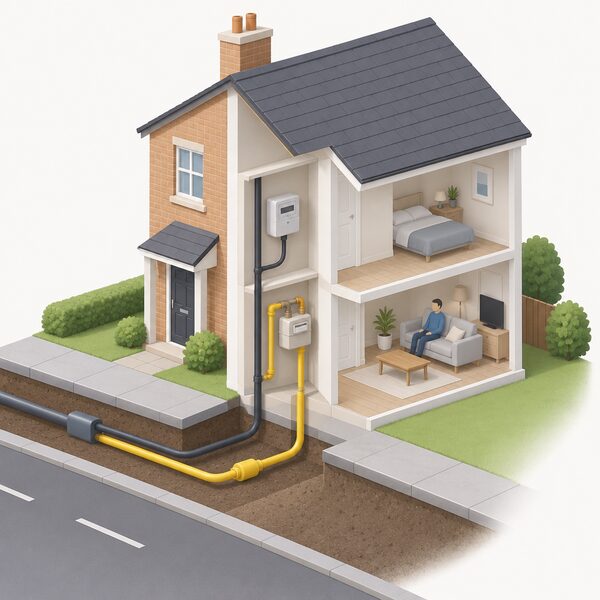
A green tariff changes who a household pays and what that payment is matched against. It does not change the physical dependence: the home remains connected to the grid, supplied by a licensed supplier, and, if it uses gas, dependent on the gas network and on imports.
What a green tariff can do is shift the sourcing claim onto verifiable ground. A tariff backed by 100% of electricity bought directly from renewable generators3 is a stronger position than one matched with certificates alone, and a tariff that publishes its fuel mix and environmental benefit information2 gives a household something to check rather than something to believe.
The evidence on household behaviour is modest but real. Among households on green tariffs, 32% of owner occupiers reported an intention to upgrade efficiency measures, compared with 44% of those on time of use tariffs32. That suggests the tariff itself is a weak driver of the physical changes that reduce dependence, and time of use pricing is a stronger one.
The limits are worth stating plainly. Green gas is constrained by the small volume of renewable gas produced in the UK4, so a dual-fuel green tariff is still predominantly a fossil gas contract. Green levies make up 16% of the final price of electricity and 5.5% of the final price of gas10, and those costs apply whether or not a household generates its own power. And the supplier relationship remains: a green tariff is still a contract with a company, subject to that company's credit checks, Direct Debit terms, exit fees and, if it fails, the Supplier of Last Resort process5.
For households that want to go further, the routes that reduce dependence rather than re-label it are generation, storage and shifting consumption to times when renewable output is high. Time of use tariffs are generally cheaper at times when renewable generation is high and demand is low18, which links the tariff choice to the physical behaviour. The wider picture of how supply contracts sit within household independence is set out in Energy Suppliers and Household Energy Independence, and the supplier landscape in UK Energy Suppliers: The Full Guide to Who Supplies Your Gas and Electricity.
Sources32 cited
- Energy tariffs explained, Uswitch, 2026-02-17
- Differences between green energy suppliers, Which?, 2026-06-16
- Green energy, Uswitch, 2026-09-04
- Types of energy tariff, Confused.com, 2025-11-03
- Domestic EcoFixed 1 Year Green Tariff July 2025 principal terms, Ecotricity, 2025-07
- How to switch energy supplier, Confused.com, 2025-12-15
- Switch your home energy supplier, Ofgem, 2026
- Green energy tariffs guide, Confused.com, 2025-11-03
- Homes and energy, Manchester City Council, 2026-09-20
- Household energy bills and green levies, Nesta, 2026-09-20
- Where does my energy come from?, Uswitch, 2026-08-03
- Gas only, Confused.com, 2026
- Domestic tariff principal terms, Ecotricity, 2025-09
- How to switch energy supplier, Which?, 2026-05-15
- Energy Switch Guarantee, Energy UK, 2026-07-08
- EV tariffs and home charging, Energy Ombudsman, 2026-09-11
- Five top tips to cut your energy bills, Welsh Government, 2026-03-18
- Green electricity tariffs, Centre for Sustainable Energy, 2026-07
- How your electricity or gas bill is calculated, Ofgem, 2026
- How your electricity or gas bill is calculated, Ofgem, 2026
- Moving home: dealing with your energy supply, Citizens Advice, 2026-09-20
- Green Deal energy saving measures, GOV.UK, 2026-09-17
- Guidance for FIT Generators V18, Ofgem, 2026-04-01
- Feed-in Tariffs Annual Report Scheme Year 13, Ofgem, 2023-12
- Feed-in Tariffs quarterly report issue 63, Ofgem, 2026-03-30
- Feed-in Tariffs guidance for renewable installations, Ofgem, 2021-12-13
- Feed-in Tariff scheme factsheet, Ofgem, 2013-03
- VAT fuel and power manual VFUP4400, HMRC, 2026-09-17
- Generating your own energy: solar electricity, Welsh Government, 2018-09
- FITs annual report 2011-2012, Ofgem, 2011
- HEE statistics detailed release March 2023, Department for Energy Security and Net Zero, 2023-03-30
- Consumer survey 2021: decarbonisation and home energy use, Ofgem, 2021-08-19
 The Full Tariffs GuideWhich energy tariff suits how you live, and will switching really save you money?
 Export Rates Per kWhHow much will your supplier pay you for the solar power you send to the grid, and why do rates vary so much from one company to another?
 Fuel Mix DisclosureWhere does your electricity really come from, and how much of it is green?
 Supplier-Controlled ChargingSmart charging tariffs let your energy supplier decide when your car charges, usually overnight when electricity is cheaper.
 Batteries and Smart TariffsA home battery can earn its keep if your electricity prices change through the day.
 Fixed-Rate Energy TariffsWhat a fixed energy tariff fixes and what it does not, the contract lengths sold in the UK, exit fees and the 49-day window, how fixed rates compare with the price cap, and what happens when the term ends.