
In this guide
Switching energy supplier is an administrative change, not a physical one. The gas and electricity coming into a home stay the same; only the company billing for them changes, and no cables or pipes are replaced1. Ofgem requires suppliers to complete a domestic switch within five working days, and the process itself takes only a few minutes to set up2.
What people most often want to know is what happens to the money. If a household is in credit, the old supplier refunds it in the final bill. If a household owes money, the position depends on how it pays: on a credit meter, a switch is still possible where the debt is less than 28 days old, with the amount added to the final bill2. On a prepayment meter, the ceiling is £500 per meter2.
What happens when you switch: the process end to end
The switch is arranged between the two suppliers. A household chooses a tariff, the new supplier registers the change, and the old supplier is notified through the industry systems. Nothing is dug up, rewired or reconnected, because the same wires and pipes serve the property whoever bills for the energy1. Ofgem's own guidance is blunt about the household's role: if you pay a supplier directly for the electricity or gas you use at home, you can choose to switch to a different supplier or tariff at any time2.
The practical sequence is short. Comparing and switching takes only a few minutes, and the household is told the date the gas or electricity will move across3. The new supplier is responsible for taking the meter reading when the switch happens, and for all future readings at the property afterwards9. That removes the most common worry, which is whether a household has to be present or organised on the day.
There are two situations where the process is not a simple transfer. The first is a heat network: if a home is on one, the supplier cannot be switched at all2. The second is a business contract attached to a property, which sometimes happens in flats above shops or in homes bought from a developer. Before moving into a home supplied through a business contract, it is worth checking who holds the contract, how charges are calculated, whether they are metered or estimated, whether a supplier or tariff can be chosen, and whether it is possible to move to a domestic contract10.
If a supplier goes out of business mid-switch, the household does not lose the change it asked for. Ofgem states that anyone already in the process of switching will still move to the supplier they chose11. For households with solar panels receiving Feed-in Tariff payments, a switch means agreeing a new statement of FIT terms with the new licensee and providing up-to-date meter readings before payments restart12.

How long a switch takes: five working days, not 21

The headline figure is five working days, and it is a requirement rather than a target. Ofgem states that suppliers must switch electricity or gas supply from the old supplier to the new one within 5 working days2. Independent guidance agrees: the switch should take up to five working days, and a household can ask to delay it if a particular date suits better5. The same five-day figure appears across consumer bodies, comparison services and the Energy Switch Guarantee itself9.
The 21-day figure that many people still quote is history. The switching process previously took 21 days, and before the current rules suppliers had 15 working days to complete a switch, with only signatories to the Energy Switch Guarantee aiming for five8. The 21 working days that remains in the rules today is a different thing entirely: it is the time a supplier has to switch a household back after an erroneous transfer2.
One timing detail catches people out. The five working days run from the point the new supplier has received the registration, not from the moment a household clicks to switch13. The cooling-off period sits alongside this rather than blocking it: switching should happen within 5 days of the 14-day cooling-off period, so a household that does nothing can expect the change to complete roughly three weeks after signing up1.
Smart meters do not slow any of this down. Households can switch easily and quickly between suppliers without disruption to smart service, and the industry is moving towards transferring data, payment details and account information within five working days, eventually within 24 hours14. In practice, the meter may need attention after the switch rather than before it.
The 14-day cooling-off period and cancelling without penalty
Every domestic switch comes with a 14-day cooling-off period, and it starts the day after the contract with the new supplier is agreed5. During that window a household can cancel the switch without penalty and return to the old supplier1. The same 14 days appears in the Energy Switch Guarantee, in comparison guidance and in the standard terms suppliers must allow8.
The cooling-off period is separate from the five-day switching deadline, and the two run in parallel rather than one after the other4. That matters because a household can change its mind after the technical switch has already been arranged. Cancelling inside the 14 days does not attract an exit fee, and the same protection applies if a household switches tariff rather than supplier during that period5.
What you need before you start
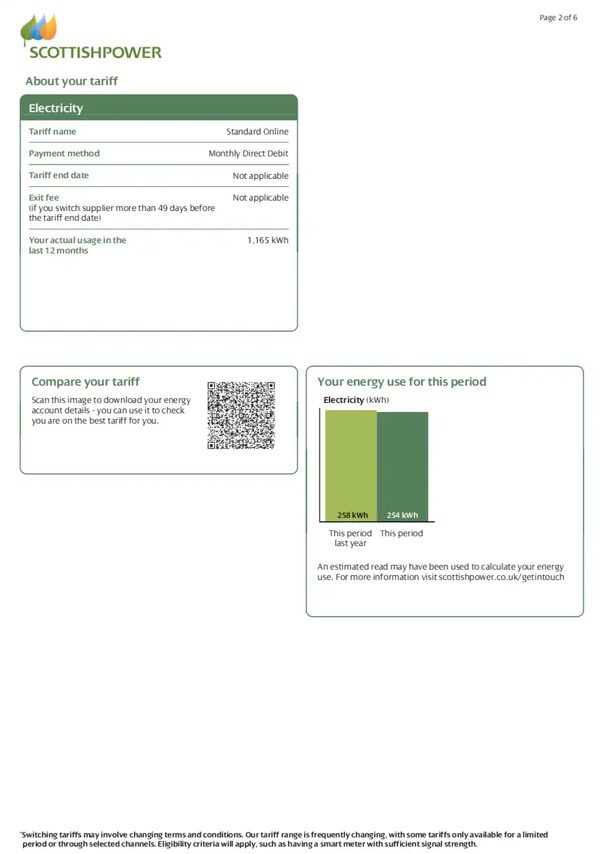
A switch needs a small amount of information, and most of it is on a recent bill. Ofgem lists the postcode, the name of the current supplier, the name of the current tariff, the amount paid per unit in kilowatt hours, and the amount of energy used each year2. Independent guidance adds how the bill is currently paid and how it would be paid with a new supplier1.
Bills themselves have to show the cost of energy for the last 12 months, unless a household has been with its supplier for less than a year, which is where the annual usage figure comes from6. When comparing, the factors that matter are unit rates, standing charges, contract length, exit fees if any, and customer ratings5.
- From a recent bill: postcode, supplier name, tariff name, unit rate in kWh, annual usage2
- Also useful: current payment method and preferred payment method1
- When comparing: unit rates, standing charges, contract length, exit fees, customer ratings5
Tenants who pay the supplier directly can switch supplier or tariff at any time, including with a prepayment meter2. Where a landlord holds the contract, the position is different, and it is worth checking who the account is in before starting.
Debt, prepayment meters and when you can still switch
Owing money does not automatically block a switch, but the rules differ sharply by payment method. On a credit meter, a household can switch if it pays by direct debit or on receipt of a bill and has owed money for fewer than 28 days, with the debt added to the final bill4. Ofgem's version is the same: where money has been owed to the old supplier for less than 28 days, it should be added to the final bill2. Where an account is in debit, a switch is still possible, but the final bill must be paid in full17.
On a prepayment meter the threshold is a fixed figure. A household can switch if it owes up to £500, and the debt is then repaid to the new supplier rather than the old one2. The same £500 ceiling appears across comparison guidance, and it applies per meter: owing more than £500 for gas and £500 for electricity prevents a switch13. Tenants with a prepayment meter should still be able to switch4.
There is a further condition for tenants in England. A tenant who owes money to a supplier cannot change back to paying by credit until the debt is paid, while a tenant who does not owe money can move to paying by credit16.
Exit fees and the 49-day window on fixed tariffs

Exit fees apply to fixed-term deals, including some tracker tariffs, and they are charged when a household leaves before the term ends2. They are typically £100 or more4. Fixed contracts usually run for 12 to 24 months, which is the period over which the fee can apply4.
The protection is the final 49 days. A provider cannot charge exit fees if a household switches within 49 days of the current deal ending, and inside that window a switch can be made without paying anything6. Comparison guidance puts the practical window at 21 to 49 days left on the tariff, which avoids spending a few days or weeks on a standard variable rate without incurring a fee5.
The fee is not always what people think it is. Ofgem research found that 70% of consumers who thought they had an exit fee on their current contract were looking at a deal with a £300 exit fee21. That is a perception figure rather than a price, but it shows how often the term is misunderstood.
| Situation | Exit fee position |
|---|---|
| Leaving a fixed deal before the end | Fee applies, typically £100 or more4 |
| Switching in the final 49 days | No exit fee6 |
| Cancelling during the 14-day cooling-off period | No exit fee5 |
| Switching tariff during cooling off | No exit fee5 |
Your final bill, credit refunds and the six-week deadline
The old supplier sends a final bill, and the deadline is six weeks. Under the Energy Switch Guarantee a household receives the final bill within six weeks, and independent guidance gives the same timeframe for a bill that includes any debt added to it8. Where a household has moved home, the final bill should also arrive within six weeks22.
Credit is refunded from that final bill. Ofgem states that the old supplier will refund any credit in the final bill, and that compensation may follow if it does not23. Under the Energy Switch Guarantee the refund comes within 14 days of the final bill date, and comparison guidance repeats the 14-day figure8. Moving-home guidance puts the refund within 10 working days of sending the final bill22.
Claiming is straightforward and can be started at any time. A household can contact the supplier to claim credit back whenever it likes, and the supplier's name is on a recent bill if it is not to hand24. Before claiming, it helps to make sure there is a recent meter reading on the account and to check the balance7.
"your old supplier will refund any credit in your final bill. You could get compensation if they do not."
Backbilling: the 12-month limit on old charges
Back billing rules put a limit on how far back a supplier can charge. Ofgem states that a household does not have to pay for energy used more than 12 months ago where it has not had an accurate bill, a statement of account, or a Direct Debit set too low25. The protection is not absolute: energy used more than 12 months ago must still be paid for if the household has acted unreasonably, for example by blocking access to the meter or ignoring requests25.
The rule matters most in cases where billing has gone wrong for years rather than months. The Energy Ombudsman has dealt with a microbusiness that received a bill for three years of electricity charges billed on a deemed rate, which is the kind of case the 12-month limit is designed to catch26.
Compensation when a switch goes wrong: £40 and beyond
Compensation for switching failures is set at £40 in several situations. A household could get £40 if its supply is switched by mistake, and if the new supplier does not put things right it must pay £402. Independent guidance confirms that £40 is paid automatically by the new supplier, with an extra £40 where a delay condition applies27. Where both the old and new suppliers take more than 20 working days to decide whether a switch was correct, £40 comes from each of them4.
The £40 figure is also written into the standards of performance regulations, which require a payment of £40 for each failure covered by the additional standard payment28. The Energy Ombudsman has recorded industry-mandated payments of £30 for a failure to complete a transfer, which is a separate and older figure29.
Compensation for supply problems is a different scale. Under the Guaranteed Standards of Performance, a power cut lasting more than 24 hours and interrupted for 72 hours could bring 4 additional £45 payments, adding up to £180, while a cut lasting more than 12 hours and interrupted for 36 hours could bring 2 additional £45 payments, adding up to £9011.
| Failure | Payment |
|---|---|
| Supply switched by mistake | £402 |
| New supplier fails to put it right | £402 |
| Delay condition applies after erroneous switch | Extra £4027 |
| Old and new suppliers take over 20 working days to decide | £40 from each4 |
| Failure to complete a transfer (Ombudsman case) | £3029 |
What the Energy Switch Guarantee actually covers

The Energy Switch Guarantee is a voluntary set of promises that suppliers sign up to, launched by Energy UK, the trade association for the UK energy industry8. It is essentially a list of 10 commitments that protect households throughout a switch, and all of the big six energy suppliers have signed up, along with several smaller suppliers8.
The commitments cover the main anxieties. Under the guarantee a switch takes no longer than 5 working days, gas or electricity supplies are not shut off at any point, a household can return to its old supplier within 14 days, the final bill arrives within six weeks, and any money owed is refunded within 14 days of the final bill date8. The guarantee is not a licence condition, so a supplier that has not signed up is not bound by it, even though the five-day switching deadline applies to all suppliers through Ofgem's rules2.
For a household thinking about energy independence, the guarantee is a useful signal but not a substitute for the underlying rules. The five working days, the 14-day cooling-off period and the £40 payments come from the regulatory framework; the guarantee restates them as a promise. Where a supplier has signed up, the household has an extra route to complain if the promise is broken.
Sources29 cited
- Switching your energy supplier, Energy Saving Trust, 2026
- Switch your home energy supplier, Ofgem, 2026
- Standard rate tariffs, Uswitch, 2026
- How to switch energy supplier, Which?, 2026
- How to switch energy supplier, Confused.com, 2026
- Understanding energy bills, StepChange, 2026
- Energy credit, Confused.com, 2026
- Energy Switch Guarantee, Uswitch, 2026
- Energy: your questions answered, Confused.com, 2026
- If you live in a home with a business energy contract, Ofgem, 2026
- What happens if your energy supplier goes out of business, Ofgem, 2026
- Feed-in Tariffs: generators, Ofgem, 2026
- Gas and electricity, Confused.com, 2026
- Smart meters: your rights and expectations, GOV.UK, 2025
- How to get a smart meter, Smart DCC, 2026
- Switching energy supplier if you're a tenant, Citizens Advice, 2026
- Gas, Energy Helpline, 2026
- A step by step guide to setting up gas and electricity in a new home, Energy Helpline, 2026
- Get help with your energy bills, Ofgem, 2026
- Gas and electricity, Uswitch, 2026
- Understanding consumers' energy tariff choices, Ofgem, 2025
- Moving home: dealing with your energy supply, Citizens Advice, 2026
- How your electricity or gas bill is calculated, Ofgem, 2026
- Understand your electricity and gas bills, Ofgem, 2026
- What to do if you get a back bill, Ofgem, 2026
- Deemed contracts and rates, Energy Ombudsman, 2026
- You've been switched to a new energy supplier without your agreement, Citizens Advice, 2026
- Check if you can get payment for a power cut, Ofgem, 2026
- The Electricity and Gas (Standards of Performance) (Suppliers) Regulations 2015, legislation.gov.uk, 2025
 Switch Energy SupplierThe practical sequence of a domestic energy switch: the details and readings needed, the five working day transfer, cooling-off periods, exit fees and the final bill.
 Supplier Licensing and FailureWhat happens when your energy supplier goes bust?
 Final Bills and Credit RefundsHow final bills and credit refunds work when you leave an energy supplier: the six-week deadline for the final bill, the ten-working-day deadline for refunding credit, the twelve-month back billing limit, and the automatic compensation that applies when suppliers miss these standards.
 Moving Home Energy AccountsMoving home means you get a new energy supplier whether you choose one or not, so who supplies your new place and what happens to your old account?
 Energy Debt Repayment PlansOwe money to your energy supplier?
 Complaining About a SupplierHow do you complain about your energy supplier, and how long should it take?