

In this answer
Short answer
Your old supplier should send a final bill within six weeks of your switch completing1. That is the headline deadline, and it applies whether you are in credit or in debt when you leave. The bill confirms the closing balance on the account, and if you are owed money it states how much2.
The switch itself is quicker than the billing that follows it. A switch takes up to five working days to complete, and your new supplier gives you the date3. The final bill then arrives separately, from the supplier you have left, within the six-week window.
If the old supplier misses that deadline, £40 compensation is due4. Credit owed is refunded within 14 days of the final bill arriving5. The sections below set out what the bill covers, how it is calculated, and what happens when it is late or wrong.
The final bill deadline: within six weeks of your switch
The six-week rule is the anchor for everything that follows a switch. Suppliers have six weeks after a customer switches to send them a final bill7. The Energy Switch Guarantee states the same commitment: you will receive your final bill within six weeks1. Independent guidance repeats it across fuel types, with a final bill from the old supplier expected within six weeks for gas5 and most final bills calculated within six weeks of the switch for electricity8.
The clock starts when the switch completes, not when you first apply. Because the switch itself takes up to five working days, the practical gap between deciding to move and holding the final bill can run to roughly seven weeks3. The new supplier contacts your existing supplier, arranges the switch date and asks for a final meter reading, so the old supplier has the closing read it needs to produce the bill9.
Where you owe money and have been in debt to the old supplier for less than 28 days, that amount is added to the final bill rather than blocking the switch10. The bill is therefore both a closing statement and, where relevant, a demand.
The deadline matters for household independence because it sets a fixed point at which the old relationship ends. Until the final bill arrives and any credit is returned, part of your money and your account history sits with a company you no longer buy from. The six-week limit is what stops that lingering indefinitely.
"Suppliers have six weeks after a customer switches to send them a final bill"
What the final bill covers and how it is calculated
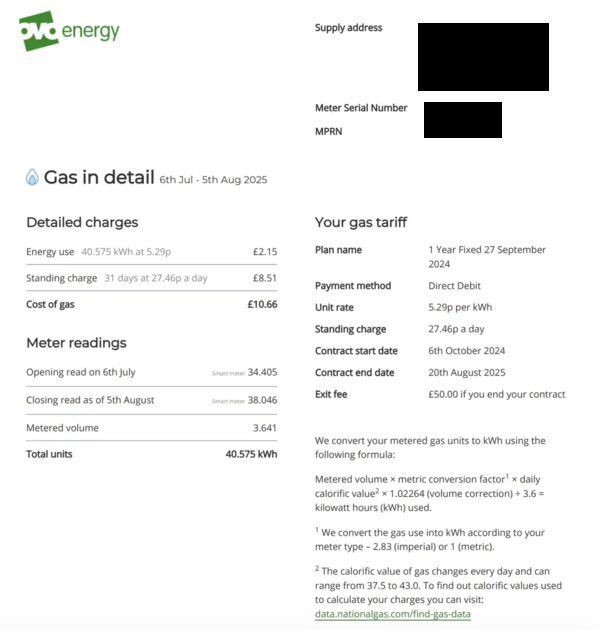
A final bill is a normal domestic energy bill with a closing read. All bills must include your name and address, the supplier's name and address, your account or reference number, meter serial numbers, meter readings, usage over the last billing period, the current bill with a breakdown of charges, tariff details including unit price and standing charge, contract details with end date and exit fees, the tariff comparison rate, and a reminder of your right to switch11.
The charges themselves are built from VAT at 5%, wholesale costs, network costs, operating, debt and industry costs, EBIT, policy costs, the type of energy you use, the type of meter installed, and how you pay12. Those components explain why a final bill can differ from your last monthly or quarterly statement: it covers a part-period, so the standing charge and usage are apportioned to the closing date rather than a full cycle.
Exit fees can appear on a final bill if you left a fixed contract early. One worked example shows exit fees of £50 per fuel, electricity and gas, a £100 total, for switching before the final 49 days of the contract13. Exit fees are not automatic: a supplier cannot charge you an exit fee to switch after they said you can switch14.
To check a final bill, the tariff and usage figures you need are on your latest bill or statement, or in an app or online account9. The information required to switch in the first place is your postcode, your energy plan name and a recent bill15.
| Item on the final bill | What it shows |
|---|---|
| Meter readings | Closing read used to calculate usage11 |
| Unit price and standing charge | Tariff rates applied to the part-period11 |
| Exit fees | Charged only where a fixed contract ends early13 |
| VAT | 5%12 |
| Credit or debt balance | What the supplier owes you, or what you owe2 |
Credit on your old account: when you get it back
An account is in credit when it has a positive balance after the latest bill has been deducted from it2. When a switch takes place, the old supplier refunds any credit in the final bill, and compensation can be due if it does not2. The Energy Switch Guarantee puts a timescale on it: any outstanding credit from the old provider arrives within 14 days of the final bill5.
That 14-day window runs from the final bill, not from the switch date, so the two deadlines stack. A switch completes in up to five working days, the final bill follows within six weeks, and the credit refund follows within 14 days of the bill3. In practice a household in credit should expect the money back within roughly two months of switching, and often sooner.
Refunds are not limited to recent switches. You might be due a refund if you closed old energy accounts when you moved home or switched suppliers during the past five years16. Suppliers hold credit on dormant accounts, and the onus is on the household to claim it. If you are in credit with your current supplier, claim the money back when you switch4.
There is a conflict in the published guidance on the £40 figure. One source describes £40 compensation where the old supplier does not issue the final bill within six weeks of a switch; the same source also describes £40 where the old supplier does not refund a credit balance within 10 working days of the final bill deadline4.
Billing during the switch: who charges you and when
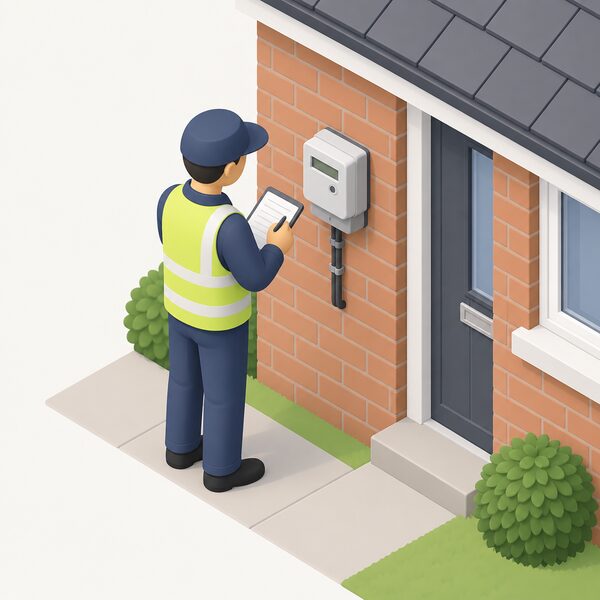
During the switch you are billed by two suppliers for different periods, and the boundary is the closing meter read. Your new supplier is responsible for taking a meter reading when you switch, and for all future meter readings at your property after the switch takes place17. The new supplier also contacts your existing supplier, arranges the switch date and asks for a final meter reading9. You do not have to organise the handover read yourself, though taking your own record is sensible.
The right to switch is broad. If you pay a supplier directly for the electricity or gas you use at home, you can choose to switch to a different supplier or tariff at any time10. The same applies in rented properties where the tenant pays the bills: if you have to pay your energy bills, you can choose to switch your supplier or tariff at any time10. Where the landlord pays, the landlord changes suppliers18.
The cooling off period starts the day after you set up a contract with the new supplier19. That window sits alongside the switch process rather than delaying it, and the switch should be completed within five days once you confirm15.
For a household, the practical effect is that independence from the old supplier is staged. Supply moves at the switch date, billing moves at the final bill, and the money moves at the refund. Until the last stage, the old supplier still holds part of the relationship.
Where the six-week rule falls short: Northern Ireland and special cases
The six-week final bill deadline is a GB market commitment, and Northern Ireland runs a separate market with separate arrangements. Energy costs in Northern Ireland are high currently, with some variation between suppliers20. The regulatory framework differs too: directions under the Energy Prices Act 2022 required domestic electricity and gas suppliers in Northern Ireland to seek agreement to make tariff changes on days other than the first day of a quarter21. Those directions were made to allow domestic electricity and gas suppliers in Northern Ireland to make tariff changes on days other than the first day of a quarter21.
Northern Ireland also has its own guaranteed standards regime, with exemptions that do not map onto the GB switching rules. Exemptions can apply where a network operator is unable to access a property, or where the customer agrees to electricity not being restored within the given timescales22. Separately, where remedial works specified in a notice are not carried out by the end of the specified period, the distributor may disconnect or refuse to connect the supply23.
Special cases in the GB market also sit outside the simple six-week story. If a supplier has ceased trading, take meter readings as soon as you are aware, because the new supplier will need them24. Where an erroneous transfer has occurred, the old supplier should switch you back within 21 days of the date they agree a mistake was made, and when you are switched back you still get bills from your old supplier and will not have to pay the new supplier anything25.
For households in Northern Ireland, the practical answer is that the six-week figure should not be assumed. The Consumer Council for Northern Ireland covers switching in that market, and the deadlines and protections differ from those in England, Scotland and Wales20.
If your final bill is late or wrong

Contact your energy supplier if you have a problem relating to late, incorrect or missing bills, back billing, being overcharged, a faulty meter, poor customer service, or refusing to refund credit from your account26. Those are the recognised grounds for a complaint, and a late or wrong final bill falls squarely within them. Independent guidance lists late or inaccurate bills, problems resulting from switching supplier or tariff, and issues with their website as complaint grounds27.
The back billing limit is the key protection on old charges. Suppliers can charge consumers for energy up to 12 months after it was used, meaning they have a full year to bill for it6. A final bill that arrives within the six-week window will normally fall well inside that limit, but the 12-month rule is what governs any older usage a supplier tries to recover.
Where a mistake is agreed, payment should follow quickly. A supplier should pay by cheque or into your bank account within 10 working days of the date they agree a mistake was made10. In an erroneous transfer, the new supplier should pay within 10 working days of the date they agree a mistake was made, and should explain what they plan to do within 5 working days of you contacting them25.
If the supplier does not resolve the issue, the Energy Ombudsman is the next step. Complaints about late, incorrect or missing bills, back billing, overcharging, faulty meters, poor service and refused credit refunds can all be escalated28. Billing problems are common: Citizens Advice helps with an energy billing issue every two minutes6.
Sources29 cited
- Energy Switch Guarantee, Uswitch, 2026-07-20
- Energy credit guide, Confused.com, 2026-07-03
- Switching energy supplier, Anglesey Council, 2025-10
- Getting the best energy deal, Age UK, 2026-09-10
- Gas only guide, Confused.com, 2026
- Energy billing issues press release, Citizens Advice, 2024-11-29
- Energy refunds guide, Uswitch, 2025-10-29
- Electricity only guide, Confused.com, 2026
- Checking your energy tariff and switching, British Gas Energy Trust, 2026-07-30
- Switch your home energy supplier, Ofgem, 2026
- How to read your energy bill, Confused.com, 2025-12-15
- How your electricity or gas bill is calculated, Ofgem, 2026
- How do I read my OVO Energy bill?, Uswitch, 2025-09-10
- Problems with your energy bill, Citizens Advice, 2026-09-17
- Types of energy tariff, Confused.com, 2025-11-03
- Government help with gas and electric bills, StepChange, 2026-09-20
- Energy questions answered, Confused.com, 2026-07-03
- How to switch supplier when moving house, Confused.com, 2025-06-27
- Switching your energy supplier, Energy Saving Trust, 2026-06-26
- Switching electricity or gas supplier, Consumer Council for Northern Ireland, 2026
- Energy Price Guarantee directions for Northern Ireland, GOV.UK, 2023-01-04
- Guaranteed standards exemptions, NIE Networks, 2026-09-19
- Electricity regulations (Northern Ireland), legislation.gov.uk, 2026-09-17
- Energy supplier out of business, Uswitch, 2026-05-29
- Switched to a new supplier without your agreement, Citizens Advice, 2026-09-17
- Complain about your energy supplier, Ofgem, 2026
- Energy complaints, Age UK, 2026-08-26
- Complain about your energy supplier, Ofgem, 2026
- Switching energy supplier if you owe money, Citizens Advice, 2023-09-21
 Final Bills and Credit RefundsHow final bills and credit refunds work when you leave an energy supplier: the six-week deadline for the final bill, the ten-working-day deadline for refunding credit, the twelve-month back billing limit, and the automatic compensation that applies when suppliers miss these standards.
 Switching SupplierHow long does switching energy supplier actually take, and what happens if you owe money?
 Switch Energy SupplierThe practical sequence of a domestic energy switch: the details and readings needed, the five working day transfer, cooling-off periods, exit fees and the final bill.
 Back Billing RulesCan a supplier really charge you for energy you used years ago?
 Supplier Licensing and FailureWhat happens when your energy supplier goes bust?
 Moving Home Energy AccountsMoving home means you get a new energy supplier whether you choose one or not, so who supplies your new place and what happens to your old account?