

In this answer
Short answer
A credit balance on an energy account is money the household has already paid. When a supplier refuses to return it, the first question is whether the refusal is allowed. A supplier that refuses to refund all or part of a credit balance must give a valid reason for doing so1. That obligation is the hinge on which everything else turns: without a valid reason, the refusal is open to challenge through the supplier's own complaints process, and then through the Energy Ombudsman.
The rules differ depending on why the account is being closed. Where a household switches supplier, the old supplier will refund any credit in the final bill, and compensation may be due if it does not2. Suppliers are bound by Ofgem to return money held in credit when a customer switches3. The same duty applies where a household simply asks for its own money back without switching: there is no requirement to change supplier to get a credit balance returned4.
What follows sets out the grounds on which a supplier may legitimately withhold a refund, how to escalate a refusal, what the Energy Ombudsman can order, and where free help sits in England, Wales, Scotland and Northern Ireland.
When a supplier can refuse to refund your credit
The starting position is that credit belongs to the household. Ofgem's guidance is that suppliers should actively refund balances on closed accounts, and customers could be entitled to compensation if the refund is not timely9. That applies whether the account closed because of a switch, a move, or a request for the money back.
The Standards of Performance Regulations set out the narrow grounds on which a supplier may withhold a refund. Regulation 6D provides that a supplier is exempt where there is a formal dispute between the supplier and the customer, and that process is still ongoing, as to the amount of the credit balance due or the refund method; where the customer gave an inaccurate postal address for a cheque refund; or where the delay is due to events outside the supplier's control10. Those are the recognised exemptions, and they are specific.
A separate rule governs how far back a supplier can reach when billing has gone wrong. Energy firms are banned from back-billing for energy used more than 12 months before the error was detected, where the supplier is at fault6. That matters to credit disputes because a supplier may try to offset an old, disputed charge against a credit balance. Where the charge falls inside the back-billing prohibition, it cannot be used to justify holding the money.
Where a supplier refuses to let a household switch at all, it should tell the customer why it will not let them switch11. A refusal to release credit and a refusal to allow a switch are often the same conversation, and the same duty to explain applies.
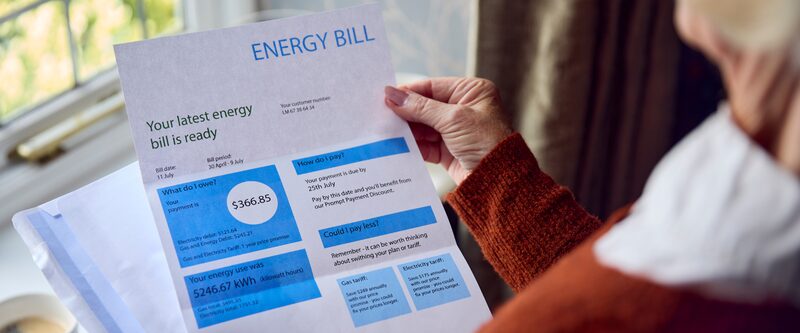
Valid reasons a supplier may give for withholding a refund

Suppliers do not have a free hand. Where a refusal is made, the reason must fit the recognised categories, and a household can test the reason against them.
The exemptions in regulation 6D are the formal ones: an ongoing formal dispute about the amount of the credit balance due or the method of refund; an inaccurate postal address supplied for a cheque refund; or a delay caused by events outside the supplier's control10. A supplier citing "company policy" or an internal review is not citing any of these.
A second category is a genuine dispute about the size of the balance. If the supplier believes the account was billed incorrectly, the amount due may be in question, which is the first exemption. The back-billing rule limits how far that argument can run: charges for usage from more than 12 months ago, where the supplier is at fault, cannot be levied6.
A third category is partial refunds. A household can claim all or part of its credit balance, so a supplier may return some and hold the rest1. Where only part is withheld, the same requirement applies: a valid reason must be given for the portion retained.
How to challenge the refusal: complaint steps and escalation
The route runs from the supplier to the Ombudsman, and the first step is a formal complaint to the supplier. Ofgem lists the problems that belong in that complaint, including late, incorrect or missing bills, back billing, being overcharged, a faulty meter, poor customer service, and refusing to refund credit from your account12. A refused credit refund is expressly one of them.
The escalation trigger is time or deadlock. A complaint can go to the Energy Ombudsman if a reported problem is not fixed within 8 weeks, if the household and the energy company cannot agree how to fix it, if a deadlock letter is received, or if the decision received is not satisfactory13. A deadlock letter states that the problem cannot be fixed or that the company believes there is no more it can do13.
Once a case is escalated, the Ombudsman asks for information and evidence, reviews the evidence from both sides, informs the household of its decision within 6 weeks, and gives the energy company a set of actions to resolve the problem7. The outcomes available include financial compensation, an apology, agreeing to fix the problem, a refund, or an affordable payment plan7.
There is also a facilitated complaints resolution stage. If an offer is made and not accepted, or the company makes no offer, the dispute moves on to a full investigation as normal and the Ombudsman will consider it14. That means a household does not lose its case by declining an early offer.

Taking your case to the Energy Ombudsman
The Ombudsman is the point at which a supplier's refusal can be overturned by an outside body. Where a supplier refuses to cooperate and will not return money that is owed, the issue can be taken to the Energy Ombudsman, which may decide to take the case on4. The Ombudsman can tell suppliers to take practical action, such as crediting or cancelling an account or changing a tariff, to make an apology, or to offer a financial award, or a combination of these, and may make recommendations to prevent the issue happening again15.
The Ombudsman's powers are set out plainly: it can tell an energy supplier to look at a complaint again, look at the complaint and say whether the decision about it is right, make the supplier give a decision about the complaint, and tell the supplier to pay financial compensation if it thinks that is right16. That is a wider set of remedies than a simple refund, and it can address the handling of the complaint as well as the money.
Two limits matter. The Ombudsman will not consider disputes against a supplier that has ceased trading, because the supplier will not be able to respond17. Where a supplier has failed, the credit balance sits with the administrator, and the position for domestic customers differs from that for businesses: businesses could potentially lose their credit balance and not receive a refund from the administrator18. A household whose supplier has gone out of business should not expect the Ombudsman route to recover the balance.
The Ombudsman also refuses cases it regards as vexatious. It will refuse to accept a case if it is apparent that the consumer is pursuing a dispute without merit and intends to cause inconvenience, harassment or expense to the supplier19. A well-evidenced credit complaint is not that.

Where to get free help: Citizens Advice and the Extra Help Unit
Free, independent help exists at each stage, and it is worth knowing which body covers which nation. Citizens Advice offers information and support on a range of topics, including struggling to pay bills, problems with an energy supplier or supply, saving energy at home, and getting a better energy deal20. Its consumer service is free for people in England or Wales with problems with energy bills or supply7.
The consumer helpline can help where support is wanted about how to complain to an energy supplier16. Lines are open Monday to Friday, 9am to 5pm8. The number is 0808 223 1133, with a textphone option of 18001 followed by the helpline number21. A Welsh language line is available on 0808 223 114422. Citizens Advice is the official source of free and independent energy advice for England and Wales, and can refer a household to the Extra Help Unit, which raises complaints with energy suppliers on a consumer's behalf where there is a risk of disconnection or complex personal circumstances23.
For households in vulnerable circumstances, the consumer service may refer a case to the Extra Help Unit if support is needed with a difficult or urgent complaint, if the household cannot deal with its supplier alone because of personal circumstances, if it is considered vulnerable, or if it is at risk of being disconnected from an energy supply7. The Extra Help Unit supports vulnerable consumers by raising complaints with energy suppliers on their behalf, particularly where there is a risk of disconnection or complex personal circumstances24. It works by referral25.
Coverage differs by nation. Citizens Advice covers England and Wales22. In Northern Ireland, the Consumer Council NI and Northern Ireland Energy Advice give free, independent and impartial energy advice to all domestic householders23, and NI Energy Advice offers referrals to energy grants and other sources of help26. Suppliers in Northern Ireland are expected to refer customers who are struggling to pay bills to organisations such as Advice NI, which offer free, independent debt advice27. National Energy Action's Energy Advice and Support Service is a free service28.
Sources28 cited
- How your electricity or gas bill is calculated, Ofgem, 2026
- Understand your electricity and gas bills, Ofgem, 2026
- Energy refunds, Uswitch, 2025-10-29
- What happens to credit if I switch, Uswitch, 2026-05-29
- Getting the best energy deal, Age UK, 2026-09-10
- How to complain about your electricity, gas or energy bill, Which?, 2026-07-30
- Complain about your energy supplier or network operator, Ofgem, 2026
- If you need more help about a consumer issue, Citizens Advice, 2026-09-17
- Customer credit balance explanatory note, Ofgem, 2024-03
- The Electricity and Gas (Standards of Performance) (Suppliers) Regulations 2015, legislation.gov.uk, 2015-07-11
- Switching energy supplier if you owe money, Citizens Advice, 2023-09-21
- Complain about your energy supplier, Ofgem, 2026
- Complain about your energy supplier or network operator, Ofgem, 2026
- Facilitated complaints resolution, Energy Ombudsman, 2026-09-20
- What to expect, Energy Ombudsman, 2026-09-19
- Complaints process easy read, Smart Energy GB, 2026-03-16
- Supplier of last resort information, Energy Ombudsman, 2026-09-20
- What happens if your energy supplier goes out of business, Ofgem, 2026
- FAQs, Energy Ombudsman, 2026-09-19
- Getting help if you can't afford your energy bills, Ofgem, 2026-09-17
- Energy terms explained, Ofgem, 2026
- Consumer protection rights, GOV.UK, 2026-09-17
- Low carbon heating, nidirect, 2026-09-17
- Worried about your energy bills, Energy Ombudsman, 2026-03-24
- Heat networks consumer protection guidance decision, Ofgem, 2026-01-13
- Heating technologies to suit your home, nidirect, 2026-09-17
- Advice if you're struggling to pay your energy bills, nidirect, 2026-09-17
- Energy webchat, National Energy Action, 2026-06-17
 Complaining About a SupplierHow do you complain about your energy supplier, and how long should it take?
 Energy Debt Repayment PlansOwe money to your energy supplier?
 Energy Complaints and RedressMaps the routes a householder has when an energy supplier, network operator, broker or heat network gets something wrong, which body handles which dispute, and what the Energy Ombudsman can and cannot do.
 Scams and Mis-SellingHow energy supplier scams present, what the doorstep and phone selling rules require, the redress available when a contract was mis-sold, and how the Energy Ombudsman handles a dispute.
 Complain About Energy SupplierThe order of a complaint: the supplier's own procedure, the eight-week point or deadlock, and referral to the Energy Ombudsman in Great Britain or the Consumer Council in Northern Ireland.
 Final Bills and Credit RefundsHow final bills and credit refunds work when you leave an energy supplier: the six-week deadline for the final bill, the ten-working-day deadline for refunding credit, the twelve-month back billing limit, and the automatic compensation that applies when suppliers miss these standards.