

In this guide
When a British energy supplier stops trading, its customers are not cut off and are not left to find a new supplier themselves. Ofgem runs a process called Supplier of Last Resort, or SoLR: it appoints another licensed supplier to take on the failed company's customer book so that, in the regulator's words, consumers of the failed supplier have a continuous supply of gas and electricity1. Ofgem describes the aim as ensuring continuity of supply for those consumers and preventing broader harm to the industry2. The household does nothing. Ofgem states plainly that if a supplier goes out of business because of financial problems, electricity and gas will still be supplied to the home or business, and the supply will not be cut off3.
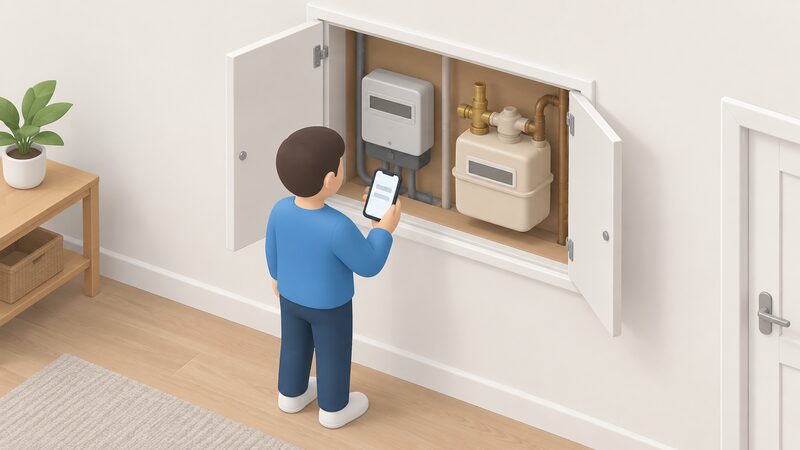
The replacement is chosen through a bidding process in which energy companies bid to take on the new customers, and Ofgem says this can take up to 14 days3. During that window the supply continues, the meter keeps recording, and the sensible step is to take a meter reading as soon as possible and keep a record of it so the new supplier bills correctly3. Credit balances are protected by the rules Ofgem sets, and the new supplier makes contact about a refund3. What does not survive is the old deal: the tariff the failed supplier sold is gone, and the new supplier places customers on its own terms.
The process has real edges. It applies to gas and electricity suppliers to residential users in the UK, excluding Northern Ireland, and it does not apply to heat networks or to the Green Deal1. It does not rescue an unresolved complaint against the company that failed. And its costs are not absorbed by the industry: customer credit balances are protected when a supplier fails, but those costs can be recovered from all consumers4.
What the Supplier of Last Resort process is and why it exists
A domestic gas or electricity supply cannot simply stop when the company selling it runs out of money. Meters keep running, homes keep drawing power, and the network operators keep delivering. The SoLR mechanism exists to attach those live supply points to a solvent licensed supplier before anyone notices a gap. Ofgem's own framing is that consumers are protected by the process to ensure continuity of supply for those consumers, and to prevent broader harm to the industry2. The second half of that sentence matters: a disorderly failure would leave unpaid network charges, orphaned meter points and settlement chaos, so the process is as much about market stability as about individual households.
Ofgem maintains published guidance on the current arrangements, filed under consumer protection5. The Energy Ombudsman describes the same mechanism from the consumer side: when an energy supplier ceases trading, to prevent a drop in service to customers Ofgem will appoint another supplier to provide their energy supply6.
The scale of the mechanism's use has been uneven. Ofgem's Supplier of Last Resort costs surged in 2021 and 2022 before tailing off7. Figures for how many customers were transferred in that period are not consistent across the record: one official account puts it at approximately 2.4 million customers since July 2021, another at 2.4 million customers of 28 failed suppliers, and the two are not reconciled here. What is clear is that the process was designed for occasional single failures and was then used at volume during a period of acute wholesale price stress.
For a household thinking about energy independence, SoLR is a reminder of where dependence actually sits. The physical supply depends on networks, not on the retailer. The billing relationship, the tariff, the credit balance and the complaint history all depend on a private company that can fail. The regulator's safety net catches the supply; it catches the money only partly, and the goodwill not at all.
Your supply continues: what happens the day your supplier fails
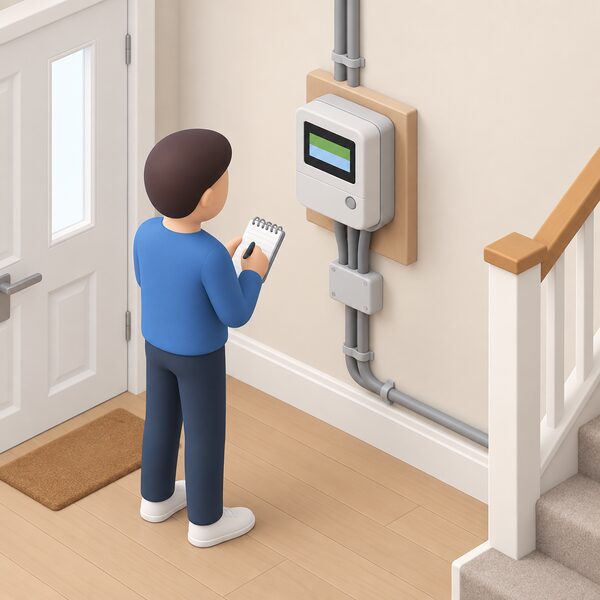
Nothing visible changes in the home. Ofgem's instruction to affected customers is that they do not need to do anything, because the regulator will choose a new supplier for them3. The same point appears in Ofgem's switching guidance: customers do not need to do anything if the current supplier goes out of business, the account is automatically moved to a new supplier, and Ofgem makes sure the energy supply is not interrupted8.
Practical continuity during the gap looks like this:
- Gas and electricity keep flowing to the property; there is no disconnection step in the process3.
- Direct Debits and top-ups relating to the failed company are in limbo until the new supplier makes contact, so a meter reading taken now becomes the reference point for the opening bill3.
- A switch already under way is not cancelled. Ofgem states that if a customer was already in the process of switching, they will still move to the supplier they chose3.
- A complaint already lodged does not automatically transfer, though the new supplier will review the complaint and check it is still relevant or whether it can be closed3.
Smart meters do not change the underlying position, though they can smooth the handover. Energy suppliers must take all reasonable steps to ensure that smart meters automatically send them gas and electricity meter readings10. Where a meter is not communicating, suppliers should promptly investigate suspected or identified issues, resolve them themselves or with third parties, and keep the consumer informed11. A household with a dumb meter, or a smart meter that has lost communication, carries more of the burden of evidencing its own consumption across the transfer.
How Ofgem picks the new supplier, and how long the transfer takes
Ofgem chooses the new supplier through a bidding process, where energy companies bid to take on new customers3. It is a competitive appointment rather than a rota, and the losing consideration is capability rather than price alone. Ofgem's stated selection criteria cover the type of energy originally supplied and who it was supplied to, and a bidder's ability to supply new customers without affecting existing customers, to arrange extra energy sources and to take on new customers. Companies will only be chosen if they can supply energy to the new customers without affecting existing customers3.
That last condition is the important one. A supplier inheriting several hundred thousand meter points has to buy the energy those homes will use, often at short notice and at whatever the wholesale market is charging that week, and must absorb the administrative load without degrading service to the customers it already has. It is the reason appointments during 2021 and 2022 concentrated among larger balance sheets, and the reason the appointed supplier's opening tariff is rarely a bargain.
Ofgem says the appointment could take up to 14 days3. In practice the sequence a household experiences runs:
- The failing supplier ceases trading and Ofgem confirms the SoLR process has begun.
- Ofgem runs the bidding process and names the appointed supplier.
- The appointed supplier contacts customers, usually by email or letter, and sets out the tariff and account arrangements.
- Meter readings are provided and opening balances, including any protected credit, are established.
- The customer decides whether to stay or to switch away.
Between steps one and three there is no one to phone about the old account. That is the weakest point in the process for anyone with a live billing dispute or an urgent payment problem.
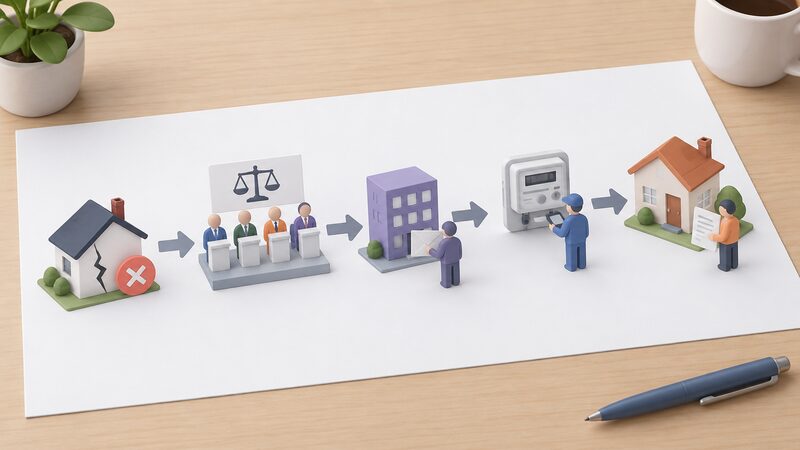
Your tariff after the transfer: fixed deals end and bills can change
The tariff sold by a company that no longer exists cannot be honoured by a company that did not sell it. Customers moved under SoLR arrive on terms set by the appointed supplier, and where a household had been sitting on a cheap fixed rate, the new rate can be materially higher. This is not a penalty: it reflects that the new supplier must buy energy for those homes at current wholesale prices, which is precisely the constraint written into Ofgem's selection criteria3.
There is a compensating protection. Ofgem states that where a supply is transferred under an energy supply administration order, a customer can switch to another supplier if they want to without any exit fees3. That matters because exit fees are otherwise a real feature of fixed deals: Ofgem notes a customer may have to pay a previous supplier an exit fee if they were on a fixed rate tariff and chose to leave before it ended8. Consumer understanding of exit fees is patchy, with Ofgem research finding 57% net correctly identifying that exit fees may still apply to a fixed contract even when moving to another deal with the same supplier12.
The Energy Ombudsman also looks at the rate a transferred customer ends up on. Its guidance says it will consider whether it was appropriate for a supplier to place a customer on a deemed rate contract, or whether supplier error or omission left the customer on high deemed contract prices for longer than necessary13. A household that is placed on an expensive default and then finds the appointed supplier slow to move it onto a proper tariff has a route to challenge that, and deemed contract rates are the relevant reference point.
Tenants are not excluded from acting. Where the occupier pays the energy bills, Ofgem states they can choose to switch supplier or tariff at any time8, a point covered further in energy supply in rented homes.
Credit balances, debts and prepayment meters: what transfers and what does not
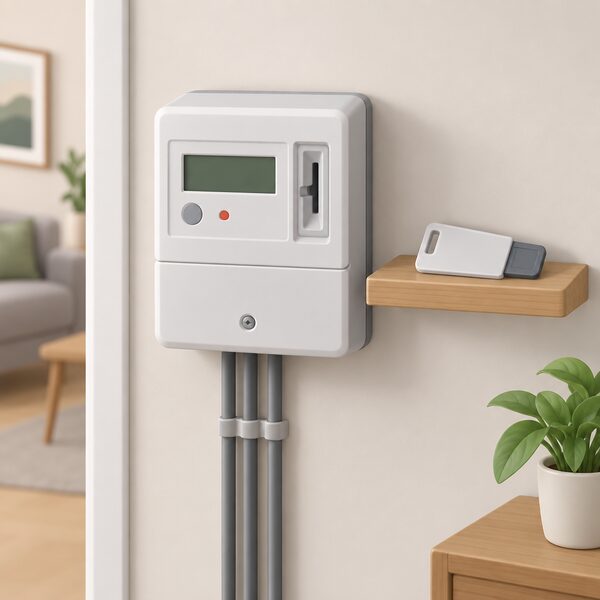
Credit is the money most households worry about. Ofgem's position is that if a supplier goes out of business, the credit balance is still protected by the rules it sets, and the new supplier will make contact about a refund3. The Energy Ombudsman adds the historical record: in the past, all Suppliers of Last Resort have committed to honouring the credit balances of customers who were owed money by the former supplier1. That is a description of past behaviour rather than a guarantee for the future, and it should be read as such.
Debt travels differently. Ofgem states that if the new supplier transfers customer debts from the old supplier, the household will need to pay them for the debt instead3. Where debts are not transferred, they remain with the failed company's administration. In an ordinary switch, the mechanics are gentler: where a customer owes money to the old supplier and has been in debt to them for less than 28 days, any money owed should be added to the final bill8, and prepayment customers can switch while owing up to £5008. The wider mechanics are set out under switching with prepayment debt.
| Element | What happens on supplier failure | Source |
|---|---|---|
| Physical supply | Continues; not cut off3 | Ofgem |
| Credit balance | Protected by Ofgem's rules; new supplier contacts about refund3 | Ofgem |
| Customer debt | Paid to the new supplier if transferred3 | Ofgem |
| Fixed tariff | Ends; new supplier sets terms | Ofgem3 |
| Exit fees on leaving | None under an energy supply administration order3 | Ofgem |
| Outstanding complaint | New supplier reviews whether it is still relevant3 | Ofgem |
Prepayment households have their own concerns. Emergency or support credit taken from a meter is a loan, not a gift: Ofgem states that any credit received must be paid back at the next top-up, and the supplier must work with the customer to agree an affordable payment plan14. Separately, where a supplier installs a prepayment meter without permission or remotely switches an existing meter to prepayment mode, it must give the customer £30 credit once it has done so, and Ofgem is explicit that such installation should always be a last resort15. On ordinary switching, credit is refunded in the final bill and compensation may be due if it is not16; see final bills and credit refunds.
What the process costs, and who ends up paying
The SoLR mechanism is not free, and it is not funded by the failed company, which by definition has run out of money. Ofgem's own explanatory note is unambiguous: customer credit balances are protected when a supplier fails, but these costs can be recovered from all consumers4. The appointed supplier meets the immediate cost of honouring balances and buying energy for the inherited customers, then claims those costs back through an industry mechanism, and the recovery lands on bills across the market. Households that never held an account with the failed supplier still contribute.
The scale of that recovery varied sharply with the market. Ofgem's Supplier of Last Resort costs surged in 2021 and 2022 before tailing off7. The pattern follows wholesale prices: when the cost of replacing a failed supplier's hedge is high, the claim is large, and when prices are stable, appointments are cheaper to absorb.
The principle of spreading an industry cost across licensed suppliers is familiar from other schemes. The Feed-in Tariff uses a levelisation process, which Ofgem describes as the mechanism by which the cost of the FIT scheme is apportioned across licensed electricity suppliers17. SoLR recovery works on the same logic of socialising a cost the market cannot leave stranded.
For a household, the consequence is worth stating plainly. The protection of credit balances is real, but it is mutual insurance funded by energy bills rather than a guarantee funded by the industry's shareholders. Reducing exposure to that cost is one of the arguments made for household energy independence, though no household escapes it entirely while it remains connected to the grid and buying from a licensed supplier.
What to do first: meter readings and the steps that protect you
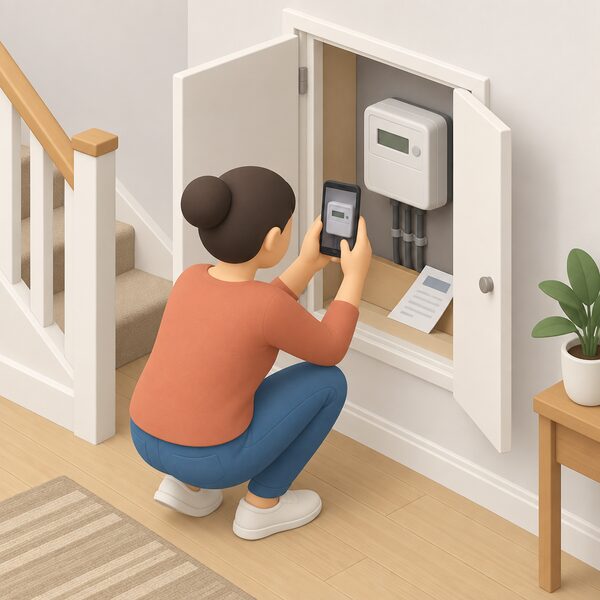
The single most useful action is evidential. Ofgem's guidance says a meter reading should be taken as soon as possible, and a record kept of it, to make sure billing by the new supplier is correct3. That reading becomes the boundary between two accounts: everything before it belongs to the administration of the failed company, everything after it to the appointed supplier. Without it, the opening balance is an estimate that may be difficult to unpick months later.
A short sequence covers the rest:
- Take and photograph a meter reading, dated, for each fuel3.
- Keep bills, statements and any correspondence showing the credit balance or debt with the failed supplier.
- Wait for the appointed supplier to make contact rather than switching immediately9.
- Check the tariff and the opening balance when contact is made, and query anything that does not match the reading taken.
- Decide whether to stay or move, knowing there are no exit fees on leaving a supply transferred under an energy supply administration order3.
Households already struggling with payments should not assume the transfer resets their arrangements. Ofgem lists the support suppliers can offer as including agreeing a payment plan, a payment break or a reduction18. An Ombudsman case study illustrates what happens when that support is not reviewed: a consumer with an agreed 12-month debt payment plan whose circumstances changed found the supplier had missed opportunities to review whether the payment plan remained suitable, and the supplier was required to reconsider what the consumer was being asked to pay, offer alternative cheaper tariffs and energy efficiency advice, apologise and make a time and trouble award19. Further detail sits under supplier support for vulnerable customers.
The Warm Home Discount does not fall away with the failed supplier. The scheme obligates participating suppliers to provide rebates to eligible low-income households20, it covers England, Scotland and Wales, and it runs until 31 March 203121. The Warm Home Discount (England and Wales) Regulations 2026 provide for a supplier of last resort to notify a failed supplier's non-core spending obligation on or before 15 February in a scheme year22. Practical eligibility questions are covered under the Warm Home Discount and suppliers.
Where the process falls short: gaps, complaints and exclusions
The gap that consumer bodies press hardest on is disputes. The Energy Ombudsman's position is that when suppliers leave the market through the Supplier of Last Resort process, consumers with outstanding disputes lose out, because there is no obligation on the new supplier to fulfil the obligations23. The Ombudsman states the same thing in its own guidance: the SoLR does not have an obligation to take on complaints about the supplier in administration, as it was not involved in the original issue1. And once a company ceases trading, no new cases can be opened against it, though prior disputes are sometimes upheld by the new nominated supplier6.
"The SoLR does not have an obligation to take on complaints about the supplier in administration as it was not involved in the original issue."
That leaves a household whose complaint was about overcharging, a faulty meter or a refused refund with no counterparty. Ofgem lists the usual complaint grounds as late, incorrect or missing bills, back billing, being overcharged, a faulty meter, poor customer service, and refusing to refund credit from an account24. Where the company behind such a complaint no longer exists, the remaining route is through the administration, not through the regulator's transfer.
Complaints about the new supplier are a different matter and do work normally. A complaint must be raised with the supplier first, following the company's formal dispute process, which the supplier should have and which can usually be found on its website25. If the issue is not resolved after eight weeks, or a deadlock letter is issued, the Ombudsman can take the case free of charge26. Ofgem lists the triggers as a reported problem not fixed within eight weeks, an inability to agree how to fix it, a deadlock letter, or dissatisfaction with the decision received27. The Ombudsman can require a supplier to put things right25, and its outcomes include practical action such as crediting or cancelling an account or changing a tariff, an apology, a financial award, or a combination, together with recommendations to prevent recurrence28. The route is set out in full under complaining about an energy supplier and the Energy Ombudsman.
Complaint handling in the sector has itself been found wanting. Ofgem's market compliance review, concluded in February 2023, identified long call wait times, high call drop rates, slow written responses, weaknesses in complaint processes, incomplete management information, weaknesses in agent training and quality control, and high rates of complaints upheld by the Ombudsman, suggesting poor initial complaints resolution29. Ofgem's consumer panel work records the plain expectation households hold: that their supplier will help them if they need support30.
Excluded sectors and the Northern Ireland position
Heat network customers have no equivalent safety net and no exit. Heat networks are natural monopolies where one entity is the supplier for all homes and businesses on the network, which means consumers cannot switch suppliers or move to a different tariff unlike gas and electricity consumers31. Since 1 April 2025 all heat network suppliers are bound by the Ombudsman's scheme rules and required to be members of the scheme6, which gives a complaints route even though it gives no supply-transfer route. Where the supplier is also the landlord they should follow both the authorisation conditions and relevant housing legislation32. That is the sharpest contrast with the gas and electricity regime: a Supplier of Last Resort transfer moves a household to a new supplier and a new tariff, with no exit fees, even if the bill rises2, whereas a heat customer stays put. More detail sits under heat network suppliers.
Northern Ireland runs a separate retail market. The standard SoLR approach applies to gas and electricity suppliers to residential users in the UK, excluding Northern Ireland1. Electricity supply disputes there run through their own legislation: following determination by a person appointed by the Department, the distributor shall maintain, connect, restore or may disconnect the supply as appropriate, subject to conditions stipulated in the determination33. Northern Ireland also sat outside the Energy Price Guarantee, where prices were not capped and suppliers have the flexibility to set their tariffs independently to reflect their costs of operating34. The market is described under energy suppliers in Northern Ireland.
Switching away from the appointed supplier, and what happens mid-switch
Nobody is trapped. Where a supply has been transferred under an energy supply administration order, Ofgem states the customer can switch to another supplier if they want to without any exit fees3. The trade-off is timing. Switching before the appointed supplier has established the account risks an unclear opening balance and a credit refund that nobody has yet calculated, which is why Ofgem's advice in past failures has been to wait until a new supplier has been appointed and has made contact9.
A switch already in progress when the supplier fails is not disturbed: the customer will still move to the supplier they chose3. That is the cleanest outcome available, because the destination supplier is one the household selected on its own terms rather than one appointed by a bidding process.
Once settled with the appointed supplier, the ordinary switching protections apply again: credit refunded in the final bill, with compensation possible if it is not16; debt under 28 days old added to the final bill rather than blocking the move8; prepayment customers able to move while owing up to £5008. General switching guidance is covered under the Energy Switch Guarantee and the wider retail market under UK energy suppliers.
What SoLR ultimately secures is the physical supply and, in practice so far, the credit balance. It does not secure the price, the complaint, the goodwill or the scheme relationship built up with a supplier that no longer exists, and it socialises its own cost across every bill in the market. The dependence a household carries is on Ofgem's process and on the solvency of whichever company wins the bid, not on the company whose name is on the bill today.
Sources34 cited
- Supplier of Last Resort information, Energy Ombudsman, 2026-09-20
- Open letter on standard licence condition 21BA, Ofgem, 2020-05-07
- What happens if your energy supplier goes out of business, Ofgem, 2026
- Customer credit balance explanatory note, Ofgem, 2024-03
- Supplier of Last Resort guidance on current arrangements, Ofgem
- Energy Ombudsman FAQs, Energy Ombudsman, 2026-09-19
- Ofgem call for input on standing charges: Welsh Government response, Welsh Government, 2024-02-15
- Switch your home energy supplier, Ofgem, 2026
- Toto Energy collapses: advice for affected customers, Energy Ombudsman, 2019-10-24
- Smart meter performance, Ofgem, 2026
- Smart meters: your rights and expectations, GOV.UK, 2025-08-08
- Understanding consumers' energy tariff choices: research report 2024, Ofgem, 2025-07
- Deemed contracts and rates, Energy Ombudsman, 2026-09-20
- Get help with your prepayment meter, Ofgem, 2026
- Check if energy suppliers can install prepayment meters without household permission, Ofgem, 2026
- Check if you are owed money on your energy bill, Ofgem, 2026
- FIT guidance for licensed electricity suppliers, Ofgem, 2024-09-06
- Getting help if you cannot afford your energy bills, Ofgem, 2026-09-17
- Case study: debt and payment, Energy Ombudsman, 2026-09-20
- Warm Home Discount eligibility statement, England and Wales 2026 to 2027, GOV.UK, 2026-09-17
- Warm Home Discount, Ofgem, 2026-09-17
- The Warm Home Discount (England and Wales) Regulations 2026, legislation.gov.uk, 2026-03-27
- Review of Ofgem call for evidence, Energy Ombudsman, 2025-02-28
- Complain about your energy supplier, Ofgem, 2026
- Understanding your rights, Energy Ombudsman, 2026-09-20
- Worried about your energy bills, Energy Ombudsman, 2026-03-24
- Complain about your energy supplier or network operator, Ofgem, 2026
- What to expect, Energy Ombudsman, 2026-09-19
- Ofgem completes review of suppliers' customer service and complaints handling, Ofgem, 2023-02-02
- Consumer First Panel: affordability and supplier support, Ofgem, 2022-09-27
- Heat networks consumer protections draft guidance, Ofgem, 2025-09-05
- Heat networks policy guidance and resources, Ofgem, 2026-09-17
- Electricity (Northern Ireland) regulations, Article 27, legislation.gov.uk, 2026-09-17
- Energy Price Guarantee up until 30 June 2023, GOV.UK, 2026-09-17
 Supplier Licensing and FailureWhat happens when your energy supplier goes bust?
 Financial Resilience RulesYour supplier going bust raises two questions: who takes over and what happens to your credit balance?
 Switching and Supplier MarketWhat is the Ofgem price cap and does it limit what you actually pay?
 Tariff Rules and ProtectionsOfgem decides which energy tariffs suppliers can offer you, so it's worth knowing what they must provide.
 Switching SupplierHow long does switching energy supplier actually take, and what happens if you owe money?
 Green Energy TariffsDoes a green tariff really mean greener electricity comes into your home, or just that your supplier buys renewable certificates to match what you use?