

In this answer
Short answer
The short answer is that you can switch immediately. There is no notice period, no waiting time and no exit fee after your supplier fails. Ofgem states plainly that you can switch to another supplier if you want to without any exit fees1, and independent guidance says the same: if you are not happy with your new supplier or tariff, you can switch without paying an exit fee2.
What happens first is automatic. Ofgem moves you to a new supplier, referred to as the supplier of last resort, and your gas and electricity keep flowing throughout. Ofgem states that if your supplier goes out of business because of financial problems, you will still have electricity and gas supplied to your home, and your supply will not be cut off1. You do not need to do anything to keep the lights on.
The practical sequence is: your supplier fails, Ofgem appoints a replacement within a few weeks, you are placed on that supplier's standard variable tariff, and from that point you are free to move again whenever you choose. The switch itself takes up to five working days once it starts3.
Your supply continues and nothing is switched off
The first thing households want to know when a supplier collapses is whether the lights stay on. They do. Ofgem's guidance is unambiguous: if your energy supplier goes out of business because of financial problems, you will still have electricity and gas supplied to your home or business, and your energy supply will not be cut off1. Independent guidance repeats the point, stating that supply will not be cut off at any point when a supplier goes out of business4.
This protection is structural rather than discretionary. Your meter, your network connection and your physical supply are not owned or operated by the retail supplier that bills you, so the failure of a billing company does not interrupt the flow of gas or electricity. What changes is who sends the bill.
There is a separate protection for households in debt. Ofgem's rules for consumers in vulnerable circumstances state that if you are in debt but actively engaging with your electricity or gas supplier to manage your energy bill, then you will not be disconnected from your electricity or gas supply6. That applies to the supplier you are with at the time, including a supplier of last resort.
The Energy Switch Guarantee, the industry commitment signed by a group of suppliers, adds that your gas or electricity supplies are not shut off at any point during your switch7. So the transition from a failed supplier to a new one, and any subsequent switch you make yourself, carries no risk to continuity of supply.
For a household thinking about energy independence, this is the reassuring part: the physical supply is not something a supplier failure can take away. The dependence that remains is commercial, not physical. You still rely on a billing supplier, on the grid, and on the wholesale market that sets the price of what you use.
Supplier of last resort: how Ofgem moves you within days
When a supplier ceases trading, Ofgem appoints another supplier to provide the failed supplier's customers with energy, a role known as the supplier of last resort8. The appointment is made as quickly as possible, and the supplier is vetted before it takes on the customers4.
The mechanism works like this. Ofgem approaches suppliers and asks whether any will volunteer to accept the customers of the failed company. If no supplier volunteers, Ofgem appoints the supplier it deems best suited4. In law, a supplier of last resort is a compulsory scheme electricity supplier given a last resort supply direction by the Authority to take over supply to another person's domestic customers9.
The timescale households should expect is a few weeks rather than hours. Independent guidance states that the regulator Ofgem will automatically move you to a new supplier within a few weeks2. During that window your supply continues and your account is administered, but the identity of your new supplier may not yet be confirmed.
There is one edge case worth knowing. If both your old supplier and the supplier you were moving to fail while a switch is in progress, the rule depends on timing: if the switch had been completed, you would be transferred to the supplier of last resort for the supplier you had decided to switch to; if it had not, you go to the supplier of last resort for the supplier you were leaving4.
Northern Ireland runs a separate market with its own arrangements, and the supplier of last resort concept as described here is a Great Britain framework. Households there should look to the Utility Regulator rather than Ofgem.
What happens to your tariff, prices and credit balance
Your fixed rate contract ends at the moment you are moved onto the supplier of last resort. You are placed on that supplier's standard variable tariff, with no early exit fee4. This is the same destination as any household rolling off a fixed deal in ordinary circumstances: customers rolling off a fixed tariff are usually rolled onto their supplier's standard variable tariff11, and suppliers will probably move you to their standard variable tariff when a fixed plan ends12.
The consequence is a price change, and usually an increase. A standard variable tariff is not a fixed price, so the rate you pay can move with the market. One worked example in bill guidance notes that a customer would be rolled onto the supplier's standard variable tariff after the tariff end date, which would probably cost them more13.
Your credit balance is protected. Ofgem states that if your supplier goes out of business, your credit balance is still protected by the rules it sets, and the new supplier will contact you about a refund1. More generally, when you switch to a new supplier, your old supplier will refund any credit in your final bill, and you could get compensation if they do not14.
| What changes | What happens |
|---|---|
| Fixed contract | Ends when you move to the supplier of last resort4 |
| Tariff you land on | The new supplier's standard variable tariff4 |
| Exit fee to leave again | None1 |
| Credit balance | Protected, refunded via the new supplier1 |
| Supply | Continues without interruption1 |
When you can switch: no notice, no exit fees, no waiting

There is no waiting period. You do not have to accept the supplier Ofgem appoints, and you do not have to wait for that supplier to contact you first. Ofgem's position is that you can switch to another supplier if you want to without any exit fees1, and independent guidance confirms that if you are not happy with your new supplier or tariff, you can switch without paying an exit fee2.
This sits alongside the ordinary rule for fixed deals. Ofgem has ruled that your energy supplier cannot charge you any exit fees if you switch within the last 49 days of your contract5, a window described elsewhere as 49 days, or seven weeks5, and as the final 49 days during which you can switch without paying any exit fees16. Ofgem research found that of consumers who thought they had an exit fee on their current contract, 93% were on a no exit fee deal18.
After a supplier failure, the fee is waived outright rather than for a window, because you have been moved onto a variable tariff rather than a fixed one. The Energy Switch Guarantee adds that the whole transfer between tariffs or suppliers will be handled by the supplier of the tariff you are moving to7, and that if you change your mind within 14 days you can return to your old supplier19.
If you were already in the process of switching when your supplier failed, you will still move to the supplier you chose1. The failure does not cancel a switch in progress.
Switching yourself versus staying with the new supplier
Staying put is a legitimate choice, and it is the default if you do nothing. The supplier of last resort becomes your supplier, you are billed on its standard variable tariff, and your account continues. Nothing further is required.
Switching away is equally straightforward. If you stay with the same supplier but want a different tariff, the switch can be done through your online account or via customer services21. If you want a different supplier entirely, you begin a normal switch, and the transfer is handled by the supplier you are moving to7.
The trade-off is between certainty and price. A standard variable tariff moves with the market, so it can rise as well as fall. A fixed deal gives certainty for its term but locks in a rate. Ofgem's own research on tariff choices is the relevant evidence base here, and it does not point to a single answer for every household.
One practical point about meters: only your current supplier can move your meter, and if you want another supplier to do it you have to switch your supply to them first22. So a meter relocation is not something to arrange with a supplier you are leaving.
For households in rented homes, the right to choose is not affected by tenure. New occupants have the right to choose any supplier they wish and do not have to stay with the current supplier23. If you pay the bills directly, the choice is yours.

What to sort out first: meter readings, your balance and your direct debit
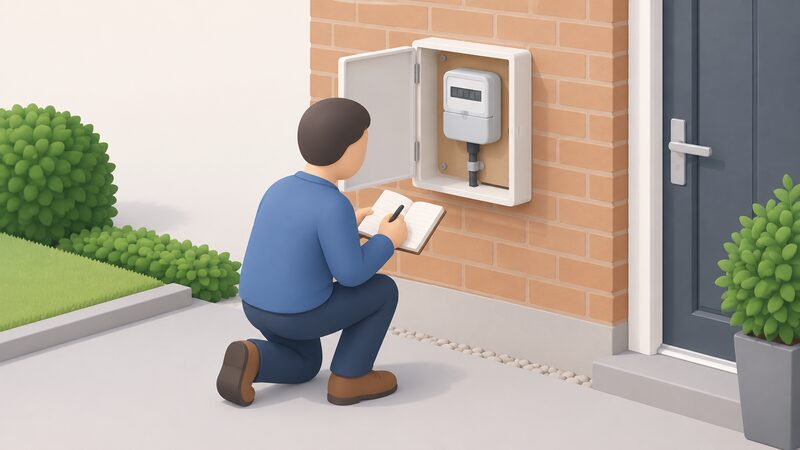
Take a meter reading as soon as you can, and keep a record of it, so that you are billed correctly by the new supplier1. Independent guidance is more specific: take meter readings as soon as you are aware that your supplier has ceased trading, because you will need them for your final bill4. This is the single most useful thing a household can do in the first days.
If you have a smart meter, readings should be sent automatically to your energy supplier24. But after a supplier failure that automatic link may not carry over. Ofgem warns that your meter may not work in smart mode when you move to the new supplier, and you may need to take meter readings manually and submit them to your new supplier instead1. You can switch suppliers if you have a smart meter, but the new supplier might not offer all smart meter services, such as remote meter readings, and the meter may need replacing3. If your smart meter stops working, contact your supplier, which is responsible for maintenance and will fix or replace it as needed25. If you suspect an issue with your smart meter, the supplier should promptly investigate it24.
On your balance and direct debit, the guidance is about notice rather than cancellation. Your supplier should give you reasonable notice of any changes to your direct debit payments, and should explain why the change is necessary26. Cancelling a direct debit does not settle a debt and does not speed up a switch.
If you are on a prepayment meter and owe money, you can still switch in some circumstances: you can switch if you pay by topping up a prepayment meter and you have less than £500 debt for each meter, repaying the new supplier instead27. If you are in debt but actively engaging with your supplier to manage your bill, you will not be disconnected6.
Sources27 cited
- What happens if your energy supplier goes out of business, Ofgem, 2026
- Struggling with energy bills, National Energy Action, 2026-05-06
- Consumer advice: problems with services, Isle of Anglesey County Council, 2025-10
- Energy supplier out of business, Uswitch, 2026-05-29
- How do I avoid exit fees when switching energy, Energy Helpline, 2026-09-20
- Code of Practice for Consumers in Vulnerable Circumstances, Utility Regulator Northern Ireland, 2025
- Energy Switch Guarantee, Energy UK, 2026-07-08
- Energy Ombudsman FAQs, Energy Ombudsman, 2026-09-19
- The Warm Home Discount (Scotland) Regulations 2026, legislation.gov.uk, 2026-04-30
- Your home energy checklist, National Energy Action, 2026-09-10
- Energy tariffs explained, Uswitch, 2026-02-17
- Fixed energy deals, Uswitch, 2026-09-07
- How do I read my OVO Energy bill, Uswitch, 2025-09-10
- Check if you are owed money by your energy bill, Ofgem, 2026
- How your electricity or gas bill is calculated, Ofgem, 2026
- Uswitch gas and electricity, Uswitch, 2026-09-17
- How to complain about your electricity, gas or energy bill, Which?, 2026-07-30
- Understanding consumers' energy tariff choices, Ofgem, 2025-07
- Energy Helpline gas, Energy Helpline, 2026-09-20
- Switch your home energy supplier, Ofgem, 2026
- How to check your energy tariff and switch if you find a better deal, British Gas Energy Trust, 2026-07-30
- Move your gas or electricity meter, Citizens Advice, 2026-09-20
- Moving home checklist, National Energy Action, 2026-06-12
- Smart meters: your rights and expectations, GOV.UK, 2025-08-08
- Smart meters, Welsh Government, 2026
- Your gas or electricity supplier has put up its prices, Citizens Advice, 2026-09-17
- How to switch energy supplier, Which?, 2026-05-15
 Supplier Licensing and FailureWhat happens when your energy supplier goes bust?
 Switching SupplierHow long does switching energy supplier actually take, and what happens if you owe money?
 Financial Resilience RulesYour supplier going bust raises two questions: who takes over and what happens to your credit balance?
 Switching and Supplier MarketWhat is the Ofgem price cap and does it limit what you actually pay?
 Exit Fees and Contract TermsExplains exit fees on fixed energy contracts, how they are charged per fuel, and the Ofgem switching window in which a supplier cannot apply them.
 OfgemOfgem sets the rules energy suppliers and network companies must follow, including the price cap on standard tariffs.