

In this answer
Short answer
When you move into a new home, whoever supplied energy to the previous owners automatically becomes your supplier1. You do not choose them, and you are not asked. The supply continues, the meter keeps turning, and a contract called a deemed contract comes into being the moment you start consuming gas or electricity without agreeing a contract with a supplier2.
That is the short answer to finding out who supplies your electricity: you already have a supplier, and the job is to identify them rather than to appoint one. The fastest route is your local electricity network operator, which holds the connection and can tell you which supplier is registered to the meter1. If you rent, your landlord can tell you who the supplier is3. For gas, the Find My Supplier service returns the Meter Point Reference Number, the gas supplier and the gas transporter4.
Once you know the name, contact that supplier to let them know you have moved in, submit meter readings and take pictures for evidence3. Everything else, from the tariff you are on to whether you switch, follows from that first identification.
Why the supplier of record matters after a move
The supplier of record is the party you owe money to, the party responsible for the meter, and the party whose name appears on the bill that follows you if you do not act. Getting the identification right early avoids a gap in billing that later arrives as a back bill, and it establishes who is responsible for readings.
Your new supplier is responsible for taking a meter reading when you switch, and for all future meter readings at your property after the energy switch takes place8. That matters because the reading at the point of change is what separates the previous occupant's consumption from yours. If you are moving out as well as in, giving your supplier time to transfer your account to your new house, if offered, or to close your account, is the cleanest way to end the old liability1.
The meter itself belongs to the supplier. Your supplier owns your electricity meter, so they are the only company that can move and connect it9. Whether they can move it depends on where the meter is now, how far you want to move it, the type of connector if it is a gas meter, and why you want to move it10. Only your current supplier can move your meter; to use another supplier you must switch your supply to them first10. None of that can be arranged until you know who the supplier is.
There is also a practical reason to identify the supplier quickly: it is the only party that can correct a faulty meter, a wrong bill or a missing account. Contact your energy supplier if you have a problem relating to late, incorrect or missing bills, back billing, being overcharged, a faulty meter, poor customer service, or refusing to refund credit from your account11.
Ways to identify who supplies your new home

There are three reliable routes, and they work in different situations.
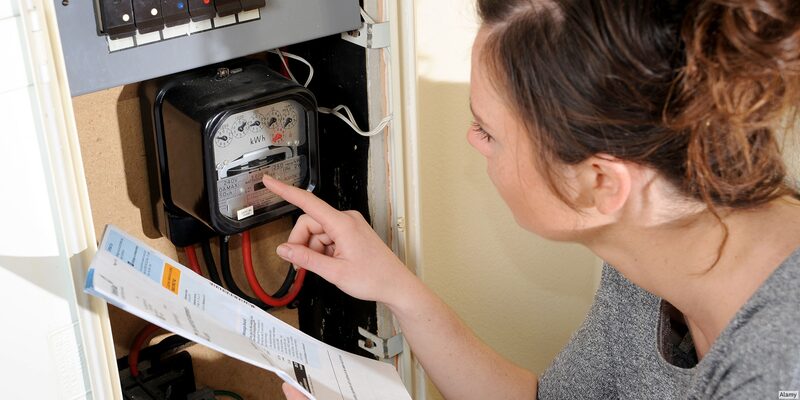
Call the local electricity network operator. You can find your new electricity provider by calling your local network operator1. The network operator is not your supplier and does not bill you for energy, but it holds the connection and the registered supplier details for the meter point. This is the route that works when the property has been empty, when the previous occupant left no paperwork, and when you cannot find a bill.
Ask the landlord, if you rent. You can find out who the supplier is from your landlord3. In a rented house this is usually the quickest answer, and it also establishes who is responsible for the account.
Use the gas supplier lookup for the gas side. The Find My Supplier website returns the Meter Point Reference Number, the gas supplier and the gas transporter4. The Meter Point Reference Number is the identifier you may need when switching supplier or moving home4.
The standard sequence for setting up supply in a new home is: find out who your energy supplier is, contact your supplier to let them know you have moved in, then submit your meter readings and take pictures for evidence3. The same three steps apply to a newly built home: identify your energy supplier, notify your energy supplier that you have moved in, and submit meter readings regularly3.
For a new owner, the wider move-in list is to find out who your supplier is, find your meter and get a reading, look into whether to switch energy suppliers, bleed any radiators, learn how to control the heating, and choose energy efficient appliances12. Identification comes first because the rest depends on it.
Deemed contracts: what you are on until you choose
A deemed contract is normally in place when a customer moves to new premises and starts to consume gas or electricity, or both, without agreeing a contract with a supplier2. It is not a penalty and it is not unusual; it is the default legal position that keeps the lights on while the paperwork catches up.
The tariff attached to it is the supplier's default or standard variable tariff5. Ofgem states that you will be put on an energy contract for 6 months called a deemed contract6. The terms are the supplier's published default terms, and the price is capped by the price cap that applies to default tariffs.
Two protections sit inside the deemed contract arrangement. First, a supplier cannot prevent you from switching to another supplier, for any reason or at any time, and cannot object to you transferring for reasons of debt or contract2. Second, an energy supplier cannot charge domestic or microbusiness consumers for energy used, or for charges more than 12 months old, due to the supplier's error14. That back billing rule matters after a move, when a supplier may not have been told the occupancy changed.
If you want the terms in writing, a copy of a deemed contract must be provided free of charge within a reasonable period of time after receiving the request15.
"a supplier cannot prevent you from switching to another supplier, for any reason or at any time, (i.e. they cannot object to you transferring for reasons of debt or contract)"
The same deemed contract concept applies on heat networks. A deemed contract applies when there is no supply contract or accepted alternative supply contract in place, for example when a consumer has moved into a heat network property and consumes heating, hot water or cooling with no supply contract in place15. Households on a heat network therefore face the same identification question, with the heat supplier rather than an electricity supplier as the counterparty.

What Ofgem does, and does not do, for households
Ofgem is the regulator, not a complaints desk. It does not directly get involved with complaints about energy suppliers or network operators, including heat network suppliers and operators, and does not investigate individual disputes9. More broadly, Ofgem generally does not intervene in individual disputes between consumers and energy businesses, including heat suppliers and operators16.
What Ofgem does is set and enforce the rules, publish guidance, and act when a supplier fails. If your energy supplier goes out of business, the regulator Ofgem will automatically move you to a new supplier within a few weeks17. Ofgem's own wording is that you do not need to do anything if your current supplier goes out of business: it will automatically move you to a new supplier and make sure your energy supply is not interrupted7. If you were already in the process of switching, you will still move to the supplier you chose8.
Ofgem also writes directly to households when a market-wide issue affects them. In one case it began writing to all the households affected, explaining that qualified professionals had started a system of checks18. And it can act against a named supplier: Ofgem issued a Provisional Order to British Gas at the start of a month temporarily banning them from doing any forced installation or remote mode switch19.
For a dispute with your own supplier, the route is the Energy Ombudsman. It provides an independent service, separate to Ofgem, if you are having problems with an energy supplier, an energy broker, a network operator or a heat network supplier10. It is approved by Ofgem, the UK energy regulator, to handle service disputes in the energy sector11.
Payment plans and what suppliers cannot force on you
Moving house often coincides with a tight month, and the rules on what a supplier can do are specific.
If you are struggling to pay for energy or think you may get into difficulty, you can ask your supplier to agree a payment plan, a payment break or reduction, review payments and debt repayments, and give access to hardship funds12. Those are things you can request; the supplier's obligation is set out in the prepayment rules.
Energy suppliers cannot force you to switch to a prepay meter, or remotely switch you, unless they have taken all reasonable steps to agree a repayment plan with you13. That is the key limit. A forced prepayment installation is not available to a supplier as a first response to arrears.
There are also limits that run the other way, depending on tenure. If your landlord pays the energy supplier for you, you cannot switch energy supplier or tariff yourself20. If your landlord pays the energy company themselves, they will choose the energy supplier, and you can ask them to change supplier but they do not have to21. Residents on a landlord's business contract may not have the right to choose their own energy supplier or switch suppliers themselves13.
| Situation | Who chooses the supplier | Can the household switch? |
|---|---|---|
| You pay the supplier directly | You | Yes, at any time7 |
| Landlord pays the supplier | The landlord | No, but you can ask them to change21 |
| Home on a business contract | The contract holder | May not have the right to choose or switch13 |
If you pay a supplier directly for the electricity or gas you use at home, you can choose to switch to a different supplier or tariff at any time7. That is the dividing line: direct payer, full switching rights; landlord pays, no switching rights of your own.
Once you know: tariffs, the price cap and switching
When you move, you are automatically switched to the new property's supplier, and it is likely your tariff will change22. If you break your contract at the old address, you will automatically go onto a standard variable tariff in your new home5. Your old supplier might let you keep the same contract and tariff at your new home without charging you a fee5, but that is at the supplier's discretion.
Ofgem lists three main types of tariffs: fixed rate, standard variable tariff and multi-rate tariff23. A multi-rate tariff, for example Economy 7, charges one rate during a specified off-peak period and another, more expensive rate during peak hours23. A single-rate tariff charges one unit rate at all hours. Some suppliers offer cheaper energy at certain times of day, as well as variable or fixed tariffs24.
Switching itself is straightforward once you have the details. You will likely need to provide your new supplier with information such as your postcode, the name of your supplier, and information about your current tariff25. Ofgem's list is your postcode, the name of your current supplier, the name of your current tariff, the amount you pay for your energy per unit in kilowatt hours, and the amount of energy you use each year7. Be aware of any exit fees you may have to pay when switching24. You may have to pay your previous supplier an exit fee if you were on a fixed rate tariff and chose to leave before it ended7.
On price, the cap sets the ceiling for default tariffs. The period running to 1 October 2026 saw the electricity unit rate change by +0.21 p/kWh26. The next price cap period starts on 1 January 2027; it will be announced in late November 2026 and take effect on 1 January 20277.

What this means for a household's independence
Identifying the supplier is the first act of control a household has over its energy, and it is a small one. The supply itself is not something a home can choose: the electricity arrives through the distribution network that serves the address, and the gas through the gas distribution network for the street. What a household controls is the commercial relationship on top of that connection: which supplier, which tariff, and when to change.
The dependence that remains is real. A deemed contract means the supplier and the tariff were chosen by circumstance, not by the occupant. The price on a default tariff is set within the cap rather than by the household. And if the supplier fails, the household does not choose the replacement; Ofgem moves it automatically17. The UK energy supply system is one in which homes are price-takers on a connection they do not own.
What a household can do is narrow the gap. Knowing the supplier, the tariff name and the unit rate is the information needed to switch7. Knowing the back billing limit of 12 months protects against a late charge14. Knowing that a supplier cannot block a switch for debt or contract reasons removes the main fear that stops people moving2. And knowing that a prepay meter cannot be forced without a repayment plan attempt sets the boundary on arrears handling13.
For a household thinking about independence in the wider sense, the energy security and household independence page sets out what homes can and cannot control. On the supplier question specifically, the practical position after a move is this: you have a supplier, you have a deemed contract, you have the right to leave it, and the work is to find out the name and then decide.
Sources26 cited
- Moving house energy checklist, Energy Saving Trust, 2026
- Deemed contracts and rates, Energy Ombudsman, 2026-09-20
- A step-by-step guide to setting up gas and electricity in a new home, Energy Helpline, 2026-09-20
- Who is my gas and electricity supplier, Confused.com, 2026-07-03
- Moving home: dealing with your energy supply, Citizens Advice, 2026-09-20
- What happens if your energy supplier goes out of business, Ofgem, 2026
- Switch your home energy supplier, Ofgem, 2026
- Energy your questions answered, Confused.com, 2026-07-03
- Complain about your energy supplier, Ofgem, 2026
- Complain about your energy supplier or network operator, Ofgem, 2026
- Get help with your home or business energy bills, Ofgem, 2026
- Energy saving house viewing tips, Energy Saving Trust, 2026-05-20
- If you live in a home with a business energy contract, Ofgem, 2026
- Check if you are owed money on your energy bill, Ofgem, 2025-04-24
- Heat networks consumer protection guidance decision, Ofgem, 2025-09-05
- Heat networks consumer protections draft guidance, Ofgem, 2026-01-13
- Your home energy checklist, National Energy Action, 2026-09-10
- Action taken to protect households with poor quality insulation, GOV.UK, 2025-01-23
- Energy regulator outlines next steps for forced prepayment meter installations, Ofgem, 2023-02
- Switching energy supplier if you're a tenant, Citizens Advice, 2026-09-17
- How to switch energy supplier, Which?, 2026-05-15
- Who supplies my electricity and gas, Uswitch, 2026-06-29
- Understand your electricity and gas bills, Ofgem, 2026
- Energy savings tips, British Gas Energy Trust, 2026-02-27
- Switching supplier with a smart meter, Smart Energy GB, 2026-03-16
- Ofgem price cap, End Fuel Poverty Coalition, 2026
 Moving Home Energy AccountsMoving home means you get a new energy supplier whether you choose one or not, so who supplies your new place and what happens to your old account?
 Supplier Licensing and FailureWhat happens when your energy supplier goes bust?
 Switching and Supplier MarketWhat is the Ofgem price cap and does it limit what you actually pay?
 Energy Complaints and RedressMaps the routes a householder has when an energy supplier, network operator, broker or heat network gets something wrong, which body handles which dispute, and what the Energy Ombudsman can and cannot do.
 OfgemOfgem sets the rules energy suppliers and network companies must follow, including the price cap on standard tariffs.
 The Full How To GuideSwitching supplier, sending meter readings, sorting an EPC, claiming a grant, complaining when something goes wrong, coping in a power cut: where do you start with any of it?