
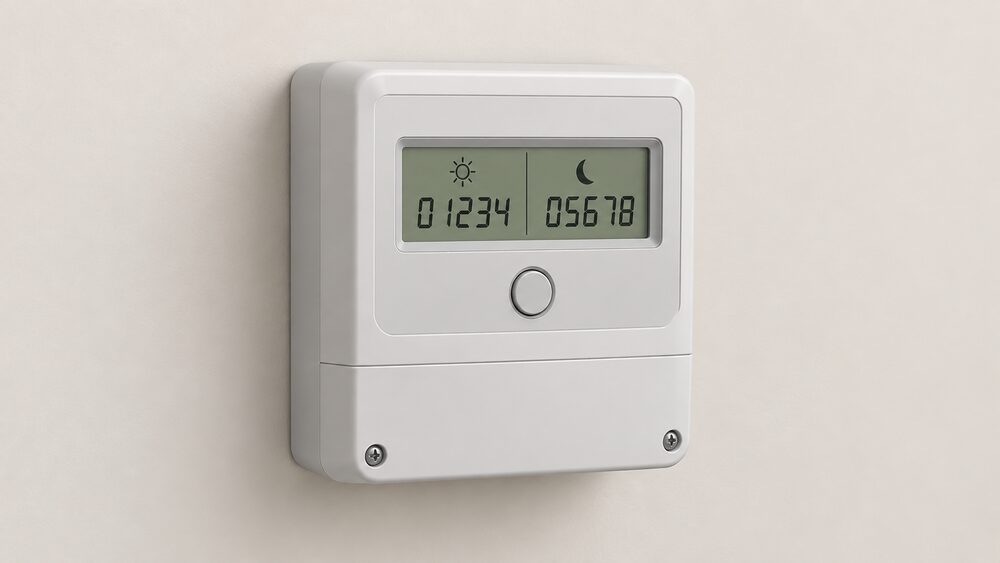
In this guide
Economy 7 is a two-rate electricity tariff: a cheaper rate for seven hours overnight and a more expensive rate for the other 17 hours of the day1. It is the oldest and most widespread time-of-use tariff in Britain, built originally around electric storage heaters that charge overnight and release heat the following day2. The cheap window is not fixed to the clock: it falls somewhere between 11.00pm and 8.00am, and the regional network operator sets the exact hours3.
The tariff suits a household that can move a large share of its electricity into the night. The rule of thumb across consumer guidance is that more than 35% of night use is needed for Economy 7 to be cost-effective, and some sources put the threshold at 40%2. Ofgem's own modelling of the Economy 7 population has used a 58% peak, 42% off-peak split as the GB average5.
Economy 10 is the variant with ten cheaper hours split across the day rather than seven at night, and it is far less widely available4. Both tariffs are tied to specific meter types, and the Radio Teleswitch Service that switches many of those meters between rates began being phased out in June 20257.
What Economy 7 is: two rates, seven cheap hours at night
Economy 7 is a time-of-use electricity tariff that charges two different prices depending on when the electricity is used3. The cheaper off-peak rate applies for seven hours out of every 24, usually at night, and the on-peak rate applies at all other times8. Ofgem describes it as a multi-rate tariff where a household pays one rate during a specified off-peak period and another, more expensive rate during peak hours9.
The structure is deliberately blunt. There is no shoulder rate and no daily variation: the meter simply records units in two registers, and the supplier prices them differently. The daytime rate on an Economy 7 tariff is usually higher than the rate on a normal single-rate tariff, which is what makes the night rate worth having only if enough consumption lands inside the window10.
That trade-off is the whole design. A household that runs storage heaters, an immersion heater or an electric vehicle overnight can put a large share of its consumption into the cheap hours. A household that heats with gas and uses electricity mainly in the evening gets the higher daytime rate without the compensating night load.
The scale of the arrangement is significant. Ofgem's 2023 call for input on the consumption split cites the 2017 figure of 58% peak and 42% off-peak as the GB average for Economy 7 customers5. Earlier Ofgem work put the number of Economy 7 or variant tariff consumers at 3.9 million out of 26 million electricity consumers, and recorded that uptake of Economy 7 was about 20% in 200812.
For a household's energy independence, Economy 7 does something specific and limited. It shifts the cost of electricity towards hours when the grid is under less strain, which is a form of demand flexibility the household controls directly. It does not reduce dependence on the grid, on a supplier or on the wholesale price of generation. The household still buys every unit from the same network; it simply buys some of them at a different price.
Off-peak hours: when the cheap window actually falls
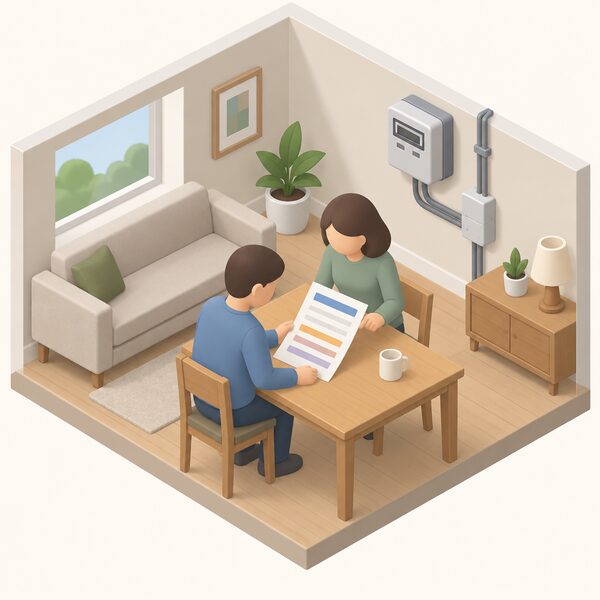
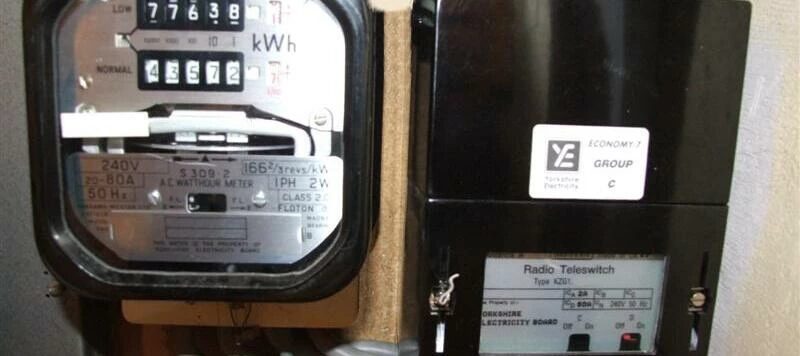
The cheap Economy 7 period runs for seven hours at some point between 11.00pm and 8.00am3. The exact hours are not set nationally. The regional network operator, the company responsible for physically supplying electricity to the property, defines the window, and it can run between seven and nine hours depending on the area3. Precise timings and costs also vary by supplier10.
The most commonly quoted arrangement is seven hours between midnight and 7am, and that is the pattern most households will recognise4. But it is a default description rather than a guarantee. Two households on the same street with different network operators, or on different supplier products, can have different cheap windows.
Some Economy 7 variations offer 8.5 or 10 hours rather than seven14. Where that happens, the extra hours are usually still clustered in the same overnight band rather than spread through the day, which is what distinguishes the arrangement from Economy 10.
The window does not change with the seasons. Summer and winter Economy 7 hours are the same clock hours, because the meter switches on a fixed schedule rather than on daylight or demand. What changes between summer and winter is how much of the household's heating and hot water demand naturally falls inside that window, which is why storage heater charging is set by the controls rather than by the household's daily routine.
"The cheaper Economy 7 time period runs for a seven-hour period at some point between 11.00pm and 8.00am."
For a household, the practical consequence is that the cheap window has to be checked rather than assumed. The hours are printed on the bill or available from the supplier, and they are the single most important number in deciding whether a given appliance or heating system can be run economically on the tariff.
Is Economy 7 worth it? The 35 to 40% night-use rule
The test is how much electricity a household can move into the cheap window. National Energy Action states that for Economy 7 to be economical, at least 40% of electricity should be used at night4. Uswitch puts the threshold slightly lower, at more than 35% of night use for the tariff to be cost-effective2. Energy Helpline gives the same 40% figure, saying a household would have to use more than 40% of its electricity during the night to make switching worthwhile10.
The spread between 35% and 40% reflects the fact that the answer depends on the specific tariff's peak and off-peak rates, not on a universal rule. A tariff with a very cheap night rate and a modest daytime premium can pay at 35%; one with a steep daytime rate needs more night load.
Ofgem's own figures show what real Economy 7 households actually do. The 2017 consumption split used in Ofgem's work was 58% peak and 42% off-peak as the GB average5. A 2019 consultation proposed moving the split to 59% peak and 41% off-peak15. Both figures sit just above the 40% threshold, which suggests the average Economy 7 household is close to the break-even point rather than comfortably past it.
The regional variation is wider than the national average suggests. In the 2019 figures, the proportion of usage taking place in peak periods ranged from 49% up to 68% across regions15. In the 2017 figures the range was 46% up to 67%13. A household in a region at the low end of peak usage is doing far better on Economy 7 than one at the high end, on identical rates.
| Measure | Figure | Source |
|---|---|---|
| Night use needed (NEA) | At least 40% | 4 |
| Night use needed (Uswitch) | More than 35% | 2 |
| GB average off-peak share, 2017 | 42% | 5 |
| GB average off-peak share, proposed 2019 | 41% | 15 |
| Regional peak share range, 2019 | 49% to 68% | 15 |
For a household's independence, the rule matters because it is the point at which the tariff stops being a discount and starts being a penalty. Economy 7 does not create energy independence; it prices the household's existing flexibility. A home that cannot shift load pays the daytime premium for nothing.
Economy 7 meters: what you have and how to tell
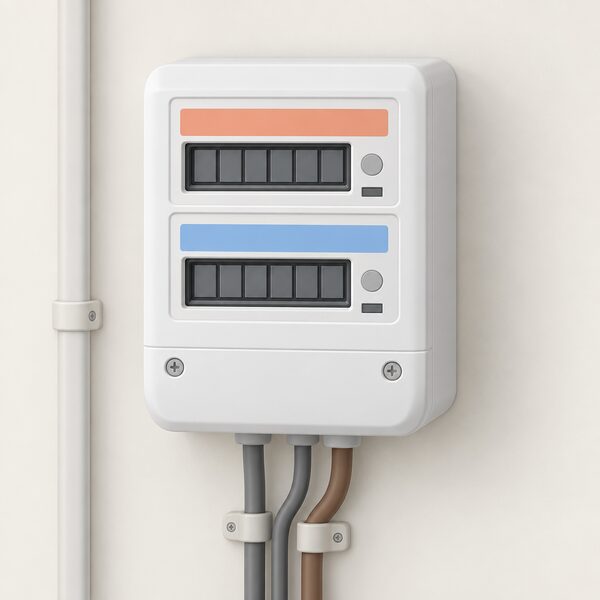
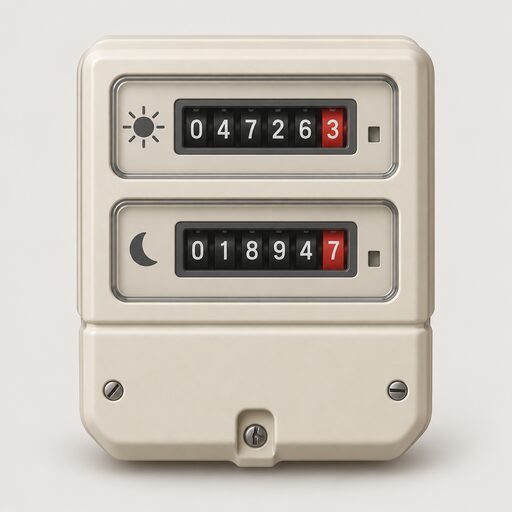
An Economy 7 meter records two readings, one for on-peak hours and one for off-peak hours16. On a digital or prepayment meter, each reading is usually accessed by pressing a button, and the registers are sometimes marked Rate 1 and Rate 216. The two sets of numbers are typically marked low and normal, where low means night and normal refers to the day10.
The labelling is not standardised. The night-time or off-peak reading is often the bottom one, marked low or night, while the daytime or on-peak reading is the top one, marked normal or day, or shown as the default display16. Some meters show a number marked day rate alongside a red button that is pressed to reveal the night rate10. Others display one set marked Day Rate with a button to switch to the off-peak reading17.
The Centre for Sustainable Energy describes the same pattern: one reading for on-peak hours, which could be marked normal or day, and one for off-peak hours, marked low or night, possibly shown as Rate 1 and Rate 2 or R1 and R218.
The simplest identification is on the bill rather than the meter. A bill showing two meter readings, a low or off-peak rate and a normal, high or on-peak rate, or a button to press to see each rate on an electronic meter, indicates an Economy 7 arrangement4. Economy 7 requires a special multi-rate meter to be installed at the home3.
In Scotland, Economy 7 meters are known as white meters, because the meters supplied by energy companies are white3. The term appears in older paperwork and in meter point records rather than in current tariff marketing, but it describes the same two-register arrangement.
Economy 10: ten cheaper hours, split across the day
Economy 10 offers much cheaper usage rates during 10 off-peak hours of the day19. The split is not ten hours at night. Energy Helpline describes seven hours during the night and three hours during the day, most likely in the afternoon or evening19. Uswitch describes three hours in the afternoon and seven overnight2. National Energy Action sets out ten set hours of cheaper off-peak electricity, with three hours in the afternoon, two in the evening and five through the night4.
The variation between sources reflects the fact that Economy 10 is not one product. Uswitch gives three example patterns: three hours in the afternoon, four in the evening and three in the early morning; two hours at lunchtime, three in the evening and five overnight; or four hours in the afternoon, two in the evening and four in the early morning6. The off-peak times vary from supplier to supplier and region to region6.
Ofgem has described Economy 10 as a tariff with three different time periods, similar to Economy 7 but potentially offering a middle rate slot in addition to peak and off-peak rates20. That three-period structure is why Economy 10 is harder to compare and harder to automate than Economy 7.
| Feature | Economy 7 | Economy 10 |
|---|---|---|
| Cheap hours | 7 | 10 |
| Typical split | 7 overnight | 7 overnight, 3 daytime19 |
| Alternative split | 8.5 or 10 hours on some variations14 | 3 afternoon, 2 evening, 5 night4 |
| Rate periods | 2 | Up to 320 |
| Standing charges | Standard | Often higher17 |
| Comparison site support | Widely supported | Often not supported6 |
Economy 10 unit rates can be up to half the price of peak rates, but the standing charges are often higher, which erodes the benefit for lower-use households6. The tariff is not as widely used as Economy 7, and not all suppliers offer tariffs that support it4. There are simply not many Economy 10 suppliers available6.
To get an Economy 10 tariff, a household must have an Economy 10 meter4. A supplier may be able to install one but may charge a fee, because the meters are fairly uncommon6. Switching from one Economy 10 plan to another may require the meter to be reprogrammed by an engineer6.
Economy 7 vs Economy 10 vs smart time-of-use tariffs
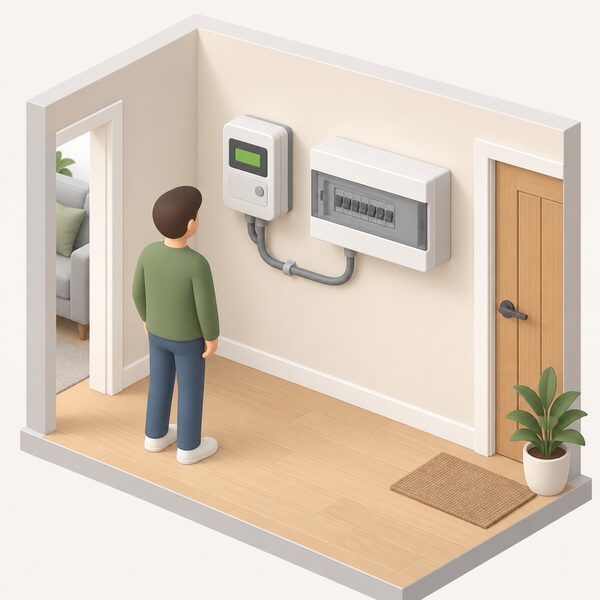
Economy 7 and Economy 10 are older time-of-use tariffs that need compatible meters, while newer flexible tariffs typically work with a smart meter8. The older tariffs use fixed cheaper periods; newer electric vehicle and tracker tariffs can be more dynamic and usually work best with a smart meter8.
Smart time-of-use tariffs vary the cost of electricity based on the time of day it is used, charging a higher price in peak periods and a lower price during lower-demand, off-peak periods21. Prices can vary across peak hours, off-peak hours and shoulder hours21. A smart meter is needed to sign up, and the household must be able to move electricity use to off-peak periods to benefit21.
Dynamic tariffs go further, charging a different amount every half-hour based on what it costs to generate electricity at that time11. These are the tariffs that most directly reward a household for shifting load, but they also expose it to price spikes that a fixed Economy 7 night rate does not.
The choice between the structures turns on what the household has. An electric vehicle charger, a heat pump or a home battery makes smart tariffs much more valuable14. For a battery with no other flexible technology, the guidance is that either a dynamic tariff or Economy 7 is the better fit11.
| Tariff type | Cheap periods | Meter needed | Flexibility |
|---|---|---|---|
| Economy 7 | 7 fixed hours overnight | Multi-rate meter | Low |
| Economy 10 | 10 fixed hours, split | Economy 10 meter | Low |
| Smart time of use | Peak, off-peak, shoulder | Smart meter | Medium |
| Dynamic | Every half-hour | Smart meter | High |
The comparison factors that matter are the same across all four: off-peak rates and times, peak rates, and any standing charges or exit fees14. For smart time-of-use contracts, early termination fees, contract duration, penalties for switching tariffs or suppliers, and the ability to switch between tariffs or opt out of time-of-use pricing all need checking21. Some smart tariffs are only available with certain equipment installed, such as an electric vehicle charger or solar panels21.
For energy independence, the direction of travel is clear. Economy 7 and Economy 10 give a household a fixed, predictable cheap window that it can plan around without any connected technology. Smart and dynamic tariffs give a household more control and potentially more saving, but they depend on a smart meter, on the supplier's platform and, in some cases, on the manufacturer's app. That is a different kind of dependence, not the absence of one.
Where Economy 7 falls short
The limitations are structural rather than fixable by choosing a better product.
- It is electricity only. It is not possible to get an Economy 7 meter for a gas supply10.
- The daytime rate is a premium. The daytime rate on Economy 7 is usually higher than on a normal tariff, and some Economy 7 tariffs charge almost double the night rate during the day10.
- It cannot be compared on a single-rate basis. Most suppliers charge around 26.3p per kWh of electricity on their single-rate standard variable tariffs in the South Wales region, which is the benchmark an Economy 7 daytime rate has to be measured against2.
- It does not suit a household that cannot shift load. If most energy is used during peak times and cannot be moved, a time-of-use tariff could cost a little more14.
The wider policy context adds a second kind of limit. The Climate Change Committee's Seventh Carbon Budget, published in February 2025, sets out a path to 87% below 1990 levels23. Electrification of heat is central to that path, and a household on Economy 7 with storage heaters is already partly aligned with it. But Economy 7 as a tariff does not itself reduce emissions; it prices when electricity is drawn, not how it is generated.
For a household's independence, the honest position is that Economy 7 trades one dependence for another. It reduces exposure to peak wholesale prices and gives the household a predictable cheap window. It increases exposure to the daytime rate, to the meter, and to the supplier's willingness to keep offering the tariff. It does not reduce reliance on the grid, and it does not generate anything.
Getting on, and off, an Economy 7 tariff
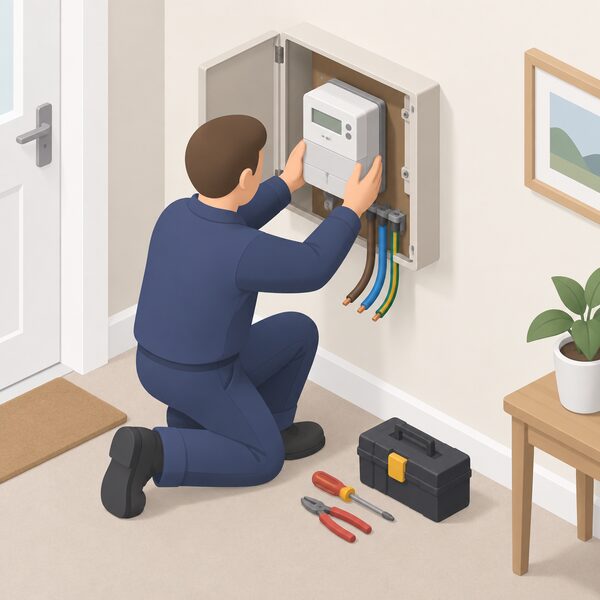
Getting onto Economy 7 requires a multi-rate meter. If a household does not already have an Economy 7 meter, the chosen supplier will need to install a new one10. The tariff is available to anyone, not only to households with storage heaters, though it is typically used with them11.
Getting off is easier than many households expect. A household that is no longer on an Economy 7 or Economy 10 tariff does not need to rush: the meter will continue to function normally, and providing all electricity is on one circuit there should be no difference in how the home operates24. The Centre for Sustainable Energy recommends smart meters in that situation24.
Switching away from Economy 10 to a standard tariff is different. A household may need to pay a fee to have a standard meter installed6.
The Radio Teleswitch Service is the deadline that matters most for existing Economy 7 and Economy 10 households. The service, used by older Economy 7 and Economy 10 meters, is being gradually phased out from June 202524. A household that is on Economy 7, Economy 10 or Total Heat Total Control may be on an RTS meter, and cheaper electricity at different times of day is a possible sign of one7.
Smart meters are the route through the transition. A household can get a smart meter if it is on an Economy 7 tariff, but not all suppliers can offer this2. The same applies to Economy 10, where availability depends on the supplier19. Smart Energy GB states that a household can get a smart meter on an Economy 7 or Economy 10 tariff25. The Energy Ombudsman states that all smart meters can support tariffs which charge different prices at different times of day and night, and that Economy 10 meters are also available26.
There is one known barrier. Some households with storage heaters on Economy 7 or Economy 10 have found that their supplier does not offer smart meters that work with Economy 7 or 10 yet25. That is a supplier limitation rather than a technical one, and it is worth checking before assuming the transition will be straightforward.
Smart meters are compatible with Economy 7 tariffs and fixed rate tariffs, and they allow a household to switch tariffs without changing the meter17. They also open access to cheaper tariffs that are only available with a smart meter, and to more flexible tariffs including dual-rate products27. Energy suppliers aim to provide every home and business in England, Scotland and Wales with free smart meters29. Access to time-of-use tariffs means cheaper rates during off-peak hours and incentives for energy usage on high-supply days30.
For a household's independence, the smart meter transition is the point at which the tariff stops being a fixed arrangement and becomes a platform. That is more flexible and more exposed at the same time: more tariffs to choose from, but also more dependence on the supplier's systems, the meter's firmware and the app that shows what the household is using.
Sources30 cited
- Types of energy tariff, Confused.com, 2025-11-03
- Economy 7 guide, Uswitch, 2026-09-08
- What is Economy 7?, Confused.com, 2025-08-20
- Getting the most from Economy 7, National Energy Action, 2026-09-10
- TDCV 2023 call for input, Ofgem, 2023-02
- Economy 10 guide, Uswitch, 2025-12-08
- Radio Teleswitch Service switch off, National Energy Action, 2026-07-29
- Energy flexibility, Smart Energy GB, 2026-08-17
- Understand your electricity and gas bills, Ofgem, 2026
- What is Economy 7?, Energy Helpline, 2026-09-20
- Tariffs for renewable technology, Energy Saving Trust, 2026-08-12
- Which? response, Ofgem, 2012-02-23
- TDCV 2017 open letter, Ofgem, 2017-06-22
- Should I switch to a time of use tariff?, Energy Saving Trust, 2026-01-23
- TDCV 2019 open letter, Ofgem, 2019-06
- How to read your gas and electricity meter, Confused.com, 2025-12-15
- What is Economy 7?, Smart Energy GB, 2026-04-07
- Reading your gas or electricity meter, Centre for Sustainable Energy, 2026-08
- What is Economy 10?, Energy Helpline, 2026-09-20
- Default tariff cap policy consultation, Ofgem, 2018-05-25
- Time of use tariffs: all you need to know, Energy Saving Trust, 2026-05-20
- Electric heating, Centre for Sustainable Energy, 2026-06
- End the fossil fuel age for a secure and prosperous future, Climate Change Committee, 2025-02-26
- Important reminder for Economy 7 and 10 meters, Centre for Sustainable Energy, 2026-06
- Can I get a smart meter?, Smart Energy GB, 2026-03-16
- Smart meters, Energy Ombudsman, 2026-09-20
- Do you have to have a smart meter by law?, Smart DCC, 2026
- Get help with your smart meter, Ofgem, 2026
- How to get a smart meter, Smart DCC, 2026
- Smart meters, Welsh Government, 2026
 Time-of-Use Tariffs ExplainedCan you pay less for electricity by using it at different times of day?
 Radio Teleswitch Switch-OffIs your storage heating or hot water still run by an old radio-controlled meter?
 Meters and Time-of-Use TariffsDo you need a smart meter for a time-of-use tariff, and does it have to send readings every half an hour?
 Tariffs in ScotlandWhy do Scottish electricity bills differ from the rest of Great Britain, and why do standing charges cost more in the north?
 Economy 7 and Restricted MetersEconomy 7 and Economy 10 meters give you cheaper electricity for a set number of hours overnight and charge you more the rest of the day.
 Prepayment and Pay As You GoHow prepayment and pay as you go energy tariffs work in the UK: meter types, top-ups, emergency credit, debt repayment through the meter, price cap treatment and how households move to a credit meter.