
In this guide
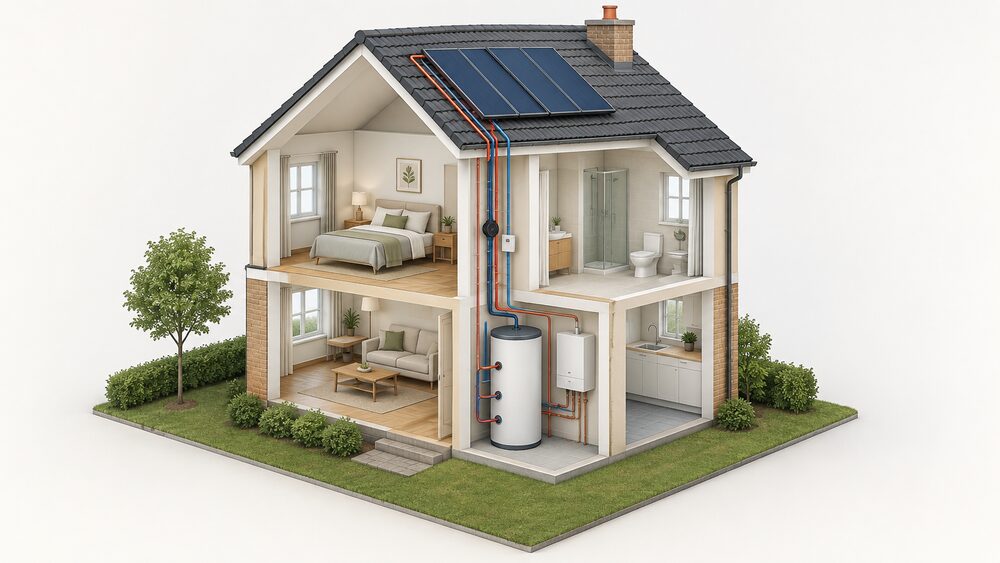
Solar water heating, also called solar thermal, uses collectors on a roof to gather the sun's energy and transfer that heat to a fluid, which then preheats water stored in a cylinder. It works alongside a conventional water heater rather than replacing it: official guidance describes systems that "gather the sun's free energy and convert it into hot water alongside a conventional water heater"1. A well-designed system can meet up to 70% of a home's annual domestic hot water needs, and in the summer months it may satisfy 100% of that need2.
The limits are as firm as the benefits. Solar thermal cannot replace a traditional liquid fuel or gas-fired central heating installation, and it does not send hot water to radiators2. Independent guidance puts the average contribution at roughly half of hot water needs across the year, dropping to around 25% in winter and rising to around 90% in summer3. A typical installation costs around £5,3003.
For a household, the appeal is straightforward: the sun's heat is free at the point of use, and the system displaces some of the gas, oil or electricity a boiler or immersion heater would otherwise burn. What remains is dependence on that backup heat source, on a cylinder that takes up floor space, on mains water pressure, and on a maintenance regime that keeps the glycol mix and the pump working. Solar thermal is a partial hedge, not a severance.
What solar water heating is and how a system works
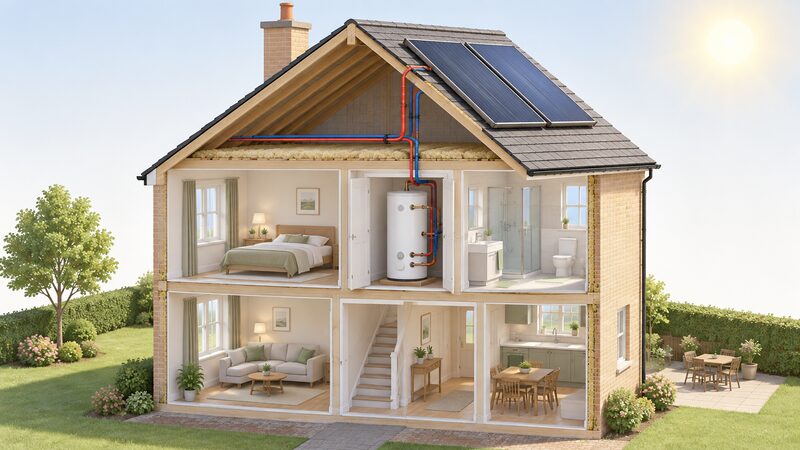
A solar thermal system has three main components: the solar collectors, a hot water cylinder, and the plumbing system that connects them1. The collectors retain heat from the sun's rays and transfer it to a fluid, which preheats water for use in sinks, showers and other hot water applications1. The heat conducting liquid is usually a mixture of water and glycol, which protects it from freezing as it flows through the tubes2.
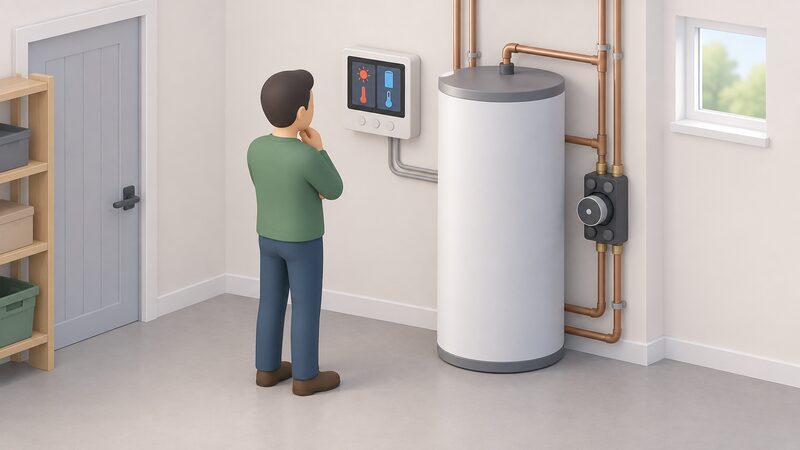
The preheated water then sits in a cylinder or thermal energy store, where a conventional heat source tops it up to the temperature the household wants3. Independent guidance gives the usual cylinder thermostat setting as 55 to 60 degrees C2. That thermostat is the handover point between the free heat and the paid heat: below the set temperature, the boiler or immersion heater runs; above it, the backup stays off.
Most solar thermal systems are designed to provide hot water for baths, showers and hot taps only3. They are not a whole-house heating solution. The technology scales beyond the home, though: official guidance notes that solar water heating can be used in the home or for larger applications, such as swimming pools4.
What it can and cannot cover: up to 70% of hot water, but no radiators
The headline figure for a well-designed solar heating system is an energy yield equivalent to up to 70% of a home's annual domestic hot water needs2. That is an annual average, and the seasonal spread matters more than the average for how the system feels in use. Independent guidance puts the typical year at roughly half of hot water needs, with around 90% in summer and around 25% in winter3. In the summer months, a system may satisfy 100% of the hot water need2.
What it cannot do is heat the house. Solar thermal systems do not send hot water to radiators, so another way of heating the home is still required3. Official guidance is blunt about the same point: solar thermal cannot provide 100% of hot water, so a boiler is still required5. The system is a preheat stage, and the backup heat source remains part of the design rather than an optional extra.
Building regulations frame the scale at which this is treated as domestic work. Approved Document L guidance covers indirect solar systems supplying domestic hot water with a solar collector area of less than 20m2 and a solar heated water storage volume of less than 440 litres6. Systems above those thresholds fall outside that scope.
For energy independence, the honest reading is that solar thermal reduces the volume of purchased fuel rather than removing the need for it. A household still buys gas, oil or electricity for the cylinder top-up and for space heating, and still depends on the grid or a delivered fuel supply. What changes is the quantity, and the quantity is largest in the months when heating demand is lowest.
Evacuated tubes or flat plate collectors: the two collector types
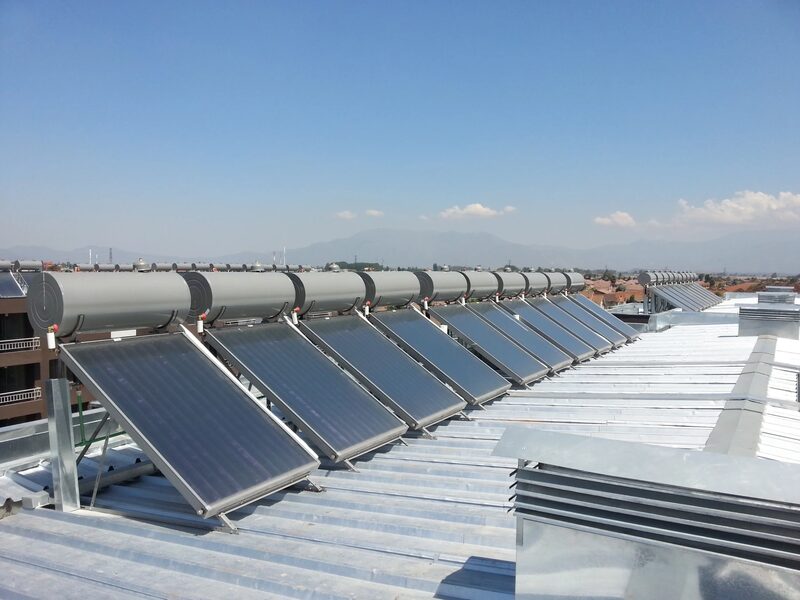
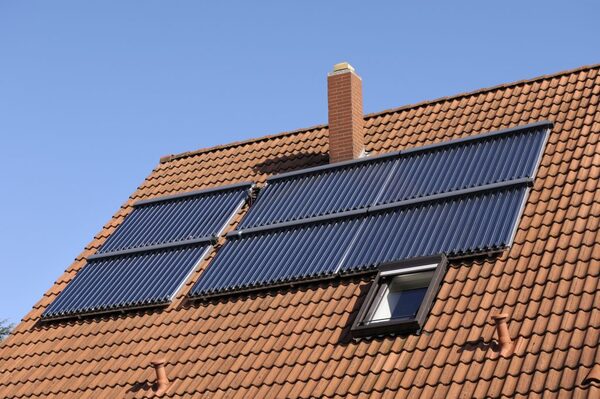
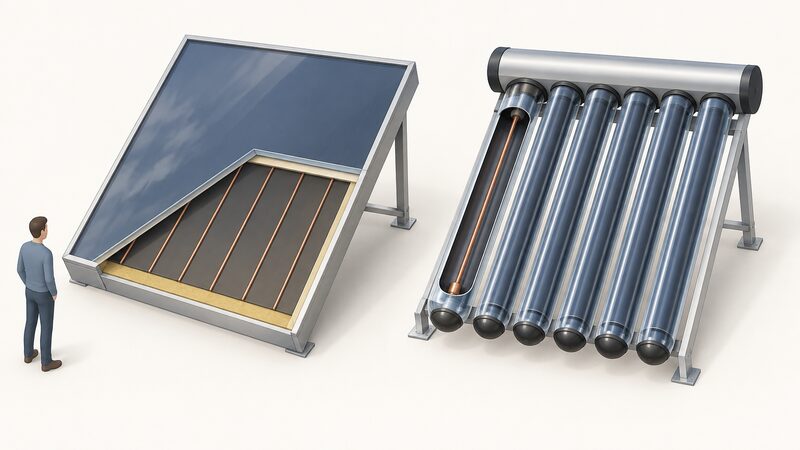
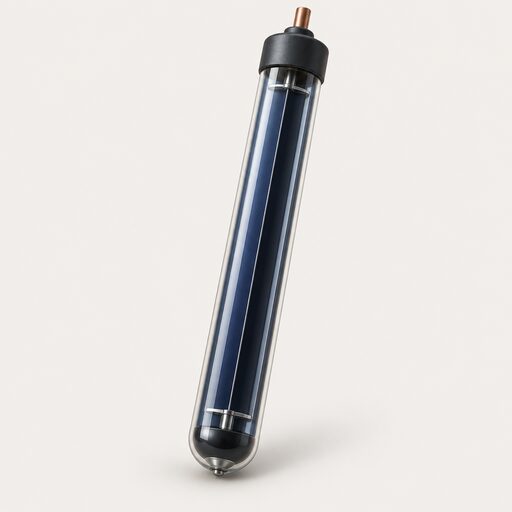
There are two main types of solar collector used in the UK: evacuated tubes and flat plate collectors2. Official guidance names the same two, describing flat plate and evacuated tubes as collectors with different characteristics1. The choice between them is a design decision made with the installer, and both are treated as eligible collector types within the equipment definitions used for VAT relief on solar collectors, which covers evacuated tube or flat plate systems together with associated pipework and equipment such as circulation systems, pump, storage cylinder, control panel and heat exchangers9.
| Collector type | What it is | Where it tends to be specified |
|---|---|---|
| Flat plate | A flat absorber behind glazing, the more established of the two types1 | Roofs with good orientation and space for a larger array |
| Evacuated tube | Tubes with a vacuum between absorber and outer glass1 | Sites where a smaller footprint or a less favourable angle is a constraint |
The rest of the system is common to both. A circulation system moves the glycol mix between collector and cylinder, a pump drives it, a control panel decides when the pump runs, and a heat exchanger transfers the collected heat into the stored water9. The cylinder is the component that most often forces a change to the rest of the heating system, because it has to hold both the solar coil and the backup heat source.
Roof, cylinder and space requirements: around 5m² of direct sunlight
Official guidance for a domestic system specifies 3 to 4 square metres of southeast to southwest facing roof receiving direct sunlight for the main part of the day4. Independent guidance puts the requirement at around five square metres that get direct sunlight for the main part of the day3. The two figures differ because they describe the same requirement at different levels of precision, and because array sizing depends on the household's hot water demand.
Orientation matters as much as area. A southeast to southwest facing roof is the band official guidance names, and a roof outside that band will collect less over the year4. Shading from trees, chimneys or neighbouring buildings reduces output in the same way it does for solar photovoltaic panels.
Inside the house, the cylinder is the constraint. A larger hot water cylinder is likely to be needed, and it will take up extra room2. Official guidance adds that space is also needed to locate an additional water cylinder if required4. For a household replacing a combi boiler, that cylinder is a new object in the home rather than a like-for-like swap, and its position relative to the collectors affects pipe runs and heat loss.
Cost: around £5,300 installed, and what determines the saving
The cost of installing a typical solar water heating system is around £5,3003. That is the only published installation figure available here, and it should be treated as a typical rather than a quoted price: what a household actually pays depends on the collector type, the size of the array, whether a cylinder has to be added or replaced, and the complexity of the roof and pipe route. Where no published price exists for a specific configuration, prices are installer-quoted.
On the benefit side, a parliamentary research briefing on the Solar Energy UK report The Value of Solar Property estimated that a solar energy system could add £1,800 to the value of an average home and save over £300 on energy bills10. Those figures cover solar energy systems generally rather than solar thermal alone, and the saving is an estimate rather than a metered result.
Two conflicting estimates of annual saving appear in the available guidance, and they are not reconciled: one puts the figure at around £275 and another at around £1603. A separate pair of estimates for England, Scotland and Wales gives £210 against £1103. What drives the real number is the share of hot water the collectors cover, the price of the fuel being displaced, and how much hot water the household uses.
Planning permission and building regulations
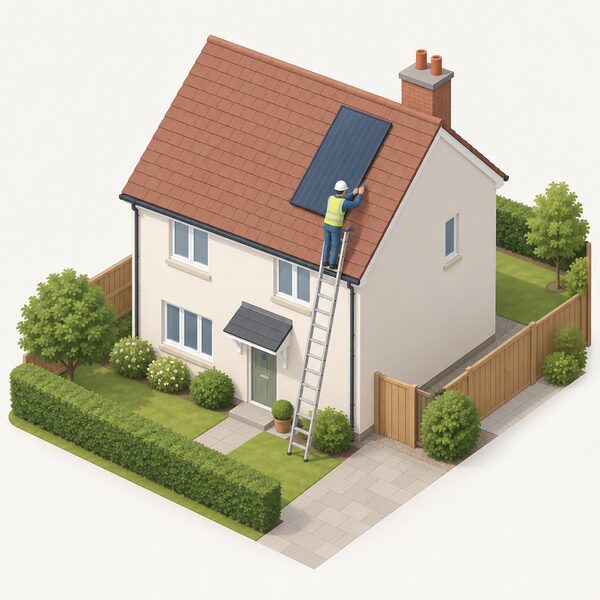
Most solar water heating systems are considered permitted development, so they do not require planning permission3. There are exceptions, including listed buildings, conservation areas and national parks3. In some locations planning permissions may also need to be granted2. Where a building is listed, Listed Building consent is required1. Local authority guidance on solar panels confirms that panels on listed buildings will need planning permission and listed building consent13.
The installation itself is not exempt from the building regulations. The installation of a solar water heating system is work covered by building regulations2. Official guidance points to the current planning regulations for solar thermal equipment, and recommends using an MCS certified installer as the best way to avoid problems with building regulations1. The MCS route matters here because the installer takes responsibility for compliance rather than leaving it with the household.
Northern Ireland operates its own guidance on solar thermal panels, published by nidirect15. Where a property sits in a conservation area or a national park, the local planning authority is the body that decides, and the position can differ between England, Scotland, Wales and Northern Ireland.
Choosing an installer: MCS certification and quotes
MCS is an independent certification scheme for microgeneration installation companies and products16. It certifies, quality assures and provides consumer protection for microgeneration installations and installers, covering small-scale renewable technologies17. Its roles include setting and maintaining technical standards for installations and products, certifying installers and products against those standards, and issuing MCS certificates for completed eligible installations16.
Independent guidance recommends getting quotes from at least three different installers3. Solar water heating installed by an MCS certified contractor comes with both workmanship and product warranties, typically including several years of workmanship and longer warranties for the solar collectors themselves3. There may also be a requirement for the installer and equipment used to be registered with MCS in some regions2.
A requirement of companies wanting to gain MCS certification is that they are members of a CTSI Approved Consumer Code of Practice scheme in the first instance18. That membership is the route by which a household gains access to a code-backed complaints process, separate from any warranty the installer offers.
Living with a system: maintenance, warranties and what to expect
The maintenance regime is modest but not optional. Independent guidance advises having the system checked thoroughly every five years to flush the system and replace the fluid mix3. The fluid is usually a mixture of water and glycol, and its job is to protect the liquid from freezing as it circulates2. A system that is never flushed risks losing heat transfer and corroding components.
Warranty cover splits into two parts. Workmanship warranties typically run for several years, while the solar collectors themselves carry longer warranties3. For comparison, warranty terms in the wider renewables market can be much longer: one approved innovation measure under the Energy Company Obligation requires a registered warranty for the solar PV array, including system components, covering at least a 25-year period20. That is a photovoltaic warranty rather than a solar thermal one, and it shows the range of terms in the market rather than setting an expectation for collectors.
What a household should expect in practice is a system that performs strongly from late spring to early autumn and modestly in midwinter, with the boiler or immersion heater covering the difference. The cylinder thermostat, usually set at 55 to 60 degrees C, decides when that backup runs2. MCS specifies handover documentation but not the quality of verbal explanation, household understanding, structured follow-up or ongoing support, so the quality of the handover depends on the installer19.
Complaints and consumer protection through MCS

MCS is the contact for issues with the installation process, the installer, or the MCS certificate or product21. It can be reached on 0333 103 8130, and MCS may also contact a property owner for a short, routine verification on behalf of Ofgem by email or phone on 0333 103 819822. Property owners contacted for those checks should aim to respond within seven days23.
The complaints route has a defined sequence. A company must be a member of a CTSI Approved Consumer Code of Practice scheme to gain MCS certification in the first instance, and that code is where a dispute about an installation is handled18. For heat networks, official guidance sets out a parallel structure: consumers should contact their supplier before the Energy Ombudsman, and the heat supplier has 8 weeks to resolve the complaint24. The period after which a complaint can be escalated to the Energy Ombudsman remains eight weeks for heat networks24. That eight-week figure applies to heat networks rather than to solar thermal installations, and it is given here as the comparable published timescale rather than as a rule for solar thermal.
For solar thermal, the practical position is that the MCS certificate is the document that records the installation, the installer's certification is the basis of the warranty, and the consumer code membership is the route to escalation. A household that keeps the MCS certificate, the handover documentation and the warranty terms has the paperwork the process depends on.
Where solar thermal sits in a household's energy independence
Solar thermal does one thing well: it takes a share of the hot water load off purchased fuel. A well-designed system can cover up to 70% of annual domestic hot water needs, and in summer it may cover all of them2. That is a real reduction in the volume of gas, oil or electricity a household buys, and it is largest in the months when the cylinder would otherwise be heated entirely by the boiler.
The dependence that remains is substantial and worth stating plainly. The system cannot replace a traditional liquid fuel or gas-fired central heating installation, and it does not heat radiators2. A boiler or immersion heater is still required, because solar thermal cannot provide 100% of hot water5. The household still depends on the grid or a delivered fuel supply for space heating and for winter top-up, on mains water pressure to move the preheated water, and on a manufacturer and installer for the pump, controller and collectors.
There is also a structural point about future options. Independent guidance states that a household with a combi boiler will likely need to add a solar hot water cylinder and replace the boiler with a conventional boiler or a heat pump3. A conventional boiler with a hot water cylinder is often compatible with solar water heating, and solar thermal systems are usually used alongside a conventional boiler or immersion heater3. The cylinder, in other words, is the component that ties solar thermal to the rest of the heating system, and it is the same component that heat pump conversions depend on. Households weighing that wider decision can compare options on heat pumps compared with boilers and read how cylinders work in hot water cylinders.
For self-builders, official sustainability guidance for self-build homes advises considering solar panels to generate electricity or solar water heating systems for hot water needs25. The wider context for household energy independence is set out in home heating and energy independence, and the full range of heating options sits under boilers and home heating.
Sources25 cited
- Generating Your Own Energy: Solar Water, Welsh Government, 2018
- Your Home Guide to Solar Water Heating, OFTEC, 2026
- Could solar water heating work for you, Energy Saving Trust, 2026
- Solar Thermal Water Heating, Planning Portal, 2026
- Clifton Local Listed Building Consent Order Guidance, Bristol City Council, 2025
- Approved Document L Volume 1: Consultation Version, Welsh Government, 2025
- Approved Document L: Conservation of Fuel and Power, Volume 1, Dwellings, HM Government, 2023
- Approved Document L: Volume 1, Dwellings, HM Government, 2026
- VAT Energy Saving Materials and Grant Funded Heating Supplies, HM Revenue and Customs, 2026
- The Value of Solar Property, House of Commons Library, 2025
- Solar Panels, Oxfordshire County Council, 2026
- Solar Panels and Planning Permission, Cornwall Council, 2026
- Solar Thermal Panels, nidirect, 2024
- Building Regulations Renewables Guidance, Bedford Borough Council, 2026
- Domestic RHI: Essential Guide, Ofgem, 2022
- Boiler Upgrade Scheme Guidance for Property Owners, Ofgem, 2026
- ECO4 Flex and GBIS Flex Information Document, Ceredigion County Council, 2026
- Renewable Energy Consumer Code, Chartered Trading Standards Institute, 2026
- Carbon Footprint Report: Heat Pump Transition, HM Government, 2026
- ECO4 Innovation Approved Innovation Measures, Ofgem, 2023
- Domestic Renewable Heat Incentive: Who to Contact, Ofgem, 2026
- Boiler Upgrade Scheme Guidance for Installers, Ofgem, 2026
- Boiler Upgrade Scheme, Ofgem, 2026
- Heat Networks Regulation: Consumer Protection Guidance Decision, Ofgem, 2026
- Self-Build Homes: Sustainability, Planning Portal, 2026
 Solar Water Heating CollectorsSolar water heating uses panels on your roof to warm the water in your cylinder, working alongside your boiler rather than replacing it.
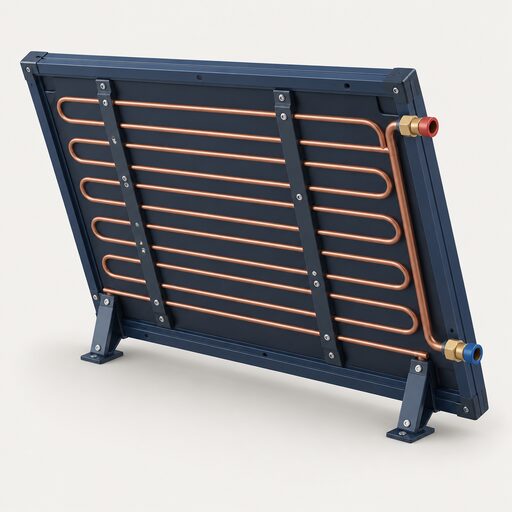 PVT Hybrid PanelsA PVT panel makes electricity and heats water from one roof space, so it suits homes without room for two separate systems.
 Energy IndependenceA heat pump runs your heating on electricity instead of gas or oil, so how much does that really cut what you pay and how exposed you are when fuel prices jump?
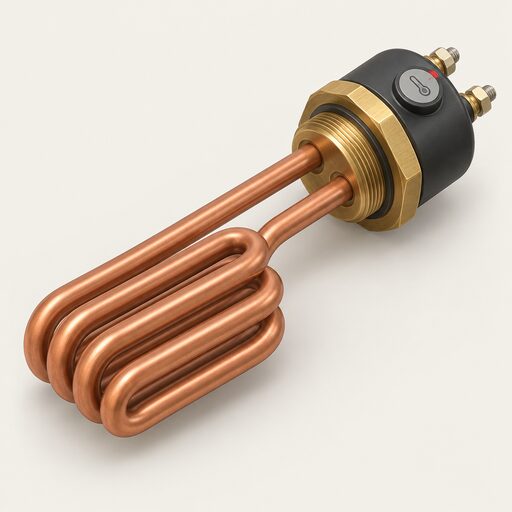 Solar DivertersYour panels often make more electricity than your home needs.
 Solar Panel CostsA typical UK home pays somewhere between four and eleven thousand pounds for solar panels fitted, with most landing in the middle.
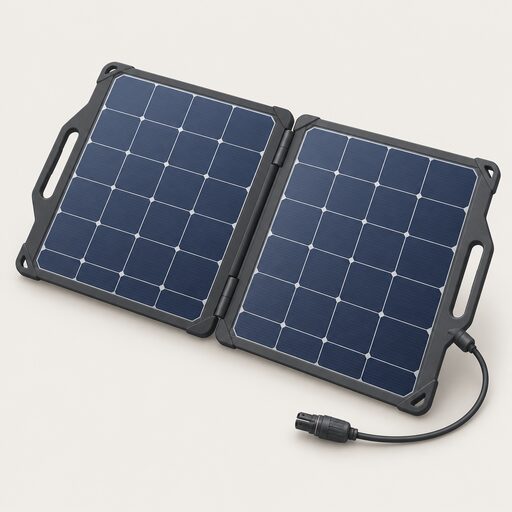 Solar Charging a Power StationCharging a portable power station from solar panels comes down to a few practical questions.