
In this guide
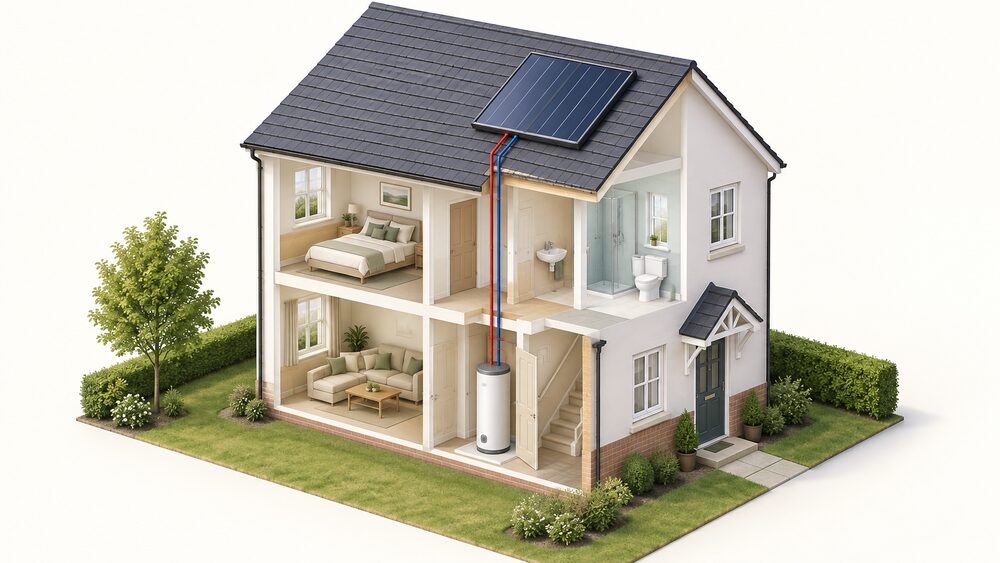
Solar water heating, also called solar thermal, uses energy from the sun to heat water for a home through roof-mounted collectors. The collectors retain heat from the sun's rays and transfer it to a fluid, preheating water for sinks, showers and other hot water applications. A system comprises three main components: the solar collectors, a hot water cylinder, and the plumbing that connects them1.
It is a pre-heat technology, not a replacement for a boiler. Solar water heating works alongside a conventional water heater, and because the amount of solar energy varies through the year, systems are usually used alongside a conventional boiler or immersion heater2. It cannot replace a traditional liquid fuel or gas-fired central heating installation3. A well-designed system can yield an equivalent amount of energy to satisfy up to 70% of a home's annual domestic hot water needs, and in the summer months it may satisfy 100% of that need3.
The practical case rests on three numbers. A typical installation costs around £5,3004, a roof-mounted system could cost between £3,000 and £6,000 depending on the number of people in the home5, and savings run from around £100 to £230 per year on energy bills, based on typical energy prices from November 20256. Coverage swings hard with the season: about 90% of hot water needs in summer and 25% in winter6.
What solar water heating is and how a system works
Solar water heating systems gather the sun's free energy and convert it into hot water alongside a conventional water heater. They do this by retaining the heat from the sun's rays and transferring that heat to a fluid, in order to preheat water for use in sinks, showers and other hot water applications1. The Planning Portal describes the same principle: solar water heating uses energy from the sun to work alongside your conventional water heater7.
The three main components are the solar collectors, a hot water cylinder, and the plumbing system1. Inside the collectors, a liquid, a mixture of water and antifreeze, flows through small pipes2. The Energy Saving Trust describes the collectors as fluid-filled and filled with a mixture of glycol and water6. That fluid carries heat down to a cylinder or thermal energy store, where it warms the water held for use4.
Most solar thermal systems are designed to provide hot water for baths, showers and hot taps only, not space heating4. That is the boundary that matters for a household: the technology displaces the fuel used to heat water, and nothing else. It can be used in the home or for larger applications, such as swimming pools7.
The system is not a standalone supply. Because the amount of solar energy varies throughout the year, solar thermal systems are usually used alongside a conventional boiler or immersion heater2. A solar water heating system will not provide 100% of the hot water needed throughout the year, and a conventional boiler or immersion heater normally makes up the difference8.
Flat plate or evacuated tubes: which collector suits which home
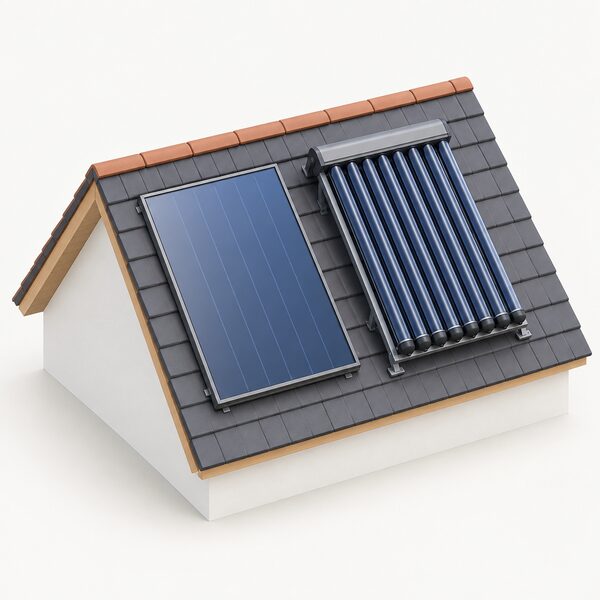
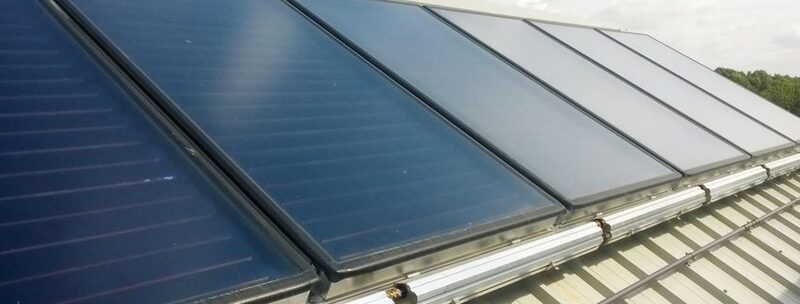
The two collector families sold in the UK are flat plate panels and evacuated tubes. Both circulate a fluid through the collector and both feed a cylinder. The choice between them is less consequential than the sizing, according to the Centre for Alternative Technology: in the UK climate, properly sized panels of either type can work well and deliver similar value for money5.
That finding is worth holding on to, because the marketing around evacuated tubes often implies a decisive performance gap. The independent position is that a correctly sized system of either type performs comparably in British conditions5. What differs is the physical form and how it sits on a roof.
| Collector type | Form | Fluid | Where it tends to suit |
|---|---|---|---|
| Flat plate | Flat absorber behind glazing, mounted flush on a pitched roof | Water and antifreeze mixture2 | Roofs where appearance and wind loading matter, and where the panel can sit close to the roof plane |
| Evacuated tube | Row of glass tubes on a frame | Glycol and water mixture6 | Roofs where a slightly deeper profile is acceptable, and where tubes can be angled independently of the roof pitch |
Both types are filled with a fluid that must be maintained. Flat plate collectors carry a mixture of water and antifreeze2; the collectors in general are described as fluid-filled and filled with a mixture of glycol and water6. That fluid is the part of the system most exposed to frost and to stagnation, and it is the reason a five-year service interval appears in the guidance.
For a household weighing the two, the deciding factors are usually roof geometry, the visual result, and what the installer is prepared to guarantee, rather than a documented efficiency gap in UK conditions5. A system that is undersized, or shaded for part of the day, will underperform whichever collector type is fitted.
How much of your hot water solar thermal can cover: about 90% in summer, 25% in winter
The seasonal swing is the single most important thing to understand about solar thermal, because it determines what the system is actually for. Solar water heating can provide about 90% of hot water needs in summer and 25% in winter6. The Energy Saving Trust gives the same figures: around 90% of hot water requirements in summer, dropping to around 25% in winter2.
Across a full year, the picture is more modest. A well-designed solar heating system can yield an equivalent amount of energy to satisfy up to 70% of a home's annual domestic hot water needs3. The Energy Saving Trust puts the average lower still: solar water heating systems normally provide roughly half of hot water needs, on average2.
The gap between the summer peak and the annual average is the whole story of the technology. In July, a correctly sized system can meet essentially all hot water demand, and in some accounts the summer months may satisfy 100% of that need3. In January, it contributes a quarter, and the boiler or immersion heater does the rest.
"For example, in the summer, it should provide around 90% of your hot water requirements, dropping to around 25% in the winter."
This is why solar thermal suits a household with a steady, sizeable hot water demand rather than one that wants a fixed annual return. The Centre for Alternative Technology notes that solar water heating will be best in a house that has a larger hot water demand, such as for a family or a house-share5. A larger demand means more of the summer output is used rather than dumped, and more of the boiler's work is displaced.
For energy independence, the seasonal pattern sets the ceiling. Solar thermal reduces the gas, oil, LPG or electricity a household buys for water heating, and it does so most heavily in the months when heating demand is lowest. It does not remove the boiler, the cylinder's immersion element, or the fuel supply behind them.
What a system costs and what it can save
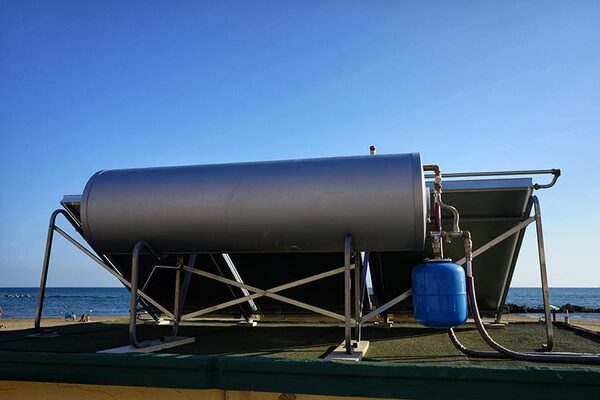
Costs and savings both come with ranges, and the ranges reflect household size, fuel displaced and the date of the figures. The cost of installing a typical solar water heating system is around £5,3004. A roof-mounted system could cost between £3,000 and £6,000, depending on the number of people in your home5. Prices are installer-quoted, and the figures above are the published ones.
Savings depend almost entirely on what the system is displacing. The table below sets out the annual figures for a 4 square metre panel system against each fuel.
| Fuel displaced | Annual saving | Basis |
|---|---|---|
| Electricity | £230 per year | 4m² panel system6 |
| LPG | £200 per year | 4m² panel system6 |
| Gas | £160 per year | 4m² panel system6 |
| Coal | £150 per year | 4m² panel system6 |
| Oil | £100 per year | 4m² panel system6 |
The headline range across all fuels is around £100 to £230 per year on energy bills, based on typical energy prices from November 20256. The Centre for Alternative Technology gives a figure of £180 per year or more where solar water heating replaces a gas boiler, and several thousand pounds over the system's life5. The Energy Saving Trust gives £110 with an existing gas system for England, Scotland and Wales8.
Those gas figures do not agree. The documents give £160 per year for a 4 square metre system6, £180 per year or more5, and £110 with an existing gas system8. The disagreement is unresolved, and the spread is wide enough that a household should treat any single gas saving figure as indicative only.
Maintenance costs for solar water heating systems are generally very low8. Against a typical installation cost of around £5,3004, the savings figures above indicate a long payback, and the case for the technology rests on fuel independence and on displacing the most expensive fuels rather than on a fast financial return.
Cylinders, boilers and the combi problem
The cylinder is where solar thermal meets the rest of the heating system, and it is where most of the practical difficulty sits. Most systems use a single cylinder, with either an immersion heater or another coil near the top that connects to your boiler2. Some solar thermal systems use two cylinders, one dedicated to the solar collectors and another for the immersion heater2.
A conventional boiler with a hot water cylinder is often compatible with solar water heating4. Where a boiler is to be combined with the solar system, it connects via a compatible hot water cylinder having two heating coils, a twin-coil cylinder3. The existing cylinder usually has to be replaced with one designed for solar water or a dedicated solar water cylinder2.
A combi boiler is the problem case. It is difficult to use a solar water heating system with a combi boiler6. Few combi boiler models are compatible with solar thermal systems, as they are not designed to heat water in a cylinder2. A household with a combi would likely need to add a solar hot water cylinder and replace the boiler with a conventional boiler, or a heat pump4.
The cylinder also has a sizing rule attached. The dedicated solar storage volume should be a minimum of 25 litres per net square metre of the solar collector absorber area, or at least 80% of the daily hot water demand as defined by SAP9. Approved Document L guidance for Wales sets a minimum volume of 25 litres for every 1m² of the net absorber area of the solar collector10.
For a household, the cylinder is the point at which solar thermal stops being a bolt-on. It changes the hot water architecture of the house, and it is the reason the technology fits some homes and not others. More detail on the cylinder, controller and pump station side of a system is covered in solar thermal cylinders and controls, and the boiler compatibility question in more depth in can my boiler work with solar water heating.
Roof space, orientation and sizing: around 5 square metres of collector

Roof space is the first constraint a household can check for itself. Official guidance puts a domestic system at 3 to 4 square metres of southeast to southwest facing roof receiving direct sunlight for the main part of the day7. Other guidance suggests around five square metres for the panels in a sunny location, ideally on a south-facing roof8.
The two figures differ because they describe different things: a minimum viable collector area on a good roof, and a comfortable area for a household with a larger demand. As a rule of thumb, about 1 square metre per person gives enough hot water in summer5. A four-person household therefore points towards roughly 4 square metres, which sits inside both published ranges.
Sizing is not only about the collector. Building Regulations guidance scopes indirect solar systems supplying domestic hot water at a solar collector area of less than 20m211. The same guidance sets the storage rule: a minimum volume of 25 litres for every 1m2 of the net absorber area of the solar collector10. Wales applies the same scope, to indirect solar systems that supply domestic hot water and have a solar collector area of less than 20 m2 and a solar heated water storage volume of less than 440 litres13.
| Sizing parameter | Figure | Source basis |
|---|---|---|
| Collector area, domestic system | 3 to 4 square metres | Southeast to southwest facing roof7 |
| Collector area, sunny location | Around 5 square metres | Ideally south facing8 |
| Rule of thumb | About 1 square metre per person | Enough hot water in summer5 |
| Scope of Building Regulations guidance | Less than 20m2 collector area | Indirect solar systems, domestic hot water11 |
| Minimum storage volume | 25 litres per 1m2 of net absorber area | Or 80% of daily hot water demand as defined by SAP9 |
Orientation matters as much as area. A southeast to southwest facing roof receiving direct sunlight for the main part of the day is the official requirement7, and a south-facing roof in a sunny location is the ideal8. Shading, pitch and the position of the cylinder relative to the roof all affect what can be fitted. The roof space question is covered in more detail in how much roof space does solar water heating need.
Planning permission, building regulations and MCS installers
Most solar water heating systems are considered permitted development, so they do not require planning permission4. You do not need planning permission for most domestic solar water heating systems in the UK, as long as they are not too big6. MCS gives the same position: in most cases, you do not need planning permission to install solar heating panels8.
Local authority guidance on solar panels generally confirms the permitted development route. In many cases, even in conservation areas, homes can have solar panels without requiring planning permission from the Council under permitted development14. The installation of solar panels and equipment on residential buildings may be permitted development with no need to apply to the local authority for planning permission15. Flats and listed buildings are the usual exceptions, and listed buildings require planning permission and listed building consent for some technologies16.
On building regulations, the practical route is through the installer's certification. The best way to avoid problems with building regulations is to use an MCS certified installer for the fitting17. Generally, installers that are MCS certified do not need to submit a Building Regulations Application, though all installers should check with local Building Control18.
MCS certification also underpins warranty and any incentive claim. Installers should be certified with the Microgeneration Certification Scheme2. Solar water heating installed by an MCS-certified contractor comes with both workmanship and product warranties2. Where an incentive payment scheme operates, there may also be a requirement for the installer and equipment used to be registered with the Microgeneration Certification Scheme3.
For a self-build or a renovation, the Planning Portal advises considering solar panels to generate electricity or solar water heating systems for hot water needs as part of the sustainability approach19. Solar thermal is one of the technologies listed in the qualifying energy products that attract the reduced VAT rate for energy-saving materials, alongside central heating and hot water controls, insulation, solar panels, heat pumps, micro combined heat and power units, wood-fuelled boilers, and wind and water turbines in Great Britain20.
Solar Keymark: the quality mark for collectors
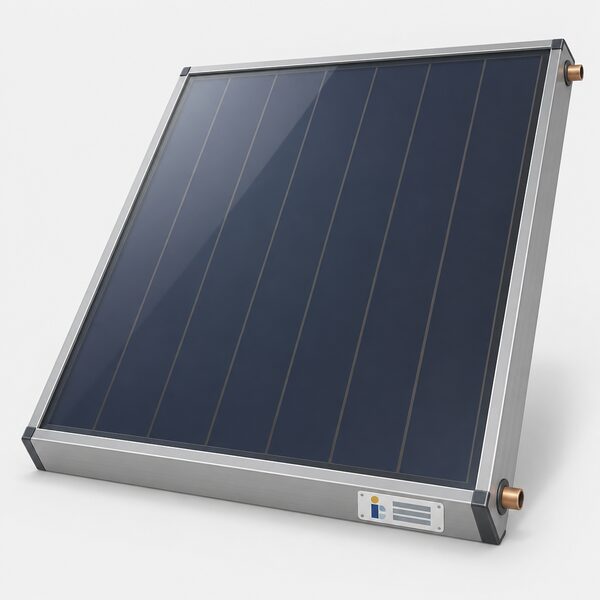
The Solar Keymark is a voluntary third-party certification mark for solar thermal products21. Its purpose is to promote the use of high quality solar thermal products in the European market and beyond22. It is a well-proven quality mark, in use for 18 years, and it is increasingly recognised worldwide21.
What the mark certifies is specific. Every certified product is in full conformity with the relevant European standards21. The certificate confirms that products are fully tested according to the relevant standards, that they meet additional requirements, and that they are aligned with those standards22. The certificate can only be issued by an empowered certification body, after the product has been tested by an accredited testing laboratory23.
The mark also carries a guarantee about identity. It provides the guarantee that the product sold is identical to the tested product22. That level of quality is maintained by initial type testing and by regular control of the products and their production sites by independent inspectors21. The mark filters out many lower-quality products available on the market21.
For a household, the mark matters in two ways. It ensures that the certified product will provide a good performance, as well as being resistant and durable21. And it is used in several support schemes in Europe: the Solar Keymark is required by several public authorities as an eligibility criterion for public support schemes23, and it is used in several support schemes in Europe21. Certified products gain eligibility for subsidies that include the certification as criteria22.
The mark is not compulsory in the UK, and it is not the same thing as MCS certification, which covers the installer and the installation. Solar Heat Europe is the Secretariat of the Solar Keymark23. A household comparing collector models can use the mark as a filter on product quality, and MCS certification as the filter on who fits it.
Maintenance, warranties and living with a system
Living with solar thermal is mostly a matter of an annual glance and a five-year service. Have your system checked thoroughly every five years to flush the system and replace the fluid mix4. MCS gives the same interval: these will typically be carried out every five years, but you can choose to have shorter, more regular checks for peace of mind8. Maintenance costs for solar water heating systems are generally very low8.
The fluid is the reason for the interval. The collectors are filled with a mixture of glycol and water6, or a mixture of water and antifreeze2. That fluid protects the system against frost and carries heat to the cylinder, and it degrades over time. Flushing and replacing it is the core of the five-year service4.
Warranties on the hardware are longer than the service interval. Most solar water heating systems come with a five-year or ten-year warranty8. Solar water heating installed by an MCS-certified contractor comes with both workmanship and product warranties, typically several years of workmanship and longer warranties for the solar collectors2.
| Item | Interval or term | Source basis |
|---|---|---|
| Thorough system check, flush and fluid replacement | Every five years | Energy Saving Trust4 |
| Maintenance check interval | Typically every five years, shorter checks optional | MCS8 |
| System warranty | Five-year or ten-year warranty | MCS8 |
| Workmanship warranty | Typically several years | MCS-certified installation2 |
| Collector warranty | Longer than the workmanship warranty | MCS-certified installation2 |
The limits are worth stating plainly. The system does not remove the boiler or immersion heater, and it does not heat the house. It has moving parts in the pump station and a fluid that must be replaced. It performs least well in the season when hot water demand is highest. And it commits the household to a cylinder, which is a constraint on future heating choices as well as a benefit now.
Where solar water heating fits in an energy-independent home
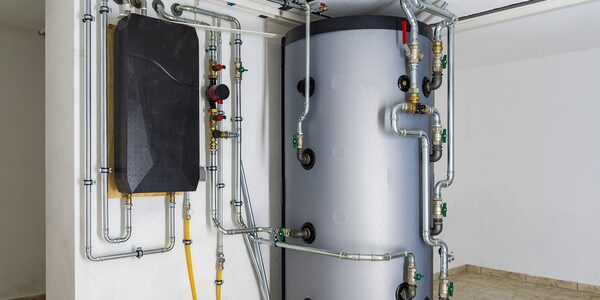
Solar thermal's contribution to independence is real but bounded. It converts sunlight into preheated water, reducing the fuel a household buys for baths, showers and hot taps. It cannot replace a traditional liquid fuel or gas-fired central heating installation3, and it will not provide 100% of the hot water needed throughout the year, with a conventional boiler or immersion heater normally making up the difference8.
What it does well is displace the most expensive fuels. The savings figures run highest for electricity at £230 per year and LPG at £200 per year, against £160 for gas and £100 for oil, on a 4 square metre panel system6. A household off the gas grid, heating water with electricity, LPG or oil, therefore gets more from the same collector area than one on mains gas.
The seasonal shape limits the independence it delivers. About 90% of hot water needs in summer and 25% in winter6 means the system is at its most useful when the heating system is least used. Over the year, a well-designed system can satisfy up to 70% of annual domestic hot water needs3, and the Energy Saving Trust puts the average at roughly half2.
Solar thermal also sits alongside solar PV rather than competing with it. Domestic solar comprised 30% of UK solar capacity and 84% of total UK solar installations at the start of 202617. A household weighing the two technologies is choosing between electricity generation and hot water pre-heat, and the two can be combined. The comparison is set out in solar thermal vs solar PV, and the wider picture of self-sufficiency in solar panels and household energy independence.
The dependence that remains is straightforward. The household still needs a boiler or immersion heater, still needs the fuel or electricity that feeds it, and still needs a cylinder and its controls. Solar thermal reduces the size of the bill and the volume of fuel imported; it does not sever the connection.
Sources23 cited
- Generating your own energy: solar water, Welsh Government
- Solar water heating, Energy Saving Trust
- Your home guide to solar water heating, OFTEC
- Could solar water heating work for you, Energy Saving Trust
- Solar water heating, Centre for Alternative Technology
- Solar water heating with solar thermal panels, Which?
- Solar thermal water heating, Planning Portal
- Solar heating, MCS
- Approved Document L draft consultation version, Welsh Government
- Approved Document L Volume 1 consultation version, Welsh Government
- Approved Document L, Conservation of fuel and power, Volume 1: Dwellings, HM Government
- Approved Document L, Volume 1: Dwellings, HM Government
- Building Regulations Part L and F review, Approved Document L, Welsh Government
- Solar panels and permitted development, London Borough of Richmond upon Thames
- Solar photovoltaic (PV) panels, London Borough of Bromley
- Solar panels, London Borough of Hammersmith and Fulham
- Building regulations renewables guidance, Bedford Borough Council
- Barcud Solar Panel Installation Scheme Specification, Sell2Wales
- Sustainability for self-build homes, Planning Portal
- VAT on energy-saving materials, HM Revenue and Customs
- Solar Keymark for public authorities, Solar Keymark
- Solar Keymark for consumers, Solar Keymark
- Solar Keymark network, Solar Heat Europe
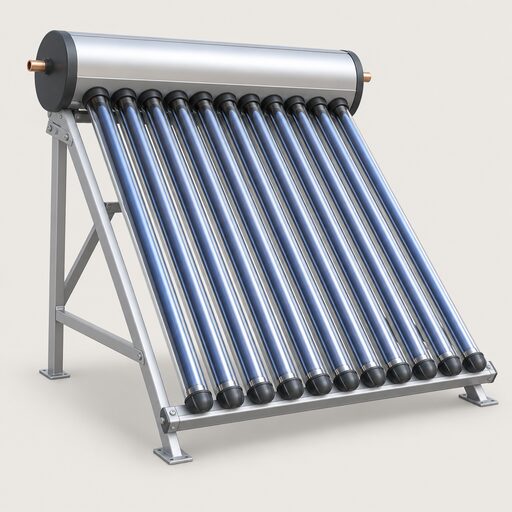 Solar Thermal Water HeatingSolar thermal panels heat your water using the sun, working alongside your boiler rather than replacing it.
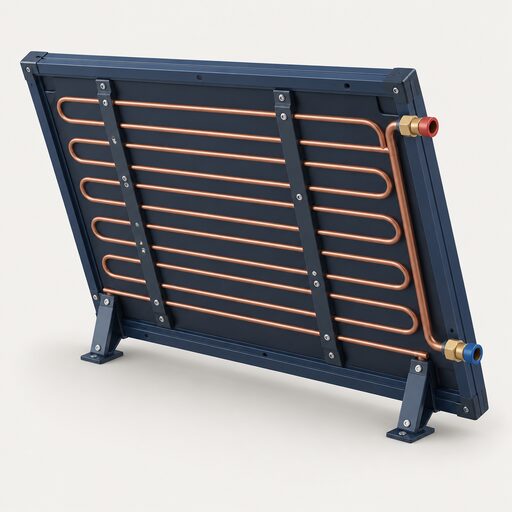 PVT Hybrid PanelsA PVT panel makes electricity and heats water from one roof space, so it suits homes without room for two separate systems.
 Energy IndependenceA heat pump runs your heating on electricity instead of gas or oil, so how much does that really cut what you pay and how exposed you are when fuel prices jump?
 Solar DivertersYour panels often make more electricity than your home needs.
 Hot Water Heat PumpsA hot water heat pump heats only the water in your cylinder, using air instead of a boiler flame.
 Whole-Home Energy DesignHeating and hot water use more energy than anything else at home, so that choice shapes everything.