
In this guide
- How Panels Work and Types
- Monocrystalline and Thin Film
- Appearance and Roof Integration
- Efficiency Ratings Explained
- Roof Space and Orientation
- Cost Savings and Payback
- Planning and Grid Registration
- Lifespan and Maintenance
- Warranties and Installer Cover
- VAT on Panels and Batteries
- MCS and TrustMark Certification
- Panel Choice and Independence
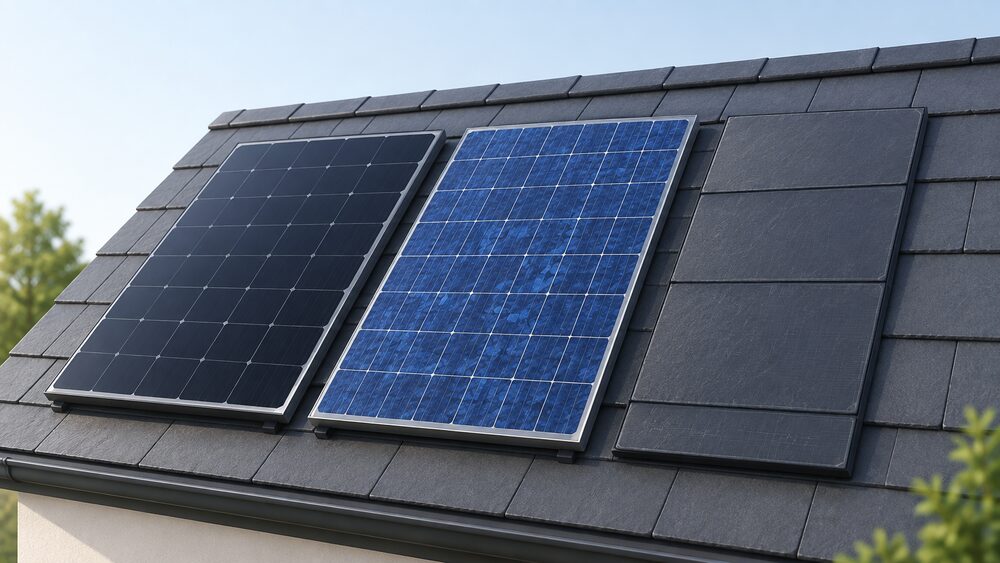
Almost every solar panel offered to a UK household today is a crystalline silicon module, and in practice that means monocrystalline. Monocrystalline panels are described as the most efficient panels currently available for domestic properties, with module efficiencies quoted up to 25 per cent, while polycrystalline modules average around 14 to 15 per cent and thin-film is less efficient than either. Beyond the cell type, the choices a householder actually faces are about format and appearance: a framed on-roof module in silver or all-black, a roof-integrated tile or slate, or a small plug-in kit.
Solar photovoltaic panels capture energy from the sun and turn it into electricity for the home to use, and they are the most common domestic renewable energy source in the UK, with nearly 1.7 million installations on homes across the country. An average system is around 3.5 kilowatt peak, using between six and 12 panels, costing around £6,100 as of October 2025 and saving between £530 and £650 a year on electricity bills1.
This page covers the panel types sold in the UK, what separates them on output and price, and the practical framework around them: roof space, cost and payback, planning and building regulations, warranties, VAT and certification. It does not recommend a type or a brand.
What a solar panel does, and the families of panel sold here
A solar panel, also known as a photovoltaic or PV panel, captures energy from the sun and turns it into electricity for the home to use7. The cells produce a direct current, which must pass through an inverter to become the alternating current a house uses1. A complete PV installation is therefore panels plus cabling, a control panel and an AC/DC inverter8.
Official guidance groups PV technology into crystalline cells, thin-film and hybrid9. Within crystalline, the split is monocrystalline and polycrystalline. Separately, PV can be installed as tiles and slates, which work in the same way as traditional solar PV panels but resemble traditional tiles or slates10.
Photovoltaics and solar thermal are different products that share the same roof. Solar thermal panels heat water rather than generating electricity, and come in two types, flat plate and evacuated tube, both in use in the UK market11. Solar thermal is described as the most popular form of solar energy used in the UK11, while solar PV is described as the most common domestic renewable energy source2. The two claims measure different things, and neither settles which is more widely installed.
A newer category is plug-in or balcony solar, now available to buy and use across Great Britain and to self-install13. Official specification work classifies plug-in solar into one-component, two-component and multi-component devices15.
Monocrystalline, polycrystalline and thin-film
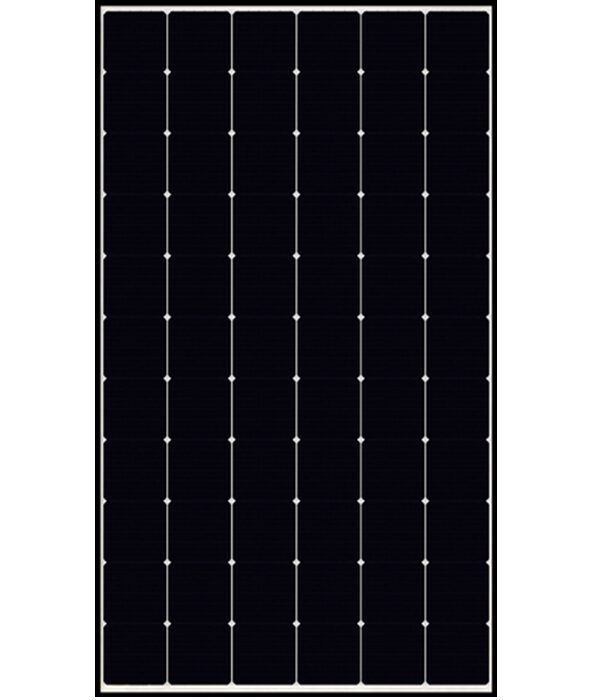
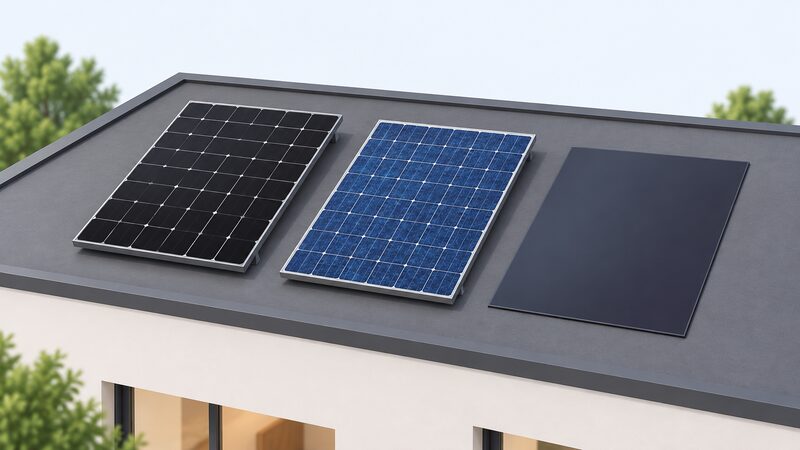
Monocrystalline panels take their efficiency from the single-crystal silicon that makes up the photovoltaic cells, and are the most efficient panels currently available for domestic properties6. Module efficiency is quoted at up to 25 per cent3. They are dark blue or black with no visible crystals16. The trade-off is price: they are described as very pricey3.
Polycrystalline panels are made by melting small silicon crystals together rather than using a single larger fragment of silicon6. The result is a module with visible crystals in different shades of blue, slightly less efficient than monocrystalline16, averaging around 14 to 15 per cent efficiency4. The gap between around 14 to 15 per cent and up to 25 per cent is wide enough that, on a roof of fixed size, panel choice materially changes how much generation fits.
Thin-film panels are less efficient than either monocrystalline or polycrystalline, and common materials include amorphous silicon, cadmium telluride and copper indium gallium selenide6. They are rarely the domestic default in the UK.
How firmly the market has moved is visible in procurement rules. A Welsh social landlord's solar installation specification requires monocrystalline panels for all installations, and states that polycrystalline panels "must NOT BE INSTALLED in any Barcud properties unless otherwise approved"4. That is one scheme's rule, not national law, but it reflects where new supply sits.
| Type | Appearance | Efficiency | Notes |
|---|---|---|---|
| Monocrystalline | Dark blue or black, no visible crystals16 | Up to 25%3 | Most efficient domestic option6; very pricey3 |
| Polycrystalline | Visible crystals, shades of blue16 | Around 14 to 15%4 | Slightly less efficient than mono16 |
| Thin-film | Laminate rather than cell grid | Less than crystalline6 | Amorphous silicon, cadmium telluride, CIGS6 |
| PV tiles and slates | Resemble roof tiles or slates10 | Not stated | Work in the same way as traditional PV panels10 |
For the cell architectures inside a modern monocrystalline module, see solar cell technology and N-type vs P-type solar cells. Format choices are covered in bifacial and glass-glass solar panels and roof-integrated solar.
Appearance: all-black modules and roof-integrated PV
Appearance is the reason many households end up choosing between two modules of near-identical output. Monocrystalline cells are already dark blue or black with no visible crystals16, and full-black or all-black modules extend that to the frame and backsheet so the array reads as a single dark rectangle. Polycrystalline panels, with their visible blue crystals, look quite different on a roof16. Panels come in different shapes and sizes and can be fitted on the roof, which is by far the most common option for domestic installations, in the garden, or on an external building such as a shed or garage17.
Where appearance is a planning matter rather than a preference, PV tiles and slates are the alternative: they work in the same way as traditional solar PV panels but resemble traditional tiles or slates10. That matters in conservation areas and on listed buildings, where planning permission may be required18. One local listed building consent order goes further and specifies that panels should be installed on the inverted slopes of a butterfly roof, or on a flat roof at a minimum of two storeys or six metres above street level, so they are not visible from the street.
Appearance carries no independence benefit of its own, but it determines whether an installation is permitted at all on a sensitive building, which is the point at which a household either can or cannot generate its own electricity.
Efficiency: what the rating means and what changes it
Module efficiency is the share of the light landing on the panel that becomes electricity. It sets how much generation fits on a given roof, not how much a panel is worth: a larger array of lower-efficiency modules can produce the same output where space allows.
Efficiency ratings are laboratory figures. In the real world, output is set by daylight, orientation and shading. Solar PV requires only daylight and not direct sunlight to generate electricity9, and panels work during daylight even when it is cloudy or overcast, because they use light rather than heat19. Panels also work in winter, generating less than in summer20. Orientation still carries a measurable penalty: a system facing east or west tends to get around 15 to 20 per cent less energy than one facing directly south1.
Panel efficiency also falls over time. The average lifespan of solar panels before they show significant degradation is about 25 years, and after 25 years many panels will have experienced degradation rates of anything between 12.5 per cent and 75 per cent21. That is a very wide band, and it is a reminder that a performance warranty, not a headline efficiency figure, is what a household actually holds.
Adding solar panels improves the energy performance of a home and can boost its Energy Performance Certificate rating; EPCs run on a scale from A to G, with A the most efficient. Datasheet conventions are explained in reading a solar panel datasheet.
Roof space, orientation and how many panels fit
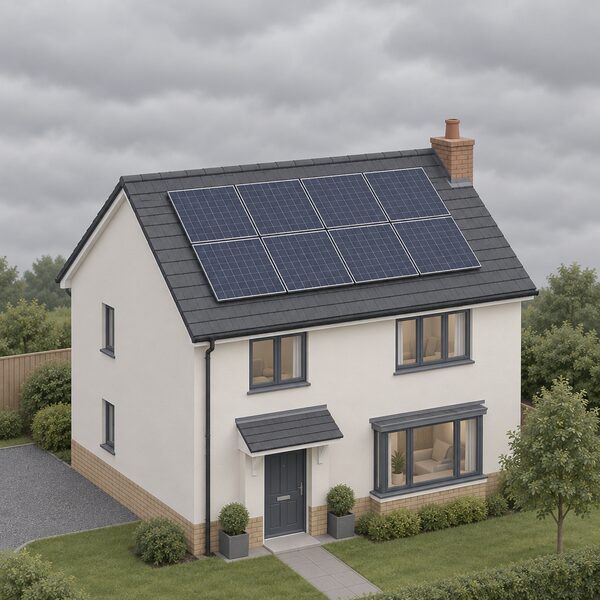
The average domestic system is around 4 kilowatt peak, requiring at least 20 square metres of roof space22. A 3.5 kWp system typically covers between 10 and 20 square metres using between six and 12 panels1, and a 4.5 kWp system typically covers between 20 and 30 square metres, using around 12 panels23. A general rule puts 10 to 20 square metres of PV at 20 to 40 per cent of a typical household's electricity needs12.
Panel counts by house size vary between sources. A one-bedroom house is quoted at around six panels and a standard three-bedroom house at 1021; a medium home of three to four bedrooms is elsewhere put at seven to nine panels24. The figures differ because they assume different panel wattages and different shares of demand covered. A typical rooftop system size is given as 4.6 kilowatts25.
Suitability is not only about area. A roof roughly south-facing gets maximum exposure; a roof with an east-west aspect could use panels on both sides26. The roof must be in good condition and have sufficient space, and if it is heavily shaded, solar panels may not be the most suitable option18. The number of panels that can be installed may be limited by roof shape, skylights, shading from nearby buildings or trees, local planning or conservation area requirements, and local grid capacity and export limits27.
Panels can be installed on both pitched and flat roofs; on a flat roof they need to be tilted and spaced to avoid shading1. That gives more flexibility over angle but is more complex, because panels may need additional mounting systems and the roof must support the extra weight, so it might cost more than a pitched roof installation27. Further detail sits in roof orientation, pitch and shading and what size solar system does a home need.
Cost, savings and payback
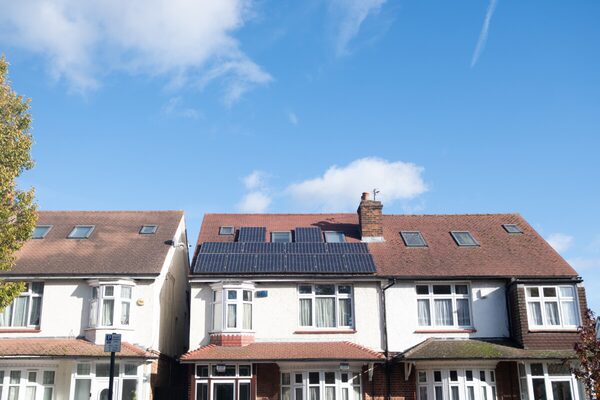
A typical installation costs around £6,100 for a system of around 3.5 kWp, saving between £530 and £650 a year on electricity bills in a home without electric heating or an electric vehicle. The split is behavioural: £650 a year if someone is home all day, £530 a year if everyone is out until 6pm. Both figures were current in October 20251.
The reason occupancy matters so much is that rates for selling electricity to the grid are much lower than tariffs for using electricity from the grid, so using solar electricity in the house is much more cost-effective than exporting it1. That is the single most important economic fact about domestic solar, and it is also the independence point: value comes from displacing imported units, not from selling.
Payback estimates differ widely across UK sources, and they do not agree:
| Source and date | Stated payback |
|---|---|
| Official council guidance1 | 10 to 12 years |
| Energy Saving Trust, August 202620 | About 10 to 12 years, as little as nine years |
| Uswitch, September 202624 | 7 to 10 years |
| Home Energy Scotland, September 202628 | 5 to 10 years, typically 8 to 12 years depending on maintenance |
| Which?, April 202629 | 10.9 to 12.2 years for rooftop panels |
Solar panels generally offer a reasonable payback within their lifetime. Adding storage changes the arithmetic: a solar and battery system has been put at about 10.5 years to pay off with the increased savings. Plug-in panels sit on a different scale, with payback quoted at 3.6 to 7.1 years29 and elsewhere at five to ten years, reflecting their far lower cost and far smaller output, typically 800 watts maximum against 4.6 kilowatts for a rooftop system29.
Householders who already have panels may be approached by solar buyback schemes, where companies offer a lump sum in exchange for receiving the remainder of the household's feed-in tariff. Costs and returns are set out at solar panel cost and savings and payback.
Planning permission, building regulations and grid registration
Solar panels often do not need planning permission because they are considered permitted development, but there are exceptions for listed buildings and homes in conservation areas1. Solar panels on listed buildings need both planning permission and listed building consent30, and that requirement extends to buildings within the curtilage of the listed building which pre-date July 194831. One council states plainly that planning permission is required for panels on flat roofs32. Rules vary by local authority and between the four nations, so the position is checked locally; there are separate pages for England, Scotland, Wales and Northern Ireland.
Building regulations are a separate matter from planning. An application is needed when installing a solar panel on a roof: roof strength must be assessed and may need strengthening, and the regulations also cover the electrical installation30. Approval may be required because of the additional loading on the roof structure and the associated electrical works18.
See connecting solar to the grid and building regulations and roof loading.
Lifespan, degradation and maintenance
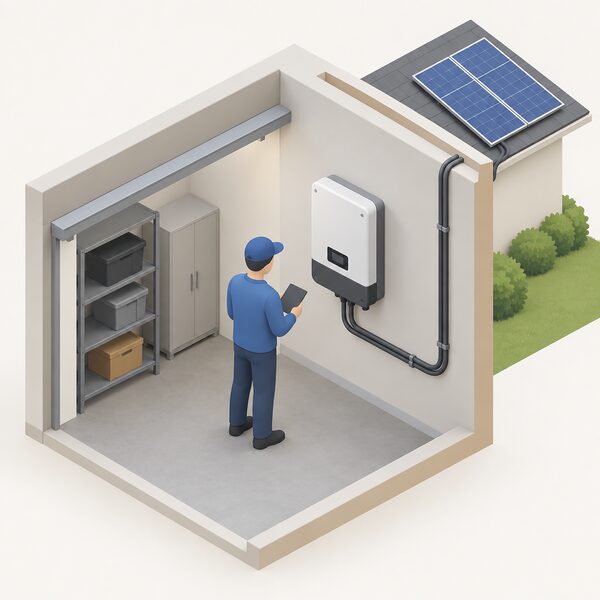
Panels are long-lived. The estimated lifespan of new solar panels is 25 to 30 years, although this can vary depending on their environment5. Other UK sources give 25 years or more1, over 25 years, and 25 years or more up to 30 years when properly maintained24; these figures are broadly consistent, though the upper bound is not agreed. Panels are made to last 25 years or more and need very little maintenance.
Maintenance is mainly cleaning and inverter replacement. A light clean every 12 to 24 months helps the system operate at its best by removing dirt, dust and other build-up34, and the Energy Saving Trust is also quoted as recommending cleaning every 12 to 18 months24. Professional cleaning typically starts at around £60 to £100 for a standard system34, or around £4 to £15 per panel depending on how easy the panels are to access and how dirty they are19.
The inverter is the recurring cost. Estimates for its replacement interval vary and do not agree: around 12 years1, 10 to 12 years6, about 10 to 12 years20, and every 10 to 15 years34. On a 25 to 30 year panel life, that implies at least one and possibly two inverter replacements. It is also the clearest limit on independence: the panels may outlast their manufacturer, but the electronics tie the system to a supply chain and, on many modern units, to an app and a cloud service. More detail at solar inverters explained and maintenance and cleaning.
Warranties: product, performance and installer cover
Two different warranties come with a panel. Solar panels usually come with a 25-year performance warranty and a five to 10-year product warranty35. The performance warranty covers output falling below a stated level; the product warranty covers the physical module. A typical rooftop panel warranty is given as 25 years, against 10 years for plug-in panels29. The gap between a five to 10 year product warranty and a 25 to 30 year expected life is where degradation claims and inverter failures fall.
Plug-in systems should be registered with the manufacturer to activate any warranty and so the owner can be contacted about any problem or safety recall14. Warranty terms and degradation curves are covered at solar panel warranties and degradation.
VAT on panels and batteries
Solar panels qualify for a lower rate of VAT as an energy-saving material36. Where a battery is fitted at the same time, HMRC treats "the combined installation of solar panels (an energy-saving material) and a battery for the storage of power generated from the solar panels" as a single supply of the installation of solar panels37, so the panel treatment carries the battery. The equipment covered alongside the panels is described as cabling, control panel and AC/DC inverter8. Rates and reliefs change; the position applying on the day of quotation is the one that counts.
Certification: MCS and TrustMark
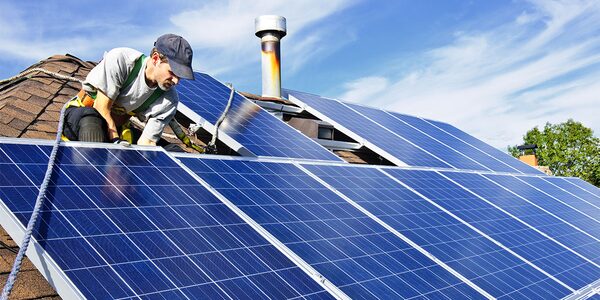
Official and scheme guidance is consistent on installer certification. Councils recommend using an installer certified by the Microgeneration Certification Scheme18, and note that using an MCS certified installer is the best way to avoid problems with building regulations38. Which? points out that in the UK solar panels are sold via installers rather than direct to consumers, which shapes what a buyer can compare39.
Funding schemes make certification a condition rather than a suggestion. Under the Warm Homes: Social Housing Fund, solar panels must be installed using an MCS approved product, by an MCS certified installer, to the relevant MCS installation standard15. One social landlord's specification requires that "The company providing the installation must carry a valid Trustmark and be MCS certified"4. ECO4 guidance requires measures to be installed by or under the responsibility of a TrustMark registered installer with a relevant certificate of lodgement40.
"Solar Photovoltaic systems should only be installed and certified by MCS certified contractors working to the latest published MIS3002 standards"
See MCS certification for solar PV.
What panel choice does, and does not, do for independence
Choosing a module type changes how much of a roof's potential is realised and how the array looks. It does not change the structural dependencies. A grid-connected system stays registered with a Distribution Network Operator and stays tied to a supplier for the units it cannot cover: 10 to 20 square metres of PV is put at 20 to 40 per cent of a typical household's electricity needs12, and output falls in winter20. Value comes chiefly from self-consumption, because export rates are much lower than import tariffs1. And the inverter, replaced every 10 to 15 years on some estimates34, keeps the household attached to a manufacturer for the life of the system. The panels are the durable part; almost everything else is a recurring relationship. The wider picture is set out on the solar PV pillar page and at solar panels and household energy independence.
Sources40 cited
- Solar panels: energy improvement options, Hammersmith and Fulham Council, 2026-09-17
- Generating renewable electricity, Energy Saving Trust, 2025-12-11
- Are solar panels worth it?, Which?, 2026-05-15
- Solar Panel Installation Scheme Specification, Sell2Wales, 2026-06-15
- Solar photovoltaics research briefing, POST, UK Parliament, 2026-06-25
- Solar panel installation, maintenance and repair, NICEIC, 2026-09-17
- Solar panels guidance, East Herts Council, 2026-09-17
- VAT on energy-saving materials: installations, HMRC, 2026-09-17
- Generating your own energy: solar electricity, Welsh Government
- Solar equipment on residential buildings technical advice note, Hart District Council, 2025-01
- Solar thermal panels, nidirect, 2024-10-22
- Plumbing with renewables, CIPHE, 2026-09-17
- Simple tips for a greener Easter, Home Energy Scotland, 2026-03
- Plug-in solar consumer guide, Electrical Safety First, 2026-08
- Plug-in solar interim product specification, UK Government, 2026
- Solar photovoltaic information, Centre for Alternative Technology, 2026-03-10
- Solar photovoltaic (PV) for consumers, MCS, 2026-07-30
- Solar photovoltaic (PV) panels, Bromley Council, 2026-09-17
- Solar panel myths debunked, Which?, 2026-06-09
- Solar power facts, Energy Saving Trust, 2026-08-13
- How long do solar panels last?, Uswitch, 2026-07-13
- Buying advice for solar panels, Which?, 2026-08-12
- Solar panels advice, Energy Saving Trust, 2026-08-27
- Are solar panels worth it?, Uswitch, 2026-09-16
- Plug-in solar panels, Which?, 2026-03-26
- A complete guide to solar PV, Centre for Sustainable Energy, 2025-11
- Solar panel installation, Energy Saving Trust, 2026-09-07
- Solar panels, Home Energy Scotland, 2026-09-20
- Plug-in solar panels vs rooftop systems, Which?, 2026-04-27
- Solar panels and planning permission, Cornwall Council, 2026-09-17
- Solar photovoltaics and planning in conservation areas, West Suffolk Council, 2026-09-17
- Planning and solar, Frome Town Council, 2025-09-02
- Plug-in solar connections, Electricity North West, 2026-09-20
- Solar panel cleaning and maintenance, Energy Saving Trust, 2026-08-25
- Buying a house with solar panels, Energy Saving Trust, 2026-08-13
- Tax on shopping: energy-saving products, GOV.UK, 2026-09-17
- VAT on energy-saving materials: single and multiple supplies, HMRC, 2026-09-17
- Building regulations renewables guidance, Bedford Borough Council, 2026-09-17
- How we test solar panels, Which?, 2026-08-12
- ECO4 delivery guidance version 4.0, Ofgem, 2026-03-26
 Solar Panel Manufacturers UKWhich solar panel brands are actually worth buying in the UK, and who really makes them?
 Solar Panel CostsA typical UK home pays somewhere between four and eleven thousand pounds for solar panels fitted, with most landing in the middle.
 The Full Solar Panels GuideHow much do solar panels cost, and what could they save you each year?
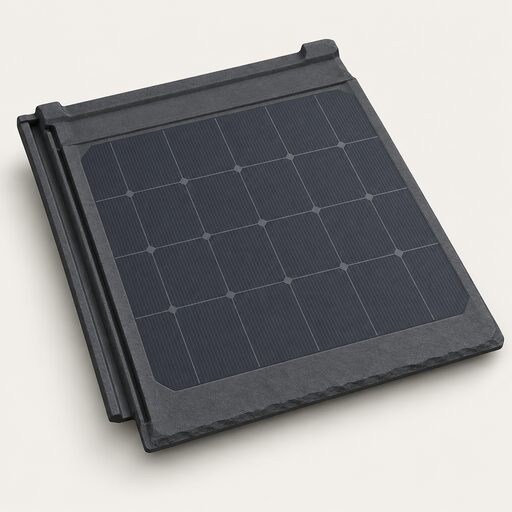 Roof-Integrated SolarSolar tiles replace your roof covering instead of sitting on top of it, so the finished roof looks like a roof.
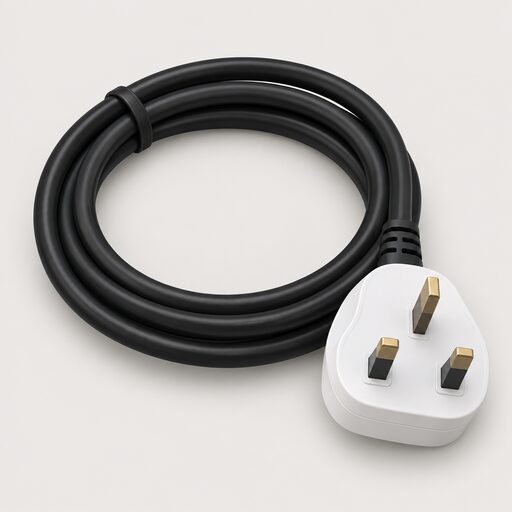 Plug-In Solar KitsCan you really plug solar panels into a normal wall socket in the UK, and is it legal now?
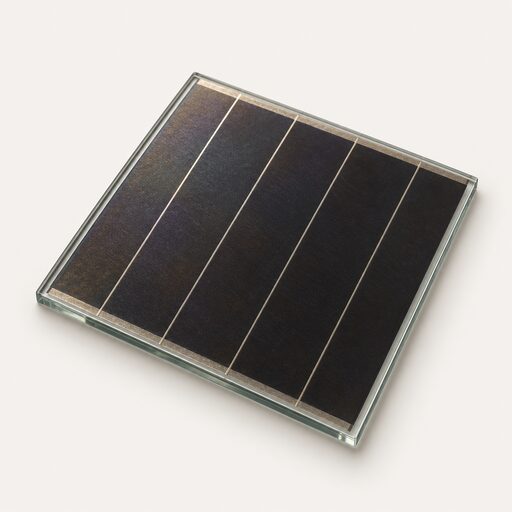 Perovskite Solar CellsPerovskite solar panels are a newer kind of panel that could be cheaper and more efficient than the ones sold today.