
In this comparison
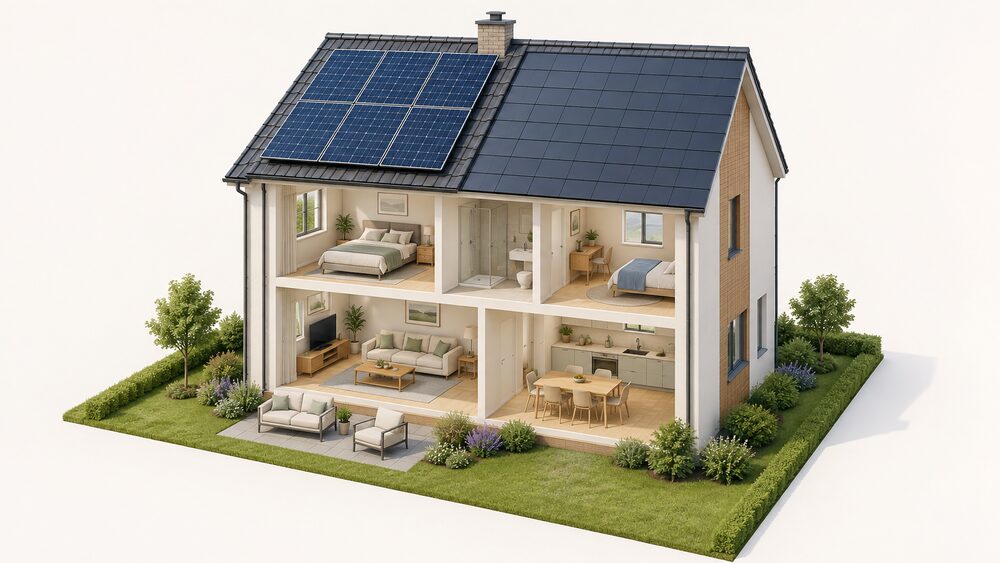
Solar panels and solar roof tiles do the same job by different means. Both turn sunlight into electricity, but panels sit on top of an existing roof covering while tiles replace it. The trade is straightforward: tiles look like a roof, panels look like an addition. Independent guidance puts solar tiles at normally about 1.5 times the cost of a solar panel installation1, and a separate guidance page describes them as approximately double the price of solar panels2. On output, tiles are less efficient per area than panels, typically producing only 80% of the electricity for the same roof area1.
That combination, more money for less electricity per square metre, is why the case for tiles rests on aesthetics and on timing rather than on generation. Independent guidance is blunt that tiles are only really cost effective if you are renovating the roof or building a new home1. If the roof is sound and staying put, panels on top are the cheaper route to the same kilowatt hours.
For a household weighing energy independence, the two options deliver the same thing: generation on your own roof, a smaller import bill, and the same residual dependence on the grid for evenings, winter and anything the roof cannot cover. The choice between them is about how the roof looks and when the work happens, not about how independent the house becomes.
Solar panels vs solar tiles: the short answer
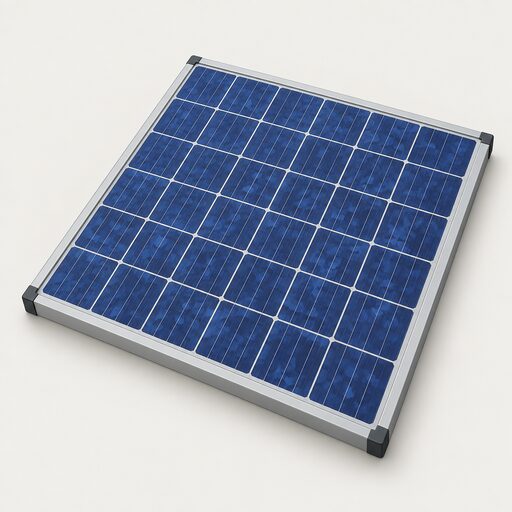
Solar electricity panels, also known as photovoltaics (PV), are the familiar on-roof product4. Solar roof tiles, also called solar slates or solar shingles, are a solar technology that looks like normal roof tiles1. Both generate electricity directly from sunlight; the difference is where the generating surface sits in relation to the roof structure.
The practical answer for most households comes down to three questions. Is the roof being replaced anyway? Is the appearance of the roof a deciding factor? Is the budget able to carry a premium for the same or slightly lower output? Independent guidance frames the cost gap as normally about 1.5 times a panel installation1, while another guidance page puts tiles at approximately double the price of solar panels2. The two figures are not identical, so both are worth holding in view.
On performance, the direction is consistent across sources. Tiles are less efficient per area than panels, typically producing only 80% of the electricity for the same roof area1. A separate guidance page states they are not as efficient as solar panels and will produce less electricity from the same surface coverage2. Neither source suggests tiles outperform panels.
Where the two converge is in what they do for the household. Either way, generation happens on your own roof, and the household still draws from the grid when the sun is down or demand exceeds output. The independence gained is real but partial, and it is the same partial independence whichever product is chosen.
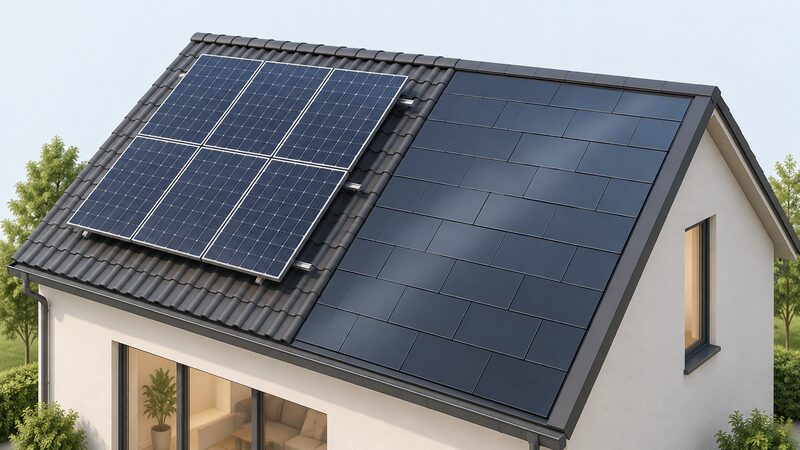
What solar roof tiles are and how they differ from panels
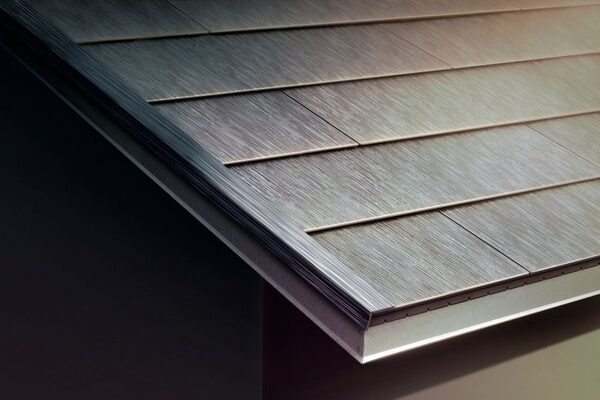
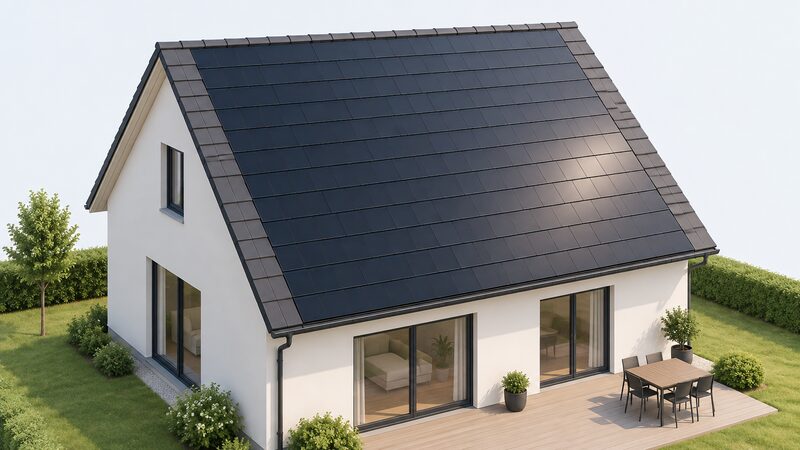
Solar roof tiles incorporate mini solar panel units to generate clean electricity from sunlight1. They are fitted to your roof instead of normal tiles, so the solar installation does not affect the look of your roof1. They are built into the structure of the roof itself, ensuring that they blend in as much as possible2.
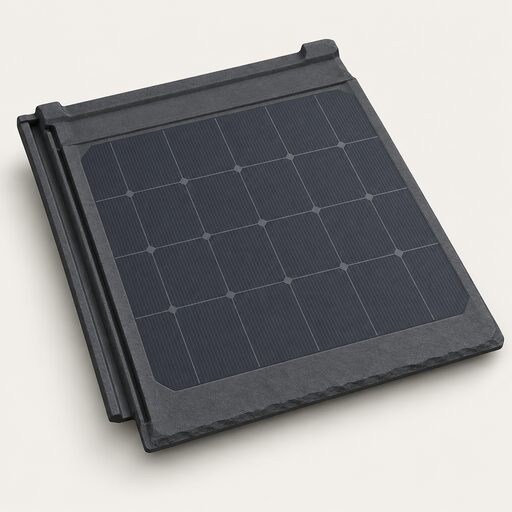
Official guidance describes the same product family from the planning side: solar PV can also be installed in the form of PV tiles and slates, which work in the same way as traditional solar PV panels but resemble traditional tiles or slates5. That is the cleanest statement of what the product is. The photovoltaic effect is unchanged; the packaging is what differs.
The materials are also the same. Independent guidance states that solar tiles are made from the same materials as solar panels, and that they generate electricity directly from sunlight while providing the performance and appearance of standard roof tiles2. They are fitted in the same way as standard tiles2, which is why the roofing trade rather than the electrical trade leads the installation.
Coverage is where tiles change the geometry of a job. They can cover the entire roof, almost to the edge, and then can be accompanied with matching, non-solar tiles around the edges; they can also be used to cover part of a roof1. Official guidance notes that solar tiles and slates can integrate seamlessly with new and existing roofs and are compatible with a wide range of roof tiles and slates6. That compatibility matters on a re-roof, where the new covering has to meet the old at a detail that will not leak.
The dependence that remains is the same as for any grid-connected PV system: an inverter, a connection agreement, and a supplier relationship for whatever the roof cannot supply. Tiles do not change that. They change what the roof looks like while doing it.
Cost: tiles at 1.5 to 5 times the price of panels
The cost picture has to be read carefully because the published figures compare different things. Independent guidance gives the multiple as normally about 1.5 times the cost of a solar panel installation1. A separate guidance page says solar roof tiles are approximately double the price of solar panels2. A consumer body states that solar tiles can cost double the amount of an equivalent solar PV panel system7. 5 times to about double.
For the panel baseline, the figures are more consistent. Independent statistics give a typical retrofit cost of £5,000 to £10,0003. Independent guidance puts panels at between £6,100 and £11,000 depending on the size of your property8, and another source gives an average upfront cost of £6,1009. Independent news reports an initial cost typically between £6,000 and £10,00010. Official guidance from 2017 gave an indicative £5,000 to £8,00011, which is older and lower than the current figures.
| Item | Figure | Source |
|---|---|---|
| Solar tiles vs panel installation | Normally about 1.5x | 1 |
| Solar tiles vs solar panels | Approximately double | 2 |
| Solar tiles vs equivalent PV system | Can cost double | 7 |
| Panel retrofit, typical | £5,000 to £10,000 | 3 |
| Panels, by property size | £6,100 to £11,000 | 8 |
| Panels, average upfront | £6,100 | 9 |
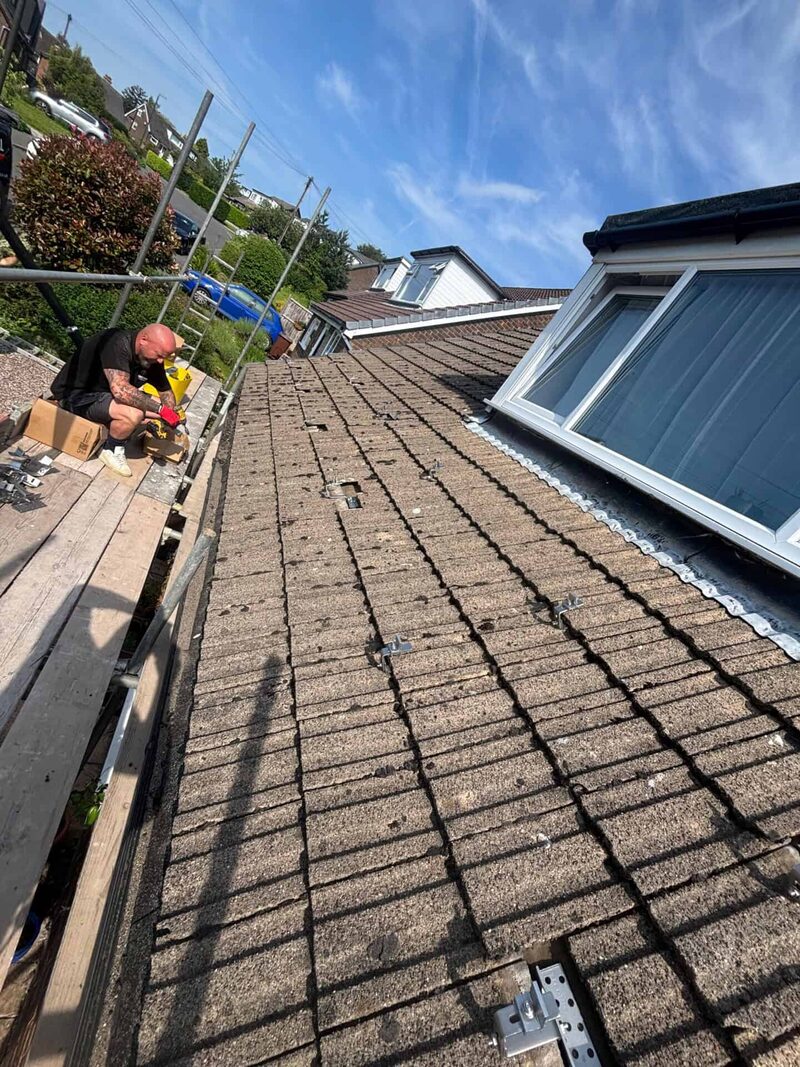
Two exclusions matter on a tile quote. Independent guidance notes that the price does not include removing existing tiles or your scaffolding costs1. On a re-roof those are not optional extras, they are part of the job, so the headline multiple understates the real difference between the two routes.
Cost also depends on factors beyond the product. Independent guidance lists size, how easy it is to access your roof, and whether you prefer panels or tiles12. Another source lists whether you are having solar panels or solar tiles, and whether the panels are to be installed on your roof or ground-mounted13. The product choice is one variable among several, but on tiles it is the one that moves the number most.
Efficiency: tiles produce about 80% of what panels do from the same roof area
The efficiency gap is the strongest argument for panels. Independent guidance states that solar tiles are less efficient per area than solar panels, typically producing only 80% of the electricity for the same roof area1. A separate guidance page says they are not as efficient as solar panels and will produce less electricity from the same surface coverage2. Both point the same way.
The reason is area. A tile carries a smaller active photovoltaic area than a framed panel of the same footprint, because the tile has to interlock and overlap like a roof covering. The generating material is comparable; the proportion of the roof that is actually generating is not.
Output from any PV system depends on more than the product. Independent news lists the factors as your geographical location, the season and therefore hours of daylight, your roof's compass direction and slope, and any shading that might block the panels at certain times of day14. Those factors apply to tiles as much as to panels, and they can matter more than the 80% figure on a roof that is partly shaded or not ideally angled.
For a household, the practical consequence is that a tile roof may need more of the roof covered to reach the same annual generation as a panel array. Where the roof is large, that is a design choice. Where the roof is small, it can be the difference between hitting a target output and not.
The independence implication is modest but real. A system producing 80% of what a panel array would produce from the same area supplies less of the household's demand, so more is imported. That does not make tiles a poor choice, but it does mean the case for them has to rest on appearance and on the timing of the roof work rather than on generation.
Where tiles work best: roof orientation and roof replacement projects
Orientation is less of a barrier than it is often assumed to be. Independent guidance says east or west will work well, while south facing works best, and that solar tiles are not recommended for north facing roofs2. Official Welsh guidance notes that east or west installations can also provide good performance and can be used for a building with a roof or wall that faces within 90 degrees of south15.
For panels, the guidance is similar in shape. Independent guidance says a south-west or west-facing roof would also be suitable, though a little less productive16. Another source notes that while south-facing roofs typically perform best, you can still benefit from solar energy with north-facing roofs17. Independent guidance states that solar panels generate the most electricity when they face south18. The general rule is that south is best, east and west are workable, and north is the weakest case.
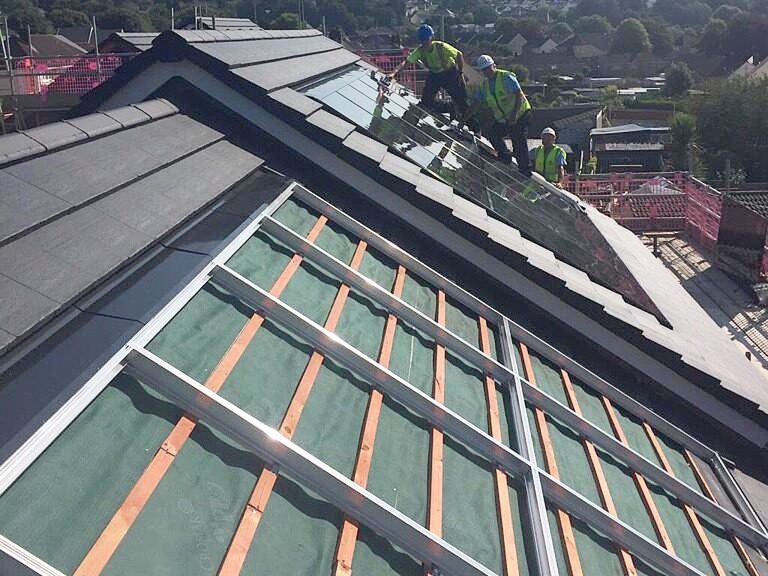
The decisive factor for tiles is not orientation but timing. Independent guidance says solar tiles can be installed as part of a new build property or as a roof replacement, but not into an existing roof2. The same source says they are very difficult to retrofit, meaning that it is likely an entire roof would need to be replaced in order to install them2. Independent guidance confirms they are only really cost effective if you are renovating the roof or building a new home1.
Tiles also suit certain roof shapes. Independent guidance lists angled roofs, roofs with eaves and other complicated roofs as cases where tiles can be a good solution for getting the most out of the available space1. That is the opposite of the usual panel constraint, where complex geometry creates shading and fixing problems.
Who installs them: roofer plus solar electrician, and more connection points
A tile installation is two trades, not one. Independent guidance states that a professional roofer can carry out the installation, but that a solar electricity professional will be required to wire them together2. The roofing side is a roof replacement; the electrical side is a PV installation. Both have to be right, and they are covered by different warranties.
Building regulations normally apply. Official guidance for England states that if you wish to install a solar panel on your roof building regulations will normally apply19. The equivalent Welsh guidance says the same20, as does the guidance for Northern Ireland21. Structural questions are part of that: official guidance states that where a structural check is needed it must be done by a qualified structural engineer22.
Waterproofing is the tile-specific risk. Independent guidance notes that manufacturers and installers may offer a waterproofing warranty for solar roof tiles1. That warranty is the counterpart to the roof covering being replaced, and it is worth establishing in writing who carries it and for how long.
On procurement, independent guidance recommends getting quotes from at least three different installers to make sure you are getting the best value1. Where a group-buying scheme is used, official guidance describes the process: once you accept your offer, a surveyor will visit your property to assess whether your roof is suitable for a solar installation and confirm the number of panels, their location, other details such as cabling locations and colour23.
The connection-point question has no published count. What the guidance establishes is that tiles need a solar electricity professional to wire them together2, and that a professional roofer can carry out the roofing work2. The number of joints depends on the tile product and the roof, and is settled at design stage rather than from a general figure.
When panels on top of the roof are the better choice
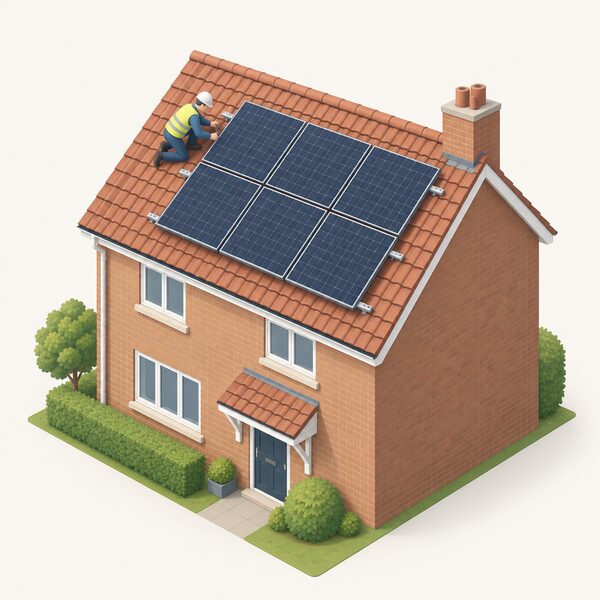
Independent guidance is direct on this: panels on top of the roof are the cheapest option, while tiles are the most expensive for the equivalent system24. Where the roof is sound and not being replaced, that settles the cost question. Panels are also listed as best suited for existing roofs1, which is the situation most households are in.
Panels are the more flexible product. Independent guidance notes that you can choose between having solar panels installed on your roof, by far the most common option for domestic installations, or ground mounted25. Official guidance adds that solar panels can be installed on both pitched and flat roofs, and that on a flat roof the panels will need to be tilted and spaced to avoid shading5. Tiles do not offer that range of siting.
There is a structural condition either way. Official guidance states that solar panels are not light and the roof must be strong enough to take their weight, especially if the panel is placed on top of existing tiles26. That is a check on the roof, not a reason to prefer one product, but it is part of the survey on any installation.
For a household thinking about independence, the panel route buys more generation per pound and leaves the roof covering undisturbed. The dependence that remains is unchanged: the grid, a supplier, and an inverter that will need replacing before the panels do. Panels do not remove that dependence, and neither do tiles.
Where the roof is being replaced anyway, the calculation shifts. The scaffolding is going up regardless, the tiles are coming off regardless, and the marginal cost of integrating generation into the new covering is smaller than the headline multiple suggests. That is the narrow window in which tiles make financial as well as visual sense, and it is the case independent guidance identifies1.
For the wider picture on how generation, storage and export fit together for a UK household, see Solar PV for UK Homes and Roof-Integrated Solar: In-Roof Systems and Solar Tiles. For the on-roof alternative in detail, see Roof-Integrated vs On-Roof Solar Panels and Solar Panel Cost in the UK.
Sources26 cited
- Solar roof tiles, Energy Saving Trust, 2026-08-13
- Solar roof tiles, Home Energy Scotland, 2018-12-04
- Watt a Save, Home Builders Federation, 2026-02
- How do I retrofit my home: solar panels, Oxfordshire County Council, 2026-09-17
- Solar equipment on residential buildings, Hart District Council, 2025-01
- UK Solar PV Strategy Part 2, Parliament, 2014-04
- Are solar panels worth it?, Which?, 2026-05-15
- Make your home more energy efficient, Confused.com, 2026-07-06
- Are solar panels worth it?, Uswitch, 2026-09-16
- Do solar panels increase home value?, CPA, 2026-01-20
- Domestic private rented property minimum energy efficiency standard, GOV.UK, 2017-10-01
- Understanding energy: how do solar panels work, Smart Energy GB, 2026-03-16
- Solar PV, Flexi-Orb, 2025-04-22
- Solar panels: how much of your electricity can they produce, Which?, 2024-06-27
- Generating your own energy: solar electricity, Welsh Government, 2026-09-17
- A complete guide to solar PV, Centre for Sustainable Energy, 2025-11
- Solar panel installation, Energy Saving Trust, 2026-09-07
- Solar panels, Renewable Energy Consumer Code, 2026-09-17
- Building regulations, Planning Portal, 2026-09-17
- Building regulations: solar panels, Welsh Government, 2026-09-17
- Solar panels, Wirral Council, 2026-09-17
- Solar panels, East Herts Council, 2026-09-17
- Installing solar panels at your home, Brighton and Hove City Council, 2026-09-17
- Solar panels, Home Energy Scotland, 2026-09-20
- Solar panel installation, maintenance and repair, NICEIC, 2026-09-17
- Solar thermal water heating, Planning Portal, 2026-09-17
 Roof-Integrated SolarSolar tiles replace your roof covering instead of sitting on top of it, so the finished roof looks like a roof.
 Solar Mounting SystemsWill your roof take the extra weight of solar panels, and will it still keep the rain out afterwards?
 Panel TypesWhich solar panels are best for a UK home, and how much do they cost?
 Panels by Home TypeCan your house have solar panels, and how many will fit?
 Solar Panel CostsA typical UK home pays somewhere between four and eleven thousand pounds for solar panels fitted, with most landing in the middle.
 Roof Orientation and ShadingWhich way should your roof face for solar panels, and does it really matter if it is not south?