
In this answer
Short answer
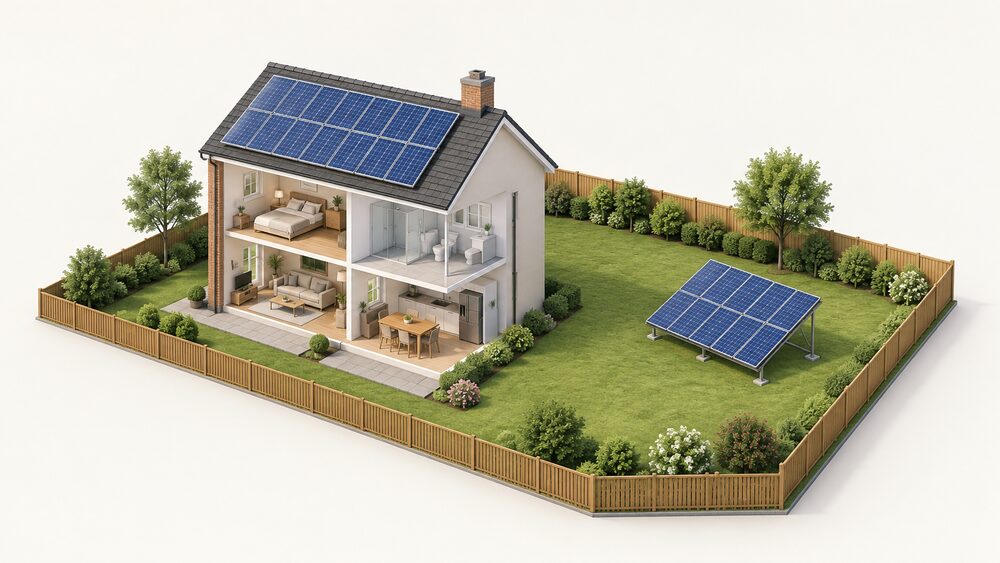
Roof mounting is the default for UK homes, and for most households it is the only practical option. Ground mounting is a genuine alternative where the roof is unsuitable, shaded or too small, and it is classed as permitted development in most cases provided the array stays within set limits: no more than 9 square metres of panel surface, no higher than 4 metres, and no closer than 5 metres to a boundary1.
The two routes differ in more than appearance. A roof array is fixed to the dwelling, so it stays with the property and adds no separate footprint. A ground array can be positioned and angled to face south regardless of the building's orientation, is easier to reach for maintenance, and can be expanded, but it consumes garden or land, needs site preparation, racking and wiring, and may need planning permission if it crosses the permitted development thresholds2.
Cost is the other dividing line. Published UK figures cover rooftop systems: around £7,600 on average, or £7,400 for a typical system, with a 3.5 kW domestic system put at about £6,100 in 20263. Ground mount has no equivalent published price because site preparation, racking and wiring vary so much from one plot to another2.
Roof or ground: which mounting option fits which home
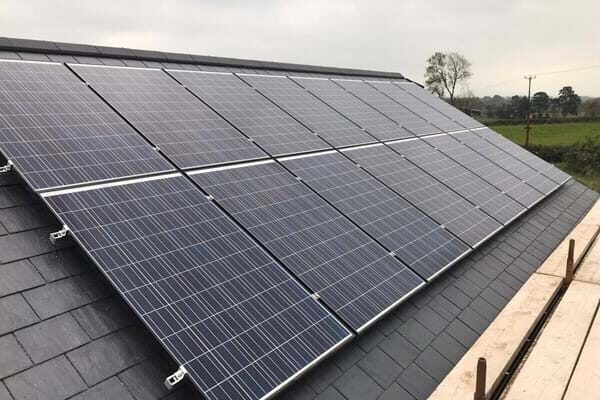
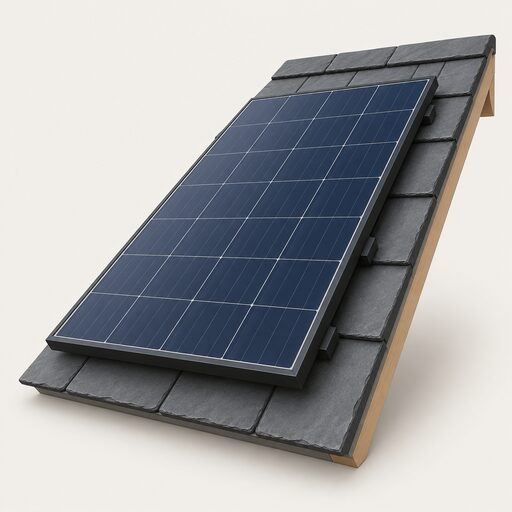
Roof mounting is by far the most common option for domestic installations, and the reasons are structural rather than aesthetic5. The roof is already there, it is above the shading of fences and neighbouring buildings in most cases, and the array adds nothing to the garden. Panels can be installed on both pitched and flat roofs, though on a flat roof they need to be tilted and spaced to avoid shading6.
The constraint is orientation and space. A roof roughly south-facing is needed for maximum exposure, and where the roof has an east-west aspect, panels can be used on both sides7. Solar panels generate the most electricity when they face south because they capture as much sunlight as possible8. Roof size dictates capacity, so a small or heavily interrupted roof caps the system size regardless of budget2.
Ground mounting earns its place where the roof cannot do the job. It suits homes with a north-facing or heavily shaded roof, roofs crowded with skylights or vents, or a garden with an open southerly aspect. It also suits households wanting a larger array than the roof can carry, or wanting the option to expand later. The trade-off is land: the array occupies ground that would otherwise be garden, and it needs a mounting structure rather than roof hooks and rails.
Solar water heating follows the same logic, with panels mounted on a roof, fixed to a frame on a flat roof or hung from a wall9. Some solar products are designed for more than one position: the Naked Energy Virtu is described by its maker as roof, façade or ground mounted6. For most households, though, the choice is between a roof array and a ground array, and the deciding factors are orientation, shading, available space and how much garden the household is willing to give up.
Roof mounting: the default for a reason
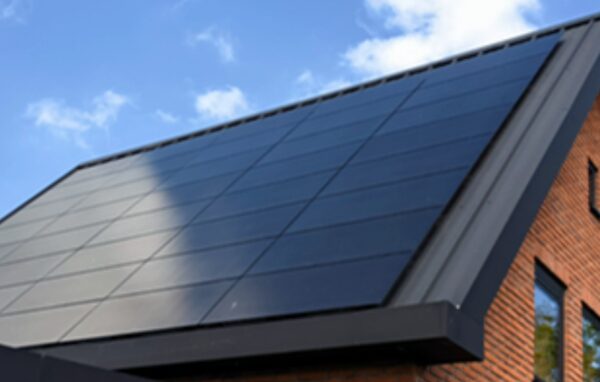
Roof-mounted panels are usually a permitted development, so planning permission is not normally needed10. Generally, permission is not required for most domestic installations as long as they are fitted to minimise the effect on the external appearance of the building9. Placing solar panels on the roof of a house or flat, or a building within the grounds, is considered permitted development in most cases, whether in a conservation area or otherwise11. In England the relevant route sits under the Town and Country Planning (General Permitted Development) (England) Order 2015, Schedule 2, Part 14, Class J12.
There are limits even within permitted development. The highest part of the solar panel or equipment must not be higher than the highest part of the roof, excluding any chimney13. Roof-mounted panels should project no more than 200mm from the roof slope or wall surface14. In conservation areas and National Landscapes, prior approval is required where solar panels are located on a flat roof15. Planning permission is not usually required to install solar panels on the roof of a house or block of flats in a conservation area, even if the roof faces a highway16. Solar panels fitted to roofs in conservation areas do not require planning permission provided they meet the general rules17.
The practical advantages are cost and simplicity. Rooftop mounting wins for buyers focused on tighter installation scope and fewer site variables18. The cost of rooftop solar installation may also be 10% cheaper for new builds4. Against that, roof suitability affects cost: skylights or roof vents may make it harder to install solar panels and increase the installation costs, and a steep roof might slowly build up dirt on the panels19. Which solution is best depends on the roof and the substructure, and the mounting system must suit the roof type with the manufacturer's installation instructions followed20.
Ground mounting: when it earns its place
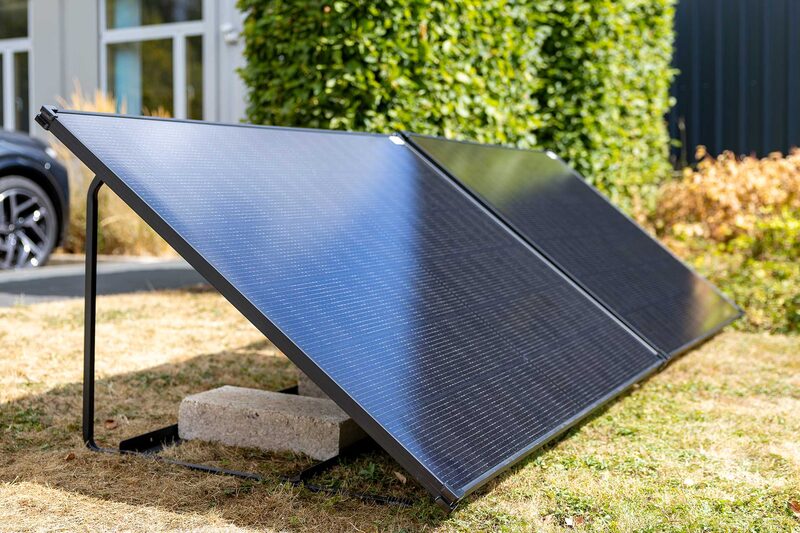
Ground mounting is the route for households whose roof cannot carry a worthwhile array, or who want more capacity than the roof allows. A ground-mounted system wins on maintenance and serviceability, on scaling, and on output optimisation, because the array can be sited and angled freely rather than following the roof pitch18. It can be built on varied terrain, even integrated into carports or farms2.
The planning position is more conditional than for roofs. Ground-mounted solar installations are classed as permitted development, which does not need planning permission, unless specified conditions are met21. Permission is required where any part of the equipment is within 5 metres of the boundary of the property's grounds or gardens, where the surface area of the solar panels is more than 9 square metres, where any part of the equipment is taller than 4 metres, where any part would be closer to the road than the closest part of the main property, where the installation is within the grounds or gardens of a listed building or scheduled monument, or where there is already a stand-alone ground-mounted solar equipment installation within the grounds1. The same conditions apply in Bath and North East Somerset, where permission is needed if there is already a stand-alone ground-mounted installation within the curtilage21.
Ground-mounted solar PV installations should normally be regarded as a temporary use of land10. That framing matters for two reasons: it reflects that the array can be removed and the land returned to another use, and it signals that a ground array is not treated as a permanent structure in the way a building is. For a household, it means the array is potentially relocatable, though whether it can practically be moved depends on the mounting system and the installer.
Cost and planning differences between the two
The published cost figures are for rooftop systems, and they vary by source and by what is included. A rooftop solar panel system costs around £7,600 on average3. A typical system is put at £7,40022. The Energy Saving Trust calculates the average domestic solar panel is 3.5 kW and costs around £6,100 in 20264. The spread reflects system size, roof access and whether panels or tiles are preferred: cost can depend on things like size, how easy it is to access the roof, or whether panels or tiles are chosen19.
Ground mount has no comparable published UK price. More site preparation, racking and wiring can increase expenses2, and those costs depend on ground conditions, cable runs back to the consumer unit and the mounting structure chosen. Prices are installer-quoted, and the honest position is that a ground array is priced per project rather than from a table.
| Roof mounted | Ground mounted | |
|---|---|---|
| Planning route | Usually permitted development10 | Permitted development unless conditions are met21 |
| Surface area limit | Not applicable in the same way | 9 m² for permitted development1 |
| Height limit | Must not exceed the highest part of the roof13 | 4 metres1 |
| Boundary rule | Projects no more than 200mm from the roof slope14 | Not within 5 metres of a boundary1 |
| Published cost | Around £7,600 on average3 | Installer-quoted, no published UK figure |
| Portability | Stays with the property | Regarded as a temporary use of land10 |
Payback figures differ by date and method. Rooftop solar panels were reported as paying for themselves in just over six years in 202223. More recent analysis of quoted upfront costs puts payback within nine to 10 years24. The difference reflects changes in import costs, tariffs and the period measured, and both figures are reported rather than guaranteed.
What the choice means for household energy independence
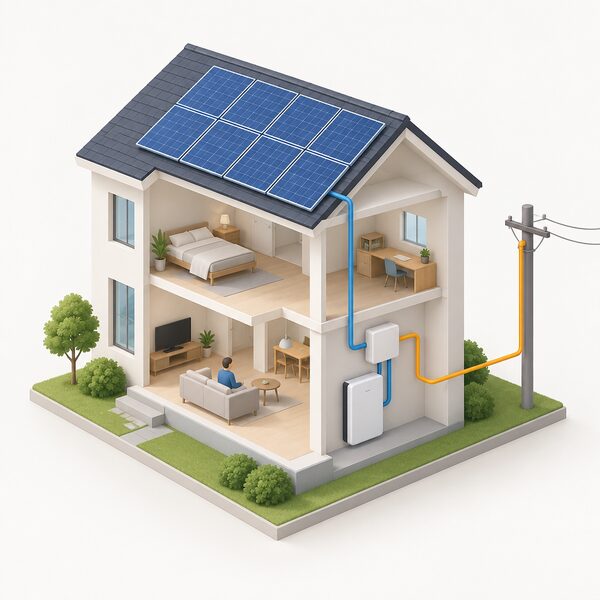
Either mounting option reduces the electricity a household draws from the grid. Rooftop solar systems with home batteries mean less electricity is drawn from the grid, reducing the amount paid in bills25. A typical domestic rooftop system produces around 3.5 kW at its peak4. The independence is real but partial: the array still depends on the grid for export, for backup when generation is low, and for the inverter and monitoring equipment that makes the system work.
The dependence that remains differs between the two routes. A roof array depends on the building's orientation and pitch, on the roof structure, and on the manufacturer of the mounting system and inverter. A ground array depends on the land, on the planning position, and on the cable route back to the house. Neither removes the household from the grid, and neither removes the need for a supplier for import and export.
The wider picture is that both routes matter at national scale. Half of the UK's solar potential is expected to come from rooftop solar (domestic, business and schools) and half from ground mount solar26. The Future Homes Standard consultation included an option that would have required solar PV panels covering the equivalent of 40% of a new home's ground floor area27, and Approved Document L refers to roof-mounted photovoltaic arrays installed over an area equivalent to 40% of the dwellinghouse's ground floor area28. Those are standards for new homes rather than existing ones, but they show the direction of travel.
For households weighing the choice, the practical sequence is to establish whether the roof can carry a worthwhile array, then whether the garden can accommodate a ground array within the permitted development limits, then to get installer quotes for both. Where the roof is unsuitable, ground mounting is the route that keeps a solar plan alive. Where the roof works, it is usually the simpler and cheaper path.
"Plug in solar panels have the potential to help consumers reduce their energy bills, and their lower cost and portability make them a good option for households where a larger rooftop system isn't an option"
For households where neither roof nor ground mounting is viable, plug-in solar is a lower-cost alternative. Ground-mounted panels in gardens may be no more than 9 square metres in total22. One in three households (35%) are put off installing roof-mounted solar panels due to the upfront cost24, which is part of why smaller options have gained attention. The getting started guide sets out how a solar decision fits into a wider home energy plan, and solar panels, a battery or a heat pump covers the order question.
Sources29 cited
- Planning permission for solar panels, Bristol City Council, 2026-09-17
- Rooftop vs ground mounted solar: which is right for your project, Astronergy, 2025-07-21
- Plug-in solar panels, Energy Saving Trust, 2026-09-17
- POSTnote 771: Solar photovoltaics, Parliamentary Office of Science and Technology, 2026-06-25
- Solar panel installation, maintenance and repair, NICEIC, 2026-09-17
- Solar panels, London Borough of Hammersmith and Fulham, 2026-09-17
- A complete guide to solar PV, Centre for Sustainable Energy, 2025-11
- Solar panel installation, Energy Saving Trust, 2026-09-07
- Solar panel installation, Which?, 2026-08-12
- Solar note under 50kW, Maidstone Borough Council, 2014-01
- Solar photovoltaics and planning in conservation areas, West Suffolk Council, 2026-09-17
- Solar panels, Wirral Council, 2026-09-17
- Renewable energy: solar panels and heat pumps, Rother District Council, 2026-09-17
- Solar panels advice note, Bedford Borough Council, 2022-06
- Permitted development, Cotswold District Council, 2026-09-17
- Solar panels guidance, City of York Council, 2026-09-17
- Planning and solar, Frome Town Council, 2025-09-02
- Rooftop vs ground mounted solar inverters, Solax Power, 2026-04-17
- How do solar panels work, Smart Energy GB, 2026-03-16
- Solar mounting systems for pitched roofs, Valk Solar Systems, 2026-09-17
- Solar panels planning permission, Bath and North East Somerset Council, 2026-09-17
- Plug-in solar panels, Which?, 2026-09-15
- 19 years of free electricity from solar panel payback analysis, Energy and Climate Intelligence Unit, 2022-12-13
- Plug and play: 7 million want plug-in balcony solar as law changes, Uswitch, 2026-08
- Batteries in the home, Solar Energy UK, 2026-09-17
- Mythbusting our most frequently asked questions, Low Carbon Hub, 2025-12-10
- The Future Homes Standard, House of Commons Library, 2026-09-17
- Approved Document L, Volume 1: Dwellings, HM Government, 2026
- DESNZ plug-in solar regulatory amendment and interim product specification: Which? response, Which?, 2026-07-02
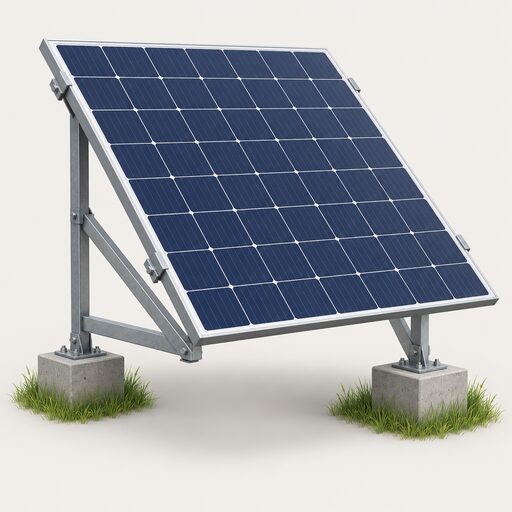 Ground-Mounted SolarGround-mounted solar panels sit on a frame in your garden instead of on your roof, which helps if your roof is shaded, small or facing the wrong way.
 Panels by Home TypeCan your house have solar panels, and how many will fit?
 Solar Mounting SystemsWill your roof take the extra weight of solar panels, and will it still keep the rain out afterwards?
 Planning Permission EnglandMost homes in England can have solar panels fitted without planning permission, but does yours count as one of the exceptions?
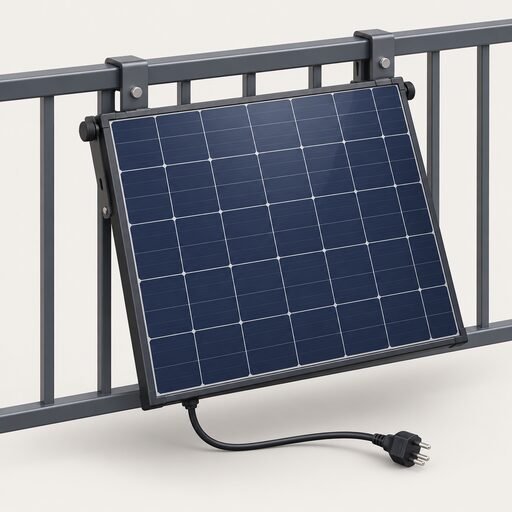 Balcony Solar SystemsCan you really plug solar panels into a normal socket, and what will it save you?
 Planning Permission WalesDo you need planning permission for solar panels on your house in Wales?