In this guide
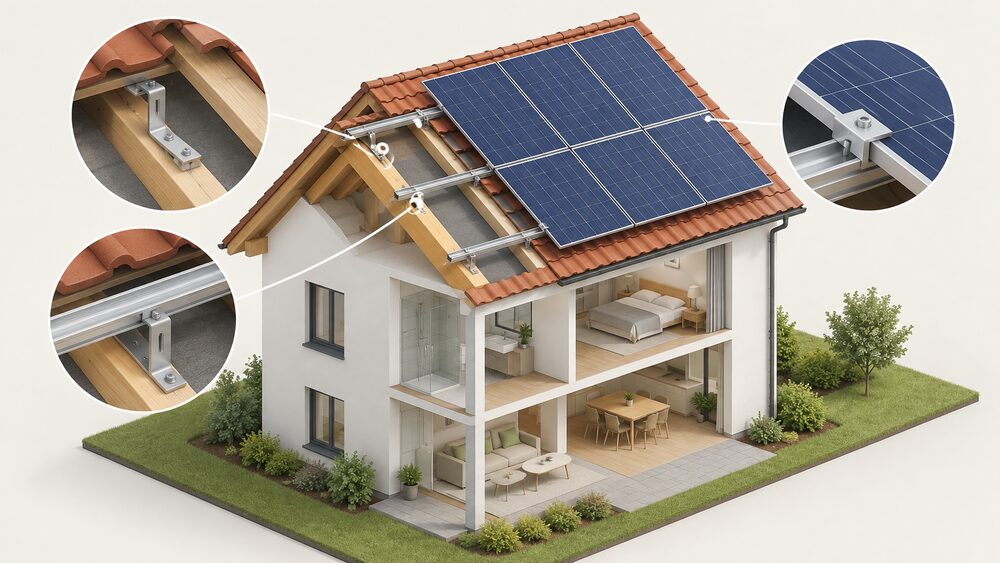
A solar panel mounting system is the frame that holds the array to the roof, and it is the part of a solar installation that most directly decides whether the roof stays watertight and whether the structure can carry the load. On a pitched roof, roof anchors are screwed directly onto the roof rafters and bars are connected to the anchors to create a frame1. On a flat roof, panels are normally tilted up to help maximise energy production, and they need to be spaced to avoid shading each other2.
The weight is modest but not trivial. Official guidance puts a solar panel system at around 20kg per square metre when everything is included2. Where the installation will increase the load on the roof by 15 per cent or more, Part A of the Building Regulations requires that the supporting structure is checked to confirm it can carry the additional weight4. A typical domestic array is around 4kWp, needs at least 20 square metres of roof space, and a 4.5kWp system typically uses around 12 panels across 20 to 30 square metres5.
The product standard behind all of this is MCS 012, the Solar Mounting Product Standard. Issue 3.0 came into effect on 10 May 2023, and Version 3 extends its scope to include both mechanically attached and non-mechanically attached systems designed for flat roofs with a pitch of 10 degrees or less6. That scope change is what brought ballasted flat roof frames properly into the certification system.
What a solar panel mounting system does
The mounting system has three jobs, and they pull against each other. It has to hold the panels at the right angle and orientation for output, it has to transfer wind, snow and static loads into the roof structure without damaging it, and it has to keep the roof weathertight where fixings pass through the covering. Every design decision on a pitched roof is a compromise between those three.
Angle matters because output does. Around 30 degrees is described as the best roof pitch in UK conditions8. On a pitched roof the panels simply follow the existing slope, so the mounting system is a set of anchors and rails rather than an angle-setting frame. On a flat roof the mounting system has to create the angle itself, which is why flat roof frames are taller, heavier and more heavily ballasted or fixed than their pitched roof equivalents.
Load matters because roofs are designed for their covering, not for an array. Official guidance is explicit that the roof must be checked to support the additional wind, snow and static load imposed by the solar panels, and that it must comply with Part A: Structure9. The 15 per cent threshold is the point at which that check becomes a formal requirement rather than good practice4.
Weathertightness matters because a failed penetration is a slow, expensive problem. MCS 012 sets the benchmark: the solar panel system shall have a level of performance at least equal to that of the unaffected roofing elements, or equal to that of any other roofing element of known acceptable performance10. In plain terms, the roof must not be worse after the panels go on than it was before.
For a household, the mounting system is also the part of the installation most tied to the building rather than to a supplier. Panels and inverters can be replaced; the fixings, the flashing and the load path are set by the roof. That is the independence the mounting system delivers, and the dependence it leaves: the array remains attached to one roof, at one angle, in one place.
Pitched roofs: roof hooks, clamps and hanger screws
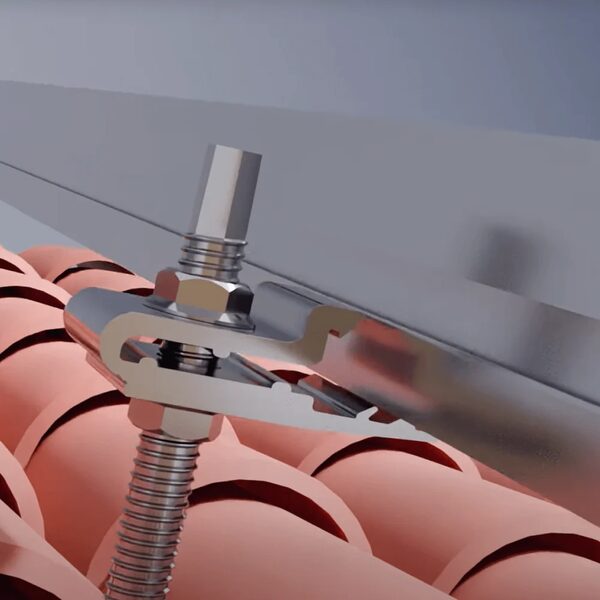
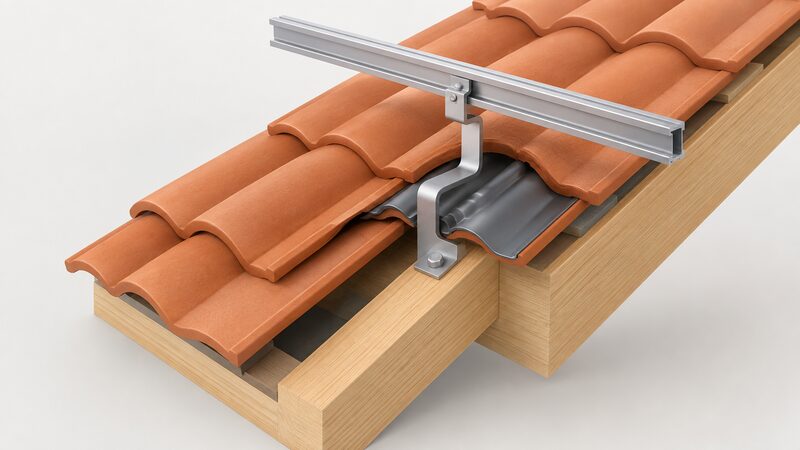
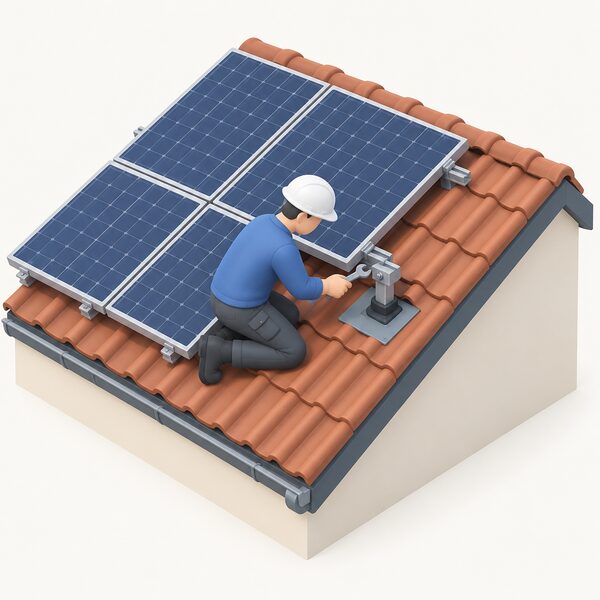
On a pitched roof, the sequence is well established. Roof anchors are screwed directly onto the roof rafters, and bars are connected to the anchors to create a frame1. The anchor, usually called a roof hook, is the load-bearing element; the rail is the element that carries the panels; the clamp is what holds each panel to the rail.
The critical detail is what the hook is fixed into. Screwing into rafters rather than into battens or the underside of the covering is what gives the fixing its pull-out strength, and it is also what makes the roof structure, not the covering, the thing being loaded. This is why the structural check under Part A is about the roof as a whole rather than about the tiles.
Materials are specified rather than left to the installer. One official scheme specification requires that all mounting should be manufactured in stainless steel or aluminium for all installations, because of the high exposure nature of the setting11. That is a durability requirement as much as a structural one: a fixing that corrodes in a coastal or exposed location will fail long before the panels do.
On pitched roofs there are also position rules that bear on the mounting design. Panels must not exceed the highest part of the roof, excluding chimneys, and should project no more than 200mm from the roof slope3. Those limits constrain how far a rail can stand off the roof surface, which in turn constrains the choice of hook and the depth of the frame.
Flat roofs: tilted frames and flexible positioning
Flat roof mounting is possible and, in one respect, better than pitched roof mounting: there is more flexibility over the angle of the panels1. Because the frame sets the tilt rather than the roof, a flat roof array can be aimed at the optimum angle even where the roof itself is level. Panels on flat roofs are normally tilted up to help maximise energy production3.
The trade-offs are real. Flat roof installation is more complex, panels may need additional mounting systems, and the roof must support the extra weight, so it might cost more than a pitched roof installation1. Spacing is the reason for much of that complexity: on a flat roof, panels need to be tilted and spaced to avoid shading2. Tilting a row of panels creates a shadow behind it, so rows have to be set further apart than the panels themselves, which reduces the number that will fit on a given roof area.
Flat roof mounting divides into two families, and MCS 012 Version 3 now names both. The standard extends its scope to include both mechanically attached and non-mechanically attached systems designed for flat roofs with a pitch of 10 degrees or less7. Mechanically attached means fixed through the membrane or into the structure; non-mechanically attached means held down by ballast, with no penetration at all. The second category is the answer to the question of whether a flat roof can take solar without the membrane being pierced.
Ballasted systems carry their own constraints. They add weight rather than remove it, which pushes directly against the 20kg per square metre figure and the 15 per cent structural check threshold2. They also depend on the roof's edge details and wind exposure, because the ballast is what resists uplift.
Hanger bolts for metal and fibre cement roofs
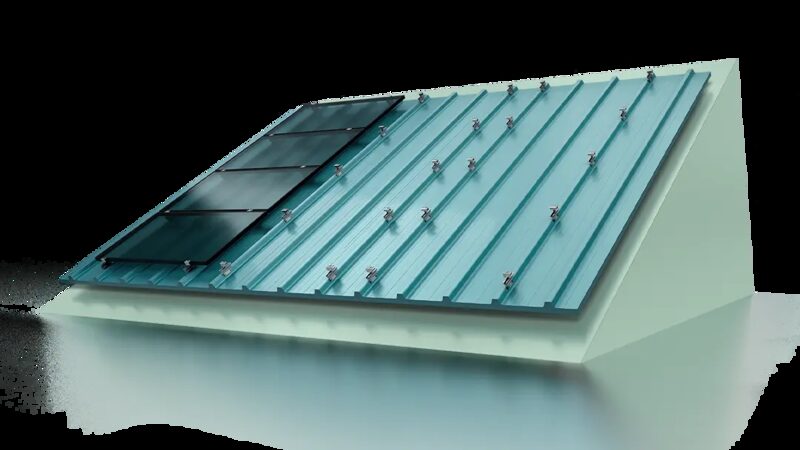
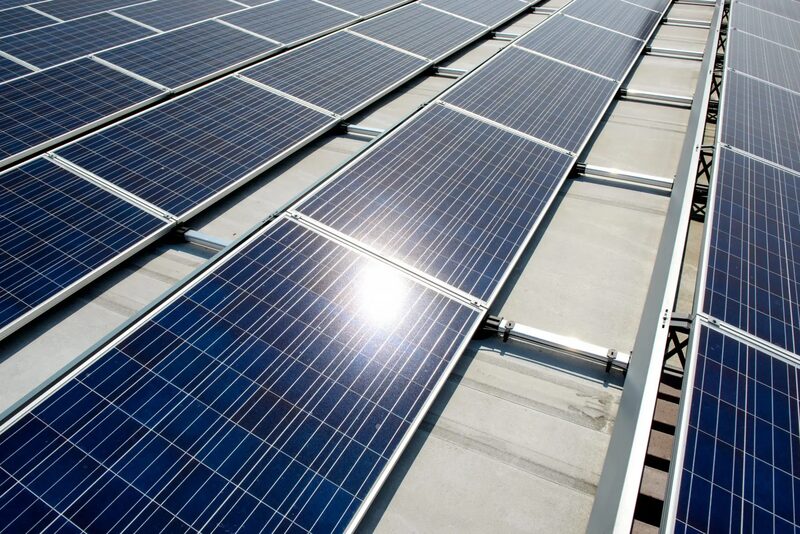
Where the roof covering is not tile or slate, the fixing changes. A hanger bolt is a threaded fixing that passes through a metal or fibre cement sheet and is sealed at the point of entry, rather than a hook that sits over a batten. One maker datasheet lists its hanger bolt as usable on corrugated roofs, steel roofs, EPDM, bitumen and Arabic tiles, and suitable for both landscape and portrait positioning of solar panels12.
That spread of compatible coverings is the point. Corrugated metal, standing seam steel, single ply membranes such as EPDM, bitumen felt and fibre cement all present different problems: some are thin and prone to distortion under a point load, some are brittle, some rely on a continuous membrane for weathertightness. A hanger bolt with a proper seal addresses the penetration; the rail and the spread of fixings address the load.
The landscape and portrait point matters more than it sounds. Panel orientation changes the spacing of the rails and the number of fixing points per panel, which changes the load per fixing. A system that supports both orientations gives the designer room to work around roof features, but the fixing schedule is not the same in each case.
For a household with a metal or fibre cement roof, the practical consequence is that the mounting system is more likely to be a specific product matched to the covering than a generic hook and rail set. The compatibility guidance required under MCS 012 is what makes that match checkable rather than assumed10.
Roof-integrated kits and how they differ from on-roof mounting
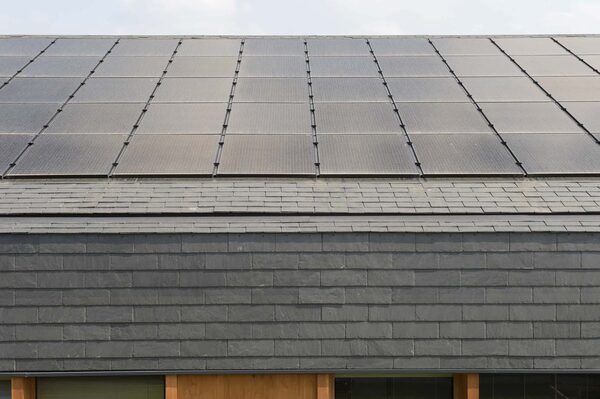
Roof-integrated panels are built into the roof rather than mounted on top of it. The benefit is stated plainly: they are built into the roof, leaving no gaps for birds or rodents to get into, but they can be complex to retrofit4. That is the whole trade in one sentence. On-roof mounting leaves a void under the array that wildlife can exploit; in-roof mounting closes it but demands more work at the point of installation.
The difference for the mounting system is fundamental. An on-roof system is an addition to a finished roof: hooks, rails and clamps sit above the covering, and the covering is expected to perform as it did before. A roof-integrated system replaces part of the covering, so the panels and their frame become the weatherproof layer. That is why the MCS 012 weathertightness benchmark is worded as it is: the solar panel system shall have a level of performance at least equal to that of the unaffected roofing elements10.
Retrofit complexity is the main practical cost. An in-roof installation on an existing house means removing and reinstating covering, and it is harder to reverse than an on-roof array. For a household weighing the two, the relevant comparison is set out in roof-integrated vs on-roof solar panels, and the wider category is covered in roof-integrated solar.
There is a separate, much smaller category that also uses brackets rather than a full mounting system. Plug-in solar kits typically include one or two solar panels, a microinverter, a lead fitted with a standard three-pin plug, mounting brackets and an app for monitoring5. These are photovoltaic systems, typically up to 800W peak13. They need no electrician and no professional installation, being plugged into wall sockets14. Their mounting is a bracket, not a roof system, and their ability to cut home running costs is much less than a conventional domestic rooftop array and battery system16.
MCS 012: the Solar Mounting Product Standard explained
MCS 012 is the product certification standard for solar mounting systems, and its history explains why flat roof mounting is discussed so carefully. On 10 May 2023, MCS published an update to The Solar Mounting (Product) Standard7. Issue 3.0 of the Solar Mounting Product Standard came into effect on 10 May6. The release of Version 3 extended its scope to include both mechanically attached and non-mechanically attached systems designed for flat roofs with a pitch of 10 degrees or less6.
That expansion is the substantive change. Before it, the standard's centre of gravity was pitched roof installation kits; the scope now includes non-mechanically attached mounting systems in addition to mechanically attached mounting systems designed for installation on flat roofs of 10 degrees or less7. Ballasted frames, which had sat awkwardly outside a standard built around fixings, were brought inside it.
The standard also governs what information must accompany a product. The test report records the manufacturer, model, dimensions, design type, supplier and the publication date, version or edition of the laying instructions for the solar panel10. Guidance must be given on compatible solar panels and roof systems10. This is what makes the compatibility question answerable: a mounting system is certified against particular panels and particular roof types, and the paperwork says which.
Certification of the mounting system sits inside a wider scheme. BRE Global carries out certification assessments for solar PV, heat pumps, biomass, micro-CHP, solar thermal, wind turbines and pitched roof mounting systems17. On the installation side, one official scheme specification requires that solar PV systems should only be installed and certified by MCS certified contractors working to the latest published MIS 3002 standards11.
There is a route for the awkward cases. Under clause 5.5.5 of MIS 3002, where no MCS 012 certified mounting systems suitable for a given installation exist, a custom designed mounting system may be used, subject to two specific conditions being met7. MCS has also said it will review The Solar Mounting Product Standard to address any challenges manufacturers are facing and enable certification of non-mechanically attached products7.
K2 mounting systems: rails, spans and accessories
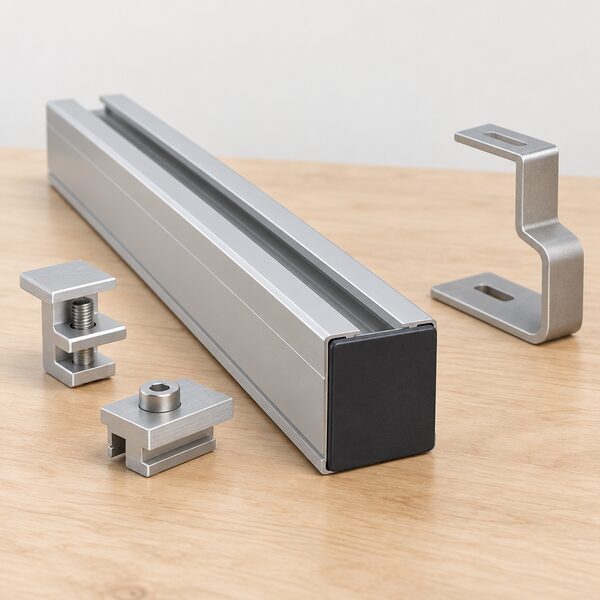
K2 Solar Mounting Solutions Ltd is one of the mounting brands a UK household is likely to encounter, and its range illustrates how these systems are put together. The products named in the certification investigation were the CrossRail, MiniRail, SolidRail and SpeedRail systems18. Those names describe rail families of different weights and spans rather than complete kits: the rail is the component that carries the panels, and the family chosen depends on the span between fixings and the load.
Components are sold individually rather than only as kits. The K2 EndCap for SolidRail Light is listed as a component, with next day delivery available19. An end cap is a finishing part that closes the cut end of a rail, and the fact that it is catalogued separately is a useful signal about how these systems are specified: a designer picks rails, hooks, clamps and accessories to suit the roof, rather than ordering a single boxed product.
That has a practical consequence for a household. The mounting system on a quote may be described by brand and rail family, and the accessories that complete it may not be itemised. Because certification attaches to products and to the compatibility guidance that accompanies them, the specific rail family and the panel it is certified with are the details worth having in writing10.
The certification position on the K2 rail families is the thing to establish before ordering. A grace period was announced for affected solar mounting products, and the investigation named these systems specifically18. That does not mean the products are unusable; it means the certification status at the time of purchase is the fact that matters, and it is checkable.
Renusol and Schletter: other certified systems
The UK mounting market is not one brand deep. Renusol and Schletter both supply systems for the same job, and both have dedicated pages on this site: Renusol mounting systems covers roof hooks, rails and flat roof trays, and Schletter solar mounting systems covers that maker's range. The reason to name them here is that the certification framework is brand-neutral: MCS 012 sets the requirement, and any manufacturer can certify a product against it.
What differs between makers is the component set and the roof types each system is designed around. A pitched roof tile system, a metal roof system and a ballasted flat roof tray are different products solving different problems, and a maker's range usually spans several of them. The compatibility guidance required under MCS 012 is what allows a household or an installer to check a specific panel against a specific system rather than assuming interchangeability10.
The wider certification infrastructure is shared. BRE Global carries out certification assessments across solar PV, heat pumps, biomass, micro-CHP, solar thermal, wind turbines and pitched roof mounting systems17. That breadth matters because it means mounting certification sits alongside, rather than apart from, the certification of the panels and the installation.
For a household, the practical point is that brand loyalty is not the deciding factor. What decides is whether the system is certified for the roof type in question, whether the compatibility guidance names the panels being fitted, and whether the certification is current. Those three questions apply equally to any maker.
Choosing a mounting system for your roof type
The choice follows from the roof, not from the panels. The number of panels that can be installed may be limited by the roof shape, skylights, shading from nearby buildings or trees, local planning or conservation area requirements, local grid capacity and export limits1. Several of those constraints act on the mounting system directly: roof shape and skylights determine where fixings can go, and shading determines whether tilting and spacing can solve a problem or only move it.
Cost factors sit alongside. The overall price of a system depends on whether solar panels or solar tiles are being fitted, and whether the panels are installed on the roof or ground-mounted20. Mounting is one line within that, and it is the line most sensitive to roof type: a straightforward pitched tile roof and a flat roof needing ballasted tilted frames are not comparable jobs.
The sequence that follows from the rules is short.
- Establish the roof type and covering, since that determines whether the system uses roof hooks, hanger bolts or a ballasted frame1.
- Check the roof can support the additional wind, snow and static load, and that it complies with Part A: Structure9.
- Confirm whether the load increase reaches 15 per cent, which triggers the formal structural check4.
- Check the mounting system's certification and its compatibility guidance for the specific panels and roof system10.
- Confirm the position rules for the roof type, including the 200mm projection limit on pitched roofs3.
For anything beyond a straightforward installation, quotes are the mechanism. Official guidance is to get various quotes to compare prices of different installers21. Because mounting is specified rather than standardised, comparing quotes means comparing the mounting system named in each, not only the total.
Warranty, maintenance and what the mounting system leaves behind
Warranty on a mounting system is rarely a standalone document. Many parts of a solar panel system will be covered by a warranty from the installer, so warranty documents should be kept safe22. Solar panels usually come with a 25-year performance warranty and a five to 10-year product warranty23. Solar panels can have warranties of up to 20 or 25 years, but inverters are not expected to last as long4. Any faults caused by poor workmanship should be covered free of charge by the installation warranty4.
The condition attached to that cover is the part households miss. Some installers require a full service within a specific period to keep the warranty valid22. For a mounting system, the serviceable items are the fixings, the seals and the flashing, which is why maintenance matters more than it appears to. Roof-integrated systems have a different maintenance profile from on-roof arrays, and the comparison is set out in roof-integrated vs on-roof solar panels.
The independence question is worth stating plainly. A mounting system does not generate anything, store anything or reduce a household's reliance on a supplier. What it does is convert a roof into a fixed, certified platform for generation, at an angle and a load the structure can carry. The dependence that remains is the roof itself: the array cannot be moved to a better site, it shares the building's structural limits, and its weathertightness depends on workmanship at the penetration. That is why the certification, the compatibility guidance and the structural check are the three things worth holding on to after the installers leave.
Sources23 cited
- Solar panel installation, Energy Saving Trust, 2026-09-07
- Building regulations and renewables guidance, Bedford Borough Council, 2026-09-17
- Planning permission: solar equipment mounted on a house or a block of flats, Planning Portal, 2026-09-17
- Solar panel problems and how to solve them, Which?, 2026-03-26
- Buying advice for solar panels, Which?, 2026-08-12
- Update on investigations into solar mounting certification and flat roof solar PV mounting issues, MCS Certified, 2025-09-01
- MCS provides an update for solar PV flat roof mounting systems, MCS Certified, 2025-10-23
- Solar panel myths: five common concerns debunked, Which?, 2026-06-09
- Planning and building: solar panels, East Herts Council, 2026-09-17
- MCS 012 Product Certification Scheme Requirements: Pitched Roof Installation Kits, GreenBook Live, 2013-06-21
- Barcud Solar Panel Installation Scheme Specification, Sell2Wales, 2026-06-15
- ClickFit EVO corrugated roof brochure, Esdec, 2026-09-17
- MCS responds as plug-in solar panels become available in the UK, MCS Certified, 2026-09-14
- Plug-in solar panels vs rooftop systems, Which?, 2026-04-27
- Plug and play: 7 million want plug-in balcony solar as law changes on 27 August, Uswitch, 2026-08-18
- Solar put at heart of response to energy crisis, Solar Energy UK, 2026-03-15
- MCS Microgeneration Certification Scheme, BRE Group, 2026-09-20
- Grace period announced for affected solar mounting products, MCS Certified, 2025-05-15
- K2 EndCap for SolidRail Light, Alternergy, 2026-09-17
- Solar PV, Flexi-Orb, 2025-04-22
- Solar photovoltaic panel installers, London Borough of Bromley, 2026-09-17
- Solar panel cleaning and maintenance, Energy Saving Trust, 2026-08-25
- Buying a house with solar panels, Energy Saving Trust, 2026-08-13
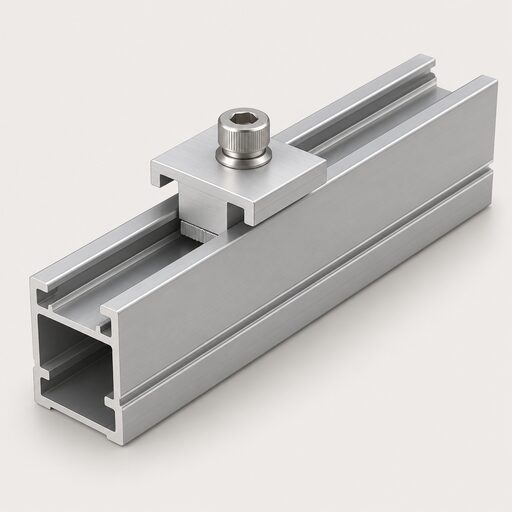 Solar Mounting System MakersWhich solar mounting brands might appear on your quote, and does the maker actually matter?
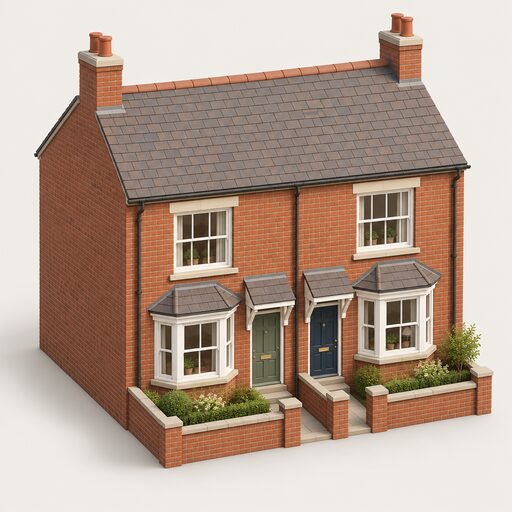 Panels by Home TypeCan your house have solar panels, and how many will fit?
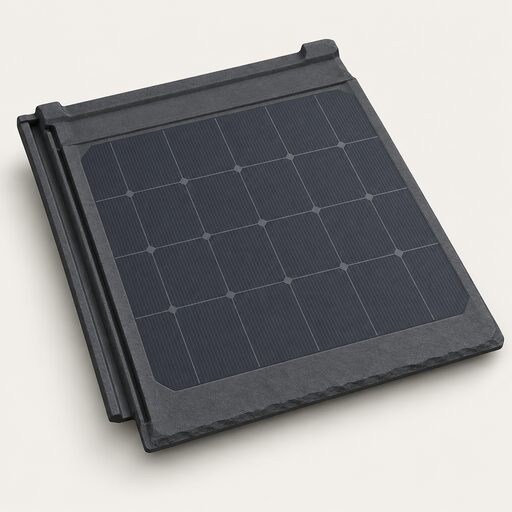 Roof-Integrated SolarSolar tiles replace your roof covering instead of sitting on top of it, so the finished roof looks like a roof.
 Roof Orientation and ShadingWhich way should your roof face for solar panels, and does it really matter if it is not south?
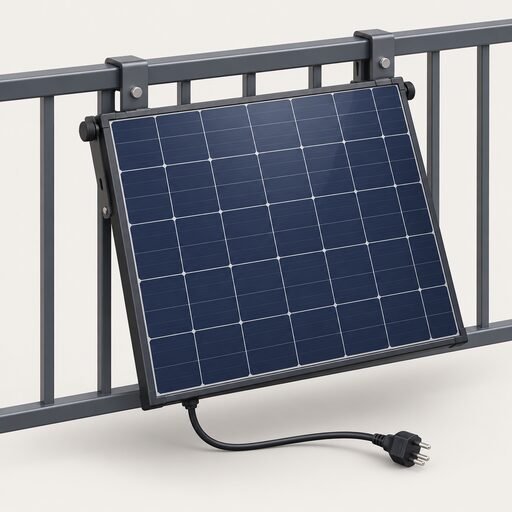 Balcony Solar SystemsCan you really plug solar panels into a normal socket, and what will it save you?
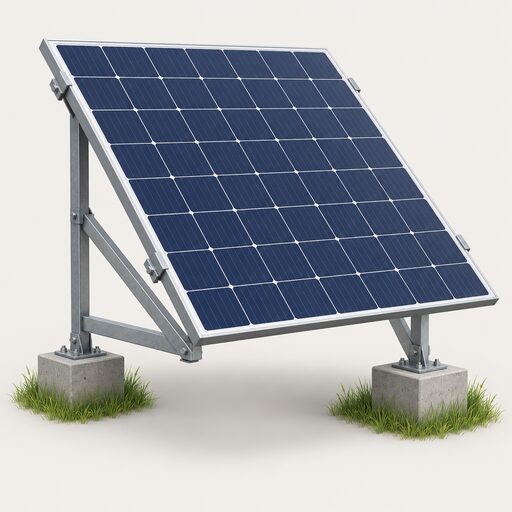 Ground-Mounted SolarGround-mounted solar panels sit on a frame in your garden instead of on your roof, which helps if your roof is shaded, small or facing the wrong way.