In this guide
Renusol is a mounting specialist rather than a panel or inverter maker. Its catalogue covers pitched roof systems for tile, fibre cement and metal roofs, flat roof rail systems, an in-roof integration system, and the clamps and roof connections that hold a module array to a building. The company describes its range as providing "solutions for a vast amount of applications and roof coverings"1.
The two names most often searched are the TS+ triangular elevated system and the FS Pro flat roof rail system. The TS+ is described as "the universal triangular elevated mounting system for unlimited possibilities"2, while the FS Pro is presented as "the new standard for flat roofs"3. Alongside them sits the RS 1, a patented universal clamp that is height adjustable and matches all Renusol mounting systems for all types of roof4.
Mounting is the part of a solar installation that decides whether a roof can carry an array at all, and on a flat roof it decides how much weight the structure must take. It generates no electricity and stores none, so it changes what a household can install rather than how independent it becomes. The sections below set out what each system is for, how the components fit together, and where the limits sit.
What Renusol makes: roof hooks, rails and flat roof trays
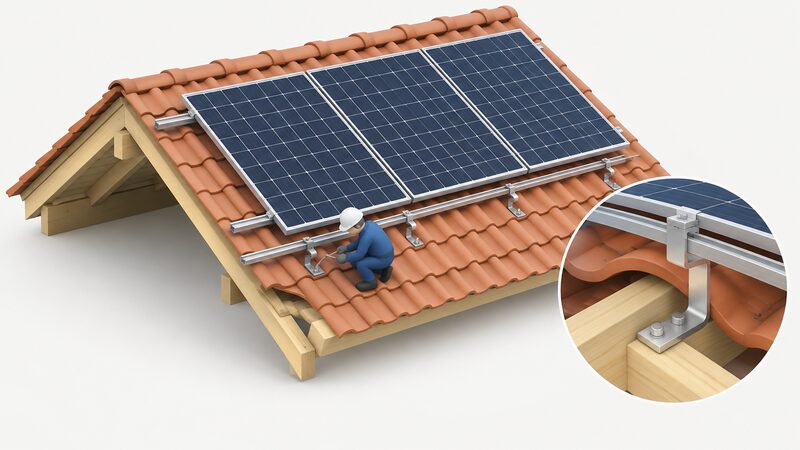
The pitched roof side of the catalogue is built around roof connections. The VS+ system connects to the roof "by means of roof hooks, hanger bolts, standing seam clamps", and Renusol states that the reasonable choice of roof hooks allows installation "with the most diverse roof covering materials and substructures"5. That is the practical heart of pitched roof mounting: the rail is standard, but the hook or bolt that reaches through or over the covering is specific to the roof.
The VS+ is a modular design system with two mounting rails for medium and high load, variable rail lengths and heights, and one clamp for all applications5. It is sold as suitable for nearly all types of pitched roofs in Europe, and the portfolio is described as the best possible solution for the assembly and fastening of photovoltaic systems on pitched roofs of all sorts7. A separate datasheet for the VS+ notes that roof slope admissibility should be checked with the Renusol Configurator8.
For metal roofs, the MS+ and MS+P systems install on trapezoidal and corrugated sheet metal "while saving material. Without continuous rails"2. That is a different fixing philosophy from a tiled roof: the profile of the sheet becomes the mounting surface, and the rail is omitted where the geometry allows.
The flat roof side is a family of rail systems. The FS Pro, FS10-EW and FS 10/18-S are all listed as rail system flat roof mounting systems, with the FS 10/18-S and FS10-EW described as "the light-weight flat roof system"3. The CS+ is a different approach again, listed as a plastic bucket flat roof mounting system3. For roofs that should not be penetrated at all, the ISSE system is a roof integration product that "replaces the roof covering"9.
Renusol TS+: the triangular elevated mounting system
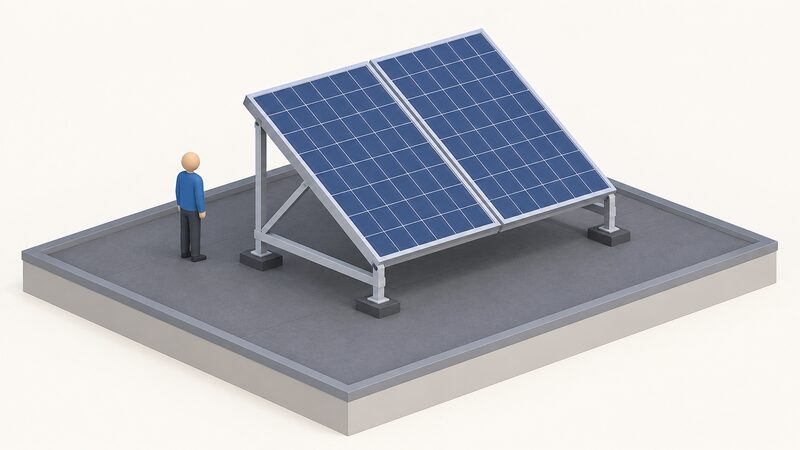
The TS+ is the elevated option. Renusol describes it as a triangular elevated mounting system and as the universal triangular elevated mounting system for unlimited possibilities2. The triangular frame raises the modules above the roof surface at an angle, which is what makes it useful where the roof itself is not at a suitable pitch, or where the array needs to sit clear of the covering.
Elevated mounting is not the same as a flat roof tray. A tray or rail system lays modules close to the roof at a shallow angle; a triangular system builds a frame that presents the modules at a chosen tilt. That distinction matters for yield, for wind loading and for how much material the installation consumes. It also matters for maintenance, because a raised array is more accessible from below than one laid flat.
The TS+ sits in a catalogue that also includes the VS+ for pitched roofs and the MS+ and MS+P for trapezoidal and corrugated sheet metal2. The metal roof systems are notable for what they leave out: installation on trapezoidal and corrugated sheet metal is done "while saving material. Without continuous rails"2. The same logic of matching the fixing to the substrate runs through the range.
For a household, the TS+ question is usually about a roof that cannot take a flush array: a flat roof where a shallow angle is wanted, or a structure where the modules need to stand clear. The maker's own framing is broad, and the datasheet route for the pitched roof range points to the configurator for admissibility8. The same principle applies here: the system is a frame, and whether it is admissible on a given roof is a structural question rather than a catalogue one.
Renusol FS Pro: flat roof mounting for large panels
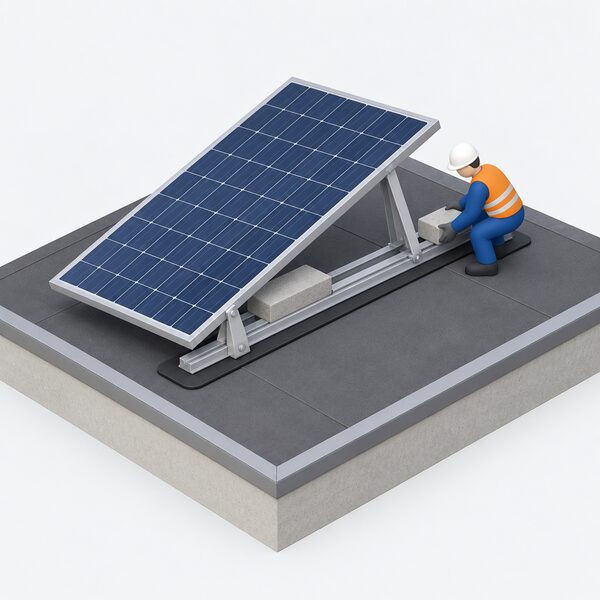
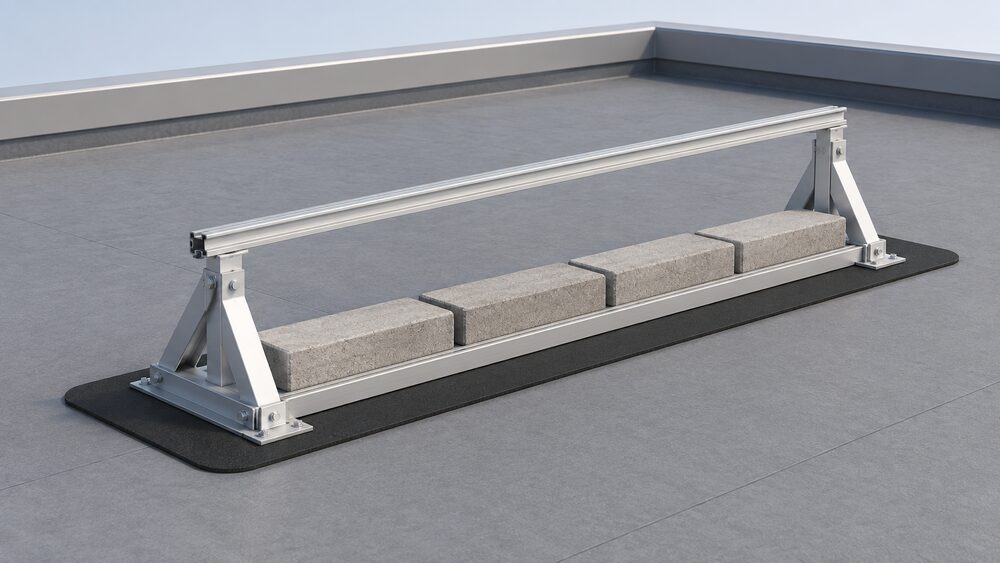
The FS Pro is the current flat roof rail system, described by Renusol as "the new standard for flat roofs"3. It is suitable for all types of flat roofs, "including roofs on residential buildings, industrial buildings, garages, etc.", and the suitable roof coverings are "foil roofs, bitumen roofs, gravel roofs and green roofs"3. That covering list is wide, and it is the reason the system appears on both domestic garages and commercial buildings.
Two details shape how it is installed. The ridge and eave supports are already attached to the base rail, and the building protection mat is pre-glued3. Renusol claims the new system "can be set up 30% faster than the previous system"3. Pre-assembly of that kind reduces site time, which is one of the larger costs in a flat roof job.
The ballast rule is the figure most households need. Renusol states that "for roof pitches of up to 5°, ballasting alone is sufficient"3. Above that pitch, or where the structure cannot take the ballast weight, the system can be secured differently: it "can be screwed onto trapezoidal sheets and sandwich profiles"3. A variant, the FS Pro-HL, is offered "for high snow and wind loads"3.
| Renusol flat roof system | Type | Notes |
|---|---|---|
| FS Pro | Rail system | All flat roof types; foil, bitumen, gravel and green coverings3 |
| FS Pro-HL | Rail system | For high snow and wind loads3 |
| FS 10/18-S | Rail system | The light-weight flat roof system3 |
| FS10-EW | Rail system | The light-weight flat roof system3 |
| CS+ | Plastic bucket | Flat roof mounting system3 |
The FS Pro was announced as available from the first quarter of 20243. Installation documentation is published by version: the FS Pro 10-S guide is version V1 dated 13 September 2024, and the FS Pro 10-EW IFP manual is version V1 dated 12 February 2025. The IFP variant was added to the Renusol PV Configurator on 15 September 2025, including an option to specify an FS Pro system secured with roof fasteners6.
Renusol RS 1: height-adjustable mounting
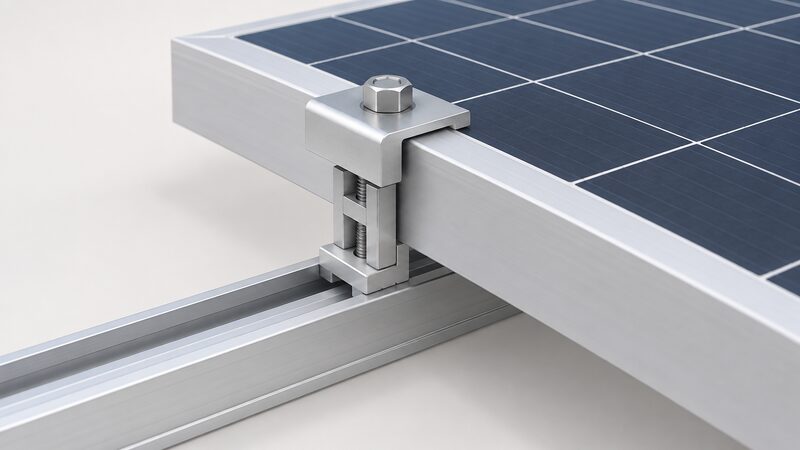
The RS 1 is the component that ties the range together. It is a universal clamp, patented, and height adjustable4. It matches all Renusol mounting systems for all types of roof, and its click-clamp base is compatible with all Renusol rails4. For a household, that is the part that makes a mixed or extended array practical: one clamp type covers middle and end clamping, and the clamping head turns by 90 degrees to change function4.
The height adjustment is the detail that matters most when panels change. The RS 1 accepts "all module frame heights from 30 to 50mm"4. Module frames vary between manufacturers and between generations, so a clamp that spans that range can accommodate a replacement panel without a new rail. The clamp is described as easy to insert by a click and to displace4.
That is as far as the maker's published position goes on reuse. Renusol does not state in the material available here that rails can be reused across a panel change, and no reuse claim should be read into the clamp's compatibility. The honest position is that the clamp is designed to span frame heights, and any decision to keep existing rails when modules are replaced belongs with the installer and the structural design of the array.
The RS 1 also illustrates how the range is put together. A pitched roof job uses roof hooks or hanger bolts, a rail, and clamps; a flat roof job uses a base rail with pre-attached supports, ballast or fasteners, and the same clamps. The clamp is the common part, and the roof connection is the variable. That is why the roof survey, not the panel choice, usually determines which Renusol system is specified.
Choosing between pitched roof, flat roof and elevated systems
The choice follows the roof, not the panel. Renusol's own framing is that the range covers "tile roofs, fibre cement, etc." on the pitched side and "flat roofs of all kinds" on the flat side1. Independent guidance from another mounting maker puts the same point directly: "Which solution is best depends on your roof and the substructure", and the panel can be held either by "panel clamps or an insert system"10.
For a pitched roof, the covering decides the roof connection. The Building Regulations recognise two general roof construction types, pitch roof and flat roof11, and official guidance notes that on a pitched roof "the type of tile or slate you wish to use will be partly governed by how steep or shallow the slope" is11. That is a roofing constraint that reaches the solar design: a shallow pitch may rule out a covering that a steeper one would take, and the hook or bolt has to suit whatever covering is there.
For a flat roof, the covering and the structure decide the method. Independent guidance on flat roofs identifies three build-ups: "warm deck, cold deck, or inverted roof"12. Which one is present affects where a fixing can penetrate and how much ballast the deck can take. The FS Pro's covering list, foil, bitumen, gravel and green roofs3, is broad precisely because flat roofs vary so much in construction.
For an elevated array, the question is whether the roof can take a frame at all, and what tilt is wanted. The TS+ is the maker's triangular option2. Where the roof should not be penetrated, the ISSE in-roof system replaces the roof covering instead9, and the VS+ pitched roof range is described as suitable for nearly all pitched roof types in Europe5.
The information a mounting designer needs is consistent across makers: "the type of roofing, the roof structure, including rafter spacing, the dimensions and orientation of the modules, and the wind and snow loads at the site"13. A household that can supply the roof type, the covering and the approximate rafter spacing will get a faster and more accurate design back.
The Renusol PV Configurator and PV*SOL integration
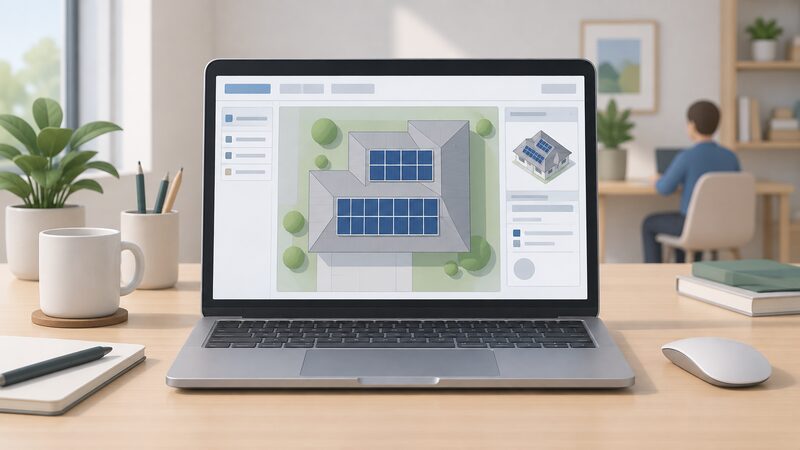
Renusol runs a planning tool, the Renusol PV Configurator, and the VS+ datasheet directs users to it for roof slope admissibility8. The configurator is not a consumer calculator: it is the design route through which a system is specified and checked.
The tool connects to mainstream solar design software. PV*SOL premium 2025 includes an interface to the Renusol PV Configurator planning tool and transfers the project report into PV*SOL premium, and data exchange between PV*SOL premium and the Renusol PV Configurator 3.0 became possible via an interface on 23 July 20256. The FS Pro IFP was added to the configurator on 15 September 2025, including an option to specify an FS Pro system secured with roof fasteners6.
That integration matters for what a household receives. A design produced this way carries the mounting layout, the module positions and the structural assumptions in one document. It also aligns with the paperwork an MCS installation is expected to hold: the manufacturer's datasheet for the proposed solar modules, inverter and, where applicable, module level power electronics and electrical energy storage system, a proposed module layout drawing, and a Sunpath diagram where the shading factor is below 1.0 and the MCS methodology is used, all before contract award14.
The configurator also sits alongside a wider ecosystem of module makers whose products are designed to work with many mounting systems. DMEGC Solar states that its residential modules "can be integrated with a variety of mounting and racking systems, inverters and roof types"15, and BISOL describes its modules as built to resist mechanical stress16. Mounting compatibility is therefore usually a question of the roof and the clamp, not of the panel brand.
What a mounting system means for household energy independence
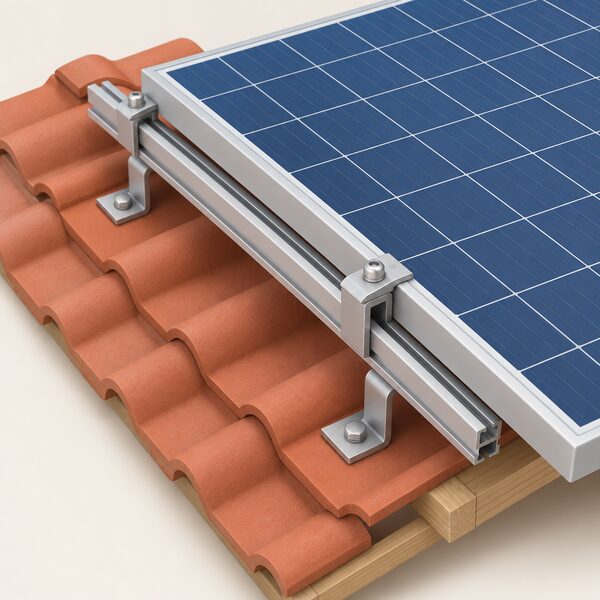
Mounting is the enabling layer, and it is worth being precise about what it does and does not deliver. A Renusol system holds modules to a roof. It generates nothing, stores nothing and connects to nothing. Every kilowatt-hour still depends on the modules, an inverter, a consumer unit and, in a grid-connected home, a network connection and a supplier.
What the mounting system does decide is whether a roof can host solar at all, and how much of the structure's capacity the array consumes. On a flat roof, the ballast rule is the clearest example: Renusol states that for roof pitches of up to 5 degrees, ballasting alone is sufficient3, and the FS Pro-HL exists for high snow and wind loads3. Ballast is weight the roof must carry permanently, so the mounting choice reaches directly into the building.
The dependence that remains is structural and commercial rather than electrical. The array is tied to one roof, one set of fixings and one design. If the roof is re-covered, the array has to come off and go back, and the clamp compatibility that the RS 1 provides across frame heights from 30 to 50mm4 is the part of the system that makes a panel change less disruptive. Beyond that, the household remains on the grid, on a supplier and on whatever the roof will bear.
The wider context is that mounting is now a regulated product category in its own right. The Solar Mounting Product Standard was expanded in scope to include "non-mechanically attached mounting systems, in addition to mechanically attached mounting systems, designed for installation on flat roofs (≤ 10°)"17. That is the standard behind ballasted flat roof systems, and it is the reason the ballast calculation is documented rather than assumed.
For a household weighing independence, the position is straightforward. A Renusol mounting system is the interface between a roof and an array, and it is specified by roof type, covering, rafter spacing, module dimensions and site wind and snow loads13. It makes solar possible on a given roof and it constrains what that roof can carry. The electricity, the storage and the grid relationship sit elsewhere, and the solar mounting systems overview sets out how the alternatives compare.
Sources17 cited
- Solar panel mounting overview, Renusol, 2026
- Metal roof and elevated mounting systems, Renusol, 2026
- FS Pro flat roof mounting system, Renusol, 2026
- RS 1 universal clamp, Renusol, 2026
- VS+ pitched roof system, Renusol, 2026
- Renusol PV Configurator and PV*SOL interface, Renusol, 2025
- Pitched roof mounting systems, Renusol, 2026
- VS+ system datasheet, Renusol, 2021
- ISSE in-roof system, Renusol, 2026
- Pitched roof mounting applications, Valk Solar Systems, 2026
- Building regulations for new roofs, Planning Portal, 2026
- Installing blanket insulation, Which?, 2026
- Pitched roof mounting systems, AEROCOMPACT, 2026
- MCS 032 solar PV installation standard, MCS Certified, 2025
- Residential solar panels, DMEGC Solar, 2026
- Durable solar modules, BISOL, 2025
- MCS update on flat roof mounting systems, MCS Certified, 2025