In this guide
The GSE In-Roof System is a low cost system of plastic trays which manage waterproofing and can accommodate most sizes and makes of standard framed solar panels, held in place by frame clamps1. The trays replace the tiles or slates in the area the array covers, so the panels become part of the roof surface rather than sitting on top of it. Installed cost is quoted from around £1,400 per kWp, the lowest figure given for any in-roof system in the material reviewed here1.
It is made in France by GSE Intégration, which joined the Wienerberger group in 2025, and it is sold in the UK through distributors including Midsummer Wholesale and Wind and Sun2. The weatherproofing warranty runs for 15 years, against 25 years on the British-made GB-Sol Integrated system1. Panels can be fitted in portrait or landscape orientation, roof windows can be incorporated, and the maker states that 10 to 16 panels can be installed in around 6 hours1.
For a household, the appeal is straightforward: a lower installed cost per kWp than tile-replacement systems, a roof surface that stays watertight, and the freedom to choose from most panels sold in the UK rather than being tied to one maker's module5. The dependence that remains is the same as any grid-connected array: an inverter, a consumer unit, a distribution network operator and an electricity supplier. The mounting system changes the roof, not the fuel.
What the GSE In-Roof System is: plastic trays that replace tiles
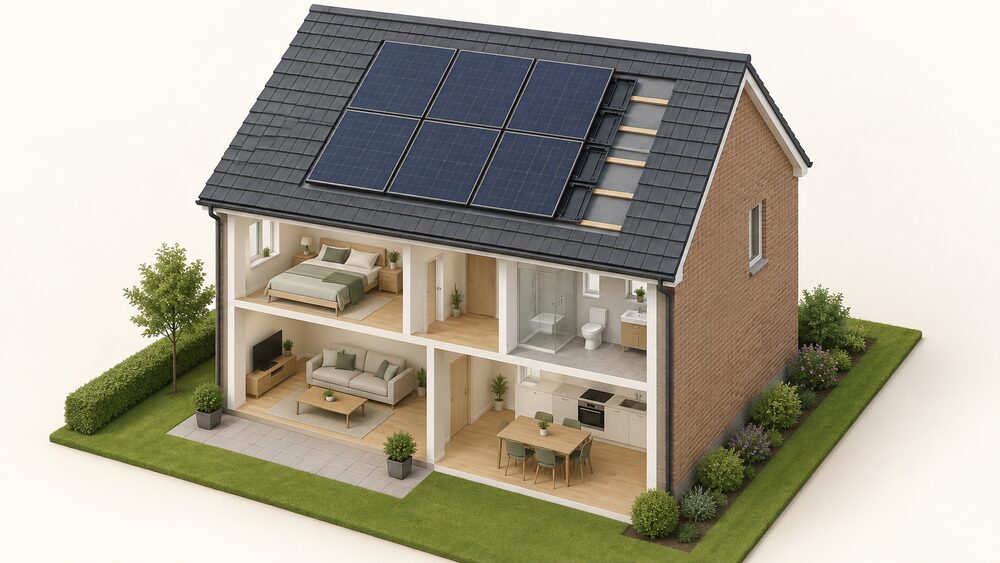
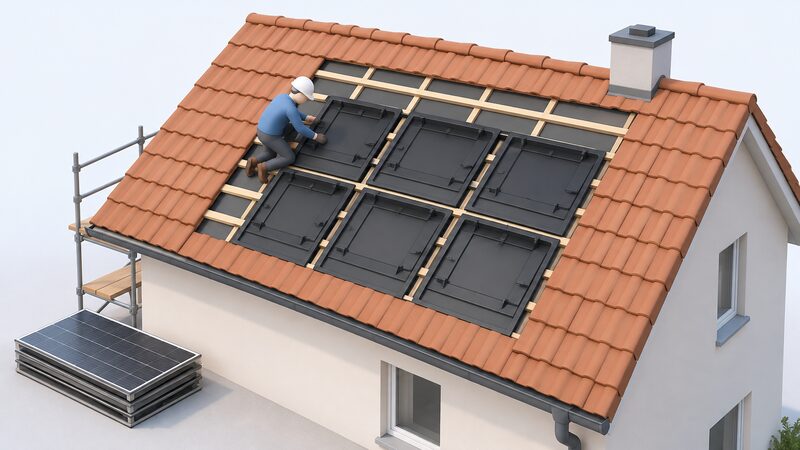
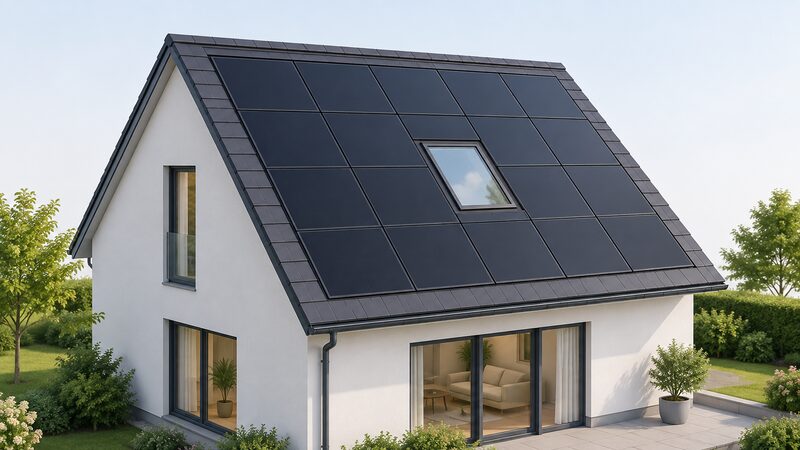
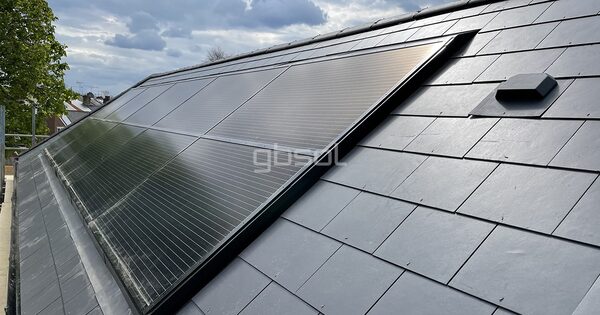
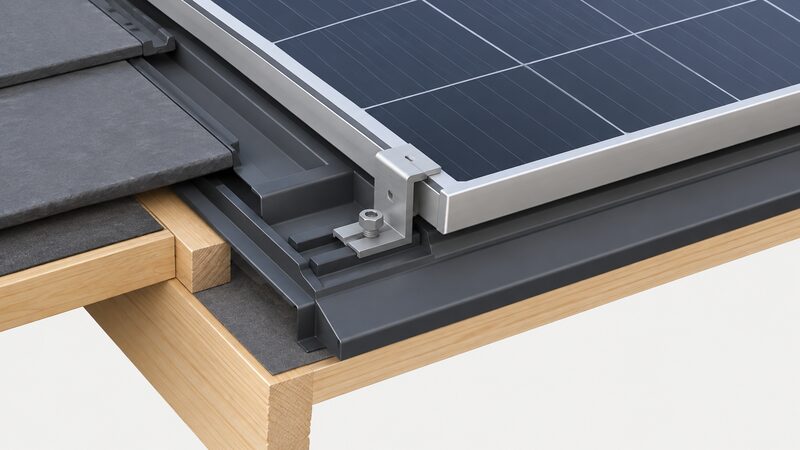
In-roof solar means the integrated panels replace the roof slates or tiles, so they are part of the roof itself rather than sitting on top of it5. The GSE system does this with a set of plastic trays that manage the waterproofing layer, into which standard framed panels are clamped. The trays are installed directly onto the roof battens, creating a secure and watertight base for the panels, and they are designed to replace traditional roof coverings rather than sit above them6.
The distinction matters for how the roof behaves. An on-roof array leaves the original covering intact and adds rails, hooks and panels above it, which is why it suits existing roofs. An in-roof array removes the covering in the panel area and substitutes the tray and panel assembly, which is why it is most often specified on new builds and full re-roofs. The GSE system is described as a cost-effective system that replaces traditional tiles or slates, and as an attractive solution for integrated work3.
The trays are supplied in quantity: 116 half-frames per pallet2. That is a trade unit rather than a household one, but it indicates the scale at which the system is bought and the fact that it is priced as a roofing component rather than a consumer product. The maker also offers an online configurator to plan an installation and determine the list of products needed, which is the practical route to working out how many trays, clamps and flashings a given roof requires2.
How it works: waterproofing, panel gaps and ventilation
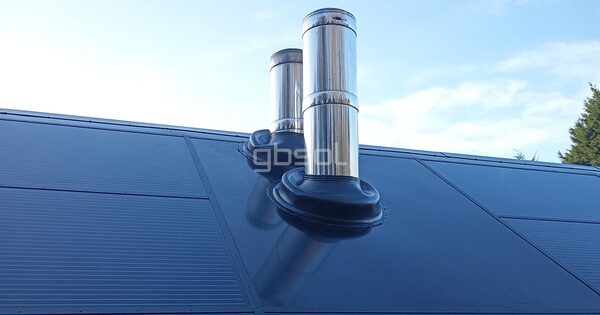
Waterproofing is the whole point of the tray. GSE Integration states that the system replaces the roof surface and ensures complete watertightness of the PV system, and describes perfect, long-lasting watertightness4. In-roof panels integrate directly into the roof structure, creating a continuous, watertight surface, which is a different proposition from an on-roof array where the original covering still sheds the water6.
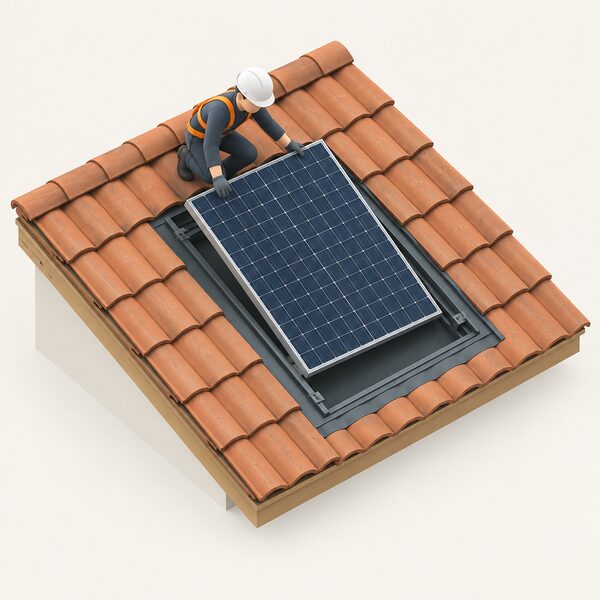
The installation sequence follows the roof, not the electrics. It typically begins with a site survey and system design, then existing roof tiles are removed in the area where the solar array will sit, a waterproof membrane and trays are installed, panels are fitted into the trays, electrical connections are made to an inverter and consumer unit, and the system is commissioned and tested6. Because the trays go on before the panels, the roof is closed up in stages rather than left open.
Two details affect how the finished roof looks and performs. The first is the gap between panels: the GSE system leaves 15 to 20 millimetres between panels, which is a deliberate spacing rather than a tight butt joint1. The second is ventilation, which the maker describes as optimal, and which matters because panels lose output as they heat up2. The trays sit above the membrane and below the modules, so air can move behind the array.
Panel compatibility: module sizes, portrait and landscape formats
The GSE trays are built around standard framed modules rather than a proprietary panel. The maker describes the system as accommodating most sizes and makes of standard framed solar panels, held in place by frame clamps, and as an inexpensive option that still allows a choice from most solar panels available in the UK1. Panels can be fitted in portrait or landscape orientation, on all roof types and between pitches of 12 and 50 degrees5.
The landscape configuration is newer. The maker states that the GSE IN-ROOF LANDSCAPE SYSTEM is now available, having been announced as operational in January 2026, and that the portrait format was the existing configuration before it2. The system has also been revised to make it possible to fit larger and wider modules, which reflects the direction of module sizes over the past few years2.
There is an unresolved point on maximum module size. The maker's own documents give a portrait maximum of 1990 mm by 1135 mm in one place and 1800 mm by 1160 mm in another, and the two figures disagree. Both should be treated as provisional until the tray dimensions for a specific module are confirmed with the supplier. The same applies to cell format: the maker's material refers both to 66 cell M6 format modules and to 60 cell M10 format modules, without a ruling between them.
| Attribute | GSE In-Roof System |
|---|---|
| Panel type | Standard framed modules, most sizes and makes1 |
| Orientation | Portrait or landscape1 |
| Roof pitch range | 12 to 50 degrees5 |
| Gap between panels | 15 to 20 mm1 |
| Roof window | Can be incorporated1 |
| Ventilation | Optimal, per the maker2 |
| Made in | France1 |
Roof windows and other configuration options
Roof windows can be incorporated into a GSE installation, and the maker states that the system allows all types of configuration, portrait or landscape, with or without a roof window1. The trays are described as universal with all types of roof configuration, including with windows3. That flexibility is one of the practical differences between an in-roof system and a solar tile, where the tile format tends to dictate the layout.
Glazing is not the only alternative to a panel. Double or triple glazed units can replace individual panels where a window is wanted in the array area, which allows a rooflight to sit within the array footprint rather than forcing a break in it1. Triangular panels can also be made to make the most of more awkward roof shapes, though that is a feature of the GB-Sol Integrated system rather than the GSE trays1.
Roof orientation is a separate question from configuration. East and west facing roofs can also be suitable for solar, and some customers have low profile systems that are completely horizontal9. The number of panels that will fit is limited by the roof shape, skylights, shading from nearby buildings or trees, local planning or conservation area requirements, local grid capacity and export limits11. On a flat roof, panels need to be tilted and spaced to avoid shading, which is a different mounting problem altogether12.
Cost: from around £1,400 per kWp
Installed cost for the GSE In-Roof System is quoted from around £1,400 per kWp1. That is the headline figure and it is the lowest given for an in-roof system in the material reviewed here. The same source notes that smaller or more complex systems will be more expensive per kWp, because the fixed costs of design, access and labour are spread over fewer panels1.
For comparison, the British-made GB-Sol Integrated system is quoted at from around £1,850 per kWp1. Solar roof tiles sit far higher: the price of a typical 4 kilowatt-peak installation is around £12,000, with prices accurate as of November 202513. On-roof panels remain the cheapest route, at around £7,600 for a typical 4.5kWp system, or roughly £2,000 per kWp14.
| System type | Cost basis | Figure |
|---|---|---|
| GSE In-Roof System | Installed, per kWp | from around £1,4001 |
| GB-Sol Integrated | Installed, per kWp | from around £1,8501 |
| Solar roof tiles | Typical 4kWp installation | around £12,000, November 202513 |
| On-roof panels | Typical 4.5kWp system | around £7,60014 |
| On-roof panels | Per kWp | £2,00016 |
| Typical domestic rooftop system | 3.5kW, 2026 | £6,10017 |
Two further figures frame the decision. The cost of rooftop solar installation may be 10 per cent cheaper for new builds, according to Solar Energy UK, which is where in-roof systems are most often specified17. And a typical existing UK home could save around £530 a year from installing rooftop solar, based on the current energy price cap18. The saving figure is for rooftop solar generally, not for the GSE system specifically, and it depends on the tariff and the household's usage pattern.
Installation: 10 to 16 panels in around six hours
The maker states that 10 to 16 panels can be installed in around 6 hours, and elsewhere that 16 panels can go in in as little as six hours2. That figure covers the mounting and panel fitting. It does not include the survey, the design, the removal of the existing covering, the electrical work or the commissioning, all of which form part of the sequence described for in-roof installations6.
Independent guidance on complete installations puts the job at one or two days once scaffolding is up, with larger or more complex jobs taking longer19. A 4.5kWp system typically covers between 20 and 30 square metres of roof surface area, using around 12 panels, which sits inside the 10 to 16 panel range the maker quotes for a six hour fit14. The two sets of figures are consistent if the six hours is read as the roofing and mounting phase.
The wider market context is that installations are running at a high rate. More than 19,800 rooftop solar panels were installed in July 2026 alone, equivalent to one installation every two minutes21. That volume matters for scheduling: scaffolding, roofing labour and electrical sign-off all compete for the same diary slots, and the speed of the tray system is one reason it is specified on new-build sites where the roof is being covered anyway.
Warranty, fire and impact resistance, and certification
The GSE In-Roof System carries a 15 year weatherproofing warranty1. That is the term a household should weigh against the panel warranty, which is typically 25 years on rooftop modules, and against the 25 year weatherproofing warranty on the GB-Sol Integrated system23. The mounting warranty is the shorter of the two on a GSE installation, and it is the one that covers the part of the roof the trays have replaced.
On fire and impact, the maker describes the system as having excellent fire and impact resistance2. The specific test ratings in the material reviewed here belong to the GB-Sol Integrated system rather than to GSE: GB-Sol's Infinity and Integrated solar roofs achieved EXT.S.AA, the highest possible rating under BS 476-3: 2004 Roof Fire Test, and testing confirmed passes for the CEN/TS1187:2012 Test4, where AA (national class) is equivalent to Broof(t4) (European class)22. Those figures should not be read across to the GSE trays.
Certification for the UK market is separate from the mounting hardware. GSE Intégration reported in January 2026 that its MCS certificate had been updated to provide greater flexibility for rooftop photovoltaic projects in the UK2. MCS certification is what allows an installation to qualify for government schemes, and it applies to the installer and the installation as well as to the products17.
GSE Intégration: the maker, its French origin and UK track record
The GSE In-Roof System is made in France, and the maker describes bringing European design and production capabilities to the range1. GSE Intégration joined the Wienerberger group in 202524. That ownership matters for a household only in the sense that it affects the continuity of the product line and the supply of replacement trays over the life of the roof, which is a longer horizon than most building products.
The UK track record is real but recent. GSE Intégration reported on the UK's first Zero Bills homes in January 2025, and exhibited at Solar and Storage London in 20262. The system was presented at Intersolar in Munich in May 2022, and a project in Goes in the Netherlands covering 194 houses with 12 modules per house and about 4,000 square metres of solar roofing was reported the same month2. The landscape configuration became operational in January 20262.
For installers, the maker provides online training, webinars and on-site training, alongside technical data sheets and installation manuals, and an online configurator to plan an installation and produce the product list2. The system is sold in the UK through distributors including Midsummer Wholesale and Wind and Sun3. The alternative British-made route is covered in the GB-Sol panels page, and the wider comparison between integrated and on-roof mounting sits in roof-integrated vs on-roof solar.
What the system does for a household's independence
An in-roof array changes the roof, not the fuel. The household still draws from the grid when the array is not generating, still needs a distribution network operator connection, and still sells or uses export through a supplier. The independence the GSE system offers is structural and financial rather than energetic: the roof covering and the generation surface become one assembly, the installed cost per kWp is lower than tile-replacement alternatives, and the array is not sitting on top of a covering that will one day need replacing underneath it1.
The dependencies that remain are worth naming. The trays come from France, so replacement components follow a European supply chain1. The weatherproofing warranty runs for 15 years, shorter than the panel warranty and shorter than the equivalent British product1. The electrical side, the inverter, the consumer unit and the metering, is unchanged by the mounting choice, and is covered in solar mounting systems and roof-integrated solar. For the full picture of what a system delivers and what it still depends on, the solar PV guide sets out the whole chain.
Sources24 cited
- GB-Sol Integrated Buyers Guide, GB-Sol, 2026
- GSE In-Roof System, GSE Intégration, 2026
- Roof Integrated Solar PV, Midsummer Wholesale, 2026
- GSE Integration, Wind and Sun, 2026
- Benefits of In-Roof PV, Midsummer Wholesale, 2026
- In-Roof Solar Panels, Fuse Energy, 2026
- Solar Panels, East Hertfordshire District Council, 2026
- Generating Your Own Energy: Solar Water, Welsh Government, 2018
- GB-Sol Integrated, GB-Sol, 2026
- GB-Sol FAQs, GB-Sol, 2026
- Solar Panels, Home Energy Scotland, 2026
- Solar Panel Myths, Which?, 2026
- Solar Roof Tiles, Energy Saving Trust, 2025
- Solar Panel Installation, Energy Saving Trust, 2026
- Solar Panel Costs, Which?, 2026
- A Complete Guide to Solar PV, Centre for Sustainable Energy, 2025
- POST Note 771: Solar PV, Parliamentary Office of Science and Technology, 2026
- Rooftop Solar for New Builds to Save People Money, Department for Energy Security and Net Zero, 2025
- Solar Power Facts, Energy Saving Trust, 2026
- Solar Panel Installation, Energy Saving Trust, 2026
- First Regional Solar Breakdown as Installations Hit Record Highs, Department for Energy Security and Net Zero, 2026
- UK Solar Power Hits Record High Over Summer 2026, Carbon Brief, 2026
- GB-Sol Integrated Solar Roof Brochure, GB-Sol, 2025
- Plug-In Solar Panels vs Rooftop Systems, Which?, 2026