In this guide
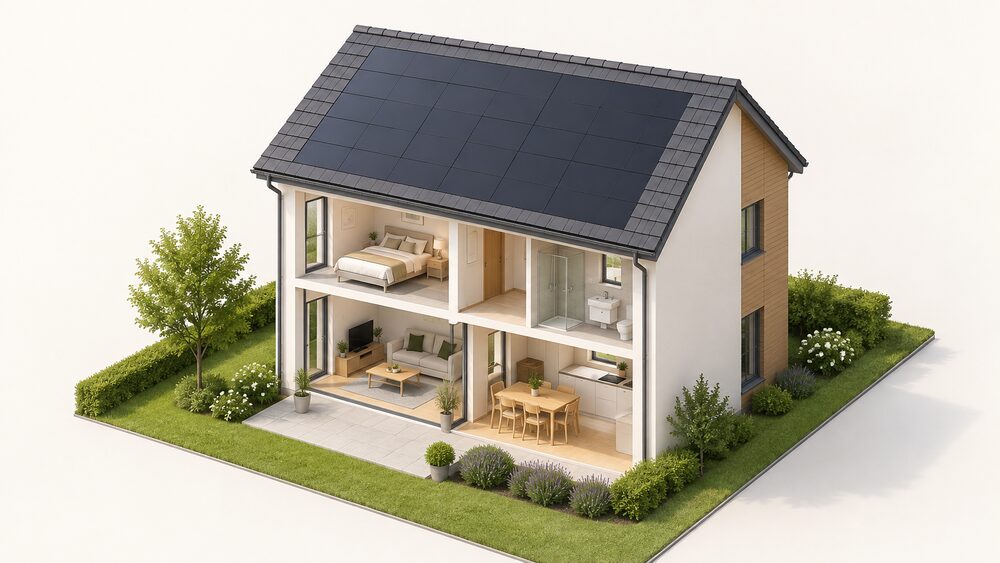
Roof-integrated solar, also called in-roof solar, replaces part of the roof covering rather than sitting above it on brackets. The modules or tiles become the weatherproof layer, so the finished roof reads as a roof rather than as a roof with panels bolted on. The trade-off is cost and output: solar roof tiles normally cost about 1.5 times a solar panel installation1, and they are less efficient per area than solar panels, typically producing only 80% of the electricity for the same area1.
The case for the approach is strongest at the two moments when a roof is already being opened up: a re-roof and a new build. Solar roof tiles are best suited for installing when renovating a roof or for new build houses1. For an existing roof in good condition, an on-roof array on rails usually delivers more generation per square metre for less money, and the choice between the two is set out in more detail on roof-integrated vs on-roof solar panels.
What follows covers how in-roof systems differ from bracketed panels, how the electricity is produced, which roof types suit which approach, the planning and building regulations position across the four nations, cost and payback, and what the Future Homes Standard is expected to do to the market.
In-roof solar: what it is and how it differs from panels on brackets
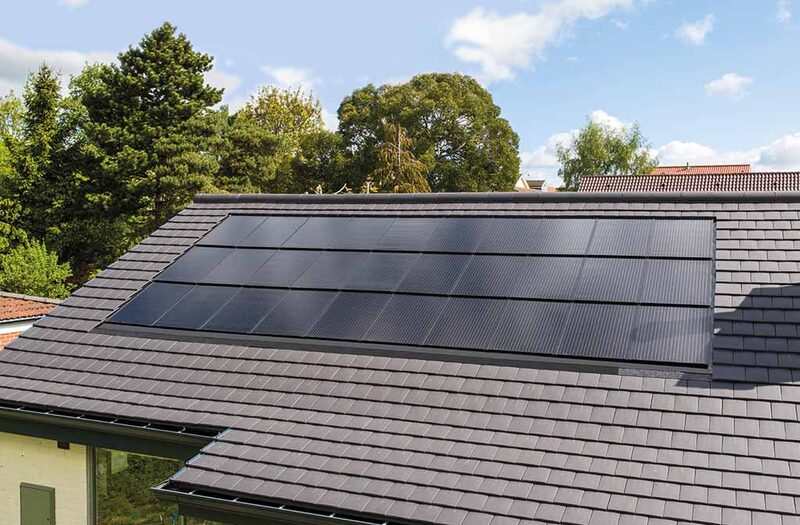
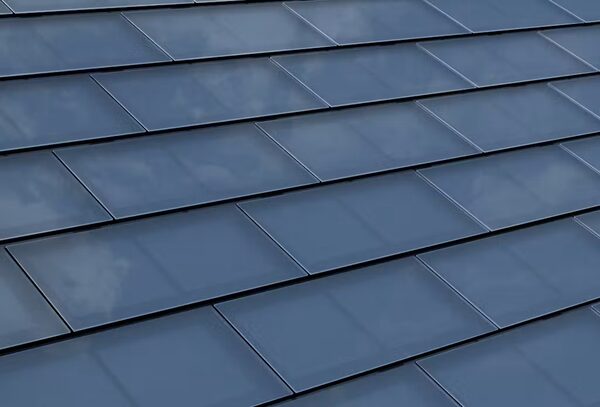
An in-roof system uses the module itself as the roof covering. Instead of rails fixed to the rafters with the tiles left underneath, the array sits flush in a tray or frame that takes the place of the slates or tiles it displaces. Solar roof tiles take this further: they are a solar technology that look like normal roof tiles, and they are fitted to your roof instead of normal tiles so the solar installation does not affect the look of your roof1. They are also sometimes referred to as solar slates or solar shingles1.
The distinction matters for three reasons. First, appearance: an in-roof array is close to flush with the surrounding covering, and solar tiles can cover the entire roof, almost to the edge, and then can be accompanied with matching, non-solar tiles around the edges, or can be used to cover part of a roof1. Second, weatherproofing: the array is part of the roof's water-shedding layer, so the detailing around it, the flashings, the tray upstands and the junctions at ridges and valleys, carries the same duty as the rest of the covering. Third, the roof has to be opened: an in-roof installation is a roofing job as much as an electrical one, which is why it lines up with re-roofing and new build rather than with a retrofit onto a sound roof.
Solar roof tiles incorporate mini solar panel units to generate clean electricity from sunlight1. That is the same photovoltaic effect as a conventional module, packaged in a smaller unit that is laid like a tile. The consequence is a greater number of smaller units, more interconnections and more roof area given over to edges and overlaps, which is where the 80% figure comes from.
"Solar roof tiles (also called solar slates or solar shingles) are a solar technology that look like normal roof tiles."
How solar PV works: from daylight to usable electricity
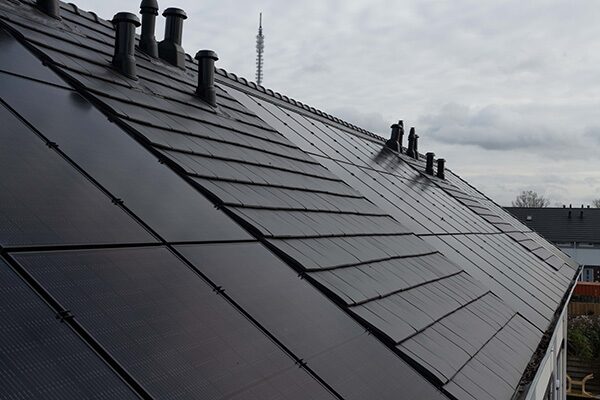
Solar Photovoltaic (PV) uses energy from the sun to create electricity to run appliances and lighting5. Solar photovoltaic panels capture energy from the sun and turn it into electricity for your home to use2, and the cells convert the sunlight into electricity, which can be used to run household appliances6. Solar panels, or photovoltaic (PV) systems, convert sunlight into clean, renewable electricity7.
The output is not fixed. Solar PV panels convert the sun's energy into electricity, and the greater the intensity and duration of the sunlight, the more electricity is produced8. Panels work best in direct sunlight, but they absorb energy from the light spectrum visible to us and wavelengths that can pass through clouds9. That is why a roof still generates on an overcast day, and why the annual total is driven as much by the number of daylight hours and the angle of the array as by peak summer output.
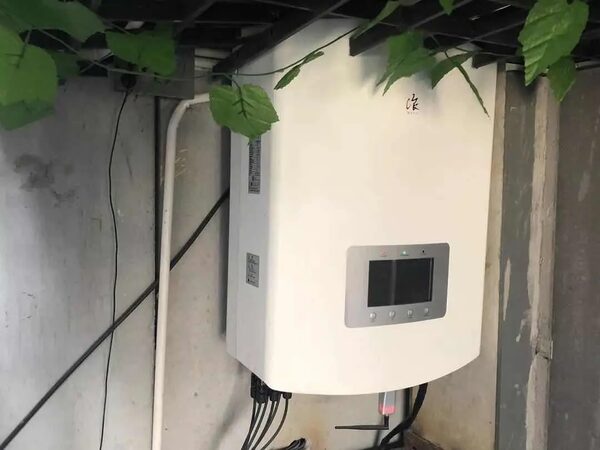
The direct current the modules produce needs to pass through a solar inverter to turn it into alternating current (AC) electricity2. The inverter is the component that makes the output usable by ordinary household circuits, and it is also the component most likely to need replacing during the life of the system. Inverters usually need replacing after around 12 years2, and one independent source gives a replacement interval of about 10 to 12 years9. The two figures are close but not identical, so the precise interval is reported differently across sources; either way, the inverter is a mid-life replacement cost that a household should plan for.
For an in-roof system the electrical architecture is the same as for any other array. The difference is mechanical and thermal: modules set into the roof sit closer to the deck, with less air moving behind them than a rail-mounted array has, and the roof build-up has to manage that. The generation principle, the inverter, the metering and the connection to the grid are unchanged.
In-roof panels or solar tiles: which fits which roof
The two approaches are not interchangeable, and the deciding factors are the state of the roof and the look that is wanted.
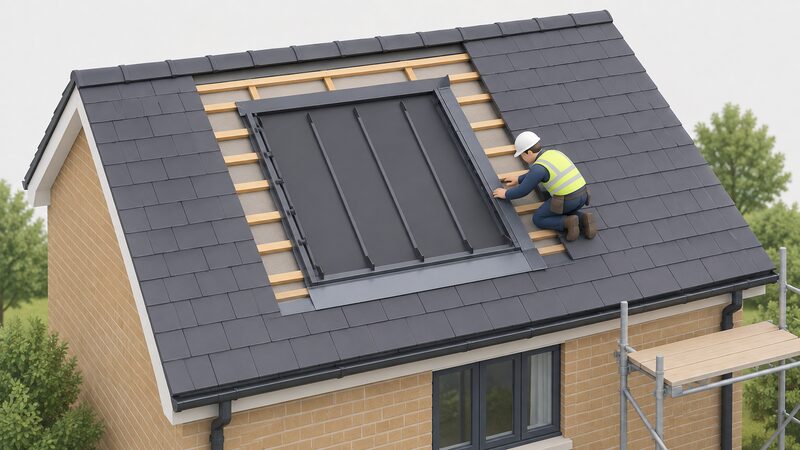
In-roof panels use standard modules in a tray that replaces the covering across the array's footprint. They give the flush appearance with conventional module efficiency, and they are the usual choice where a roof is being replaced or a new roof is going on and the household wants the array to sit within the plane of the roof.
Solar tiles go further and cover more of the roof with generating units. They can cover the entire roof, almost to the edge, and then can be accompanied with matching, non-solar tiles around the edges; they can also be used to cover part of a roof1. The cost of that coverage is output per square metre: solar tiles are less efficient per area than solar panels, typically producing only 80% of the electricity for the same area1.
| Approach | What it replaces | Relative cost | Output for the same area | Best suited to |
|---|---|---|---|---|
| On-roof panels on rails | Nothing; sits above the covering | Baseline | Baseline | Existing roofs in good condition1 |
| In-roof panels in a tray | The covering under the array | Above baseline | Close to baseline | Re-roofs and new build |
| Solar tiles or slates | The covering across the whole roof | Normally about 1.5x a panel installation1 | Typically 80% of a panel's electricity1 | Re-roofs and new build, where full coverage is wanted1 |
The practical rule that follows from the sources is that solar tiles are best suited for installing when renovating a roof or for new build houses, while existing roofs are the natural territory of conventional panels1. Where a roof is sound and the household is not re-covering it, an in-roof system means paying to lift and reinstate a covering that did not need work, on top of the premium for the integrated product itself.
Roof suitability: condition, space, orientation and shading
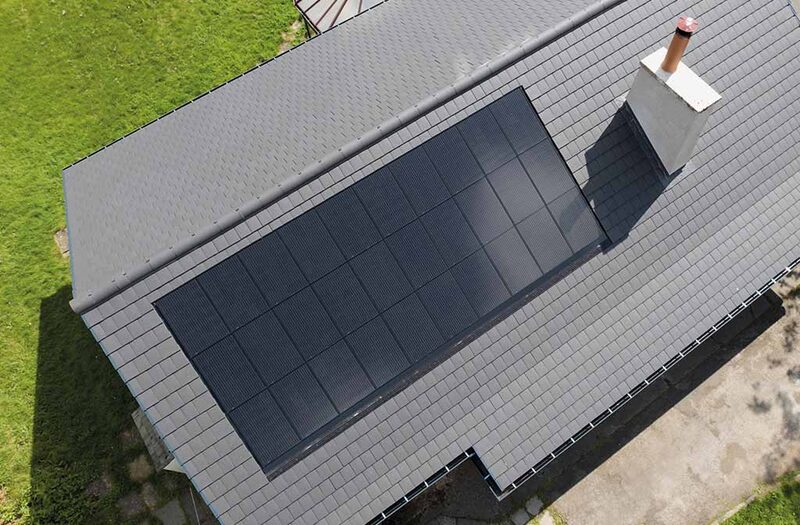
The roof has to be able to take the array, and the checks are the same whether the system is integrated or surface-mounted. Your roof must be in good condition, and it must have sufficient space10. If your roof is heavily shaded, solar panels may not be the most suitable option10.
Structure is a building regulations matter as much as a practical one. The adequacy of the existing roof to carry the load (weight) from the panel will need to be checked and proven11. The check covers the additional wind, snow and static load imposed by the solar panels, and compliance with Part A: Structure, and it must be done by a qualified structural engineer12. For an in-roof system the loading picture differs from a rail-mounted array, because the covering that is removed had its own weight and the tray and modules replace it, but the wind uplift and the point loads at fixings still have to be assessed.
Orientation and pitch drive yield. The greater the intensity and duration of the sunlight, the more electricity is produced8, so a roof that faces the sun for more of the day will outperform one that does not. Shading from chimneys, dormers, trees and neighbouring buildings reduces output, and it affects integrated systems in the same way as any other array. The detail is covered on roof orientation, pitch and shading for solar panels.
Flat roofs are workable. Solar panels can be installed on both pitched and flat roofs; on a flat roof, the panels will need to be tilted to help maximise energy production2, and they are normally spaced to avoid shading each other10. On a flat roof, panels should project no more than 0.6 metres from the plane of the roof7. That projection limit is a permitted development condition, and it is one of the reasons flat roof arrays are usually tilted frames rather than flush systems.
Cost, savings and payback: what a typical system returns
A typical solar panel installation costs around £6,100, for a system of around 3.5 kWp2. The same figure appears in an independent estimate, which puts a typical solar system at around £6,100 to install9, and in a parliamentary briefing, which records that the average domestic solar panel is 3.5 kW and costs around £6,100 in 20264. A larger domestic system, around 4.5 kWp, is put at around £7,6003.
Solar tiles carry a premium over that baseline. Solar roof tiles normally cost about 1.5 times a solar panel installation1. On the £6,100 figure that is a substantial uplift, and it buys appearance and full roof coverage rather than more generation: the same source records that tiles typically produce only 80% of the electricity of panels for the same area1.
Savings are usually expressed against the whole bill. The government estimates that installing solar panels could reduce energy bills by around £500 a year4. One official source gives between £530 and £650 a year for a typical home without electrical heating or an electric vehicle2. The two figures differ because they describe different households and different assumptions about self-consumption; the range is the honest answer, and the proportion of generation used in the home rather than exported is the main variable.
Payback follows from those two numbers. Solar panels usually pay for themselves in 10-12 years2. A parliamentary briefing records a different measure of value: the Resolution Foundation estimate that for every £1 spent, rooftop solar returns 7 pence per year, which is double the return from large-scale solar4. Both are modelled figures rather than guarantees, and both assume the system is well sited and the household uses a good share of what it generates. The wider arithmetic is set out on solar panel savings and payback periods.
Planning permission and building regulations for in-roof systems
Placing solar panels on the roof of a house or flat, or a building within the grounds, is in most cases permitted development, whether in a conservation area or otherwise14. Homes can often have solar panels without requiring planning permission from the council, covered by permitted development so long as certain conditions apply15. If the proposed solar panels meet those requirements, no planning permission application is needed16.
Conservation areas are less restrictive than many households expect. Planning permission is not usually required to install solar panels on the roof of a house or block of flats in a conservation area17, and solar panels fitted to roofs in conservation areas do not require planning permission provided they meet the general rules18. Flat roofs are the exception: planning permission is required for panels on flat roofs in conservation areas18, and prior approval will be required where solar panels are located on a flat roof in conservation areas and National Landscapes19.
Listed buildings are a different regime entirely. Solar panels on listed buildings will need planning permission and listed building consent15, and if the home is listed, whether Grade 1, Grade 2*, Grade 2 or curtilage-listed, listed building consent is needed for the installation of solar equipment8. Consent is also required for panels on a building within the curtilage of a listed building17. New roofing materials, or the addition of fabric or features to a roof such as solar panels, require listed building consent21. Some authorities have adopted local listed building consent orders that pre-authorise solar equipment on roof structures, including the roof of any extension, outrigger or other ancillary structure forming part of the principal listed building22.
Building regulations apply in parallel. Building regulations will normally apply if you wish to install solar panels on your roof14, and approval is likely to be needed11. The reasons are the additional loading on the roof structure and the associated electrical works17. The adequacy of the existing roof to carry the load will need to be checked and proven11, and the structural check must be done by a qualified structural engineer12. Building regulations approval is a separate consent from planning permission, and permitted development rights do not remove it.
In Northern Ireland, the installation, alteration or replacement of solar PV or solar thermal equipment on the roof of a dwellinghouse, or any building within its curtilage, is permitted development under Part 2, Class A of the Planning (General Permitted Development) Order (Northern Ireland) 201525. The same order restricts the right where the equipment would be installed within the curtilage of a listed building unless listed building consent has previously been granted25. The position differs in detail between England, Scotland, Wales and Northern Ireland, and the nation-by-nation pages cover each: England, Scotland, Wales and Northern Ireland.
Installation, certification and grid registration
An in-roof installation runs in a fixed order, and the roofing and electrical stages interlock.
- Structural check: confirm the roof can support the additional wind, snow and static load, and that it complies with Part A: Structure, carried out by a qualified structural engineer12.
- Building regulations application, covering the roof loading and the electrical installation15.
- Roof works: strip the covering across the array footprint, fit the tray or tile battens, and detail the flashings and junctions.
- Electrical works: mount and connect the modules, run the DC cabling, install the inverter and connect to the consumer unit.
- Commissioning and handover, including the certification needed for any export payments.
- Registration with the Distribution Network Operator.
Registration is a distinct step. A solar panel system must be registered with your Distribution Network Operator (DNO), and the installer will usually register your system for you9. The same requirement is stated independently: if you are planning to install a solar panel system in your home, you must register it with your Distribution Network Operator3. In Northern Ireland, your installer will register your system with NIE Networks3. One official source names the operator for its area, stating that you must register it with UK Power Networks, usually done by your installer2. The DNO is determined by where the property is, not by the household's choice of supplier.
The connection itself is governed by the engineering standards for small-scale generation, and the process is explained on connecting solar to the grid: G98 and G99. Certification of the installation, which matters for building regulations sign-off and for export payments, is covered on MCS certification for solar PV installations.
Panels, inverters and how long the system lasts
The system has two lives to plan for: the modules and the electronics.
You can expect your solar system to last for 25 years9. That figure describes the array as a whole, and the modules are the long-lived part of it. The inverter is not: inverters usually need replacing after around 12 years2, and one independent source gives about 10 to 12 years9. The options and their lifespans are set out on solar inverters explained.
For an in-roof system there is a third consideration that does not apply to a rail-mounted array: the roof covering around the array. Because the modules form part of the weatherproof layer, any later work on the roof, or on the array itself, involves opening the covering. Removing and refitting modules for roof repairs is a different job on an integrated system than on a surface-mounted one, and it is covered on removing and refitting solar panels for roof work.
Warranties and degradation are the other half of the lifespan question. Module performance guarantees, the rate at which output is expected to fall, and what is and is not covered are set out on solar panel warranties, degradation and lifespan. For the specific integrated products sold in the UK, Marley SolarTile covers roof-integrated solar specifications, and Viridian Solar covers Clearline panels and roof-integrated PV. Mounting hardware for in-roof trays and the alternatives is described on solar panel mounting systems for roofs and, for one widely used integrated system, on GSE in-roof system.
What the Future Homes Standard means for rooftop solar
The Future Homes Standard is the main regulatory driver behind in-roof solar, because it pushes generation into the fabric of new homes rather than onto them afterwards.
The government's position is that the new Standard will ensure solar panels are installed on the vast majority of new build homes once it comes into force27. That is a statement of intent about coverage rather than a specification, and it is dated June 2025. An earlier consultation option would have gone further and more precisely: Option 1 would have required solar PV panels covering the equivalent of 40% of a new home's ground floor area28. The two documents describe different stages of the same policy development, and the final requirement is not settled by either.
The significance for in-roof systems is structural. A requirement to fit solar to the vast majority of new homes makes the roof-integrated route the natural one on a new build, because the roof is being constructed anyway and the array can be designed in from the start rather than retrofitted. It also shifts the cost calculation: on a new build the marginal cost of integrating the array is lower than the cost of a retrofit onto a finished roof, because the covering and the scaffolding are already part of the build.
For existing homes the Standard changes nothing directly. It applies to new build, and the permitted development and building regulations position for retrofit work is unchanged. What it may change indirectly is the supply chain: a larger new-build market for integrated products tends to widen the range and bring prices down over time. The wider policy picture, including the government's solar capacity ambitions, is covered on solar PV for UK homes.
Owning an in-roof system: what it means for energy independence
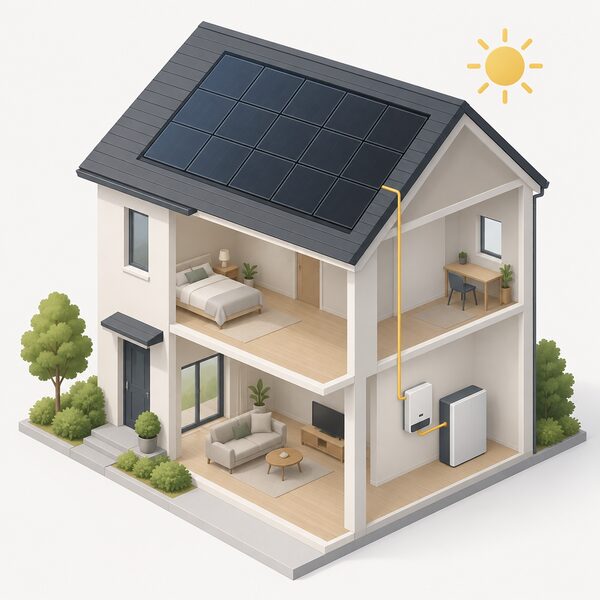
An in-roof array does the same job for a household's independence as any other solar system: it generates electricity at the point of use, so a share of the home's demand is met without drawing from the grid. The greater the intensity and duration of the sunlight, the more electricity is produced8, and the proportion of that output used in the home rather than exported is what determines the bill reduction. The government estimate of around £500 a year4 and the official range of between £530 and £650 a year2 both describe that offset, not a severance from the grid.
The dependence that remains is substantial and worth stating plainly. The system is grid-connected, so the property still relies on the network for everything it does not generate, including all of its demand at night and most of it in winter. It relies on a supplier for the import tariff and for any export payment. It relies on an inverter, a piece of electronics with a replacement interval of around 12 years2, and on the manufacturer of that inverter continuing to support it. And it relies on the roof: because the array is part of the covering, the household's independence from roofing work is reduced, not increased, since the array and the roof now have to be maintained together.
Storage changes the balance. A system with solar panels on the roof, a battery, and intelligent controls to manage the system can shift generation into the evening and reduce import further29. Adding storage is covered on adding battery storage to a solar system, and the wider question of what self-generation can and cannot deliver is set out on solar panels and household energy independence.
Sources29 cited
- Solar roof tiles, Energy Saving Trust, 2026-08-13
- Solar panels, London Borough of Hammersmith and Fulham, 2025-10
- Solar panels, Energy Saving Trust, 2026-08-27
- Research briefing POST-PN-0771, Parliamentary Office of Science and Technology, 2026-06-25
- Solar electricity photovoltaics, Planning Portal, 2026-09-17
- Research briefing CBP-8090, House of Commons Library, 2026-09-17
- Solar panels and permitted development, London Borough of Richmond upon Thames, 2026-07-06
- Solar equipment on residential buildings, Hart District Council, 2025-01
- Solar power facts, Energy Saving Trust, 2026-08-13
- Solar photovoltaic (PV) panels, London Borough of Bromley, 2026-09-17
- Building regulations: energy efficiency, Welsh Government, 2026-09-17
- Solar panels, East Hertfordshire District Council, 2026-09-17
- Barcud Solar Panel Installation Scheme Specification, Sell2Wales, 2026-06-15
- Solar photovoltaics and planning in conservation areas, West Suffolk Council, 2026-09-17
- Solar panels and planning permission, Cornwall Council, 2026-09-17
- Solar panels planning permission checklist, London Borough of Islington, 2026-09-17
- Solar panels guidance, City of York Council, 2026-09-17
- Planning and solar, Frome Town Council, 2025-09-02
- Solar panels guidance, London Borough of Islington, 2026-09-17
- When consent is required, Buckinghamshire Council, 2026-09-17
- Planning and listed building consent requirements, West Northamptonshire Council, 2023-12-14
- Installing solar panels using the local listed building consent order, Royal Borough of Kensington and Chelsea, 2026-09-17
- Local listed building consent order for the installation of solar panels, Royal Borough of Kensington and Chelsea, 2022-05-18
- Solar panels, Wirral Council, 2026-09-17
- Planning (General Permitted Development) Order (Northern Ireland) 2015, legislation.gov.uk, 2015-02-25
- Planning (General Permitted Development) Order (Northern Ireland) 2015, schedules, legislation.gov.uk, 2015-02-25
- UK solar roadmap, Department for Energy Security and Net Zero, 2025-06
- Research briefing CBP-10170, House of Commons Library, 2026-09-17
- Batteries in the home, Solar Energy UK, 2026-09-17
 Solar Mounting SystemsWill your roof take the extra weight of solar panels, and will it still keep the rain out afterwards?
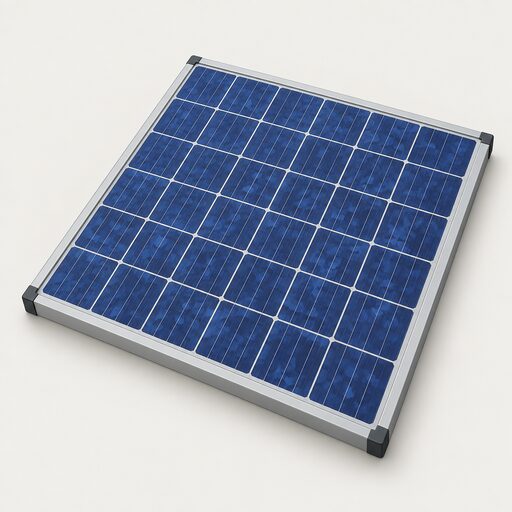 Panel TypesWhich solar panels are best for a UK home, and how much do they cost?
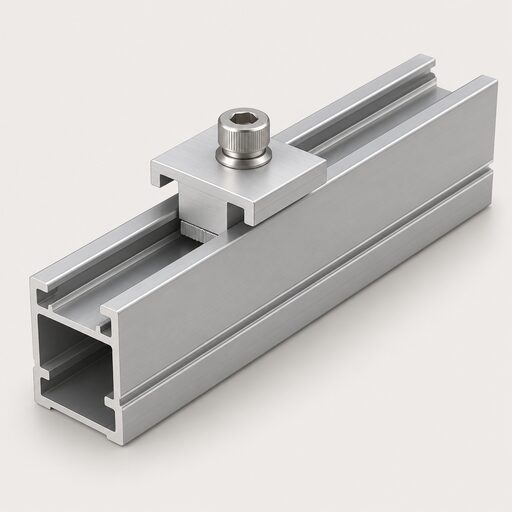 Solar Mounting System MakersWhich solar mounting brands might appear on your quote, and does the maker actually matter?
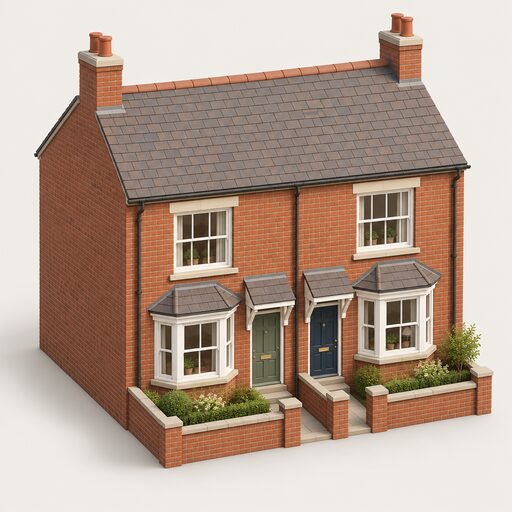 Panels by Home TypeCan your house have solar panels, and how many will fit?
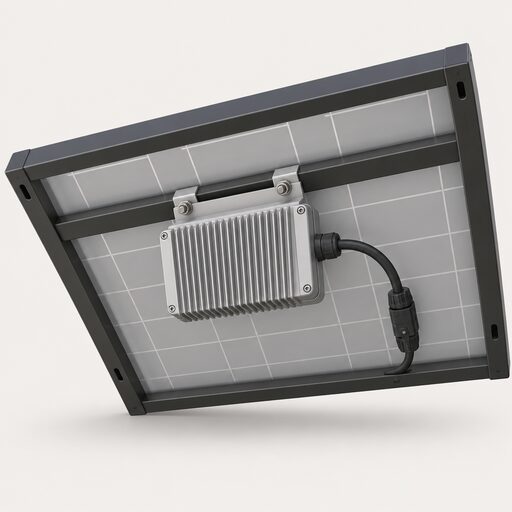 MicroinvertersMicroinverters sit behind each panel and turn its power into household electricity right there on the roof.
 Adding Battery StorageCan you add a battery to solar panels you already have, or does the whole system need replacing?