
In this guide
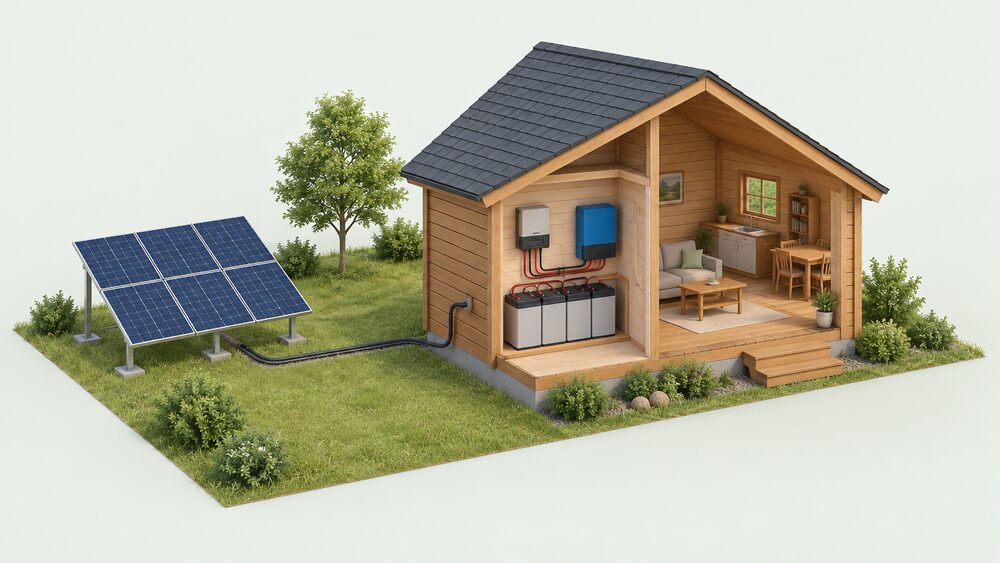
Off-grid solar means a photovoltaic array, a battery bank, a charge controller and an inverter, with no connection to the national grid at all. The array generates, the battery stores, and the inverter converts stored direct current into the alternating current that household appliances use. Nothing is imported when generation falls short, because there is nothing to import from. That single absence shapes every other decision: array size, battery size, system voltage and cost.
The planning definition is narrower than the everyday one. Official legislation defines stand-alone solar as "solar PV or solar thermal equipment which is not installed on a building"1. A ground-mounted array in a garden is stand-alone solar in that sense even when the house behind it is grid-connected. This page covers both readings: genuinely independent systems for homes, cabins and boats, and the stand-alone ground arrays that permitted development rules govern.
Cost is the first hard limit. There is no published UK price for a complete off-grid domestic system. The nearest published figure is for a grid-tied 4kW system at £5,000 to £7,000 without a battery, for a three to four person household2, and the average solar system is put at £10,2703. An off-grid system carries a battery bank sized for winter autonomy plus charge control and an off-grid inverter, so it sits well above those figures. Off-grid prices are installer-quoted.
What off-grid solar means, and what it does not
An off-grid system is defined by what it lacks. There is no grid connection, so there is no fallback when the battery empties and no export route when the array produces more than the household can store or use. A grid-tied system behaves in the opposite way: official guidance notes that when consumption is more than the solar generated, it can draw energy from the national grid in the same way as when there was no solar PV6. Off-grid removes that sentence from the manual.
The distinction matters because it changes the design target. A grid-tied system is sized to offset as much annual consumption as possible, and the grid absorbs the mismatch between a sunny June and a dark December. An off-grid system must be sized for the worst week, not the average year, because nothing arrives to cover the shortfall.
It is worth separating off-grid solar from two things it is often confused with. Plug-in solar systems are defined in the government's consultation as "plug-in solar systems (without batteries) that are designed to be connected directly to a standard UK mains socket and operate alongside the electricity network"7. They are the opposite of off-grid: they depend on the network and are configured without batteries8, and the government's own announcement notes they come with no installation cost and without taking any electricity from the grid9. A grid-tied system with a battery is a third thing again, and it keeps the grid as backup.
For a household's energy independence, off-grid solar delivers the strongest form available: no supplier, no standing charge, no import. What it does not deliver is resilience without cost. The dependence does not disappear, it moves: to a battery manufacturer, to a charge controller, to the weather, and to whoever services the system. A grid-connected home with a battery reduces what it draws from the grid, and therefore what it pays in bills10, but it never has to carry the whole load alone.
The parts of an off-grid system: panels, battery, inverter and charge control
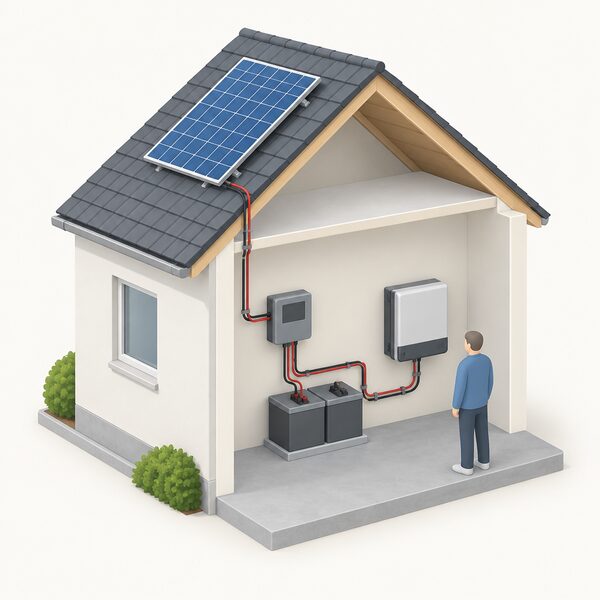
The component list is short and the interactions are not. Official guidance describes photovoltaic panels with cabling, control panel and AC/DC inverter11. Independent guidance on home battery systems describes the same architecture as solar panels on the roof, a battery, and intelligent controls to manage the system10. An off-grid system takes that architecture and removes the grid connection, which promotes the charge controller from an accessory to a critical component.
The four parts do different jobs:
- The array generates direct current. Its output depends on orientation, pitch and shade, and on the module specification.
- The charge controller regulates what reaches the battery. This is where MPPT and PWM controllers differ, and where a mismatched controller wastes generation or shortens battery life.
- The battery bank stores energy for the hours and days when the array produces nothing. Its capacity, chemistry and depth of discharge set how long the household can run without sun.
- The off-grid inverter converts stored direct current into mains-voltage alternating current. Its efficiency and its idle draw both subtract from what the battery holds.
The system voltage ties these together. A small cabin or boat system typically runs at a low battery voltage, while a whole-home off-grid system runs higher to keep cable currents and losses manageable. The choice is not free: it determines which controllers, inverters and batteries are compatible, and it is difficult to change later without replacing the bank.
For a household's independence, the component list is also a list of dependencies. The array is passive and long-lived. The controller, the inverter and above all the battery are active equipment with finite lives, and each is a single point of failure that the grid would otherwise have covered. That is the trade an off-grid household makes knowingly.
Sizing the system to the load: why consumption comes first
Sizing an off-grid system starts with a consumption figure, not a panel count. The array is sized to refill the battery bank within the generation window available in the dullest month, and the battery bank is sized to carry the load through the longest run of days when the array produces little. Both numbers come from the household's own consumption, which is why an off-grid design begins with a metering exercise rather than a quotation.
The scale of the mismatch is visible in the grid-tied figures. Adding a battery to a solar installation increases self-consumption from 30 to 40% to 70 to 80%, according to Great British Energy11. That is the grid-tied case, where the grid still covers the remainder. An off-grid system has to reach the top of that range by design, because there is no remainder to import.
Consumption patterns matter as much as totals. An independent case study of a UK solar household describes shifting usage to the middle of the day, especially during the summer, to use as much of their own electricity as possible12. Off-grid households do the same thing for a harder reason: a load run at midday comes straight from the array, while the same load at night comes out of the battery and pays a round-trip loss.
Two further constraints bear on sizing. The first is seasonal: a UK winter produces a fraction of a summer day's generation, so the battery bank must be sized for the season that defines the design, not the season that flatters it. The second is headroom in the wider system. The Solar Roadmap states that there is grid capacity available for an additional 10 GW of solar, should it be required11, which is a grid-tied consideration, but it illustrates how much capacity the network absorbs on behalf of connected homes. An off-grid home absorbs that variability itself.
The practical consequence is that off-grid sizing is iterative and conservative. A household that under-sizes the bank does not get a warning from a supplier; it gets a dark evening. That is the point at which the independence the system delivers is tested.
Panels and placement: south-facing roofs and open ground work best
Placement rules for off-grid arrays are the same as for grid-tied ones, because the physics does not change when the cable stops at a battery instead of a meter. Independent guidance states that a mainly south-facing roof gets the best power output, with southwest or southeast-facing roofs also good13. Pitch matters too: around 30 degrees is best13.
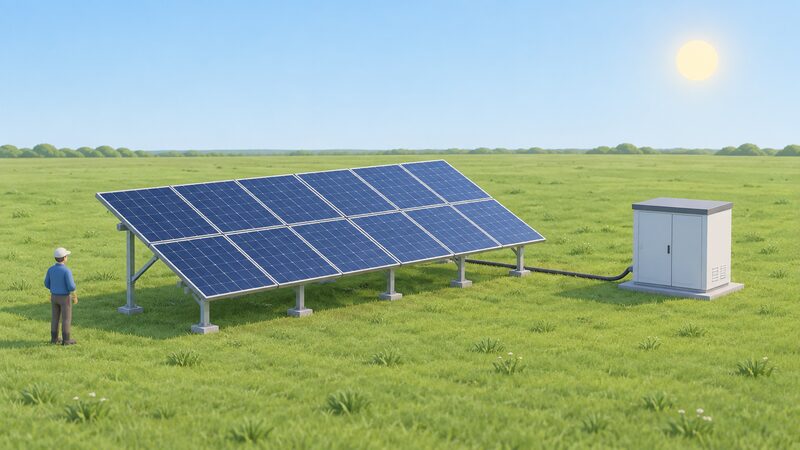
For a ground-mounted off-grid array, the siting freedom is greater but the constraints are real. Open ground avoids the shading that chimneys, dormers and neighbouring buildings cast on roofs, and a ground array can be tilted to the optimum angle rather than accepting the roof's pitch. It also allows the array to be sited close to the battery enclosure, which shortens the direct current cable run and reduces losses.
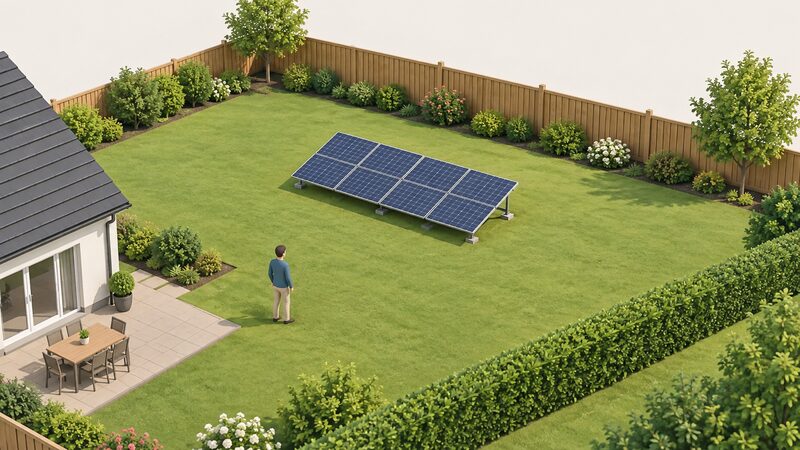
The trade is that ground arrays consume garden space and attract planning conditions that roof arrays do not. In England, stand-alone solar is often permitted development, but the conditions include a 4 metre height limit, a 9 square metre array area limit and a boundary distance rule4. Those limits are covered in the planning section below.
Shading deserves particular attention off-grid, because there is no grid to make up a shortfall. A partially shaded array does not simply produce less; depending on the configuration it can drag down the output of the modules around it. For an off-grid household, a shading survey is not a refinement, it is part of the sizing calculation.
Portable bifacial panels for cabins, boats and vans: the Anker SOLIX range
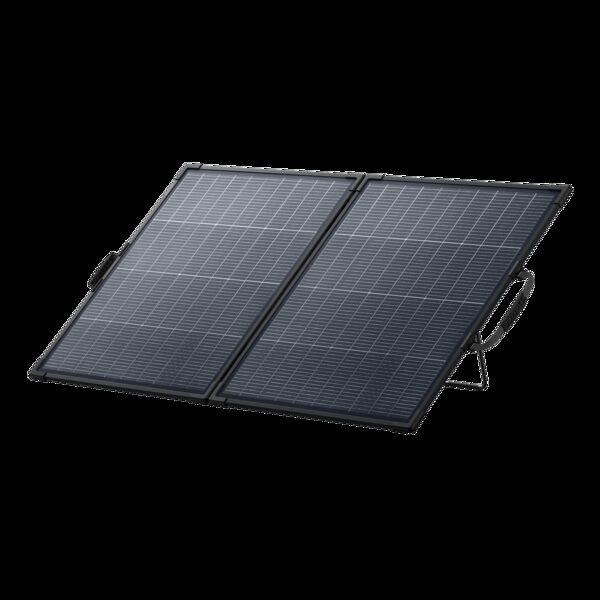
Where a fixed array is impractical, portable bifacial panels fill the gap. The Anker SOLIX PS200 Bifacial Portable Solar Panel is the model with published UK specifications. The maker states that it is engineered with advanced N-type solar cells and offers 25%+ conversion efficiency14. Its bifacial design gives up to 10% more power from dual-sided output14, and a 35 degree tilt is stated to optimise power generation from 10 AM to 5 PM in Japan, the US and Europe14.
| Specification | Anker SOLIX PS200 Bifacial Portable Solar Panel |
|---|---|
| Cell type | Advanced N-type solar cells14 |
| Module efficiency | 25%+ conversion efficiency14 |
| Bifacial gain | Up to 10% more power with dual-sided output14 |
| PV output | 48V=4.16A14 |
| Dimensions, unfolded | 137.7 × 79.2 × 1.7 cm14 |
| Weight | 5 kg including the stand14 |
| Frame | Reinforced aluminium frame and impact-resistant materials14 |
| Water and dust rating | IP6814 |
| Warranty | 5 years14 |
| Stated lifespan | 10 years14 |
The maker states that the panel is 10% lighter than the previous version and over 30% lighter than typical 200W panels14. The box contains the panel, two 2.5 m solar charging cables, a 0.5 m XT-60i solar charging cable, a quick start guide and a safety card14. Shipping for the PS200 bifacial portable solar panel is scheduled to begin in early July14.
For a cabin, boat or van, a portable panel of this kind offers generation without a fixed installation, and it can be moved to follow the sun or stowed when the vessel is under way. The dependence it leaves is on the maker's warranty and on the battery it charges. The panel carries a 5-year warranty and a stated 10-year lifespan14, and a 30-day money-back guarantee14. Those are the maker's own terms, and they are the terms a buyer would rely on.
Planning rules for stand-alone solar: height, area and siting limits
Stand-alone solar is often permitted development in England, which means no planning application is needed if the conditions are met. Official guidance states that these installations are classed as permitted development unless specified conditions are met15, and that the installation of solar panels and equipment on residential buildings may be permitted development with no need to apply to the local authority16. In many cases, even in conservation areas, homes can have solar panels without requiring planning permission under permitted development17.
The conditions are where the detail sits. For ground-mounted solar PV, official guidance sets a stand-alone height limit of 4 metres, a panel surface area limit of 9 square metres, and a limit of no more than one stand-alone solar installation18. Other official guidance states that no part of the installation should be higher than 4 metres19, and that it would exceed 4m in height is a trigger for permission20.
| Condition | Limit | Source |
|---|---|---|
| Maximum height | 4 metres | 18 |
| Array surface area | 9 square metres | 18 |
| Number of stand-alone installations | No more than one | 18 |
| Distance from property boundary | At least 5 metres | 5 |
| Height within 5 m of boundary | 2 metres | 4 |
| Height within 5 m of boundary, forward of principal elevation | 1 metre | 4 |
| Height in a conservation area, closer to the highway than the house | 2 metres | 4 |
Boundary distance is the condition most likely to catch a garden array. Official guidance states that no part of the installation should be higher than 4 metres5, and that the size of the array should be no more than 9 square metres5. A second stand-alone installation on the same property also requires permission5.
The rules changed on 27 August 2026. The Planning Portal reports changes intended to broaden the scope of solar installations for houses in England without requiring an application for planning permission21. Following those changes, stand-alone equipment must be no more than 9 square metres in array area, and height limits of 2 metres within 5 metres of the boundary and 1 metre where the equipment sits within 5 metres of the boundary and forward of the principal elevation apply4. A 12-month transitional period runs to 27 August 2027, during which either the old or the new rules may be followed4.
Listed buildings, scheduled monuments and conservation areas
The exclusions are firm. Official guidance states that panels should not be installed within the boundary of a listed building or a scheduled monument4, and that the panels must not be installed on a building that is within the grounds of a listed building or on a site designated as a scheduled monument26. Ground-mounted solar requires planning permission where the installation is within the grounds or gardens of a listed building or scheduled monument5, and permission is needed where the installation site is designated as a scheduled monument29.
Conservation areas are treated differently from listed buildings. Permitted development can still apply in a conservation area, but with tighter height limits: 2 metres where the equipment is closer to the highway than the nearest part of the house4. Where permitted development rights have been removed by an Article 4 Direction, the stand-alone solar conditions no longer apply and an application is needed18.
Where off-grid falls short: cost, inverter efficiency and maintenance
The limitations of off-grid solar are structural, not fixable by buying better components.
- Cost. There is no published off-grid price, but the components are more numerous than a grid-tied system's. The published comparison points are a grid-tied 4kW system at £5,000 to £7,000 without a battery2 and an average solar system at £10,2703. An off-grid system adds a battery bank sized for winter autonomy.
- Inverter efficiency and idle draw. Every conversion from direct current to alternating current loses energy, and an inverter that is left running draws power even with no load. Off-grid households carry both losses because there is no grid to absorb them.
- Maintenance and shutdown. An independent case study reports no annual maintenance or service requirement, but notes that the inverter is likely to need replacing at some point12. Official fire guidance states that shutting down off-grid systems or systems with a battery back-up is more complicated, and that locating and making safe the battery banks is necessary30.
- No fallback. A grid-tied system draws from the grid when consumption exceeds generation6. An off-grid system has no such option, so a component failure removes supply entirely.
- Scale limits. The UK Solar PV Strategy notes that solar PV in Great Britain above 10 GWp would make managing the grid significantly more challenging and costly31. That is a system-level figure, but it illustrates the scale at which grid management becomes the constraint rather than generation.
The wider context is that solar deployment is not running ahead of need. The Climate Change Committee's 2025 progress report states that the roll-out of solar appears significantly off track and will need to improve to deliver its contribution to a decarbonisation target32. That is a national picture, and it does not change what an individual off-grid system can do, but it sets the expectation for how quickly grid-connected alternatives will expand.
For a household, the honest summary is that off-grid solar buys independence at the price of carrying every failure mode itself. The grid-tied household with a battery gets most of the self-consumption benefit, from 30 to 40% up to 70 to 80%11, while keeping the grid as a backstop. The off-grid household gets the whole of the independence and none of the backstop.
Off-grid or grid-tied with battery: which fits which property
The choice turns on whether a grid connection exists and what it costs to keep.
A property with no grid connection, or one where a connection quote is prohibitive, is the natural off-grid case. A remote cabin, a boat, a van and an isolated rural building all fall here. For these, the comparison is not off-grid against grid-tied, it is off-grid against no electricity at all, and the sizing exercise described above sets the cost.
A property that already has a grid connection is a different calculation. A grid-tied system with a battery reduces the electricity drawn from the grid and therefore the amount paid in bills10, and it keeps the connection as backup. Adding a battery to a solar installation increases self-consumption from 30 to 40% to 70 to 80%11. The household keeps the grid's resilience and gains most of the independence benefit.
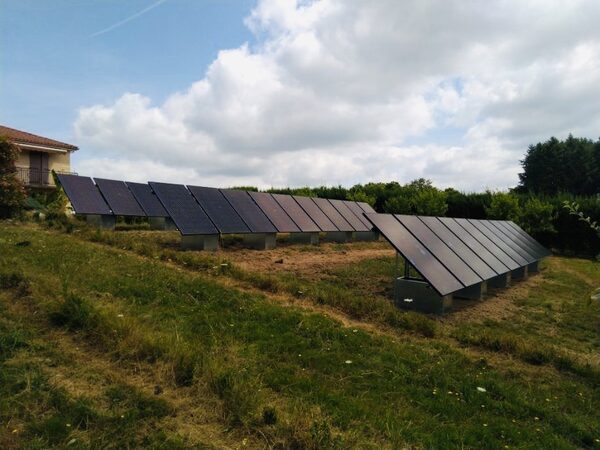
A third case is the property that wants some independence without leaving the grid. Stand-alone ground-mounted solar can be added under permitted development in England, subject to the height, area and boundary conditions above4. That is not an off-grid system, but it is a stand-alone array in the planning sense, and it can be sized to the garden rather than the roof.
| Property type | Natural fit | Why |
|---|---|---|
| Remote cabin or isolated building with no connection | Off-grid | No grid to fall back on, so the system must carry the whole load |
| Boat or van | Off-grid, often portable | No fixed connection; portable bifacial panels suit stowage and repositioning14 |
| Grid-connected home wanting lower bills | Grid-tied with battery | Self-consumption rises from 30 to 40% to 70 to 80% while the grid remains as backup11 |
| Grid-connected home wanting a garden array | Stand-alone solar under permitted development | Subject to height, area and boundary conditions4 |
The dependence that remains is worth naming in each case. Off-grid households depend on a battery manufacturer, a controller and an inverter, and on their own ability to manage load through a dull week. Grid-tied households depend on a supplier and a network, but they also depend on a battery maker if they have added storage. Neither route removes dependence; they place it differently.
For the wider picture of how solar interacts with household energy independence, the solar PV pillar guide sets out the grid-tied case in full, and adding battery storage to solar covers the storage decision in detail. Households weighing a garden array against a roof array will find the planning conditions for each in ground-mounted solar and solar panel planning permission in England.
Sources32 cited
- The Town and Country Planning (General Permitted Development) (England) Order 2015, Schedule 2, Part 14, legislation.gov.uk, 2026
- Solar panels, Uswitch, 2026
- How to decide if solar panels are right for your home, ivie, 2026
- Planning permission: stand-alone solar equipment, Planning Portal, 2026
- Solar panels advice note, Bedford Borough Council, 2022
- How do I retrofit my home: solar panels, Oxfordshire County Council, 2026
- Plug-in solar consultation document, UK Government, 2026
- Plug-in solar, UK Government, 2026
- Households can save as plug-in solar panels come to market, UK Government, 2026
- Batteries in the home, Solar Energy UK, 2026
- Batteries in the home, Parliamentary Office of Science and Technology, 2026
- Installing solar panels to help reduce your carbon footprint, Energy Saving Trust, 2025
- Solar panel myths: five common concerns about solar PV debunked, Which?, 2026
- Anker SOLIX PS200 Bifacial Portable Solar Panel, Anker SOLIX, 2026
- Solar panels planning permission, Bath & North East Somerset Council, 2026
- Solar photovoltaic (PV) panels, London Borough of Bromley, 2026
- Solar panels and permitted development, Richmond upon Thames Council, 2026
- Retrofit and energy efficiency: permitted development, Cotswold District Council, 2026
- Solar panels guidance, Islington Council, 2026
- Solar panels, Wirral Council, 2026
- Changes to permitted development rules for domestic solar installations, Planning Portal, 2026
- Planning permission: solar panels, Welsh Government, 2026
- The Planning (General Permitted Development) Order (Northern Ireland) 2015, Schedule, Part 37, legislation.gov.uk, 2026
- The Planning (General Permitted Development) Order (Northern Ireland) 2015, Schedules, legislation.gov.uk, 2026
- Permitted development rights: impact assessments, Scottish Government, 2026
- Installing solar panels at your home, Brighton & Hove City Council, 2026
- Do I need planning permission to add air conditioning to my home?, Planning Portal, 2026
- Do I need building regulations approval to add underfloor heating?, Planning Portal, 2026
- Solar Together, Swindon Borough Council, 2026
- Fire and solar PV systems: literature review, UK Government, 2017
- UK Solar PV Strategy, Part 2, UK Government, 2014
- Progress in reducing emissions: 2025 report to Parliament, Climate Change Committee, 2025
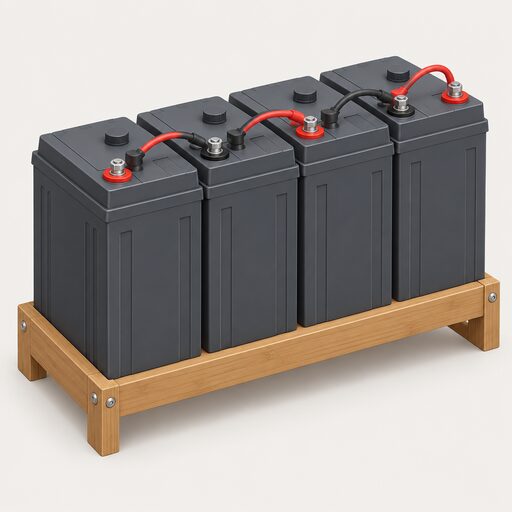 Off-Grid Battery SystemsHow many days of power do you need when there is no sun?
 Off-Grid Wind PowerHow much power can a small wind turbine actually make for a house, boat or caravan that is not on the grid?
 Off-Grid in a UK WinterHow does a home with no mains connection keep the lights on through the darkest, stillest weeks of a UK winter?
 Off-Grid System CostWhat does going off grid really cost, and what makes up most of that figure?
 Going Off-Grid in the UKA whole-picture account of an off-grid UK home: electricity, heat, hot water, cooking, water and waste, and the seasonal management it demands.
 Backup Power and IndependenceA power cut leaves most homes completely dark, so how much backup do you actually need to keep the lights on?