In this guide
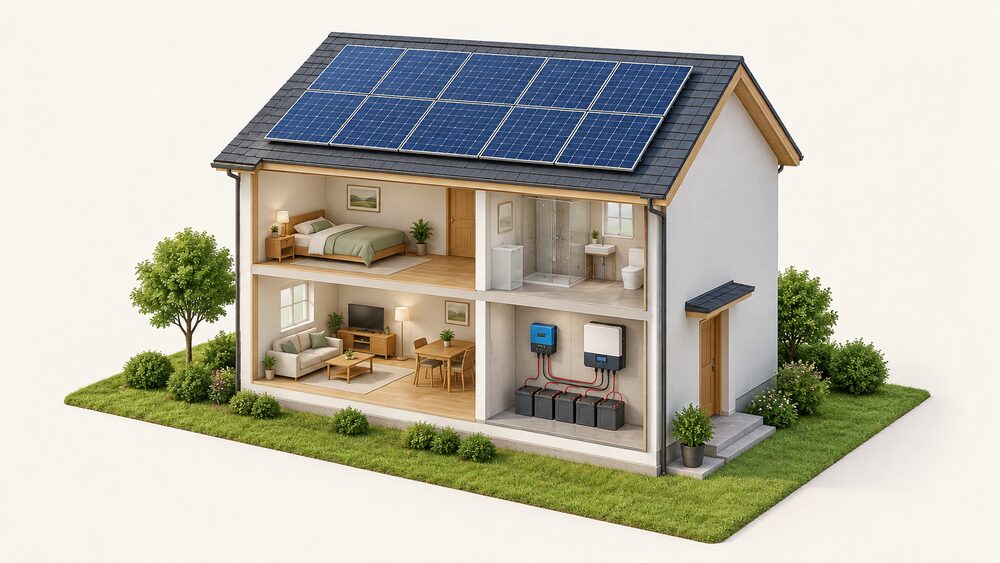
An off-grid battery system is a battery bank, a charging source and an inverter that together supply a property with no mains connection at all. The battery is not an optional extra in this design: for off-grid systems, batteries are essential, and they will need replacing every six to 10 years1. Where a grid connection exists, the same equipment is usually described as backup or self-consumption storage rather than off-grid storage, and the design rules differ.
The core sizing question is autonomy, meaning how many days the bank can carry the property without sun. One maker's guidance for off-grid homes is to plan for a backup of 3 to 5 days, with a recommended battery sized to keep critical loads running for several days2. A documented off-grid house in the UK runs a 48V/440Ah battery bank, a 5kVA inverter and a 4kWp solar array, with 21kWh of lead-acid storage3.
Costs are quoted rather than published. Independent guidance puts the basic equipment for a 1kW off-grid battery charging system at £5,000 to £6,000 plus installation costs4, and a documented off-grid house system at £55k in total3. Off-grid batteries themselves are listed in the UK from £37.73 through £796.90 across 26 variants5.
What an off-grid battery system is and what it must do
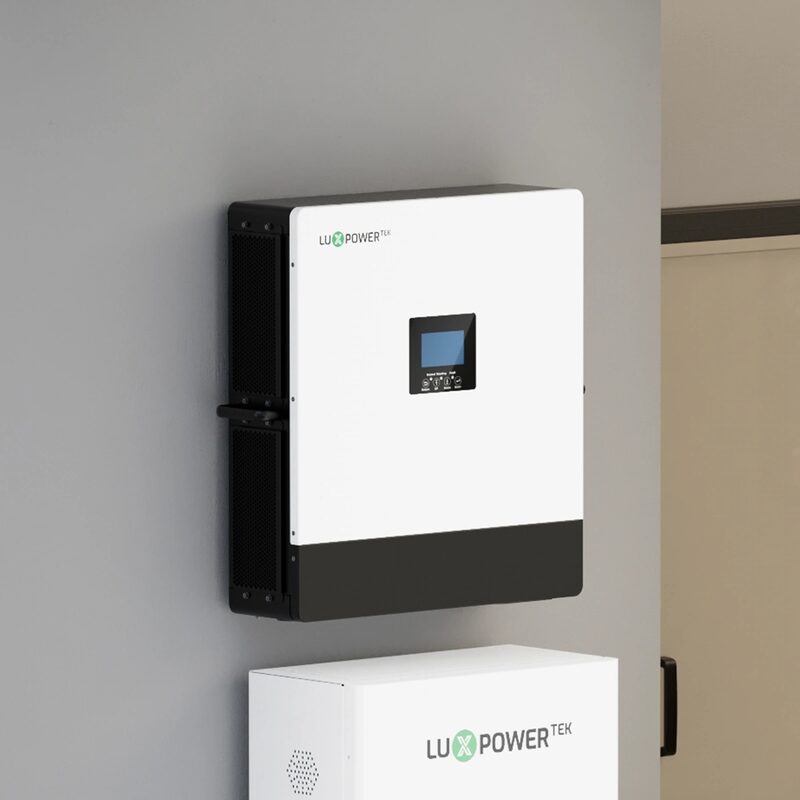
An off-grid system is not connected to the electric grid and is instead entirely self-sufficient6. That single sentence sets the whole design. There is no fallback, so the battery must store enough energy to power the home for several days without sunlight6, and the inverter must be able to run the loads from the battery alone. Many off-grid inverters only support battery integration, drawing charge only from the battery7.
The battery is therefore doing two jobs at once: it is the fuel tank and it is the buffer. Off-grid systems depend on battery quality, and the system's capacity depends on the battery size8. A small bank with a large inverter will trip under load; a large bank with a small inverter will not deliver the power the loads ask for. The two are chosen together.
Charging comes from whatever generation exists on site. Solar is the common case, but small wind is also used, and the same rule applies: if the system is off-grid, the batteries will need replacing9. Micro-hydro is a third option where a suitable watercourse exists4. In every case the battery is the component that converts intermittent generation into a steady supply, and it is the component that wears out.
What the system must do, in order of priority, is: run the critical loads through the longest expected cloudy spell; accept charge from the generation available without overcharging; and give the household a readable state of charge so that demand can be managed before the bank is empty. The last of these is the one most often skipped, and it is the one that decides whether a system survives its first winter.
Where they are used: cabins, boats and homes with no grid access
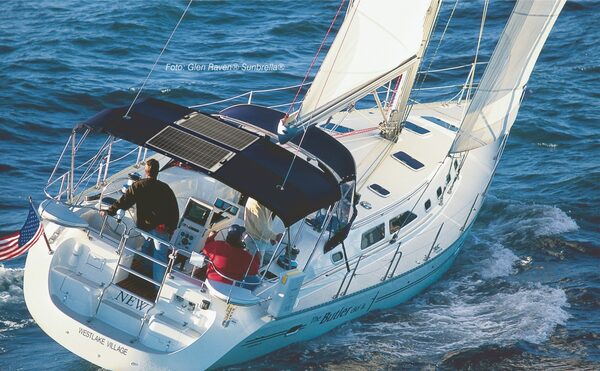
Off-grid inverters are described by makers as ideal for cabins, RVs, boats and rural areas with no grid access10. The same equipment appears in remote applications such as vehicles, camping, boats and recreational vehicles, and emergency backup7. Off-grid inverters suit rural or remote locations without grid access8.
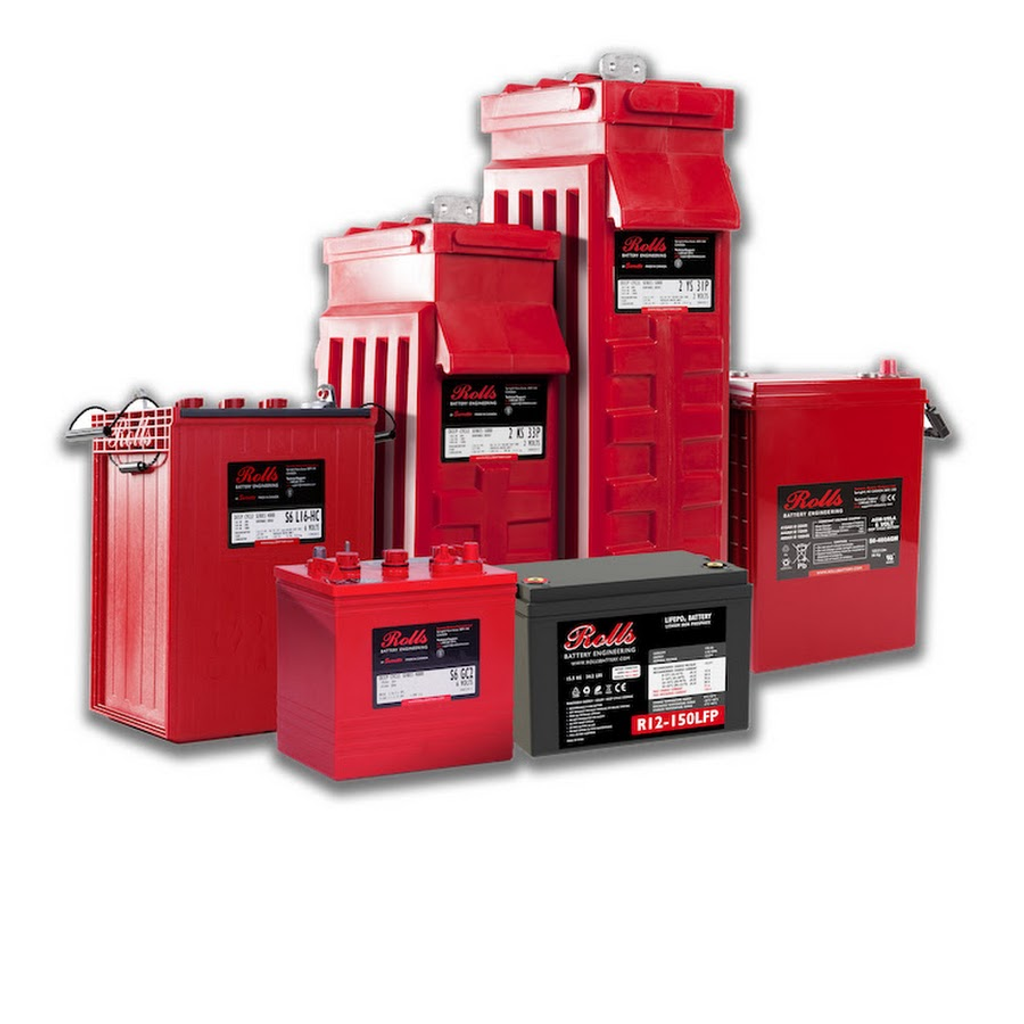
The UK has a long history of exactly this kind of installation. Rolls batteries have been used in several minigrid projects, including those installed at the Scottish Isles of Eigg, Muck, Rum, Fair Isle and Foula, where they have been operating for up to 15 years11. Those are island-scale systems rather than single dwellings, but they demonstrate the same principle: a battery bank sized for days of autonomy, charged by whatever generation the site can support, with no cable to the mainland.
At the domestic end, the applications run from a single cabin with a few lights and a fridge to a full house. Rolls batteries are used in residential off-grid, grid-tied or backup power installs, and also in large scale applications such as diesel generator replacement in developing countries and island mini-grid systems11. The equipment is the same family of products across that range; what changes is the number of batteries in the string and the size of the inverter.
For a boat, the constraints are different again. Space and weight limit the bank, and the charging sources are typically an alternator, shore power where available, and solar. For a cabin, the constraint is usually winter: a weekend property with no permanent occupant has to survive long periods with no load and no maintenance, which is where low self-discharge matters. The AGM range is quoted with particularly low self-discharge so that the batteries will not go flat during long periods without charge12.
Battery types compared: gel, AGM and long-life flooded lead-carbon
Off-grid solar systems commonly use lithium iron phosphate (LiFePO₄), lead-acid in AGM, gel or flooded form, and lithium-ion NMC10. In the UK off-grid market, the lead-acid options remain the mainstream choice for cabins and boats, and the distributor range is built on AGM or gel deep cycle batteries to suit different application and system requirements5.
AGM and gel are both valve-regulated lead-acid types, and they share some characteristics. Both use high purity materials and lead calcium grids, which give particularly low self-discharge12. The AGM range has very low internal resistance, making it particularly suitable for high current discharge applications such as inverters, thrusters and winches12. That matters off grid, because the inverter draws a large current the moment a load switches on.
Gel batteries are quoted with a higher number of deep cycles possible and a greater than five year expected life, and gel technology delivers general power and long or deep discharges without the need for immediate recharge5. That last property is useful where charging is intermittent.
Flooded lead-carbon is the long-life end of the family. Rolls batteries are reported as operating for up to 15 years in the Scottish island minigrid projects11, which is well beyond the six to 10 year replacement interval given for off-grid system batteries generally1. The trade-off is maintenance: flooded cells need watering and ventilation, which is why they suit permanent installations rather than occasional-use cabins.
| Type | Characteristic | Source |
|---|---|---|
| AGM | Very low internal resistance, suited to high current discharge such as inverters, thrusters and winches | 12 |
| AGM and gel | Lead calcium grids, particularly low self-discharge | 12 |
| Gel | More deep cycles possible, greater than five year expected life | 5 |
| Gel | Long or deep discharges without the need for immediate recharge | 5 |
| Flooded lead-carbon | Up to 15 years in service in Scottish island minigrid projects | 11 |
| AGM and lead-acid | 50% discharge allowed | 2 |
The 50% discharge figure is the one that catches people out. If AGM and lead-acid batteries allow 50% discharge2, a nominal 100Ah battery gives roughly 50Ah of usable capacity, and a bank sized on nominal figures alone will be half the size it needs to be. Lithium chemistries are not subject to the same rule, which is part of why they cost more per nominal kWh.
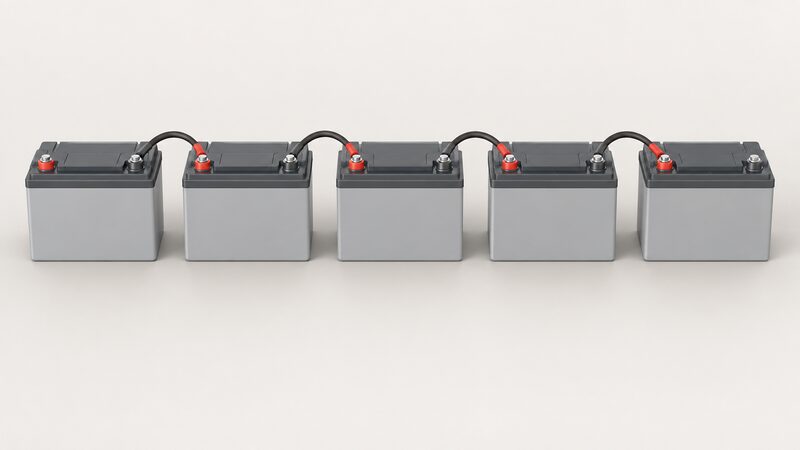
Building capacity: series and parallel connections
A battery bank is built from individual 12V or 6V blocks. The wiring decides the voltage and the capacity. Gel batteries can be connected in parallel to increase ampere-hour capacity, or in series to increase voltage, for example to 24V5. The same logic extends to 48V, which is the voltage used in the larger off-grid packages.
The practical rule is that series strings set the voltage and parallel strings add the capacity. Two 12V blocks in series give 24V at the capacity of one block. Two such strings in parallel give 24V at twice the capacity. A 48V/440Ah bank, as used in the documented off-grid house, is eight 220Ah AGM batteries arranged to give both the voltage and the capacity3.
Voltage choice has consequences beyond the battery. A 12V battery store suits small systems, a 24V store suits a modest AC load, and 48V is used for larger packages. UK distributor packages are built around all three: a 12V battery store to suit two solar panels, a 24V battery store to suit four solar panels, and an 8kWh 48V battery store14. The higher the voltage, the lower the current for the same power, which reduces cable losses and allows smaller conductors.
There is a wider context worth holding in mind. Grid-scale battery storage in the UK reached 7.5 GW of power capacity by the end of 202515, and batteries, both domestic and grid-scale, store electricity for up to eight hours16. An off-grid bank is doing something different: it is not shifting energy across a day, it is carrying the property across days. That is why off-grid banks are sized in tens of kWh where a grid-tied home battery is often sized in single figures.
Inverters: the MultiPlus and small 12V units, with UK prices
Off-grid inverters range from small 1kW units for basic setups to 10kW and above for a whole household10. The documented off-grid house runs a 5kVA inverter with a 4kWp solar array and 21kWh of lead-acid storage3. For a boat or a small cabin, the lower end of that range is the relevant one.
The inverter's job is to turn battery DC into mains AC, and its rating has to cover the surge when a motor or a pump starts, not just the running load. Available power is limited by the battery and inverter capacity, and a system may run out of power if solar generation is low and the batteries are depleted unless a backup generator is available10. That is the honest limit of an off-grid inverter: it cannot deliver what the battery cannot supply.
UK distributor packages pair the inverter with the battery store and the solar array as a single kit. The 12V EasySolar Small Off-Grid AC Package powers AC loads using a 12V battery store and suits two solar panels; the 24V version uses a 24V battery store and suits four solar panels; the 48V kit powers AC loads using an 8kWh 48V BYD LVS battery store14. Buying as a package removes the matching problem between inverter, charge controller and battery voltage.
Prices for the individual components are quoted rather than published. A 12V inverter is listed by a UK distributor at £237.50 plus VAT, with a second listing at £179.17 plus VAT; the two figures are not reconciled7. A battery monitor is listed at £95.83 plus VAT, with a second listing at £115 excluding VAT from outside the UK7. Where a price is not published, it is installer-quoted.
| Item | UK price position | Source |
|---|---|---|
| Off-grid batteries, 26 variants | £37.73 through £796.90 | 5 |
| 12V inverter | £237.50 plus VAT, or £179.17 plus VAT, figures not reconciled | 7 |
| Battery monitor | £95.83 plus VAT, or £115 excluding VAT from outside the UK | 7 |
| Basic 1kW off-grid battery charging equipment | £5,000 to £6,000 plus installation | 4 |
| Documented off-grid house system | £55k total | 3 |
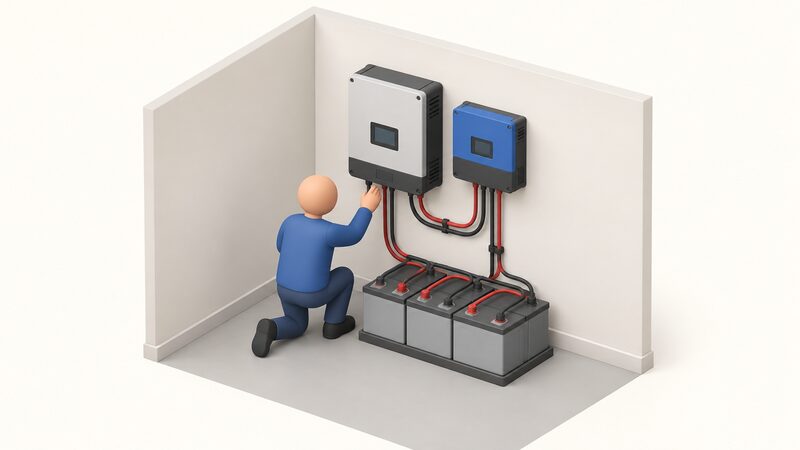
Monitoring: why a battery monitor matters
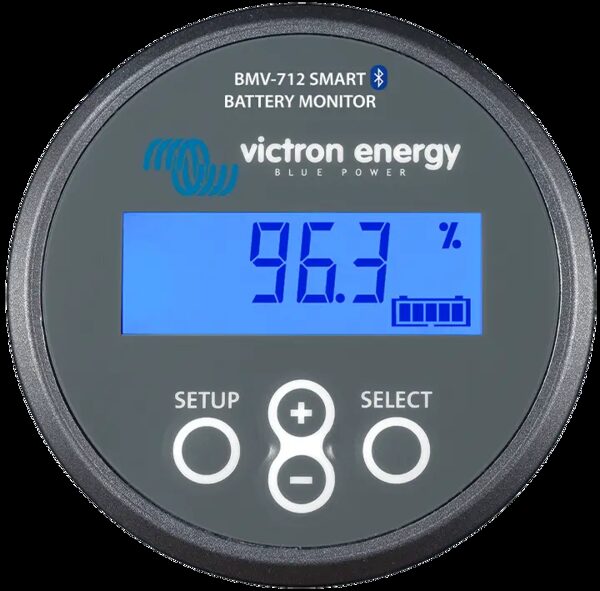
A battery monitor is the instrument that turns a bank of batteries into a managed system. Without it, the household is guessing. One maker's reliability checklist for off-grid inverter and battery systems sets out two checks that a monitor makes possible: confirm the battery reaches absorption or float stage at least once during available sun hours, and monitor state of charge over multi-day cloudy stretches using battery management system communications data, not terminal voltage17.
The second of those is the important one. Terminal voltage sags under load and recovers when the load is removed, so a voltmeter reading taken while a kettle is running tells the household very little about how much energy is left. State of charge from a shunt or from battery management system data is the figure that can be acted on.
Monitoring also covers the end of life. Most battery storage systems monitor battery health and will alert when a replacement is needed18. For an off-grid system, where a failed bank means no power at all, that alert is the difference between planning a replacement and discovering the problem in the dark.
There is a wider point about what monitoring can and cannot do. A grid-connected home battery can be set up to respond automatically to signals from the grid, maximising the economic benefits of contributing to flexibility14. An off-grid system has no such signal to respond to. Its monitoring is entirely inward-facing: state of charge, charge stage reached, and battery health. That is a real limitation of the off-grid design, and it is worth stating plainly.
Costs: what a working system costs in pounds
Off-grid costs are quoted as ranges and case studies rather than published price lists, and the spread is wide because the systems are not comparable. Independent guidance puts the basic equipment for a 1kW off-grid battery charging system at £5,000 to £6,000, plus installation costs4. A documented off-grid house system cost £55k in total3. Those two figures describe very different properties.
For comparison, grid-tied solar is priced more openly. A 6kW solar panel system averages £6,000 to £8,000 without a battery, aimed at large families or those with electric vehicles charged at home19. A complete on-grid solar PV system including installation and battery storage typically ranges from £4,850 to £13,000, with separate labour charges adding between £1,000 and £2,50020. Off-grid solar panel system averages are quoted at £5,000 to £6,000 for a 3kWh system, £6,000 to £8,000 for 4kWh, £8,000 to £9,000 for 5kWh and £9,000 to £11,000 for 6kWh20.
The gap between the two columns is the cost of autonomy. A grid-tied battery is sized to shift a day's generation; an off-grid bank is sized to carry the property through several days without generation, and it is sized on usable capacity after the 50% discharge limit for lead-acid types2. That is why an off-grid system of the same nominal battery capacity costs more than a grid-tied one.
| System | Quoted cost | Source |
|---|---|---|
| 1kW off-grid battery charging equipment | £5,000 to £6,000 plus installation | 4 |
| Off-grid solar, 3kWh | £5,000 to £6,000 | 20 |
| Off-grid solar, 4kWh | £6,000 to £8,000 | 20 |
| Off-grid solar, 5kWh | £8,000 to £9,000 | 20 |
| Off-grid solar, 6kWh | £9,000 to £11,000 | 20 |
| Documented off-grid house | £55k total | 3 |
| Grid-tied 6kW solar, no battery | £6,000 to £8,000 | 19 |
| On-grid solar with battery and installation | £4,850 to £13,000 | 20 |
Running costs are the other half of the picture. Off-grid systems require batteries, which significantly increases system cost and maintenance10. The battery replacement interval of six to 10 years1 means the capital cost recurs, and it is the single largest ongoing expense in an off-grid household's budget. A grid-tied home battery is quoted with a typical lifespan of about ten years21, which is a similar order, but the grid-tied owner has the grid to fall back on when the battery reaches the end of its life.
What owning an off-grid system means for energy independence
Off-grid systems provide energy independence8, and that is the plain benefit. The household is not exposed to the price cap, to wholesale price movements, or to the security of supply questions that affect the wider network. The trade is that the household now owns the reliability problem in full.
The measure that matters is self-sufficiency, defined as the percentage of electricity consumed in the property over a year which is met by either behind the meter solar or electrical energy storage22. An off-grid property is aiming at 100% by definition, but the definition also shows what is being given up: a grid-connected household can use storage to increase self-consumption and reduce reliance on the grid23 without taking on the whole supply obligation.
The dependence that remains is worth naming. An off-grid system depends on the battery manufacturer for replacement cells, on the inverter manufacturer for spares and firmware, and on the monitoring app or display for the state of charge reading. It depends on the weather, and on a generator if one is installed. It depends on the household's own discipline in managing loads through a cloudy spell. None of that is a reason not to do it; all of it is part of the design.
There is also a wider context that off-grid households sit inside. The UK's total installed battery capacity is now around six gigawatts14, and grid-scale battery storage power capacity reached 7.5 GW by the end of 202515. Utility-scale projections run to 33 GW and 50 GW of battery storage by 203524. Those figures describe a grid that is itself becoming more flexible, which changes the calculation for a household that has the option of a connection.
For a household with no connection, none of that applies, and the off-grid design is the only design. For a household with an unreliable supply, the same equipment can be used as backup, and the grid connection enhances the value of the system by enabling the export of surplus electricity13. The choice between the two is a choice about how much of the reliability problem the household wants to own.
Sources24 cited
- Small wind turbines, MCS Certified, 2026-08-18
- What size LiFePO4 battery for solar energy storage, LuxPowerTek, 2026-07-15
- Off-grid, backup and island systems, Victron Energy, 2025
- Micro-hydro, CAT, 2025-07-01
- Off-grid batteries, Marlec, 2025-01-02
- Differences between on-grid and off-grid solar systems, EcoFlow, 2025-06-16
- Hybrid inverter vs off-grid inverter, LuxPowerTek, 2024-07-24
- Inverter technologies compared, Sungrow, 2025-01-07
- Wind turbines, Uswitch, 2026-01-06
- Off-grid vs hybrid inverter, SolaX Power, 2026-03-13
- Rolls battery, Wind & Sun, 2026-09-20
- Gel and AGM batteries, Victron Energy, 2026-09-19
- Behind-the-meter energy systems guidance, Welsh Government, 2026-06-29
- Victron EasySolar off-grid packages, Wind & Sun, 2026-09-20
- Clean flexibility roadmap, GOV.UK, 2025-12
- Statutory security of supply report 2025, GOV.UK, 2025-12-17
- Improving off-grid inverter and battery system reliability, LuxPowerTek, 2026-09-17
- Battery storage, MCS Certified, 2026-09-17
- Solar panels, Uswitch, 2026-09-09
- Reducing solar power cost for UK homes, Jackery, 2025-06-16
- Is a home battery worth it?, IAA, 2026-09-20
- MCS 032 2025, MCS Certified, 2025-01-01
- Electrical energy storage systems, Flexi-Orb, 2025-04-22
- Economic impact of solar and battery storage, Solar Energy UK, 2025-04
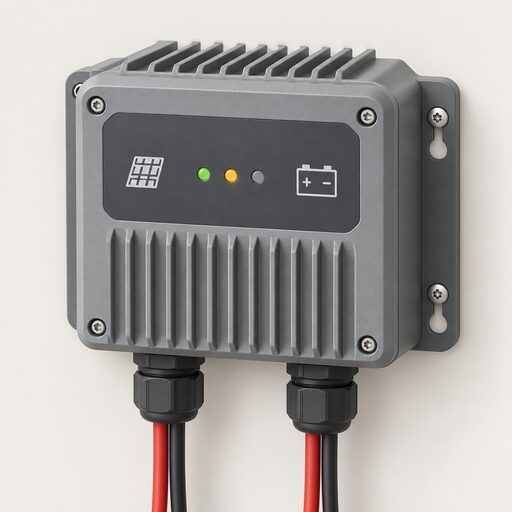 Off-Grid SolarOff-grid solar means your home, cabin or boat runs on its own power, with no connection to the grid.
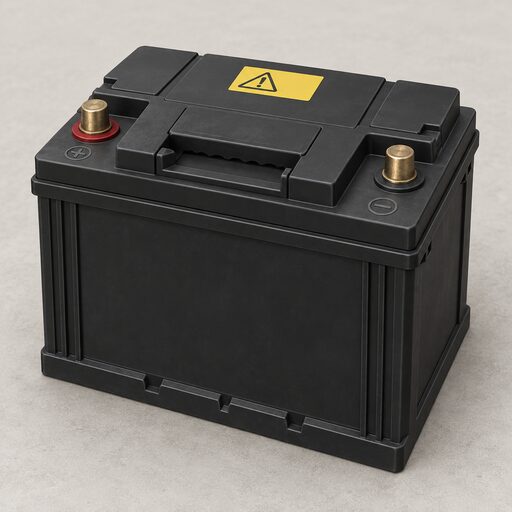 Off-Grid Wind PowerHow much power can a small wind turbine actually make for a house, boat or caravan that is not on the grid?
 Off-Grid System CostWhat does going off grid really cost, and what makes up most of that figure?
 Backup Power and EPSWill your lights stay on when the power goes out?
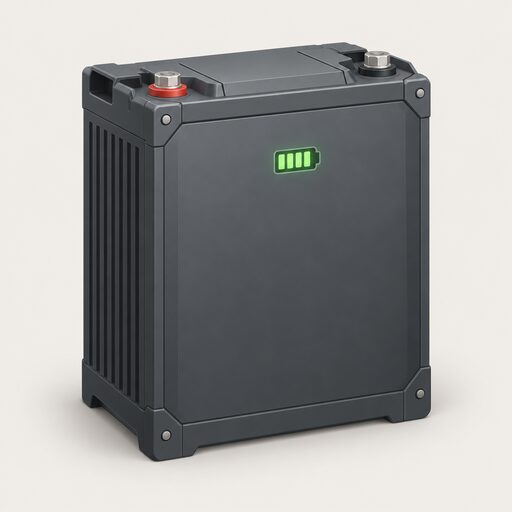 Off-Grid in a UK WinterHow does a home with no mains connection keep the lights on through the darkest, stillest weeks of a UK winter?
 Sizing a Self-Sufficient HomeHow many solar panels and how much battery storage does a home need to stop relying on the grid?