
In this guide
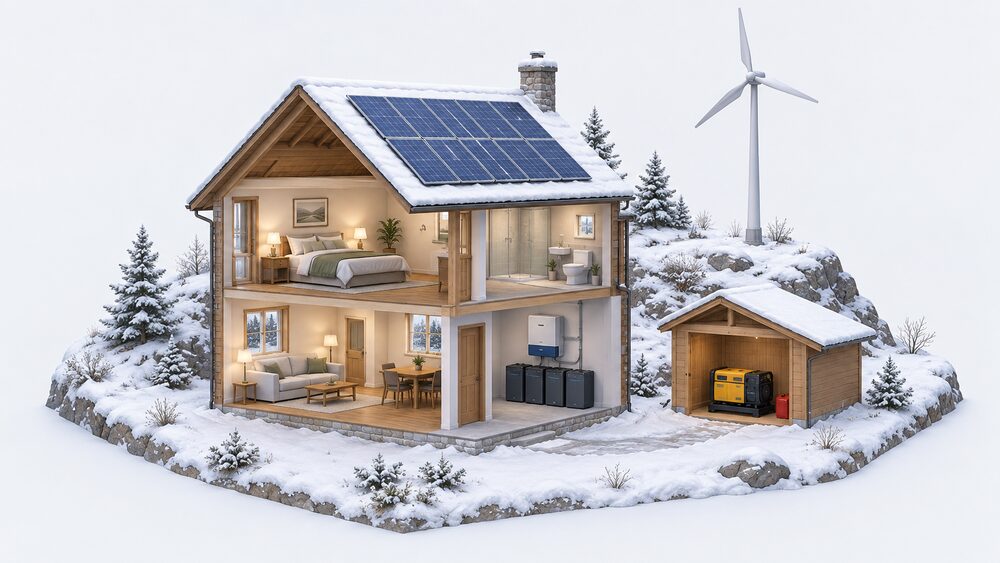
An off-grid home in a UK winter has to supply its own electricity through the weeks when demand is highest and daylight is shortest. Across the UK, electricity demand peaks on winter evenings1, exactly when solar panels produce nothing. That is why off-grid households do not rely on one source. They combine stored power in batteries, a second generator that works in the dark (a wind turbine or, where there is a suitable stream, a micro hydro plant), a backup generator for still spells, and deliberate control of how much electricity the house uses.
The numbers that matter are these. Batteries are essential in an off-grid system and need replacing every six to 10 years2. A well-positioned 6kW wind turbine can generate around 9,000 kWh a year and costs around £31,000 including installation3. A small 1kW off-grid hydro generator costs around £5,000 to £6,000 plus installation, and most hydro systems last 40 to 50 years4. For wind-based systems in low wind, the official Northern Ireland guidance notes that "It's common to run this system with a diesel generator for use during periods of low wind speeds."5
None of this is unusual in the UK. Some four million properties are off the gas grid and depend on alternative fuels for heating and cooking6, and a much smaller number also generate all their own electricity. What follows sets out what each part of an off-grid system does in winter, what it costs, where it falls short, and what dependence remains.
What off-grid living through a UK winter actually requires
Winter is the design case for any off-grid home. Solar generation falls away, heating and lighting demand rises, and the house has no supplier to fall back on. The planning question is not whether the system covers an average day, but whether it covers the worst week: a run of short, overcast, calm days in December or January when the batteries start low and nothing is recharging them. The winter gap between generation and demand is the single constraint that shapes every other decision.
Calm spells can last far longer than a week. The national electricity system operator recorded that "Last summer we saw a period of 16 weeks with very little wind."8 That was summer rather than winter, but it shows that wind alone cannot be assumed to fill a gap.
Being connected to the grid does not remove winter risk either, which is part of why some rural households look at independence. During Storm Arwen in late November 2021, more than 4,000 customers in Northern England and Scotland were off supply for between one and two weeks9. In England, 3.1 million occupied dwellings were reported in the 2024 data as unable to keep warm in winter10. An off-grid home that has been sized for its worst week does not share a network fault, but it carries the whole burden of its own supply.
Heat is usually handled separately from electricity. Off-grid homes are described by the heating industry as "the most difficult to treat", and many owners already support their main heating with secondary heating such as wood burners11. The LPG industry notes that off-grid properties "will need to transition in order to meet Government objectives on Net Zero"12. Whatever the heating fuel, a stored fuel (oil, LPG, logs) is itself a dependence on deliveries through winter.
In practice, getting through winter off-grid requires:
- enough battery storage to carry the house through evenings and short calm spells
- a generator that works in the dark, such as wind or hydro, where the site suits one
- a backup generator and a stock of fuel for it
- a lower, controlled winter demand, with a smaller base load
- heating that does not rely on the electricity system alone
The kit that makes up an off-grid system: generation, storage and backup
An off-grid system has three layers, and in winter all three work harder than at any other time of year.
Generation. Solar panels are the usual base, but in December they contribute little. A wind turbine or micro hydro plant can generate through the night and through overcast weeks. MCS describes a wind solar hybrid system as one that means "you're covered in low light and wind conditions"2. Wind is especially practical for remote areas where connecting to the grid may be costly or challenging2.
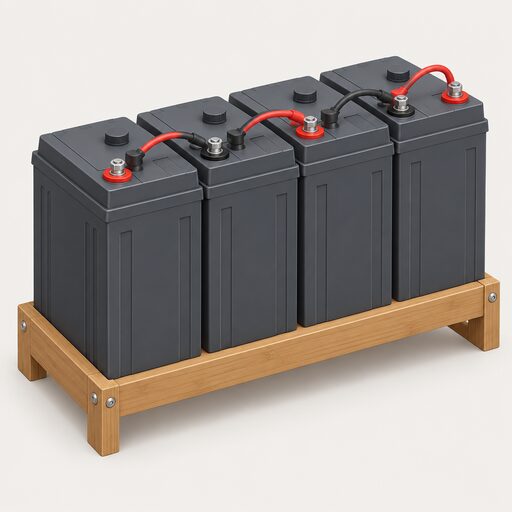
Storage. For off-grid systems, batteries are described as essential, and they will need replacing every six to 10 years2. With battery storage, excess electricity from wind turbines and solar panels can be stored for later use14. Uswitch makes the same point about lifetime costs: "If your system is off-grid you will also need to replace the batteries."7 That makes the battery the most frequently replaced large component in the system, and a recurring cost to plan for.
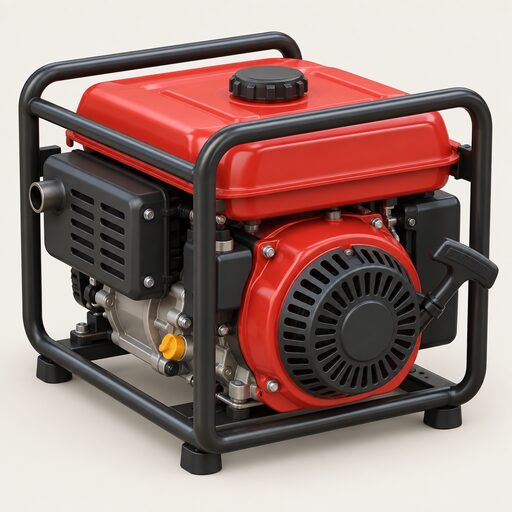
Backup. Where wind is the main winter source, a diesel generator is commonly run alongside it for periods of low wind speeds5. The generator is what turns a system that works most of the time into one that works all of the time, but it brings back a dependence on fuel.
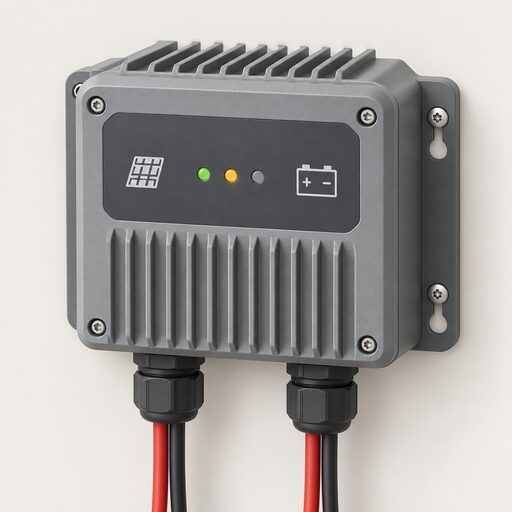
Control and conversion. An inverter converts the stored and generated power for household use. On a small wind system this is a known replacement item: for a larger system, replacing the inverter usually costs between £1,000 and £2,0002.
The way these parts are chosen and balanced is covered in more detail in whole-home energy system design and sizing generation and storage.
Small wind turbines: what they generate and what they cost

Wind turbines vary in size and power output "from a few hundred watts to two or three megawatts"5. At the smallest end, Uswitch describes turbine units that generate around 100W and charge a battery7, which suits a cabin or workshop rather than a family home. Scottish Government guidance puts domestic wind turbines generally in the range 4 to 15 kW15.
Output depends on wind speed and location. MCS states that pole-mounted turbines typically produce 3 to 15kWh of electricity, without giving the period2. The clearest annual figure comes from the Energy Saving Trust, reported by Changeworks: a well-positioned 6kW turbine can generate around 9,000 kWh a year3. No source in the UK guidance breaks this down month by month, so how much of that falls in winter is site-specific. Wind tends to complement solar across the year, which is why the Royal Society research cited by Parliament's science office suggests an optimal solar/wind mix of 20/80 at national scale16.
| Item | Figure | Source |
|---|---|---|
| 6kW pole-mounted turbine, installed | around £31,000 | 3 |
| Annual generation, well-positioned 6kW turbine | around 9,000 kWh | 3 |
| Annual bill saving, well-sited 6kW turbine | around £650 (GB), £800 (NI) | 14 |
| Carbon saving | around 2,600kg (GB), 2,200kg (NI) | 14 |
| Maintenance | around £100 to £200 per year | 17 |
| Inverter replacement, larger system | £1,000 to £2,000 | 2 |
| Life with regular upkeep | over 20 years | 2 |
The bill saving figures assume a grid-connected home offsetting purchased electricity14. For an off-grid home the value is different: each kilowatt hour from the turbine is one that does not come out of the battery or the generator's fuel tank.
Servicing is part of the running cost. Home Energy Scotland states that maintenance checks are necessary every few years and generally cost around £100 to £200 per year depending on the turbine size17. Because turbines have moving parts, they require regular servicing18. These are published figures from independent bodies; actual prices are installer-quoted.
Wind turbine sizing: rotor diameter matters more than power rating
The amount of wind a turbine captures depends on the area its blades sweep, and that area grows with the square of the rotor's diameter. The Centre for Alternative Technology puts it plainly: "When you double the diameter of a rotor, it makes the swept area four times as big."19 It follows that "A rotor with a 10 metre diameter will therefore capture one hundred times as much wind as one with a one metre diameter."19
This is why small, cheap turbines often disappoint. A rotor of a metre or two sweeps very little air. The standard assessment used for energy ratings of existing homes, where a turbine is present but its details are unknown, assumes one turbine with a 2 m rotor diameter and a 2 m hub height19. Uswitch describes small wind turbines as usually between two and eight metres high20.
The machines that generate meaningful power for a home are large. CAT notes that the larger turbines from makers such as SD Turbines and Britwind are "large machines, with a rotor that is several metres in diameter mounted on a high tower", and so are not suitable for most homes21. For an off-grid household, that trade-off is central: the turbine that can actually carry a winter load is a substantial structure needing space, a tower and permission.
Design matters too. Horizontal axis turbines have blades facing the wind, like traditional windmills, with the generator at the top of the pole behind the rotor3. Vertical axis turbines take up less space than horizontal turbines but tend to be less efficient14.
The wider question of whether a home's generation and storage can ever cover the whole year is covered in can a UK home be fully self-sufficient.
Siting a turbine: hilltops, towers and clear wind
Where a turbine stands decides what it produces. MCS advises that turbines should ideally be located on a hilltop or raised structure, away from obstructions like trees or other buildings, and notes that "higher placements catch stronger, steadier winds"2. The Energy Saving Trust states that systems work best in exposed, windy locations and are less suitable for built-up or sheltered areas14.
This works in favour of many off-grid homes. The Energy Saving Trust says that if a house is in an exposed or isolated location, a turbine could be a suitable renewable energy option22. The homes furthest from the grid are often the ones with the most wind.
There are two main types of domestic wind turbine in the UK: freestanding or pole-mounted, and roof-mounted7.
- Pole-mounted turbines stand on their own pole, usually in a clear, open area where there is plenty of wind2.
- Building-mounted turbines are smaller and can be installed on rooftops or building sides2.
Building-mounted turbines sit in the turbulent air around the house and have small rotors, which, for the reasons in the section above, limits their output. For an off-grid home relying on wind through winter, the pole-mounted type on open ground is the one the guidance describes as generating useful amounts.
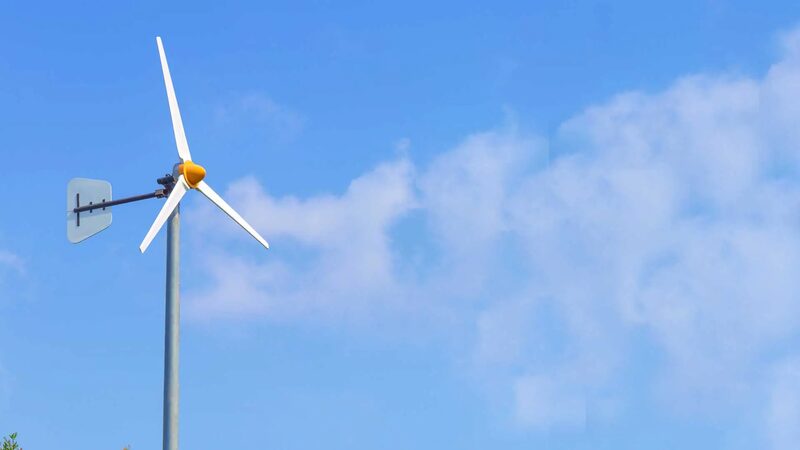
Measuring the wind before buying is the way to know. Electricity North West suggests fitting a wind gauge for a couple of months to check the wind speed near the property18. The official Northern Ireland guidance goes further, advising a professional assessment of local wind speed "for a full year at the exact location"5. A year of data captures the winter months, which is when an off-grid home most needs the turbine.
Wind or hydro: which suits your site

For a house with a usable stream, hydro is the steadier source. The Planning Portal states that for houses with no mains connection but access to a micro hydro site, a good hydro system can generate a steady, more reliable electricity supply than other renewable technologies at a lower cost23. Its separate guidance describes micro-hydro systems as ideal for off-grid homes, offering long-term savings despite high initial costs24.
Wind suits exposed, windy sites with space for a tall pole. Hydro suits sites with running water and a fall in height. Many sites have neither, and some have both.
| Question | Small wind | Micro hydro |
|---|---|---|
| What the site needs | Exposed, windy location, at least 5m/s average | A river or stream with enough fall and flow |
| Reliability | Varies with weather; calm spells | Steady, more reliable than other renewables where the site is good |
| Typical cost quoted | around £31,000 for 6kW installed | around £5,000 to £6,000 for 1kW, plus installation |
| Life | over 20 years with upkeep | 40 to 50 years for most systems |
| Maintenance | checks every few years, around £100 to £200 per year | low running and maintenance costs |
Figures in the table come from the sections of this page that cite them2.
The two technologies cluster where the geography suits them. Under the Feed-in Tariffs scheme, Ofgem found a greater proportion of solar PV deployment in the south and higher levels of hydro and wind deployment in Wales and Scotland25. For a household, that points to the upland, wetter and windier parts of the UK as the places where off-grid winter generation is most practical. A side-by-side view of solar and wind is set out in solar vs small wind.
Domestic hydropower: up to 50 years of power with almost no upkeep
Hydropower is the longest-lived generation an off-grid home can install. The Energy Saving Trust states that "Most hydropower systems can last for 40-50 years, with low running and maintenance costs."4 Uswitch describes domestic hydropower as "Almost maintenance free; a system life expectancy of up to 50 years", and adds that "once the system is installed it requires very little upkeep."26
The cost of a hydro system "depends almost entirely on its size and where you put it"26. The one published price point is for the smallest off-grid installations: around £5,000 to £6,000 for a small, 1kW off-grid generator, plus installation costs4. Installation costs are described as high26, and these depend on the site, so full prices are installer-quoted. There are three standard types of hydropower system26.
The winter case for hydro is strong because a stream flows day and night and does not depend on sunlight. A 1kW generator running around the clock supplies a steady trickle of power that keeps batteries topped up through the dark months, which is a different profile from wind's bursts and lulls. The Consumer Council for Northern Ireland notes that hydro "might be a cheaper option if your home is off the electricity grid"27.
Hydro has a long history of local use. Official Northern Ireland guidance records that hydropower "generated from dams, sluices and mill wheels, was used for many years to generate electricity in a local area"5. Hydropower now makes up around 2% of electricity generation in Great Britain28. Smart Energy GB notes there may be fewer opportunities for large new projects, but smaller schemes and community projects could provide local renewable electricity28. Where a single household cannot justify a scheme, a shared one may be an option, as in the Taff Bargoed hydropower scheme or wider community energy.
Where hydropower falls short: cost, seasonality and the river's lowest level
Hydro only works where the water does. Uswitch states that "Suitability depends entirely on location and other factors"26, and that whether a site is suitable depends "not only on your location and access, but also on how steeply the river flows and how much water passes through"26.
The critical test is the dry season, not the flood. Uswitch's guidance is that the river's lowest level will determine how feasible a site is more than its highest level26. The Energy Saving Trust gives the reason:
"As streams and rivers can dry out in the summer, not every watercourse is suitable for hydroelectricity."
For an off-grid home the seasonal pattern can work in its favour. A stream that runs low in summer, when solar is at its strongest, and full in winter, when solar is at its weakest, pairs well with panels. The risk is the reverse: a dry winter spell or a frozen upland stream, which the guidance does not quantify.
The limits, stated plainly:
- Upfront cost is high, and depends almost entirely on size and location26.
- Most homes have no suitable watercourse. It needs a river or stream near the house22.
- Low flow decides output, so a site can look promising in winter and fail in a dry year.
- A site visit is needed. Uswitch advises contacting a certified hydropower installer who can look at the site26.
Batteries, charge controllers and backup generators: keeping power through the still, dark weeks
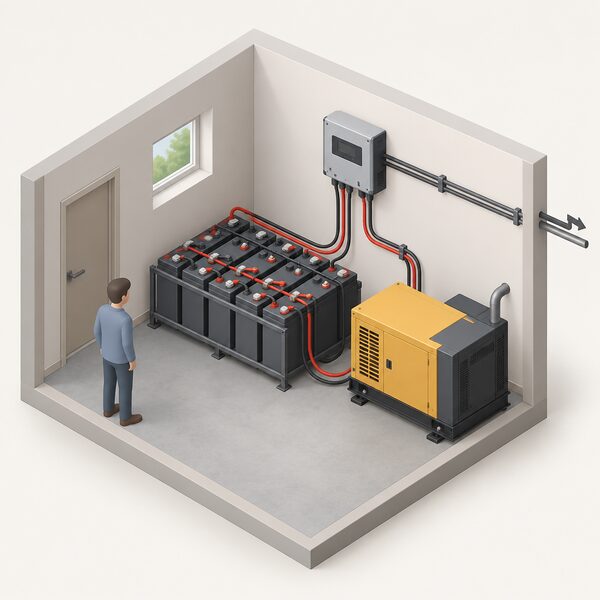
Storage is what carries an off-grid home from one charging opportunity to the next. With battery storage, excess electricity from wind and solar can be stored to use later14; MCS describes pairing a turbine with a battery "for when you most need it"2. In winter, the battery must be large enough to carry the house through the evening peak and through calm, overcast days, with the backup generator filling in when it runs low.
The battery is a consumable. For off-grid systems, batteries will need replacing every six to 10 years2, and Uswitch lists battery replacement as a lifetime cost of any off-grid wind system7. Set against a hydro system lasting 40 to 50 years4 or a turbine lasting over 20 years2, the battery bank may be replaced several times over the life of the generation equipment.
The guidance available does not set out how batteries behave in cold weather, how deep they can be discharged, or how charge controllers are specified, and none of those figures is given here. Those are matters for the installer and the battery maker's own specification.
The backup generator is the final line. For wind-based off-grid systems, official guidance notes it is common to run a diesel generator for periods of low wind speeds5. In practice, that means:
- Generation (solar, wind, hydro) charges the battery whenever it is producing.
- The battery supplies the house, including the winter evening peak.
- When the battery falls to a set level during a calm, dark spell, the generator runs to recharge it.
- The household reduces demand during long lulls to stretch both battery and fuel.
Demand control is the cheapest part of the system. Every kilowatt hour not used in December is one that does not need to be generated, stored or burned. The effect of storage on how much of a home's own generation it uses is covered in how much a battery increases self-consumption, and the choice between a battery and heat storage in home battery vs hot water tank.
Planning permission, installers and pre-installation wind monitoring
Planning rules for wind turbines differ across the UK. The Energy Saving Trust states that in Wales and Northern Ireland, planning permission must be obtained before a wind turbine is installed, while for England and Scotland "the rules are more complex", and in some specific situations permission might not be needed14. Official Northern Ireland guidance states simply: "Planning approval is needed."5
| Nation | Wind turbine planning position |
|---|---|
| England | Permitted development possible in some cases, within specified limits and conditions |
| Scotland | Rules more complex; in some situations permission may not be needed |
| Wales | Planning permission required |
| Northern Ireland | Planning permission required |
Positions in the table are drawn from the Energy Saving Trust and the Planning Portal14.
For England, the Planning Portal states that under permitted development rights "in some cases it is possible to install domestic wind turbines without the need for a" planning application, so long as specified limits and conditions are met30. Uswitch cautions that residents in all British nations will usually need to apply for planning permission before starting work7. Both positions can be true: permitted development exists, but many real installations fall outside its limits. The Planning Portal's own advice is:
"Always check with your Local Planning Authority about planning issues before you have a system installed."
Wind monitoring comes before any commitment. Electricity North West suggests a wind gauge for a couple of months18; official Northern Ireland guidance recommends a professional assessment of local wind speed for a full year at the exact location5. The two differ in how long they recommend. The longer period is the one that captures the winter months.
For hydro, Uswitch advises contacting a certified hydropower installer to assess the site26. MCS is the certification body for small wind turbines in the UK consumer guidance2. The wider legal position of disconnecting a home is covered in off-grid legality and rules.
What going off-grid means for your energy independence
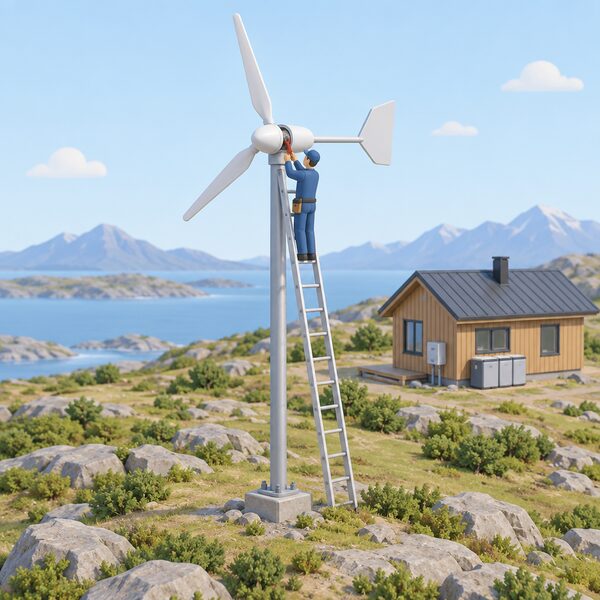
An off-grid home that gets through winter on its own generation has removed its dependence on an electricity supplier, on the distribution network and on national grid events. It is not exposed to network faults of the kind that left more than 4,000 customers without power for up to two weeks after Storm Arwen9, or to the emergency disconnection arrangements that apply to connected customers in a severe gas shortage13.
That independence is real but partial. The dependences that remain are:
- Fuel. A backup generator runs on stored fuel, and many off-grid homes heat with oil, LPG or wood11. Winter deliveries and prices still matter.
- Replacement parts. Batteries every six to 10 years2, an inverter at £1,000 to £2,000 for a larger wind system2, and servicing every few years17. Each depends on a manufacturer and a supply chain.
- Installers and servicing. Turbines need regular servicing because they have moving parts18; hydro needs little, but the initial site assessment needs a certified installer26.
- Weather. Calm spells, dry streams and short days all set the limit on what the site can produce.
Hydro gives the most independence per pound where a site exists, with a life of 40 to 50 years4. Wind gives substantial winter generation on exposed sites, but at around £31,000 for a 6kW turbine3 and with a tall structure that needs permission in much of the UK. Solar alone does not carry a UK winter. The fuller costs are set out in how much an off-grid home system costs and going off-grid in the UK, and the wider picture in the household energy independence guide.
One option sits between full disconnection and full dependence. Smart Energy GB notes that small and community schemes could provide local renewable electricity and flexibility28, and a microgrid or local energy system shares winter risk across several homes rather than leaving each one to carry its worst week alone. The more than 2,600 onshore wind farms in the UK31 show how much the national system relies on spreading generation across many sites; an off-grid home has only its own.
Sources31 cited
- Efficiency and flexibility: a UK perspective on heat pumps in the electricity system, Heat Pumping Technologies, 2024
- Small wind turbines, MCS, 2026-08-18
- Domestic wind turbines, Changeworks, 2026-06-01
- Hydroelectricity, Energy Saving Trust, 2025-11-06
- Wind, nidirect, 2026-05-18
- LPG in the home, Liquid Gas UK, 2026-09-20
- Domestic wind turbines, Uswitch, 2026-01-06
- How does storage help us balance the grid?, NESO, 2026-09-17
- Statutory consultation on amendments to the Electricity (Standards of Performance) Regulations 2015%20Regulations%2020151680596597411.pdf), Ofgem, 2023-04-04
- How well do homes in England cope with extreme weather?, Nesta, 2026-07-09
- Hybrid heat pumps, HHIC, 2026-09-17
- Rural households and net zero, Liquid Gas UK, 2026-09-20
- Electricity Supply Emergency Code, SSEN, 2026-09-19
- Wind turbines, Energy Saving Trust, 2026-05-20
- Microgeneration strategy for Scotland, Scottish Government, 2012-06-22
- POSTnote 771, UK Parliament POST, 2026-06-25
- Wind turbines, Home Energy Scotland, 2026-09-20
- Wind power, Electricity North West, 2026-09-19
- Wind power, Centre for Alternative Technology, 2025-06-27
- Microgeneration energy guide, Uswitch, 2026-06-08
- Domestic wind power, Centre for Alternative Technology, 2023-10-01
- Generating renewable electricity, Energy Saving Trust, 2025-12-11
- Hydro-electricity, Planning Portal, 2026
- Sustainable home energy solutions, Planning Portal, 2024-09-02
- Feed-in Tariffs Annual Report, Scheme Year 13, Ofgem, 2023-12
- Hydropower for the home, Uswitch, 2026-01-06
- Renewable energy, Consumer Council for Northern Ireland, 2026
- What is hydropower and how does it work?, Smart Energy GB, 2026-08-19
- Are home renewables right for you?, Energy Saving Trust, 2025-12-11
- Wind turbines, Planning Portal, 2026-09-17
- What are wind farms all about?, Smart Energy GB, 2026-03-16
 Off-Grid SolarOff-grid solar means your home, cabin or boat runs on its own power, with no connection to the grid.
 Going Off-Grid in the UKA whole-picture account of an off-grid UK home: electricity, heat, hot water, cooking, water and waste, and the seasonal management it demands.
 Off-Grid Battery SystemsHow many days of power do you need when there is no sun?
 Can a Home Be Self-Sufficient?Can a UK home really run on its own energy all year, or does the grid still do the heavy lifting in winter?
 Is Off-Grid Living Legal?Can you legally live without mains gas or electricity in the UK?
 Backup Power and IndependenceA power cut leaves most homes completely dark, so how much backup do you actually need to keep the lights on?