In this guide
A whole-home energy system is not a shopping list, it is a sequence. Generation, storage, heat and transport each behave differently across a day and a year, and a controller decides which one gets the electron. The building fabric comes first: a whole house approach to retrofit treats a warmer home and lower bills as one project rather than a run of separate purchases1, and teaching programmes on household renewables typically open with an introduction to renewables, then insulation and draught-proofing, and only then move to solar PV, wind energy and heat pumps2. Heating and hot water make up over half of a typical home's energy use, which is why the heat decision dominates the design3.
The scale of what the parts do together is measurable. The Climate Change Committee has stated that a typical household could save around £1,200 a year today by combining an electric vehicle, a heat pump, solar panels and a time-of-use tariff, rising to around £1,900 for some rural homes4. Full integration remains uncommon: in the Energy Systems Catapult Living Lab, 208 homes, 10% of homes with low carbon technology in that sample, ran the full stack of EV, solar, battery and heat pump, the second most common combination recorded5.
Independence has limits worth stating at the outset. A grid-tied system stops generating during a power cut; the connection remains the route by which surplus is turned into value; and the controller that sequences everything is usually a manufacturer's product with its own app and account. The sections below set out each part, the interfaces between them, and the points where two subsystems compete for the same kilowatt-hour.
The four parts, and the plan that holds them together
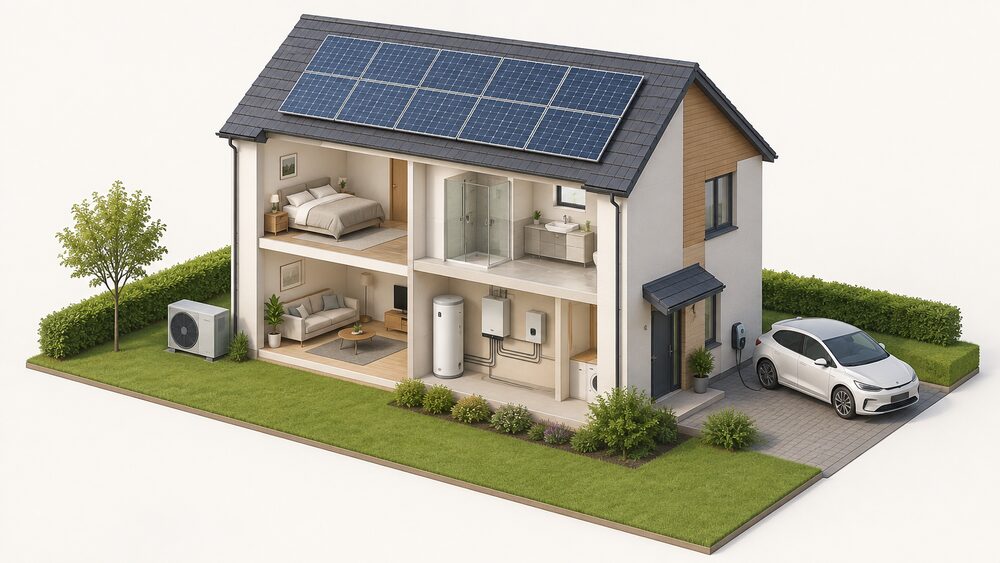
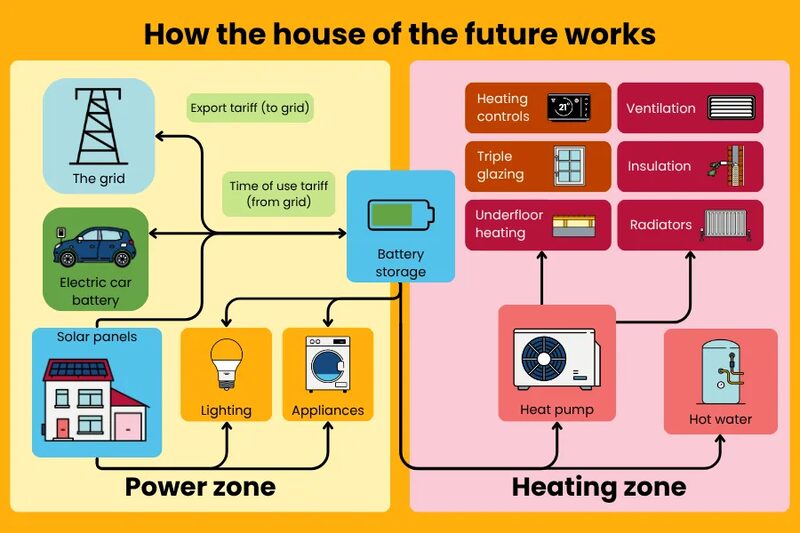
The four working parts are generation, storage, heat and controllable load, with a controller above them. Each is separately useful and separately installable, which is why most homes acquire them out of order over years rather than in one commissioning. A whole house plan is a professional service that assesses a home's energy-saving potential, helping owners plan and budget for improvements10, and its value in this context is that it fixes the order and the interfaces before the first contract is signed.
Interfaces are where the money and the disappointment sit. A battery that cannot be told to hold charge for the evening peak will be emptied by an EV charging at six o'clock. A heat pump running its hot water cycle at the same moment as a car charges can push a property past its supply capacity. Hot water and space heating are the largest single call on the system, so the heat controls are as much part of the architecture as the inverter3. Where schemes fund a package rather than a product, they tend to say so explicitly: whole house solution schemes in Northern Ireland provide an upgraded heating system to a less carbon intensive fuel where available, with full heating controls such as smart controls11.
The parts also differ in how firm they are. Generation is weather-bound. Storage is finite and shifts hours, not seasons. Heat demand is seasonal and inverted against solar output. A vehicle is mobile and may not be present when the system needs it. Designing the whole means accepting that only the loads are genuinely under the household's control, and that electricity has become the common currency: electric heating is any system using electricity as the main energy source to heat the home12, and electric boilers were the main method of heating for 4% of homes in the winter 2025 attitudes tracker13.
Generation: solar PV as the usual starting point
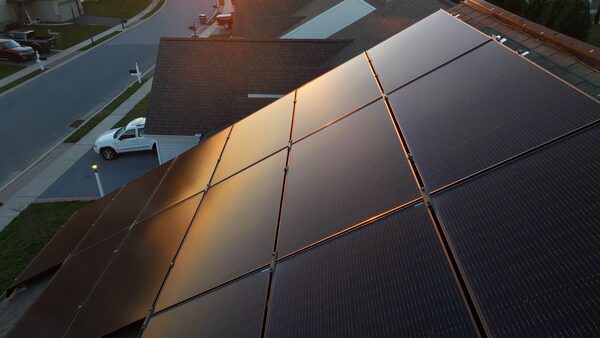
Solar photovoltaic panels use energy from the sun to create electricity to run appliances and lighting14, converting sunlight directly, with more electricity produced the greater the intensity and duration of the sunlight15. They are described by the trade body as affordable, reliable, low-impact and popular16, and they dominate domestic generation: most solar PV installations recorded under the Feed-in Tariff were domestic rooftop systems in the 0 to 4 kW capacity range17.
Sizing follows that pattern. Household solar panel systems are typically up to 4 kWp7, and an average domestic system can generate between 3,400 and 4,200 kilowatt hours of electricity a year6. The spread in that range reflects orientation, shading, pitch and location rather than disagreement between sources. For the heat side of the design, a domestic solar array of that order should generate enough during the year to balance a heat pump's requirements in a typical home18, though that is an annual balance and not an hour-by-hour one: the surplus arrives in June and the demand arrives in January.
Planning treatment is generally permissive. Solar panels sit alongside extensions, garage conversions and outbuildings among the common projects covered by permitted development rights19, and the Planning Portal maintains separate guidance for solar electricity14. Listing, conservation areas and flats change that, and local guidance exists for solar equipment on residential buildings15.
Where a roof is unsuitable, the alternatives are narrower than the marketing suggests. For houses with no mains connection but with access to a micro hydro site, a good hydro system can generate a steadier, more reliable electricity supply than other renewable technologies at a lower cost20. That is a site-specific exception, not a general substitute. For most households the realistic comparison is solar against small wind, and the honest reading of the evidence is that PV is the default because it is the one that works on an ordinary suburban roof.
Storage: what a battery adds, and when it earns its keep
A battery does not generate anything. It moves electricity in time. Without one, surplus solar electricity is wasted or exported to the grid, often at a relatively low rate; with one, that surplus is captured and held until it is needed, including for overnight EV charging21. The same store can be filled from the grid when a tariff is cheap and emptied when prices are high22, which is what turns a battery from a solar accessory into a tariff instrument.
The effect on self-consumption is the number that matters. A household with 3.5 kW of solar PV and a 6 kWh battery might be able to use 70% of the solar energy it generates8. Domestic battery systems can store as much electricity as a household typically uses in a day, enabling a PV system to provide up to 70% of a household's annual electricity demand23. Those two independent figures converge on the same order, and they set a realistic ceiling: a battery of everyday size raises self-consumption substantially, it does not deliver independence.
Capacity is not all usable. When the battery reaches a set level, perhaps 20% of total storage capacity, the system stops discharging22. Savings depend on how much energy is generated, the size of the battery, household consumption and the supplier's fees24. Anyone with a home can potentially install a battery system25, and a battery is often described in installer terms simply as storing excess energy to keep a home powered day and night26.
The sequencing question, whether the battery or the hot water cylinder should take the surplus first, is a real design trade-off and is covered in more depth in the comparison of a home battery against a hot water tank and of a solar diverter against a battery.
Heat: the heat pump, the cylinder and the hybrid case

A heat pump is a versatile system capable of providing heating, cooling and hot water for homes, commercial buildings and industrial applications28. Two independent guidance sources state that heat pumps are suitable for almost all types of home29, which shifts the design question away from whether a property qualifies and towards emitter sizing, controls and the hot water store.
The cylinder is the part that makes heat useful to the wider system. It is a thermal battery that a controller can charge with surplus electricity at midday, and it is usually cheaper per unit of stored energy than a lithium battery, at the cost of only ever returning heat. That trade is examined in whether a hot water tank can act as a battery.
Hybrids sit between the two worlds. In a hybrid combination system the existing heat generator is replaced with a hybrid heat pump and intelligent control, with hot water supplied by the boiler, which also supports during cold periods31. Grant rules treat hybrids carefully: Home Energy Scotland requires hybrid heat pumps to be whole house heating systems providing both heating and hot water, with the costs of the fossil fuelled and the low and zero emission heat elements shown separately, and assesses them case by case32. That is a Scottish condition and does not automatically apply elsewhere; support in England, Wales and Northern Ireland runs through different schemes, including the Warm Homes schemes whose battery rule is noted above27.
In operation, integration should be invisible. In one documented household combining solar panels and a heat pump, the system is totally automated and the heat pump comes on automatically33. That automation is also the dependency: the household's comfort now rests on a controller and its logic rather than on a dial.
"Heating and hot water make up over half of a typical home's energy use."
The EV as storage: vehicle-to-grid and vehicle-to-home
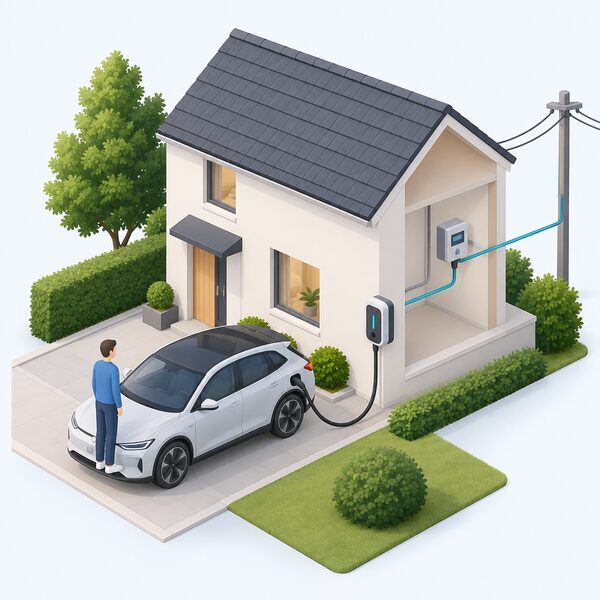
Vehicle-to-grid technology allows an electric vehicle charger not only to charge a vehicle but also to take energy from it34. The stored energy can then be fed back into the electricity network35, or used for the building the charger is connected to rather than the network in general36. Where the destination is the property, the term is vehicle-to-home: V2H uses the energy to power a home rather than delivering it back to the grid37.
The appeal is capacity. Electric vehicle batteries in principle offer a very large potential to contribute to home energy storage and electricity system balancing38, and vehicle-to-grid has been described as potentially one of the best ways of storing excess renewable energy, with electric vehicles as battery storage allowing better management of the UK's energy34. A model of an efficient future home assumes both a stationary battery and an EV battery storing electricity39. In parallel, legislation has been extended to cover electrical batteries storing electricity generated by certain energy saving materials and from the grid40.
The constraints are practical. The car must be plugged in when the system wants it, which is why plug-in rate drives every revenue estimate. Compatibility is a pairing: a bidirectional charger and a vehicle that permits export. Manufacturer rollout is still partial, with Toyota Motor Europe describing vehicle-to-grid integration as a more advanced solution planned as it expands its energy collaborations to additional countries41. Solar electricity in a system with a vehicle can in any case be used throughout the home, exported to the grid, or stored in a battery for use at another time42, and the choice between charging from solar and charging on a cheap tariff is often decided by when the car is at home.
What vehicle-to-grid costs and what it pays
Household revenue estimates differ by a factor of nearly three, and the reason is the assumption about availability and the services sold.
| Measure | Figure | Basis |
|---|---|---|
| Estimated average UK V2G revenue | £150 to £200 per year9 | Average UK household |
| High plug-in rate scenario | £414 annual grid services revenue, almost all from frequency response43 | Modelled scenario |
| Annual depreciation saving from managed charging | £2309 | Via reduced capacity fade |
| Battery capacity fade reduction | 9.1% over a year through battery management9 | Modelled |
| Useable battery life extension | 10%9 | Modelled |
| Predicted V2G charger cost | £1,000 by 20309 | Cenex prediction |
| Predicted V2G hardware prices | below £3,000 to £5,000 by 20259 | Cenex prediction |
The hardware predictions are forecasts made before their target dates and should be read as such rather than as observed prices. No verified current installed price is available here, so a household should treat V2G equipment as installer-quoted.
System-level benefits are larger and accrue mainly to the network rather than the driver. V2G operation could generate a whole energy system net saving of between £40 million and £90 million a year in Great Britain by 2030, depending on limits to V2G energy throughput43, an amount described elsewhere as additional to the savings from smart charging alone44. It could help save £200 million of cumulative distribution network investment by 203044 and defer network upgrades of £5 billion, or £180 per household9. Reduced renewable curtailment could amount to a saving of 6 MtCO₂e per year9, and storing generation from a 4 kWp domestic solar PV system in an EV battery over a weekend with six hours of sun per day has been credited with over 600 kgCO₂e per year9. The feasibility work behind several of these figures formed part of the Vehicle-to-Grid competition43.
One unresolved point: published estimates of annual V2G unit revenue have ranged from around £300 to £400 per year up to £725, and those documents disagree. The figures in the table above are the ones that carry a clear basis.
Control: what an energy management system actually does
An energy management system is a technology that helps homeowners monitor, control and optimise their use of energy45. Where a solar system has battery storage, the EMS controls how and when energy is stored, saving excess solar power for use at night or on cloudy days45. In law, building automation and control systems are characterised by continuously monitoring, logging, analysing and allowing for adjusting energy use46, which is a fair description of what separates a controller from a timer.
Scope extends beyond the battery. Home energy management systems can also integrate EV chargers, heat pumps and PV diverters23, which is precisely the sequencing problem the whole-home design creates. Compatibility is the constraint: some systems may require a particular inverter while others can be universally retrofitted23, and manufacturers state that many EMS solutions are compatible with solar panels from different brands as long as components such as inverters and optimisers are supported by the EMS45. Most systems with app support allow management of multiple properties from one account, depending on the app's capabilities45.
Regulation has not settled. In responding to the Smart Secure Electricity Systems Programme consultation on load control licensing, the Energy Systems Catapult argued that government should clarify how home energy management systems and optimisation services are treated where they may initiate or schedule control actions47. Until that is resolved, a household buying a controller is accepting a manufacturer's cloud, account and update policy as part of the system, a dependency explored in local control versus the manufacturer's cloud and in who owns your home energy data.
Grid-tied or off-grid: why the connection usually stays
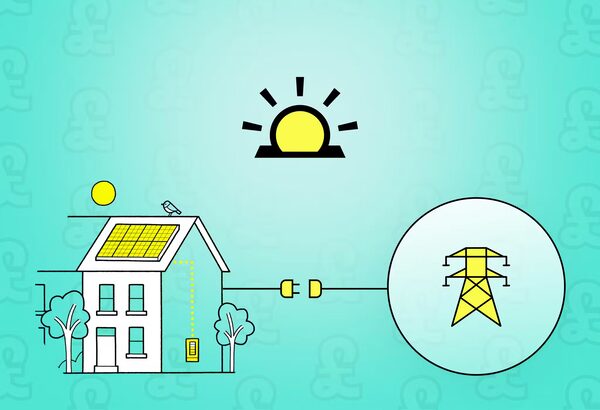
A grid connection is not mandatory for a behind-the-meter system, but it enhances value by enabling the export of surplus electricity48. That sentence contains the whole argument. Without export, summer surplus has nowhere to go once the battery and cylinder are full; with it, the same array earns through the months when the house needs least.
The connection also works in the other direction, as insurance against the seasonal shortfall that no domestic battery bridges, a problem set out in the winter gap. Grid electricity distribution turns on two elements, demand and availability49, and household flexibility feeds directly into that: when enough renewable energy is generated to cover more homes for longer through the day, the grid needs to generate less electricity from fossil-fuelled generators49.
Staying connected carries one firm limitation. Solar panels automatically switch off during a power cut, a safety feature that prevents electricity being exported into the network, and they usually restart on their own once power returns; equipment should not be damaged and will be ready to use again once power is restored50. That applies to solar panels, heat pumps, EV chargers and batteries alike50. The mechanism is explained in islanding and anti-islanding. Backup during an outage is a separate design with separate hardware: further innovation in home battery technology, vehicle-to-everything and solar can provide households with additional backup options during power outages51.
For households genuinely considering disconnection, the practicalities are in going off-grid and disconnecting from the electricity grid.
Running the system: maintenance, updates and data
A whole-home system has more moving parts and more software than the heating system it replaced, and its ongoing obligations are different in kind. Certification bodies publish guidance for householders on solar panel installation, maintenance and repair52 and on renewables and electrics more generally42, and certification schemes exist for consumers commissioning renewable and storage work26.
Day-to-day performance depends on settings as much as hardware. Local energy advice programmes offer day to day energy efficiency hints and tips and check that a heating controller is working correctly53, which in a multi-part system means confirming that the heat pump schedule, the battery charge window and the charger timer are not fighting each other. Independent advice on home energy information and guidance has been produced by the Energy Systems Catapult for government54.
Data is the newer obligation. A controller that continuously monitors, logs and analyses energy use46 is producing a detailed record of household occupancy, held in a manufacturer account that may also cover other properties45. Continuity of that account, and access to the data if the supplier or manufacturer changes, is part of the system's design rather than an afterthought.
What the design buys, and what it does not
The combined package has a measured value: around £1,200 a year for a typical household combining an EV, a heat pump, solar panels and a time-of-use tariff, and around £1,900 for some rural homes4. Against that, the residual dependencies are specific. The grid remains the winter supply and the export route48. The supplier tariff sets whether storage and flexible loads earn anything. A manufacturer's controller sequences the house. And the array that balances a heat pump's annual requirement18 does so across the year, not across a January evening.
That is a fair account of what a whole-home system delivers: a large reduction in imported energy and a home that moves its demand to when power is clean and cheap, rather than a home that no longer needs a supply. The measurement of how far it gets is set out in self-sufficiency ratio and other measures, and the cost of pushing further in what energy independence costs and the wider guide to household energy independence.
Sources54 cited
- A guide to creating an energy efficient home, Federation of Master Builders, 2025-09-18
- Why we teach renewables for households, Centre for Alternative Technology, 2025-12-16
- Take control of your heating at home, Energy Saving Trust, 2026-09-11
- Faster electrification would cut UK household bills, Climate Change Committee, 2026-06-24
- What the Living Lab tells us about home energy technology adoption, Energy Systems Catapult, 2025-11
- Solar power, Electricity North West, 2026-09-19
- Buying advice for solar panels, Which?, 2026-08-12
- Battery storage advice, Centre for Sustainable Energy, 2025-10
- More than money: finding the true power of V2G, Cenex, 2026-09-17
- Energy glossary, Low Carbon Hub, 2026-08-05
- Energy grants in Northern Ireland, Energy Saving Trust, 2026-09-17
- Electric heating, Energy Saving Trust, 2026-07-01
- DESNZ Public Attitudes Tracker: heat and energy use in the home, winter 2025, DESNZ, 2025
- Solar electricity (photovoltaics), Planning Portal, 2026-09-17
- Solar equipment on residential buildings technical advice note, Hart District Council, 2025-01
- Everything under the sun: the facts about solar energy, Solar Energy UK, 2026-09-17
- Feed-in Tariffs annual report, scheme year 13, Ofgem, 2023-12
- Heat pump questions answered, Energy Saving Trust, 2026-05-27
- Permitted development rights, Cornwall Council, 2026-09-17
- Hydro electricity, Planning Portal, 2026
- Can solar panels charge electric cars?, Construction Plant-hire Association, 2026-04-15
- Battery storage advice, Energy Saving Trust, 2026-08-19
- Making the most of your solar PV panels, Centre for Sustainable Energy, 2026-08
- Electrical energy storage systems, FlexiOrb, 2025-04-22
- Batteries in the home, Solar Energy UK, 2026-09-17
- Information for consumers, MCS, 2026-06-23
- Warm Homes social housing fund wave 3 scheme guidance addendum, DESNZ, 2026-06
- Heat pumps campaign, CIBSE, 2026-09-17
- Heat pumps, Energy Saving Trust, 2026-06-11
- Renewable heating: what are the options for your home, Energy Saving Trust, 2024-03-01
- Hybrid heating systems guidance, Heating and Hotwater Industry Council, 2026-09-17
- Home Energy Scotland grant and loan terms and conditions, Home Energy Scotland, 2024-06-05
- Russell and Kate's story: solar panels and a heat pump, Energy Saving Trust, 2026-08-13
- Vehicle-to-grid best practice guide, Energy Saving Trust, 2026-05-05
- Storage, Electricity North West, 2026-09-19
- EV glossary, Uswitch, 2024-11-26
- Low carbon technologies strategy, Energy Networks Association, 2026-09-17
- Demand flexibility, CREDS, 2026
- The energy efficient house of the future, Energy Saving Trust, 2026-07-15
- Explanatory memorandum to SI 2024/24, legislation.gov.uk, 2026-09-17
- Toyota to expand EV charging ecosystem across the UK, SMMT, 2025-12-04
- Renewables and electrics, NICEIC, 2026-09-17
- V2GB: Vehicle to Grid Britain, Cenex, 2026-09-17
- Vehicle to Grid Britain, Energy Systems Catapult, 2026-09-17
- Energy management systems for the home, SolarEdge, 2025-03-13
- Energy Performance of Buildings Directive, consolidated text, legislation.gov.uk, 2026-09-17
- Response to the DESNZ consultation on load control licensing, Energy Systems Catapult, 2026-03-17
- Behind-the-meter energy systems guidance, Welsh Government, 2026-06-29
- Balancing the grid, Uswitch, 2026-02-09
- Planned power cuts, SSEN, 2026-09-19
- Monitoring framework: a well-adapted energy system, Climate Change Committee, 2026-09-19
- Solar panel installation, maintenance and repair, NICEIC, 2026-09-17
- Grants and funding for energy saving, Tameside Council, 2026-09-17
- Home energy information, advice and guidance, DESNZ, 2026-03-11
 Energy IndependenceA heat pump runs your heating on electricity instead of gas or oil, so how much does that really cut what you pay and how exposed you are when fuel prices jump?
 What a HEMS DoesWhat does a home energy management system actually do, and is it worth having one?
 Baseline Your Energy UseBefore spending money on a heat pump, solar panels or a battery, you need to know what your home actually uses now.
 Heating and Energy IndependenceCan you heat your home without relying on gas or oil, and what would that take?
 System Design and BalancingWhy do some radiators stay cold while others get too hot, and what does balancing actually do?
 Charging With a Home BatteryHow a home battery and an EV charger share one supply, whether a battery can usefully charge a car, and how combined systems are controlled so the battery is not discharged into the vehicle at a loss.