
In this guide
Reducing the energy a home needs is the first move in energy independence, because every unit of heat not lost through the fabric is a unit that never has to be bought, imported or generated. The Scottish Government's Heat in Buildings Strategy states the principle plainly: "Making buildings waste less energy through energy efficiency is the first step to zero emissions."1 The same logic runs through the UK government's Future Homes and Buildings Standards consultation, which lists as a policy priority reducing the energy demand of homes by requiring high performing building fabric and building services, "thereby improving energy security"2.
The scale of the task is large. In Bristol alone, over half of homes need energy efficiency improvements such as insulation to reduce the amount of energy they use3. Nationally, the government's own analysis of heat and buildings found that there is currently a greater need for innovation in the approaches used to deploy existing insulation technology cost-effectively than in the insulation technologies themselves4. The technology exists; the delivery is the hard part.
For a household, the practical consequence is a sequence. Fabric measures come first, because they shrink the load that any heating system, heat pump, solar array or battery has to meet. Insulation, energy efficient windows and doors and reduced draughts can significantly reduce energy use and reduce energy bills5. What follows is what the evidence says about where heat escapes, which measures fit which homes, what the rules allow, and what support remains.
Why reducing demand comes first
The argument for fabric first is not aesthetic. It is arithmetic. A home that loses less heat needs a smaller heating system, and a smaller heating system costs less to buy and less to run. The Future Homes and Buildings Standards consultation makes this the second of its stated policy priorities, requiring high performing building fabric and building services in new buildings so that energy demand falls and energy security improves2.
The Scottish Government frames the same point as a sequence rather than a preference: making buildings waste less energy through energy efficiency is the first step to zero emissions1. That ordering matters because it determines what a household gets for its money. Money spent on generation or storage before the fabric is addressed is money spent sizing equipment for a load that could have been smaller.
The evidence on deployment is more nuanced than the case for the principle. The government's heat and buildings analysis concluded that there is currently a greater need for innovation in the approaches for deploying existing insulation technology cost-effectively than in specific insulation technologies4. In other words, the materials are not the bottleneck. The same analysis identified unlocking data collection, analysis and sharing across all stages of construction as an innovation need for new builds, existing properties and heating, ventilation and air conditioning systems across 2025 to 20304.
For a household, this translates into a simple ordering principle. Insulation, glazing and draught-proofing reduce the load. Only then does the choice of heat source, and the size of that heat source, get made against a smaller number. The rest of this page sets out where the heat goes, what can be done about it, and what the rules and support allow.
Where heat escapes: walls, roofs, floors and draughts
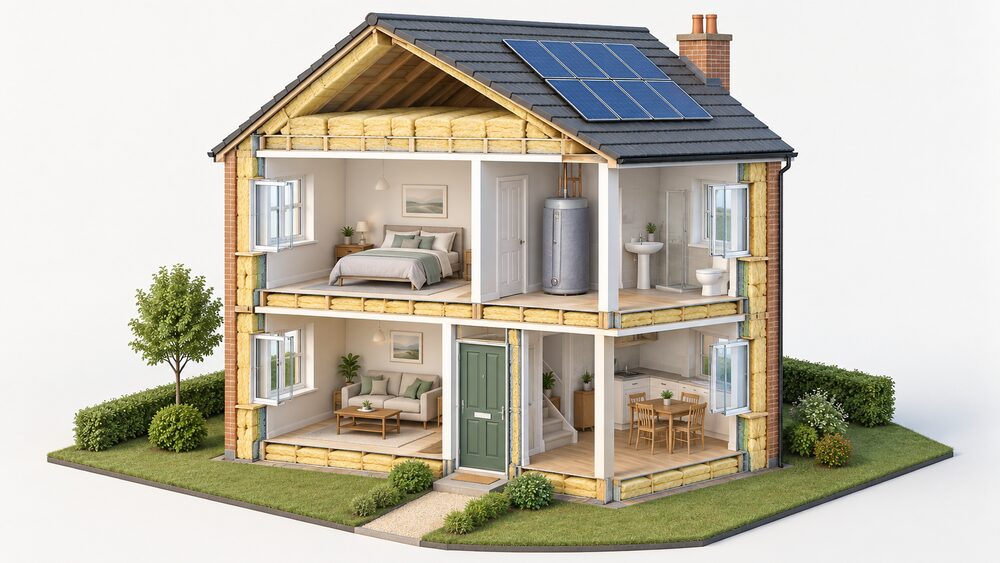
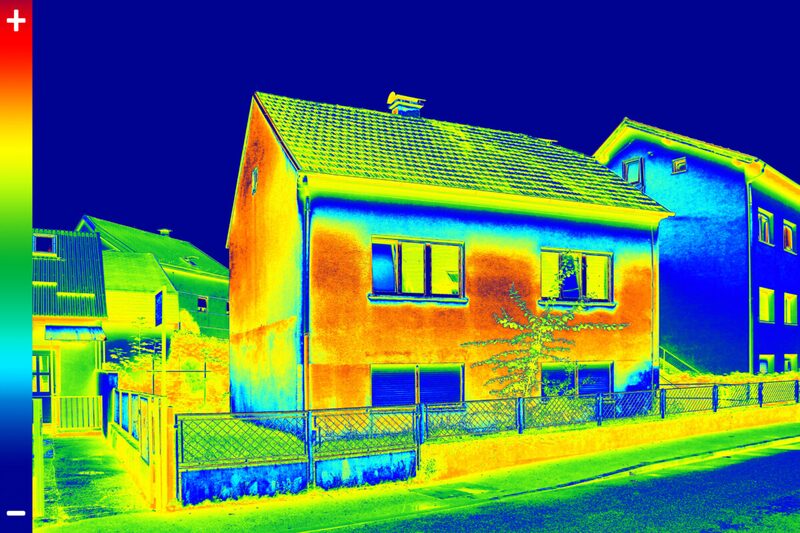
Heat leaves a home through several routes at once, and the measures that address them are not interchangeable. Official guidance is direct that properly installed insulation, energy efficient windows and doors and reducing draughts can significantly reduce energy use, and that the same measures reduce energy bills5. Northern Ireland's guidance makes the same connection for the two most common measures: installing loft and cavity wall insulation not only lowers the amount of heat escaping, but could also cut fuel bills11.
The routes are well established. Walls, roofs and floors are the main fabric surfaces, and self-build sustainability guidance advises insulating walls, roof and floors to reduce heat loss12. Draughts are a separate category, addressed by sealing rather than by adding insulation thickness. Draught stripping for windows and doors is treated as an energy-saving material in its own right in the legislation that governs VAT relief on such materials13.
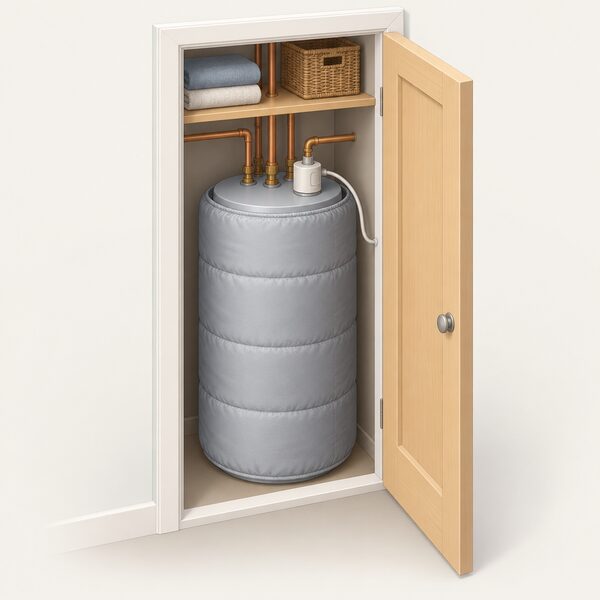
The VAT rules also give a useful map of what counts as insulation for tax purposes. Qualifying locations include walls, floors, ceilings, roofs or lofts, water tanks, pipes or other plumbing fittings14. That list is a reasonable checklist of the places heat and hot water are lost in a typical home, and it extends beyond the fabric to the hot water system itself.
| Heat loss route | Measure that addresses it | Notes |
|---|---|---|
| Walls | Cavity, internal or external wall insulation | Wall type determines which system fits15 |
| Roofs and lofts | Loft, room-in-roof, rafter or flat roof insulation | Loft and cavity insulation lower heat escaping and can cut fuel bills11 |
| Floors | Underfloor insulation | Listed among eligible works in grant schemes16 |
| Draughts | Draught stripping for windows and doors | Treated as an energy-saving material13 |
| Hot water | Cylinder, tank and pipe insulation | Qualifying location for VAT relief14 |
Insulation types and where each fits
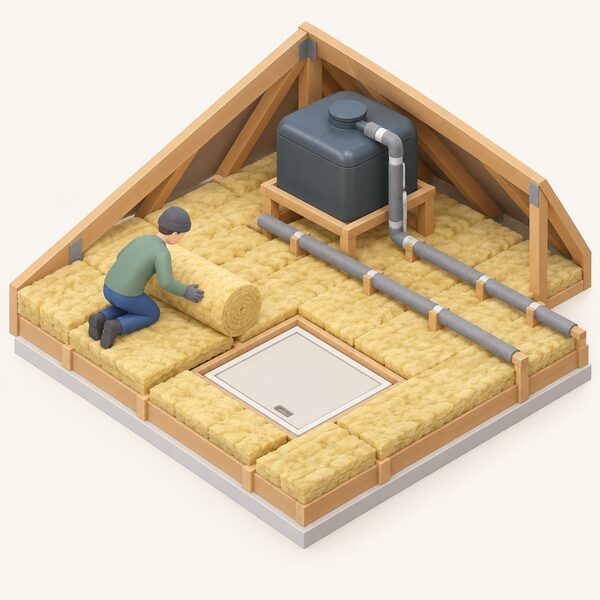
The measures divide by the part of the building they treat, and the grant schemes give a useful inventory of what is recognised. The Warm Homes: Local Grant lists cavity wall insulation, external wall insulation, internal wall insulation, loft insulation, room in roof insulation, flat roof insulation, under floor insulation, park home insulation, draughtproofing, hot water cylinder insulation, low energy lighting, heating controls, solar PV, battery storage, double or triple glazing (only recommended in rare cases) and energy efficient doors (only recommended in rare cases) as energy performance improvements16.
That list is broader than fabric alone, which is worth noting: the schemes that fund insulation increasingly fund it alongside heating controls, generation and storage, on the logic that a reduced load makes the rest go further. The narrower ECO route funds insulation specifically, for example loft, roofs and walls17.
Cornwall Council's Home Improvement loan eligibility gives a further breakdown of the insulation category, covering cavity wall; duct, roof, room in roof, loft and loft hatch, rafter and pipework insulation; draught proofing and sealing improvements; hot water cylinders; and underfloor works18. The detail matters because it shows how granular the recognised measures have become, down to loft hatches and pipework.
For a household working out what applies, the determining factor is usually wall construction. Cavity walls take cavity insulation; solid walls take internal or external systems, each with different trade-offs in space, disruption and appearance. Roofs divide between cold lofts, room-in-roof constructions and flat roofs, and floors between suspended timber and solid. The pages on loft insulation, cavity wall insulation, solid wall insulation, floor insulation and roof insulation set out the detail for each.
Fabric quality matters: U-values, design and installation
Insulation performance is not set by the material alone. It is set by the design of the whole assembly, and the building regulations treat it that way. The target fabric energy efficiency rate for a new dwelling can be achieved only through fabric energy efficiency, including U-values, thermal bridging and airtightness19. That is a statement that the three have to be addressed together: adding thickness while leaving thermal bridges and air leakage unaddressed does not deliver the target.
Compliance is assessed twice, before work starts using design values and when work is complete using figures for the building as constructed19. The dwelling primary energy rate, dwelling emission rate and dwelling fabric energy efficiency rate must not exceed their respective target rates20. The as-built check is the part that catches poor installation, because a design that performs on paper can still underperform if the insulation is compressed, gapped or bypassed on site.
The regulations also set limiting U-values for individual elements, which act as a floor rather than a target. For other doors, the maximum U-value is 1.4 W/(m2·K), or Doorset Energy Rating Band B minimum for new fabric elements in existing dwellings20. Element limits of this kind exist so that no single weak component undermines the rest of the assembly.
"The target fabric energy efficiency rate can be achieved only through fabric energy efficiency"
The practical implication for a household is that the quality of the installation matters as much as the specification. A well-specified measure fitted badly performs below its stated U-value, and the as-built compliance route exists precisely because that gap is real. The pages on U-values and R-values, thermal bridging and cold spots and airtightness and air leakage cover the detail.
Quality and consumer protection: the Ofgem solid wall case

The gap between specification and installation has a consumer protection dimension, and the solid wall insulation programme is the clearest recent example. Ofgem has written to 65,000 households potentially affected by poor-quality solid wall insulation fitted under ECO and GBIS since 20229. That figure is the single most important number on this page for anyone considering a funded solid wall measure, because it shows that the failure mode is not hypothetical.
The scale of the affected population also indicates how the schemes were structured. The Great British Insulation Scheme worked by placing an obligation on medium and large energy companies to deliver measures that result in reduced energy usage21. Delivery through obligated suppliers means the quality chain runs from supplier to installer to household, and the household is at the end of it.
The lesson for a household is about paperwork and verification rather than about any particular product. A funded measure should come with a clear record of what was installed, by whom, and under which scheme, because that record is what makes a later claim possible. The pages on the ECO4 and GBIS insulation failures, cavity wall insulation problems and finding an insulation installer deal with the practical side.
Glazing and summer overheating
Glazing sits at the intersection of two problems: heat loss in winter and heat gain in summer. On the loss side, energy efficient windows and doors are named alongside insulation and draught reduction as measures that can significantly reduce energy use and reduce bills5. On the gain side, the picture is more complicated, and the answer is not simply more glazing performance.
Official guidance on solid wall insulation notes a summer benefit that is often overlooked: it will help create a more even temperature in the home, help prevent condensation on the walls and ceilings, and can also reduce the amount of heat building up inside the home during summer hot spells22. That is a statement about the wall, not the window, and it shows that fabric measures can work in both directions.
For traditional and protected buildings, secondary glazing is often the practical route. Scottish guidance states that secondary glazing can provide an effective way to reduce heat loss without altering original windows, nor significantly reducing light levels or views23. That combination, thermal improvement without altering the original window, is what makes it the standard answer where replacement is not permitted.
Overheating risk is a design question rather than an automatic consequence of insulating. It depends on glazing area and orientation, shading, ventilation and internal heat sources together. The pages on overheating and solar gain, double glazing, triple glazing and secondary glazing cover the options.
Cost, VAT and grants: what support exists and what has ended
Support for insulation has narrowed, and the position differs by nation and by scheme. The Great British Insulation Scheme was designed to deliver improvements to the least energy-efficient homes in Great Britain to tackle fuel poverty and help reduce energy bills, funded by an obligation on medium and large energy companies21. Its purpose was to deliver improvements to the least energy-efficient homes in Great Britain to help tackle fuel poverty and reduce carbon emissions24. Applications have closed, but some energy suppliers were still accepting applications, and the official advice is to check with your supplier8. Park home insulation was among the measures funded24.
On VAT, the position is more favourable and time-limited. A single supply of the installation of energy-saving materials qualifies for the reduced rate, and loft insulation is given as a worked example7. Separately, 0% VAT on installing energy-saving materials including insulation and solar panels applies until 31 March 20277. The qualifying materials list includes draught stripping for windows and doors13, and the qualifying locations include walls, floors, ceilings, roofs or lofts, water tanks, pipes or other plumbing fittings14.
| Scheme or relief | Status | What it covers |
|---|---|---|
| Great British Insulation Scheme | Applications closed; some suppliers still accepting8 | Insulation including park homes24 |
| ECO | Open | Insulation, for example loft, roofs and walls17 |
| Warm Homes: Local Grant | Open | Cavity, external, internal, loft, room-in-roof, flat roof, underfloor, park home, draughtproofing, cylinders, controls, solar PV, battery, glazing and doors in rare cases16 |
| VAT reduced rate | In force | Installation of energy-saving materials7 |
| 0% VAT | Until 31 March 2027 | Energy-saving materials including insulation and solar panels7 |
Local authority support varies. Tameside's energy saving pages state that Your Home, Better does not offer grants or funding, but can identify sources that could help towards the costs of home energy projects25. That is a useful description of what councils can and cannot do: signposting rather than funding in many cases. The pages on insulation grants in England, Scotland, Wales and Northern Ireland set out the national positions, and closed insulation schemes covers what has ended.
Insulation and heat pumps: a smaller load makes low-carbon heating work
The connection between fabric and heat source is the core of the energy independence argument. A smaller heat load means a smaller heat pump, lower running costs and a better chance that the system performs as designed. The National Energy System Operator modelled that improved home insulation could reduce home electricity demand for heat by 11% by 20306. That is a system-level figure, and it shows how much of the electrification challenge fabric measures can absorb.
The Scottish Government's analysis of new domestic buildings found that an air source heat pump consistently resulted in the lowest delivered energy demand across the archetypes modelled, and that for houses the air source heat pump had the lowest capital cost under the business-as-usual specification, though this relationship was not observed for the block of flats, where the air source heat pump was the highest for that specification26. The distinction between houses and flats is worth noting, because it shows that the economics are not uniform across building types.
Manchester City Council's guidance makes a related point about where money is best spent: in most homes, changing the boiler is often the most cost-effective way to lower emissions27. That is a statement about emissions rather than about independence, and it sits alongside the fabric case rather than replacing it. The two work together: fabric reduces the load, and the heat source meets what remains.
For a household, the sequence is what matters. Insulating first means the heat pump can be smaller, the radiators can be sized against a lower flow temperature, and any solar or battery capacity goes further. The page on what insulation a heat pump needs covers the detail.
Planning and building rules: when consent is needed
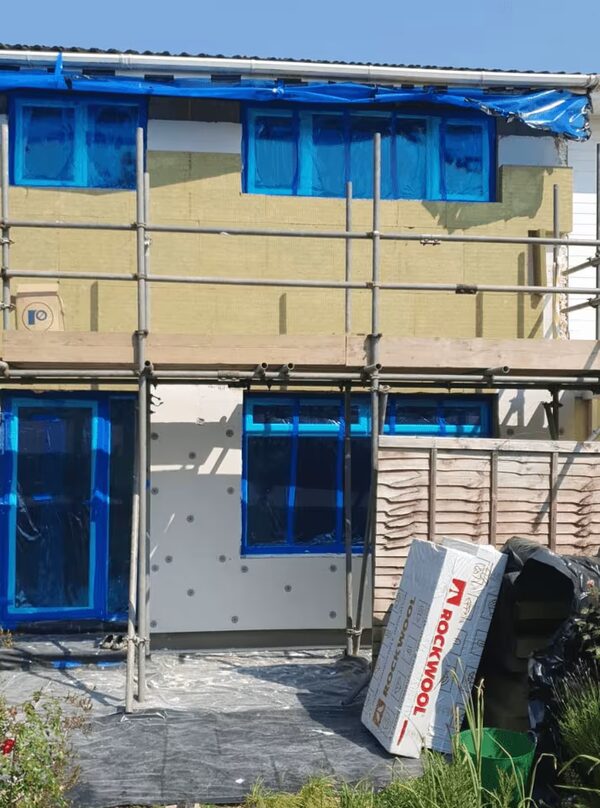
Most insulation does not need planning permission, but the exceptions are important and they turn on appearance and on protected status. Planning permission is not normally required for fitting insulation where there is no change in external appearance15. External insulation may require permission if it impacts the external appearance of the building, though it is likely not required if the materials are of similar appearance to those used in the house's construction29.
Internal wall insulation is treated more permissively. Scottish guidance notes that planning permission is usually not required, although both planning and listed building consent may be required in some situations23. In conservation areas, installing internal wall insulation in homes does not require planning permission10. For dwellings outside areas where permitted development rights have been removed, and outside an Area of Outstanding Natural Beauty or a conservation area, external wall insulation requires no planning permission, and internal wall insulation is not development30.
Listed buildings are the clear exception. More disruptive work such as internal or external insulation will usually need Listed Building Consent31, and planning permission and listed building consent are required for external and internal wall insulation in listed buildings or their curtilage10. Listed Building Consent will be required for most energy efficiency works, including internal works such as internal wall insulation10, and consent is required for introducing new materials to the property, such as insulation29.
| Situation | Consent position |
|---|---|
| Insulation with no change in external appearance | Planning permission not normally required15 |
| External insulation changing appearance | Permission may be required29 |
| Internal wall insulation, conservation area | No planning permission required10 |
| External wall insulation, most dwellings | Planning permission not required30 |
| Listed building, internal or external insulation | Listed Building Consent usually required31 |
Building regulations also allow some flexibility for protected buildings. Work to listed buildings, dwellings in a conservation area and scheduled monuments does not need to comply fully with the energy efficiency requirements if to do so would unacceptably alter the dwelling's character or appearance19. That exemption is a recognition that heritage and thermal performance can conflict, and it is not a blanket waiver. The pages on planning permission for insulation, cladding and windows, insulating and glazing a listed building and retrofitting traditional and pre-1919 buildings cover the detail.
What insulation does for independence, and what it does not
Fabric measures change the terms on which a household buys energy. A home that loses less heat needs less of whatever fuel it uses, which reduces exposure to price movements and to the import dependency that sits behind them. The government's own framing of the Future Homes and Buildings Standards puts energy security alongside energy demand reduction as a reason for requiring high performing fabric2, and the Scottish Government's strategy treats energy efficiency as the first step to zero emissions1.
What insulation does not do is remove dependence. A well-insulated home still draws from the grid, still buys from a supplier, and still relies on the gas network if it heats with gas. Insulation reduces the quantity of energy bought; it does not change the source. That is why the fabric case is usually made alongside generation and storage rather than instead of them, and why the grant schemes that fund insulation increasingly fund heating controls, solar PV and battery storage in the same package16.
The dependence that remains is worth stating plainly. A household with a heat pump depends on electricity, on a supplier and on the grid. A household with solar and a battery reduces but does not eliminate that dependence, because winter generation is low and storage is finite. A household that keeps a gas boiler depends on the gas network and on imports. Insulation is the measure that reduces the size of all of these dependencies at once, which is why it comes first in the sequence rather than last.
The evidence on adoption supports the practical case. Insulation was the most frequently mentioned form of energy efficiency improvement adopted by participants in independent research on the private rental sector27. That is a finding about what people actually do when they improve a property, and it points the same way as the policy analysis: the fabric is where the returns start.
Sources31 cited
- Heat in Buildings Strategy: easy read, Scottish Government, 2022
- The Future Homes and Buildings Standards: 2023 consultation, GOV.UK, 2026
- Our climate action on buildings, Bristol City Council, 2026
- Energy innovation needs assessment: heat and buildings, Department for Energy Security and Net Zero, 2025
- Energy efficiency advice and assessment, London Borough of Bromley, 2026
- Energy security and net zero Committee report, House of Commons Energy Security and Net Zero Committee, 2030
- VAT energy-saving materials: installation and relief, HM Revenue and Customs, 2026
- Apply to the Great British Insulation Scheme, GOV.UK, 2026
- ECO and GBIS solid wall insulation scheme issues, Age UK, 2026
- Improving energy saving and sustainability in conservation areas and listed buildings, Brighton and Hove City Council, 2026
- Heating technologies to suit your home, nidirect, 2026
- Self-build homes: sustainability, Planning Portal, 2026
- Value Added Tax Act 1994, Schedule 8, Part II, Chapter 23, legislation.gov.uk, 1994
- VAT energy-saving materials: qualifying locations, HM Revenue and Customs, 2026
- Insulation: planning permission, Planning Portal, 2026
- Warm Homes: Local Grant, Greater Manchester Combined Authority, 2026
- ECO4 Flex, South Cambridgeshire District Council, 2026
- Eligible and non-eligible works, Cornwall Council, 2025
- Approved Document L, Volume 1: Dwellings, Ministry of Housing, Communities and Local Government, 2026
- Approved Document L, Volume 1: Dwellings, 2021 edition incorporating 2023 amendments, Ministry of Housing, Communities and Local Government, 2026
- Great British Insulation Scheme, Ofgem, 2026
- Solid wall insulation, Planning Portal, 2026
- Guide to the conversion of traditional buildings, Scottish Government, 2026
- Great British Insulation Scheme: supply chain, Ofgem, 2026
- Energy saving grants and funding, Tameside Council, 2026
- Identification and assessment of improvements to the energy standard of new domestic buildings, Scottish Government, 2026
- Understanding barriers to heat pump uptake in the private rental sector, Nesta, 2025
- ECO4 new measures and products guidance v3.0, Ofgem, 2026
- When consent is required, Buckinghamshire Council, 2026
- Retrofit and energy efficiency: permitted development, Cotswold District Council, 2026
- Making alterations to a listed building, Bristol City Council, 2026
 Insulation Savings and PaybackHow much can you really save by adding insulation, and does it depend on your home, your heating and how you use it?
 Heating and Energy IndependenceCan you heat your home without relying on gas or oil, and what would that take?
 Grants and Energy IndependenceCan you get a grant for solar panels or a battery?
 Cost of Energy IndependenceA heat pump and better insulation are the usual starting point, but what does the whole job really cost, and what help is there with the bill?
 Energy Security for HouseholdsCan a household really protect itself from gas and electricity price shocks, and what actually makes a difference?
 Cooling and Energy IndependenceExplains how passive measures, efficient cooling and on-site generation reduce a household's dependence on grid electricity in summer.