

In this guide
Insulation in rented and social housing turns on a single question: who controls the fabric of the building. The tenant lives in it, but the walls, lofts and floors belong to the landlord, so consent and usually the cost sit with them. That does not leave tenants without rights. The Great British Insulation Scheme requires that a householder either owns the home or has permission from the landlord, including social housing providers and management companies1. Private landlords in England and Wales are also bound by minimum energy efficiency rules, and social landlords work to housing quality standards that include thermal comfort2.
The money is largely public. The Warm Homes: Social Housing Fund provides funding to local authorities, combined authorities, registered providers of social housing and registered charities that own social housing in England, and had reported around 25,770 measures in around 12,900 households by the end of July 20264. Its indicative national pot is £1,300m, with 50% minimum match funding expected from the sector5. In Wales, the Optimised Retrofit Programme funds registered social landlords, who must use PAS 2035 and lodge works on the TrustMark Data Warehouse6.
For a household, the practical effect is that insulation in rented and social housing is a process rather than a purchase. The tenant raises the condition of the property, the landlord consents and funds, and a grant or a landlord's own capital pays for the work. What follows sets out the figures, the rules in each nation, and what remains outside a tenant's control.
What tenants can ask for, and what landlords must provide
The starting point is that a tenant can ask, and a landlord can be required to act, but the mechanism differs by tenure. In the private rented sector in England and Wales, the Energy Efficiency (Private Rented Property) (England and Wales) Regulations 2015 set a minimum standard and cover private, local authority and other public body landlords, as well as a tenant who sub-lets a property falling within scope2. The regulations do not apply to properties let on a tenancy of less than six months or more than 99 years, so short lets and very long leases sit outside them2.
Where a landlord cannot obtain consent for a measure, the rules allow an exemption rather than an unlimited obligation. The exemption lasts for five years or until the end of the tenancy if it relates to obtaining tenants' consent2. That is a meaningful limit: a tenant's refusal, or a freeholder's refusal, can pause the duty for years.
Social housing works differently. The landlord owns the stock and plans improvements across it, so the tenant's route is a repair or condition complaint rather than a consent negotiation. In Scotland, tenants have a right to refer any landlord not complying with the carbon monoxide duty or any other element of the repairing standard to the First-tier Tribunal for Scotland Housing and Property Chamber9. That enforcement route is the closest thing to a lever a social tenant holds when a property is cold.
Tenants are separately responsible for making sure their own electrical equipment is safe, which matters where a landlord's works touch wiring or controls11.
The figures behind rented and social retrofit

The headline numbers are public spending figures, not household costs. The Warm Homes: Social Housing Fund has an indicative national pot of £1,300m, with 50% minimum match funding contributions expected5. The government stated that its commitment of £1.3 billion for Wave 3 had been more than matched by the sector, meaning over £2.6 billion is currently in delivery12. An additional £295m was announced for FY 26/27, and a further £100m was announced in April with a focus on solar PV and battery installation13.
Delivery is measured in measures and households rather than pounds. By the end of July 2026, around 25,770 measures had been reported by grant recipients in around 12,900 households4. Wave 3 began delivery in April 2025 and runs to September 2028, with all grant funding to be transferred to grant recipients and spent by 31 March 202812.
| Figure | Value | Source |
|---|---|---|
| Indicative national pot | £1,300m | 5 |
| Minimum match funding expected | 50% | 5 |
| Wave 3 commitment and sector match | over £2.6 billion in delivery | 12 |
| Additional funding, FY 26/27 | £295m | 13 |
| Solar PV and battery focus | £100m announced in April | 13 |
| Measures reported to end July 2026 | around 25,770 | 4 |
| Households upgraded to end July 2026 | around 12,900 | 4 |
For individual measures, the cost figures that exist are consultation estimates rather than prices. In Scotland, topping up existing loft insulation has an average cost of £8708. Where a landlord claims the cost exemption under the private rented minimum standard in England and Wales, evidence must be provided, with three separate quotes showing the cost to be over £3,5002. Those are the two figures a tenant or landlord is most likely to meet in practice.
What drives the figures
Three forces set the pace of insulation in rented and social housing: the condition of the stock, the funding attached to it, and the standards landlords must meet.
The condition of the stock is the baseline. The English Housing Survey 2024 to 2025 home insulation fact sheet is accredited official statistics, which makes it the strongest available picture of insulation coverage in England15. In Scotland, the Scottish Housing Quality Standard was introduced in February 2004 and means social landlords must make sure their tenants' homes are in a good state of repair; a target was agreed that all social landlords must ensure that all their dwellings pass the SHQS by April 20157. The standard is made up of 55 different elements grouped into 5 higher-level criteria, which is why compliance is audited rather than assumed7.
Funding drives the volume. The Warm Homes: Social Housing Fund targets Energy Performance Certificate band C social housing stock currently below that standard, with the objective of delivering warm, energy efficient homes16. The UK Solar Roadmap describes the same programme as part of a package of measures to take a home to EPC C14. Because the fund requires match funding, a landlord's own capital position matters as much as the grant: a housing provider without reserves cannot draw down its allocation.
Standards drive the deadline. The reformed Decent Homes Standard is stated to apply in both the social and private rented sectors from 2035, with regulation and enforcement beginning then3. That gives housing providers under a decade to audit and upgrade properties. The Scottish Government has consulted on requiring landlords to meet a minimum energy efficiency standard by the end of 2028, with properties in the private rented sector that do not meet it by then not allowed to be leased to a new tenant17.
How the rules differ across England, Scotland, Wales and Northern Ireland
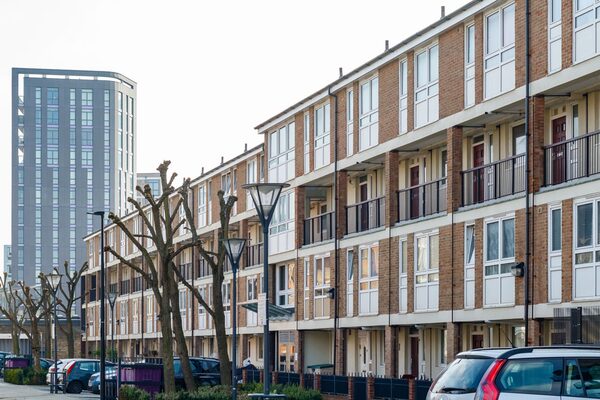
The four nations run separate standards and separate funds, and the differences matter to a tenant trying to establish what their landlord owes them.
England. The private rented minimum standard sits in the Energy Efficiency (Private Rented Property) (England and Wales) Regulations 2015, with a defined list of exemption categories: all relevant improvements made but the property remains below E; cost of relevant improvements over the spending cap; no improvements possible; expert written advice that wall insulation would harm the fabric or structure; third-party consent required after reasonable attempts; a RICS registered valuer report that improvements would reduce market value by more than 5%; property already let when the landlord purchased an interest; and sudden landlord circumstances such as insolvency of a tenant where the landlord was guarantor2. Social housing retrofit is funded through the Warm Homes: Social Housing Fund, which is England-only4.
Scotland. The Scottish Housing Quality Standard applies to social landlords, and the Heat in Buildings Bill consultation proposed requiring landlords to meet a minimum energy efficiency standard by the end of 202817. The draft Energy Efficiency (Domestic Private Rented Property) (Scotland) Regulations 2026 would define a "relevant person" for a fabric exemption as an independent architect, independent chartered engineer, independent chartered building surveyor, or independent chartered architectural technologist8. A temporary exemption for a new landlord would last six months from the date the new landlord inherits or purchases the property8. The Scottish Government has also proposed that properties used as short-term lets meet the standard by 2033 alongside owner occupied homes18.
Wales. The private rented regulations are shared with England, but social housing retrofit runs through the Optimised Retrofit Programme. Registered social landlords are required to undertake retrofit measures using PAS 2035, lodge works on the TrustMark Data Warehouse, ensure their supply chain workforce is accredited to PAS2030 or use an umbrella approach for smaller sub-contractors, install Environmental and Energy Sensors to homes compliant with the Optimised Retrofit Programme 3 Monitoring Specification V.2, use existing asset information and focussed survey data to develop a Whole Stock Assessment for all their homes, and demonstrate significant progress towards developing full TEPs for all their homes by 20276. Welsh landlord guidance also requires appropriate levels of thermal insulation to minimise heat loss as part of addressing the cold hazard19.
Northern Ireland. The Decent Homes Standard applicable to Northern Ireland is a separate instrument, and its criteria are to meet the current statutory minimum fitness standard for housing, be in a reasonable state of repair, have reasonably modern facilities and services, and provide a reasonable degree of thermal comfort20. The Northern Ireland Sustainable Energy Programme has funded insulation in social and housing association properties: one project recorded a NISEP grant of £200 per cavity wall and loft insulation measure for Housing Association properties, and another recorded 141 loft insulation measures in 2020/2121.
| Nation | Social housing standard | Private rented driver |
|---|---|---|
| England | Warm Homes: Social Housing Fund, EPC C target16 | PRS minimum standard, exemptions listed2 |
| Scotland | Scottish Housing Quality Standard, 55 elements7 | Minimum standard by end of 2028 proposed17 |
| Wales | Optimised Retrofit Programme, PAS 2035 required6 | Shared PRS regulations with England2 |
| Northern Ireland | Decent Homes Standard, thermal comfort criterion20 | NISEP-funded measures recorded21 |
Consent, access and the limits on a tenant's rights
Consent is the hinge on which most rented insulation turns, and it is worth being precise about what it does and does not cover.
For grant-funded work, the Great British Insulation Scheme requires that the householder either owns the home or has permission from the landlord, including social housing providers or management companies1. Where an eligible insulation measure is installed in owner-occupied premises in the low-income group, certain heating controls such as room thermostats are allowed as a secondary measure, but that concession is written for owner-occupiers rather than tenants1.
For regulated minimum standards, the consent problem is handled through exemptions rather than enforcement. The third-party consent exemption lasts five years or until the end of the tenancy if it relates to obtaining tenants' consent2. Where a tenant has a right to renew under the Landlord and Tenants Act 1954, non-compliance cannot be used as justification for refusing renewal or terminating the lease early, so a landlord cannot use the regulations as a route to end a tenancy2.
Access is the tenant's side of the bargain. The tenant is to allow reasonable access to the let property for an authorised purpose, and carrying out work on the let property is an authorised purpose10. In Scotland, the enforcement route for a landlord who does not comply with the repairing standard, including the carbon monoxide duty, is a referral to the First-tier Tribunal for Scotland Housing and Property Chamber9.
Two further limits are worth stating. First, the private rented regulations do not apply to tenancies of less than six months or more than 99 years, so a short let has no minimum standard behind it2. Second, VAT relief on insulation does not depend on tenure: insulation on walls, floors, ceilings and lofts qualifies for a lower rate of VAT, and materials designed and installed because of their insulating qualities qualify as energy-saving materials23. The single supply of the installation of loft insulation qualifies for relief25. That reduces the cost of the work whoever commissions it, but it does not create an obligation to carry it out.
Where the money comes from: grants and landlord funding

Rented and social insulation is paid for through a small number of routes, and a tenant's realistic hope of getting work done depends on which one their landlord can access.
The largest is the Warm Homes: Social Housing Fund, which provides funding for energy performance improvements and low carbon heating improvements to social homes26. Eligible applicants are local authorities, registered providers of social housing, and registered charities that own social housing26. Wave 3 applicants include local authorities, combined authorities, registered providers of social housing and registered charities that own social housing either directly or as part of a consortium12. Draft guidance was published on 13 May 2024 and the delivery window opened in April 20254.
The fund is devolved in places. In Greater Manchester, the combined authority received a proportionate share of the national scheme funding, and constituent local authorities and housing associations need to seek funding via GMCA rather than the national scheme for their stock in Greater Manchester26. The GMCA share is 7.8% of the £1,300m pot5. Wave 3 rules there allow void properties to be included if they are receiving low carbon heating measures, keep smart heating controls eligible, and state that digitalisation costs can no longer be grant funded26. Both grant and co-funding must be spent by the end of each financial year, and A&A grant is provided as a fixed 10% of the capital grant26.
For private rented and owner-occupied homes, ECO funds insulation such as loft, roofs and walls27. The ECO4 measures table lists eligible tenures for loft insulation as owner occupied D, owner occupied E-G, PRS E-G, social E-G and social D, with separate categories for lofts with more or less than 100mm of pre-existing insulation28. Other measures listed for the same tenures include flat roof, pitched roof, room-in-roof, solid floor, underfloor, glazing, draught proofing, external doors and park home insulation28. The Great British Insulation Scheme excludes those in EPC bands F and G unless exempt from the Energy Efficiency (Private Rented Property) (England and Wales) Regulations 201522.
What this means for a household's energy independence
Insulation in a rented home delivers the same physical benefit as in an owned one: less heat lost through the fabric, so less energy bought to keep the same temperature. What differs is control. A tenant cannot commission the work, cannot choose the contractor, and cannot decide the order of measures. The landlord holds those decisions, and the funding routes are built around landlords and social providers rather than individual tenants.
That dependence is structural, not incidental. The Warm Homes: Social Housing Fund pays local authorities, combined authorities, registered providers of social housing and registered charities that own social housing, so a tenant's route to a warmer home runs through their landlord's application4. The Optimised Retrofit Programme requires registered social landlords to develop a Whole Stock Assessment for all their homes and to demonstrate significant progress towards full TEPs by 2027, which places planning at stock level rather than dwelling level6. A tenant benefits when their home falls inside a landlord's programme and waits when it does not.
The direction of travel is towards firmer standards. The Heat in Buildings Bill consultation proposed that properties in the private rented sector which do not meet the energy efficiency standard by the end of 2028 would not be allowed to be leased to a new tenant17. The reformed Decent Homes Standard is stated to apply in both rented sectors from 20353. The Scottish Government has proposed that all buildings across all tenures achieve good energy efficiency by 2033 and zero emissions heating by 2045, regulating for this where within its legal competence18.
What remains outside a tenant's control is the timing, the specification and the standard of work. What a tenant can do is establish the facts: whether the property has an EPC, what band it holds, whether the landlord has registered an exemption, and whether the landlord has an upgrade programme covering the address. Those are the levers that exist, and they are informational rather than financial.
Sources29 cited
- Great British Insulation Scheme: homeowners and tenants, Ofgem, 2026-09-17
- Energy Efficiency (Private Rented Property) (England and Wales) Regulations 2015: guidance, Isle of Anglesey County Council, 2026-05
- Reformed Decent Homes Standard: government response, GOV.UK, 2026-01-28
- Warm Homes: Social Housing Fund statistics, August 2026, GOV.UK, 2026-08
- WMCA devolved retrofit pilot FAQs, West Midlands Combined Authority, 2026-09-17
- Optimised Retrofit Programme 3 Year 4 guidance 2025 to 2026, Welsh Government, 2025-05-08
- Scottish House Condition Survey 2024: key findings, Scottish Government, 2026-02
- Draft Energy Efficiency (Domestic Private Rented Property) (Scotland) Regulations 2026, Scottish Government, 2025-06
- Carbon monoxide alarms in private rented properties: guidance, Scottish Government, 2016-12-01
- Private Housing (Tenancies) (Scotland) Act 2016, Schedule 2 paragraph 6, legislation.gov.uk, 2026-09-17
- Electrical safety standards in the private and social rented sectors: guidance, GOV.UK, 2025-11-01
- Warm Homes: Social Housing Fund, House of Commons Library, 2026-05-13
- Carbon Budget and Growth Delivery Plan: heat and buildings factsheet, GOV.UK, 2026-06-23
- UK Solar Roadmap, Department for Energy Security and Net Zero, 2025-06
- English Housing Survey 2024 to 2025: home insulation fact sheet, GOV.UK, 2026-05-14
- Warm Homes: Social Housing Fund Wave 3 budget allocation, GOV.UK, 2024-11-21
- Delivering net zero for Scotland's buildings: Heat in Buildings Bill consultation, Scottish Government, 2023-11
- Energy efficiency in homes, Scottish Government, 2033
- Fitness for human habitation guidance for landlords, Welsh Government, 2022-01-13
- Current Decent Homes Standard: summary table, Northern Ireland Department for Communities, 2025-08-05
- NISEP Annual Report 2020-21, Utility Regulator Northern Ireland, 2020
- Great British Insulation Scheme: government response, Department for Energy Security and Net Zero, 2023-03
- Tax on shopping: energy-saving products, GOV.UK, 2026-09-17
- VAT energy-saving materials: VENSAV3040, HM Revenue and Customs, 2026-09-17
- VAT energy-saving materials: VENSAV3210, HM Revenue and Customs, 2026-09-17
- Warm Homes: Social Housing Fund, Greater Manchester Combined Authority, 2026-09-17
- ECO4 Flex, South Cambridgeshire District Council, 2026-09-17
- ECO4 measures table, Ofgem, 2022-10-11
- Building regulations: Passivhaus equivalent stage 2, Scottish Government, 2026-09-17
 Social and Rented Home StandardsWhat condition is your landlord legally required to keep your home in?
 Energy in Social HousingWhat must your landlord do if your home is cold, damp or mouldy?
 Welsh Housing Quality StandardWhat does the Welsh Housing Quality Standard mean for your home if you rent from a council or housing association in Wales?
 Renting and Home EnergyThe position of a tenant in a privately rented home: which measures need no permission, which are fixtures the landlord controls, and what the law says about heating, insulation, certificates and bills across the four UK nations.
 Energy Policy in WalesWhat help can you get in Wales to make your home warmer and cheaper to run?
 Where to Start If You RentRenting means you can switch supplier or get a smart meter yourself, but insulation, glazing and heating need your landlord's agreement.