

In this answer
Short answer
Private rented homes in Wales can receive Nest scheme measures, but the route runs through the tenant's eligibility and the landlord's registration, not the landlord's own circumstances. Nest is a Welsh Government scheme delivered under the Warm Homes programme, and it funds free home energy efficiency improvements including central heating systems, boilers, insulation, solar panels and air source heat pumps1. In the six months to 31 March 2025, 13% of recipients were in private rented accommodation1.
The condition that catches landlords out is Rent Smart Wales. Nest works in partnership with Rent Smart Wales to ensure all private landlords are officially registered before being allowed access to support2. A private renter applying to Nest must provide the landlord's details so that the scheme can request permission for any work3. Consent and registration are therefore both required before an installation proceeds.
The household, not the landlord, must meet the eligibility test. That means a home with an energy performance certificate rating of 54 (E) or less, or 68 (D) or less where someone in the household has an eligible health condition, plus a means tested benefit or a low income3. The rest of this page sets out how those rules interact for rented property in Wales.
Private rented homes are eligible, with the landlord's consent
Nest is open to households that own or privately rent their home, provided they receive a means tested benefit or live in a low-income household and the property meets the EPC condition3. The scheme's own rules for private renters are explicit about the mechanics: the tenant supplies the landlord's details so that Nest can request permission for any work3. Nothing in the scheme rules requires the landlord to be the applicant, and nothing makes the landlord's income part of the test.
That structure matters for how a tenancy is arranged. The improvements are installed in a property the tenant does not own, so the landlord's agreement is the gate. Where consent is given and the landlord is registered, the household's own circumstances decide whether the work is funded.
Wales is not the only part of the UK where private renters can access grant-funded retrofit. The Warm Homes: Local Grant is open to private renters, with landlord consent5, and Warmer Homes Scotland is available to owner-occupiers and some private rented sector tenants who are living in or at risk of fuel poverty and who meet the qualifying criteria6. In Northern Ireland, the Affordable Warmth Scheme requires the landlord to be registered with the Department for Communities' Landlord Registration Scheme7. The pattern across the four nations is consistent: private rented access exists, and it is conditional on the landlord.
For a household's energy independence, the practical effect is that the tenant gains a warmer, cheaper-to-run home without capital outlay, but the fabric of the property remains the landlord's asset and the tenant's control over it remains limited to the term of the tenancy.
The Rent Smart Wales registration requirement
Registration is the single condition most likely to stop a Nest application in the private rented sector. Nest works in partnership with Rent Smart Wales to ensure all private landlords are officially registered before being allowed access to support2. A landlord who has not registered cannot unlock the scheme for a tenant, however eligible that tenant is.
The registration duty sits within a wider regulatory picture. Since April 2020, landlords can no longer let or continue to let properties covered by the MEES Regulations if those properties fall below EPC band E, unless they hold a valid exemption8. The Government's preferred option in consultation is to require domestic rental properties to meet EPC C at a minimum for new tenancies from 1 April 2025 and for all tenancies by 1 April 20288. Those dates and bands are proposals rather than settled law, and they apply to England and Wales.
Electrical work in rented homes in Wales sits under separate rules. Work of this kind will have to be carried out by a qualified individual, such as a registered electrician, who will assess the safety of the installation9. For a landlord weighing up a Nest installation, that means the trades involved are accountable to more than the scheme's own specification.
Who qualifies: income, benefits and health condition routes
Nest supports people in Wales living on a lower income who receive a means tested benefit or live with a respiratory, circulatory or mental health condition10. The scheme rules name Council Tax Reduction related to income, Pension Credit and Universal Credit among the qualifying benefits3. Disability related payments or benefits are not counted as income3.
Income thresholds are published by household composition rather than as a single national figure. Three examples from the scheme's table:
| Household | Weekly | Monthly | Annual |
|---|---|---|---|
| One adult with one child 14 years or over | £446 | £1,931 | £23,166 |
| One adult with two children under 14 years | £477 | £2,066 | £24,788 |
| Couple with one child 14 years or over | £593 | £2,568 | £30,811 |
All three rows are from the Nest eligibility rules3.
The health condition route runs alongside the income route rather than replacing it. Eligible conditions include respiratory disease (respiratory infections, broncho-constriction in asthma, and chronic obstructive pulmonary disease), circulatory disease including cardio-vascular disease, strokes and heart attacks, mental health conditions including depression, anxiety, psychosis and bipolar disorders, dementia, and intellectual and development disorders3. Evidence can take the form of a prescription, medication package, treatment plan, or a GP or hospital appointment or referral letter3.
For a landlord, the significance is that the qualifying household is the tenant's, and the health condition belongs to a member of that household. A landlord cannot manufacture eligibility by improving the property's EPC rating alone, because the income or health route must also be met.
EPC rating limits: 54 (E) or less, or 68 (D) with a health condition
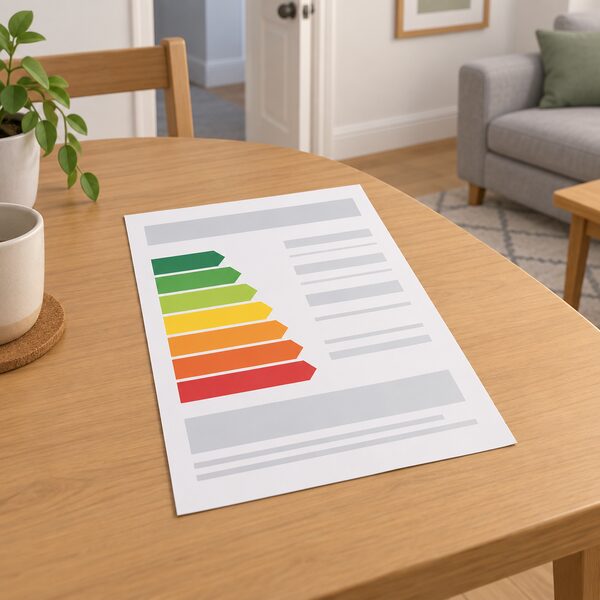
The property test has two tiers. The general limit is an EPC rating of 54 (E) or less3. Where someone in the household has an eligible health condition, the limit extends to 68 (D) or less3. The Warm Homes Nest scheme's own reporting describes the health route in the same terms: a home must have an EPC rating of D or lower (SAP score 68 or lower), and someone in the household must have a qualifying health condition1.
The two figures are not interchangeable. A D-rated home qualifies only through the health condition route. Nest states that where a home has an EPC rating of 68 (D) or less but no one in the household has an eligible condition, the details are placed on a reserve list3. Independent guidance summarises the same split: in Wales, one of the eligibility criteria to receive free home energy efficiency improvements is for the home to have EPC rating of E or less, or D or less and someone in the home has an eligible health condition11.
"If your home has an EPC rating of 68 (D) or less but no-one in your household has an eligible condition, your details will be placed on a reserve list."
For landlords, the EPC band of the property is therefore a threshold that determines which route is even open. A landlord with a D-rated let and a tenant in good health cannot access Nest on the property's rating alone, and the reserve list is not a guarantee of future funding.
What measures Nest funds: heating, insulation, solar panels
Nest delivers free home energy efficiency improvements including central heating systems, boilers, insulation, solar panels and air source heat pumps1. The Welsh Government describes the help as including replacement of a boiler or electric storage heaters to ensure a safe and reliable heating system, designed to help households facing an immediate risk to their health and wellbeing due to a lack of essential heating or hot water4. Independent guidance describes the offer as free, impartial advice and, in some cases, free home energy efficiency improvements such as a new boiler, central heating and insulation12.
Installation is carried out through a network of Wales-based installers under the management of the Nest team1. That matters for a landlord because the work is not procured by the tenant or the landlord independently; the scheme controls who installs and to what specification.
The advice element is separate from the funded measures and is broader. The free and impartial service is available to all households in Wales1, and all households in Wales have access to free, impartial advice to help reduce energy bills13. A landlord or tenant who does not qualify for funded measures can still use the advice service to understand what else is available.
For energy independence, the measures reduce the household's exposure to rising unit costs and to a heating system that cannot keep the home warm. They do not remove the grid connection, the supplier relationship or the standing charges, and solar panels installed under the scheme do not by themselves make a rented home self-sufficient.
How the application and whole house assessment work

The route in is a phone call. Nest advises households to call directly to confirm eligibility and arrange a home assessment14, and the Welsh Government's own guidance is to check eligibility by calling Nest free on 0808 808 224415. The Anglesey guidance repeats the same instruction: call Freephone 0808 808 2244 or visit nest.gov.wales10.
The assessment is a whole house exercise rather than a single-measure check. That is consistent with how Welsh housing standards treat the building: landlords must carry out a Whole Stock Assessment and produce Target Energy Pathways for their homes16, a requirement framed for social landlords under the Welsh Housing Quality Standard 2023. Registered Social Landlords must comply with WHQS 2023, rules and guidance17, and the standards are set by the Welsh Ministers under section 33A of the Housing Act 1996 for Registered Social Landlords17. Private landlords are not bound by WHQS in the same way, but the assessment logic, looking at the property as a system rather than at one faulty boiler, is the same one Nest applies.
In practice a private rented application runs in this order:
- The household calls Nest on 0808 808 2244 to confirm eligibility15.
- The tenant provides the landlord's details so Nest can request permission for the work3.
- The landlord's Rent Smart Wales registration is confirmed2.
- Evidence is supplied: for owner-occupiers a mortgage statement, buildings insurance policy or property deeds, and for everyone a benefit award letter or Council Tax statement3.
- A home assessment is arranged, and any funded measures are installed by the scheme's Wales-based installer network1.
Contacting Nest: phone, email and Welsh language support
Nest is reached on Freephone 0808 808 2244, and the Welsh Government directs households to that number to check eligibility15. The scheme's own guidance gives the same number alongside the website nest.gov.wales10. Green Homes Wales directs households to contact Nest on 0808 808 2244 for free and impartial general advice on current support options18. Calls and emails are welcomed in Welsh19.
Welsh language contact is available. Calls and emails are welcomed in Welsh15. That applies to the advice line as well as to eligibility enquiries, and it is a Welsh Government commitment rather than a scheme add-on.
The distinction matters because households often arrive at Nest having already been refused under a supplier obligation. ECO4 closes to new applicants on 31 December 2026, with no plans to extend it or launch ECO5, and installation extensions cannot allow installation dates beyond that date. Nest runs on its own rules and its own funding, so a refusal under ECO says nothing about eligibility for Nest.
Where the landlord route falls short

Three limits are worth stating plainly. First, consent is a veto: without the landlord's agreement, no work proceeds, and the tenant cannot compel it. Second, registration is a precondition, and an unregistered landlord blocks access to support regardless of the tenant's circumstances2. Third, the property test is fixed at the point of application, so a D-rated home without an eligible health condition goes to a reserve list rather than to a funded installation3.
There is also a wider question about what happens after the tenancy ends. Nest measures are installed in the landlord's property, and the tenant's benefit from them lasts only as long as the tenancy. The landlord retains an improved asset and, in the private rented sector, faces the direction of travel set out in the MEES consultation, where the preferred option is EPC C for new tenancies from 1 April 2025 and all tenancies by 1 April 20288.
For households in the other nations, the equivalent routes differ. Warmer Homes Scotland is available to owner-occupiers and some private rented sector tenants living in or at risk of fuel poverty who meet the qualifying criteria6. In Northern Ireland, the Affordable Warmth Scheme requires landlord registration with the Department for Communities' Landlord Registration Scheme7. In England, the Warm Homes: Local Grant is open to private renters with landlord consent5, and the Bright Green Homes scheme is available to homeowners and those in private rented accommodation19.
The energy independence picture for a Welsh private renter is therefore partial. The scheme can replace a failing heating system and improve the fabric at no cost to the household, which reduces bills and improves comfort. It does not give the household control over the property, does not remove reliance on grid electricity and gas, and does not transfer any asset to the tenant. What it does is remove one barrier, the capital cost of the work, and leave the others in place.
Sources19 cited
- Warm Homes Nest scheme annual report 2024 to 2025, Welsh Government, 2026-03-26
- Warm Homes Nest scheme annual report 2022 to 2023, Welsh Government, 2023-11-30
- Nest eligibility rules, Welsh Government, 2026-09-17
- Get help with unexpected costs such as food and heating, Welsh Government, 2026-04-15
- Retrofit support, National Energy Action, 2026-05-19
- Energy saving home improvements, Scottish Government, 2026-09-17
- Affordable Warmth Scheme, Northern Ireland Housing Executive, 2026-09-17
- Minimum energy efficiency standards for the private rented sector, UK Parliament, 2026-09-20
- Renters put at unnecessary risk due to Welsh Government legislation delay, Electrical Safety First, 2026-09-19
- Nest: a scheme to make your home warmer and more energy efficient, Isle of Anglesey County Council, 2026-09-17
- Northern Ireland fuel poverty strategy, Energy Saving Trust, 2025-07-03
- Grants and funding for energy bills, StepChange, 2026-09-20
- Written statement: support for householders impacted by closure of the Energy Company Obligation scheme, Welsh Government, 2026-03-13
- Boiler grants, E.ON Next, 2026-09-17
- Get help with energy efficiency in your home: Nest, Welsh Government, 2026-09-17
- Welsh Housing Quality Standard 2023, Welsh Government, 2022-05-11
- Welsh Housing Quality Standard 2023: integrated impact assessment, Welsh Government, 2024-08-02
- Green Homes Wales, Development Bank of Wales, 2026-09-17
- Get a grant or loan to improve your home energy efficiency, Bristol City Council, 2026
 Insulation in Rented HousingWho pays for insulation when you rent, and who has to agree to it?
 MEES for Rented HomesCovers the minimum EPC standards that apply to private rented homes, the cost caps and exemptions, and how exemptions are registered.
 Using an Installer in WalesExplains how installer registration, competent person schemes and building control notification apply in Wales and where Welsh rules diverge.
 Social and Rented Home StandardsWhat condition is your landlord legally required to keep your home in?
 Where to Start If You RentRenting means you can switch supplier or get a smart meter yourself, but insulation, glazing and heating need your landlord's agreement.
 Welsh Housing Quality StandardWhat does the Welsh Housing Quality Standard mean for your home if you rent from a council or housing association in Wales?