
In this guide
ECO4 is the fourth phase of the Energy Company Obligation, an energy efficiency scheme for Great Britain first introduced in 2013. It works by placing a Home Heating Cost Reduction Obligation (HHCRO) on medium and large energy suppliers, who must deliver insulation and heating measures to low income and vulnerable households1. Ofgem administers the scheme; the legal basis is the Electricity and Gas (Energy Company Obligation) Order 2022, as amended, and the guidance applies to measures installed from 1 April 20222. The scheme was valued at £4 billion when its design was consulted on3.
The obligation period runs from the commencement of the ECO4 Order on 27 July 2022, and the delivery guidance published in March 2026 states that the scheme has been extended by nine months to 31 December 2026, with Phase 4 running from 1 April 2025 to 31 December 20264. Other official pages still give the original end date of 31 March 2026, so the two dates stand side by side unresolved. Separately, some councils now describe ECO4 as closed to new applications, and one council notice states that no new applications can be funded5.
The distinguishing feature of ECO4 is that it funds whole house retrofits rather than single measures, on a fabric-first, multi-measure basis, with a minimum improvement the property must reach4. A household cannot draw down a fixed sum: ECO4 is a supplier obligation and not a grant scheme, so the money and the decision sit with an obligated supplier and its contractors6.
What ECO4 is and who pays for it
ECO is not funded from taxation. The scheme requires large energy suppliers to deliver energy efficiency improvements to domestic households, and the cost of meeting that obligation sits with the supplier and, through tariffs, with energy customers generally10. The ECO4 scheme consists of one distinct obligation, the HHCRO, and the target for delivery is divided between obligated suppliers according to each obligated supplier's relative share of the domestic gas and electricity market2.
Ofgem is the ECO4 scheme administrator11, and councils describe ECO4 and its sister schemes as UK Government-backed schemes regulated by Ofgem12. Ofgem's role is to publish the delivery and supplier administration guidance, receive measure notifications, and audit what has been installed. The version history matters when reading the rules: the current delivery guidance is version 4.0, dated 26 March 2026, superseding version 3.2 of 8 December 20254.
For a household, the practical consequence is that there is no application desk at Ofgem. The chain runs from an obligated supplier, through a managing agent or contractor, to a TrustMark registered installer, and often through a local authority that has declared the household eligible. The wider picture of how supplier-funded work fits with tax-funded grants is set out on the home energy grants pillar page and in more detail under the Energy Company Obligation.
Purpose: cutting heating costs for low income and vulnerable households

The stated main objective of ECO4 is to reduce fuel poverty by improving the least energy efficient housing stock occupied by low income, vulnerable and fuel poor households8. Obligated suppliers are legally required to reduce heating costs for that group by funding energy efficiency, insulation and heating measures6. Councils describe the aim in plainer terms: to help those living in fuel poverty and vulnerable to the risk of living in a cold home, whose house is energy inefficient5.
Two objectives sit alongside each other. Ofgem's guidance describes ECO4 as focusing on supporting low-income, vulnerable, and fuel poor households through delivering energy efficiency measures14, while scheme documents also frame it as designed to tackle fuel poverty while also reducing carbon emissions through supporting whole house energy efficiency improvements15. The British Energy Security Strategy committed to begin ECO4, which it said would upgrade 450,000 homes over four years9.
For a household's energy independence the effect is real but partial. Insulation permanently reduces the amount of energy the home needs, which is the one gain no supplier can withdraw. Heating measures, by contrast, may move the home from one fuel dependence to another: from oil or solid fuel to a heat pump running on grid electricity, or from storage heaters to mains gas. The funding itself remains a dependence on an obligated supplier's remaining budget, which is why availability varies so sharply by area and by month.
How the supplier obligation works: HHCRO and the minimum requirement
ECO4 sets a main obligation called the Home Heating Cost Reduction Obligation4. A supplier is caught by it if it supplies to at least 150,000 customers in the relevant qualification year, and each supplier that exceeds the thresholds has an obligation calculated based on each unit of supply above the supplier allowance2. Suppliers notify their domestic customer numbers and supply volumes by a fixed date for each phase: 17 August 2022 for Phase 1, then 1 February 2023, 1 February 2024 and 1 February 2025 for Phases 2, 3 and 42.
Several internal caps shape what suppliers actually deliver:
| Cap | Limit | Applies to |
|---|---|---|
| ECO4 Flexible Eligibility | no more than 50% of HHCRO2 | measures delivered under Flex |
| Private premises solutions (PPS) | 12.5% of total HHCRO4 | PPS measures |
| Building fabric repair (BFR) | 0.5% of total HHCRO4 | fabric repair costs |
Because delivery is scored rather than paid per item, projects must reach a minimum improvement rather than simply install something. Properties with starting bands F and G must be improved to a band D, while properties starting at band E or D must be improved to a band C6. Where building fabric repair is claimed under the amending Order, it must be recommended in a report by a chartered surveyor following an assessment of the condition of the insulation and related building fabric16. How the scoring works in practice, including the modelling of a premises with a total floor area of 80m2 used in the scoring consultation17, is covered under ECO4 scoring and minimum requirements.
Eligibility: benefits, EPC bands and property rules
Two tests apply at once. The household must be in receipt of a means tested benefit or qualify through one of the ECO Flex routes, and the property must need heating or insulation measures that will deliver a significant energy efficiency improvement18.
The benefits listed for the Help to Heat Group are income-based Jobseeker's Allowance, income-related Employment and Support Allowance, Income Support, Pension Credit Guarantee Credit, Pension Credit Savings Credit, Universal Credit, Housing Benefit, Child Tax Credit and Working Tax Credit, and Child Benefit subject to income caps and household composition4. Housing Benefit is confirmed as a qualifying benefit on the affordable warmth route19. The detail is set out on ECO4 eligibility and which benefits qualify.
On the property side, only homes in EPC band D to G can be treated7. Private rented homes are treated more strictly: under ECO4, private rented sector households must be in EPC bands E, F or G for all eligible routes20, and a house rented from a private landlord must have a rating of E, F or G to be eligible, with the owner's permission required10. Owner-occupied homes referred through Flex Routes 1, 3 and 4 may be in bands D to G13. Social housing support was aimed at the least efficient stock in bands E to G21.
- Eligible domestic premises include mobile homes, and premises delivered via LA Flex and in-fill4.
- Care homes and student halls of residence are not eligible, as these are commercial properties13.
- In a private rented home, replacement, upgrade or repair of a boiler, central heating system or electric storage heater is generally not eligible4.
- For an in-fill flat, eligible measures are cavity wall insulation, solid wall insulation and district heating connection, and the applied measure must match that of the associated ECO-eligible property4.
Eligibility routes: Help to Heat, LA Flex, In-Fill and Supplier Flex
The eligibility and pre-installation declaration names five routes: Help to Heat Group, Social Housing, LA Flex, In-Fill and Supplier Flex22. The same five appeared on the original eligibility requirements form in October 202223.
The Flex element allows local authorities and the Scottish and Welsh governments, referred to in the scheme as Devolved Administrations, to declare households eligible who are not on a qualifying benefit24. There are four separate qualifying routes to identify low income and vulnerable households, and suppliers may only provide evidence for Routes 2 and 425.
| Route | Who it identifies |
|---|---|
| Route 1 | Owner-occupied households in EPC bands D to G6 |
| Route 2 | Owner-occupied and private rented households in bands E to G meeting at least two proxy conditions6 |
| Route 3 | Owner-occupied in bands D to G, private rented in E to G, referred by a GP or health professional6 |
| Route 4 | Bespoke targeting: owner-occupied and private rented households referred under an approved new methodology26 |
Route 4 exists so that suppliers and local authorities can submit an application to the department where they have identified new methods to identify low-income and vulnerable households, demonstrating the methodology is more effective than Routes 1 and 2; the application must be approved by or on behalf of the Secretary of State26. Route 4 applies to ECO4 Flex only27. Qualification under ECO4 Flex Route 2 also opens a route into the Warm Homes: Local Grant28. The mechanics of the local authority declaration are covered on ECO4 Flex, and the choice between routes on ECO4 Flex vs the Help to Heat route.
What gets funded: insulation, heating, solar PV and heat pumps
ECO4 funds insulation and heating qualifying actions2. Council scheme pages group the offer as insulation, boilers and central heating, and solar and renewable energy technologies15.
The measures table in the delivery guidance covers upgrades to a non-renewable heating system, upgrades to a renewable heating system, repair of a broken heating system, replacement of a broken efficient heating system, first time central heating, electric storage heater upgrades, repairs and replacement, connection to a district heating system, heating controls, solar PV, wall, roof, floor and loft insulation, draught proofing, window glazing and higher performance external doors4.
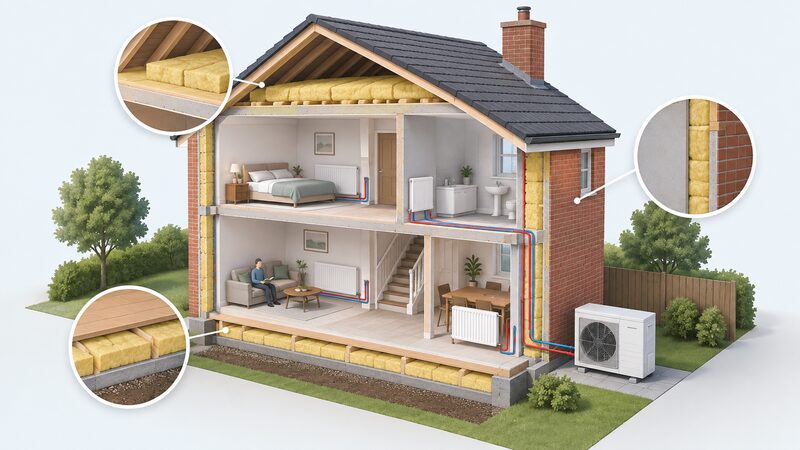
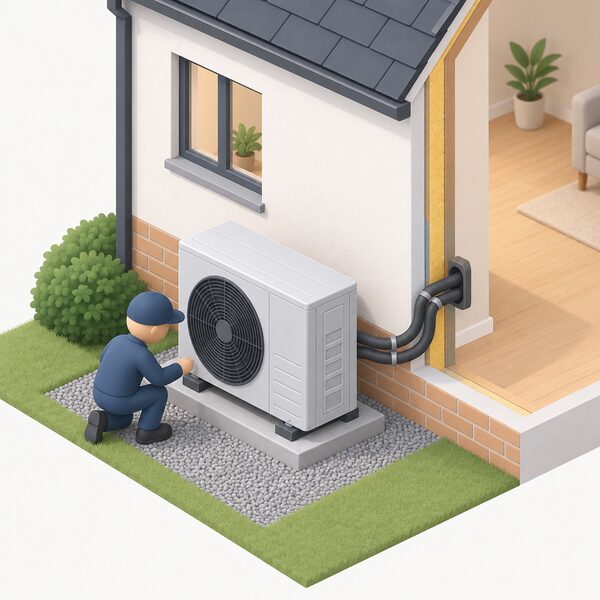
Examples given for ECO4 Flex include solid wall insulation, cavity wall insulation, room in roof insulation, loft insulation, flat roof insulation, an electric storage heater upgrade, first time central heating to an air source heat pump, a boiler upgrade from oil, LPG or solid fuel to an air source heat pump, and solar photovoltaic panels6. Solar PV panels are funded29. What household support may look like in a gas-heated home includes installing central heating where there is no boiler or radiators, replacing storage heaters or coal fires with gas central heating, replacing a non-condensing combi boiler with a modern combi, or replacing a heat only boiler with a modern combi18. A combined park home insulation measure was introduced at the design stage17.
Two limits matter. ECO4 will not provide loft or cavity wall insulation on their own18. And measures may be rejected where the project does not meet the rules30. See ECO4 solar panels and ECO4 heat pump funding.
Whole house retrofit: the fabric-first approach

ECO4 focuses on whole house retrofits for low income and vulnerable households2, shifting to a fabric-first multi-measure whole-house retrofit approach7. In practice that means the assessment looks at the building as a system: the insulation is specified first so that the heating system is sized against a reduced heat demand, and the project is judged on the band the home reaches rather than on the measures installed.
This is the clearest difference from the scheme running alongside it. The Great British Insulation Scheme complements ECO4 but, unlike ECO4's whole house approach, mostly delivers single insulation measures31. Its governing legislation is referred to as the ECO4A Order, and the two schemes share evidence forms: the Great British Insulation Scheme and ECO4 forms are used to collect and provide evidence of measure eligibility31. Crucially, a measure does not count as a qualifying action on ECO4 if it has been notified under the Great British Insulation Scheme4, though ECO4 approved innovation measures can be delivered where the insulation scheme's measure type and eligibility requirements are met32. The comparison is drawn out on GBIS vs ECO4.
For independence, the fabric-first sequence is the part with lasting value: it lowers demand permanently, which reduces exposure to whatever the household's fuel costs in future, and it makes a later low-carbon heating system viable at a smaller size.
Phases, deadlines and the nine-month extension
The obligation period runs from 27 July 2022 and is split into four phases2:
| Phase | Period |
|---|---|
| Phase 1 | 27 July 2022 to 31 March 20232 |
| Phase 2 | to 31 March 2024 (notification deadline 1 February 2023)2 |
| Phase 3 | 1 April 2024 to 31 March 20252 |
| Phase 4 | 1 April 2025 to 31 December 20264 |
Suppliers could choose to deliver early to ECO4 scheme rules and be awarded ECO4 deemed scores from 1 April 202221, and carry-over applications had to be made no later than 30 June 20232.
How a household applies: council, supplier or Flex provider

There is no single national application form. Routes seen across the country include:
- Approach an obligated supplier or its contractor directly under the Help to Heat route, where a qualifying benefit is held.
- Apply through a council-managed scheme. Leeds City Council's funding is only available for schemes managed by the council, as well as through contractors who have been endorsed by the council36.
- Apply through a council's approved Flex providers or agents, who facilitate the application process6.
- Use a regional portal, as with the Greater Manchester ECO4 LA Flex route, which directs applicants through Greater Manchester's Retrofit Portal7.
- Be referred by a local authority partner, such as YES Energy Solutions acting as local authority partner for householders interested in ECO4, ECO Flex or GBIS Flex15.
Councils can voluntarily participate in ECO4 Flex to identify eligible households not in receipt of a means tested benefit8, and ECO4 allows local authorities to identify the most vulnerable households who could benefit from energy efficiency improvements10. Some councils sit outside the process entirely: one states that it will not be accepting any ECO related requests, and that residents assessed as potentially eligible are referred on to the relevant funding scheme provider or an approved installation company, with information passed to the council for checking via a delivery partner5. Eligible households may be a homeowner, private tenant or landlord37. Local authority declarations at the start of Flex were sent to Ofgem by email for review25.
Delivery record, costs and criticism
ECO4's annual delivery costs were expected to be around 70% higher in real terms than those for ECO338. The mid-scheme changes impact assessment modelled ECO4 compliant delivery at 75%, giving total discounted costs of £671.8m and total discounted benefits of £752.4m39.
Delivery on the ground has been uneven. One council reported 2,583 households supported to make their homes warmer under LA Flexible Eligibility40. Another reports that there is very limited funding available through the ECO4 Flex scheme, and many of the approved ECO providers have no access to funding41. A third states simply that the scheme has now closed to new applications42.
Quality has also come under scrutiny. Ofgem commissioned a randomised sample of audits of solid wall insulation installed through ECO4 and the Great British Insulation Scheme, published as statistical audit results in October 202543.
"the cost of damage from faulty ECO4 and GBIS solid wall insulations exceeds the £20,000 limit covered by a valid guarantee"
Where ECO4 does not reach: blending with other schemes
Funding for measures delivered under ECO4 must not be blended with funding from other government schemes or grants, including but not limited to the Warm Home Discount, the Boiler Upgrade Scheme, the Social Housing Decarbonisation Fund and the Home Upgrade Grant24. The delivery guidance repeats the rule flatly: ECO4 funding cannot be blended with other government schemes or grants4, and Boiler Upgrade Scheme and ECO funding cannot be blended for the same measure or be included within an ECO4 project13.
That matters because the Boiler Upgrade Scheme covers similar technologies, contributing upfront capital grants to support the installation of low carbon technologies45, with a scheme budget of £400m for the 2026 to 2027 financial year46. The two are alternatives rather than a stack, which is the subject of Boiler Upgrade Scheme vs ECO4 and ECO4 and other grants.
What happens when ECO4 ends
ECO4 was due to end on 31 March 2026, with no subsequent ECO5 replacement6. Government guidance to energy suppliers on domestic energy tariff reductions refers to the ending of funding for the ECO4 scheme47, and a council news item recorded in December 2025 that the ECO4 scheme would close in March 2026, as announced in the Autumn Budget48. The March 2026 delivery guidance then reflected the nine-month extension to 31 December 20264. One council notice on the end of ECO states that no new applications can be funded37.
For households, the consequence is that ECO4 should not be treated as a standing entitlement. Where it closes, the successor routes are the Warm Homes: Local Grant, which also admits homes qualifying under ECO4 Flex Route 228, the Warm Homes: Social Housing Fund for rented stock, and the Great British Insulation Scheme for single insulation measures. Regulation is also tightening on the rented sector: private landlords are expected to upgrade properties to minimum energy efficiency standards, provisionally band C, by 2030, which will move some of the work ECO4 subsidised into a landlord obligation instead.
The independence point is worth stating plainly. ECO4 has delivered permanent reductions in demand to homes that could not have paid for them, and that part endures after the scheme closes. But the funding was always contingent on an obligated supplier's remaining budget, the administering rules changed repeatedly across four versions of the delivery guidance, and the scheme's closure was set by fiscal announcement rather than by need. A home made warmer by ECO4 is less dependent on fuel; a household relying on ECO4 to get there remains dependent on a scheme it does not control.
Sources48 cited
- Energy Company Obligation (ECO), Ofgem, 2026-09-17
- ECO4 Guidance: Supplier Administration, Ofgem, 2026-07-06
- Design of the Energy Company Obligation (ECO4) 2022-2026, GOV.UK, 2021-07-20
- ECO4 Delivery Guidance version 4.0, Ofgem, 2026-03-26
- Home energy efficiency, Bridgend County Borough Council, 2026-09-17
- ECO flexibility funding, Ceredigion County Council, 2026-09-17
- Tameside grants and funding, Tameside Council, 2026-09-17
- ECO4 Flex and GBIS Flex information document, Ceredigion County Council, 2025-11
- British Energy Security Strategy, UK Parliament deposited paper, 2022-04
- ECO 4 and ECO Flexible Eligibility, Breckland Council, 2026-09-17
- Energy Company Obligation (ECO) guidance 2022-2026, Department for Energy Security and Net Zero, 2022-07
- Financial help for energy efficiency and low carbon heating improvements, City of Edinburgh Council, 2026-09-17
- ECO4 Delivery Guidance version 3.2, Ofgem, 2025-12-08
- ECO4 New Measures and Products Guidance draft, Ofgem, 2022-07-04
- ECO4 scheme, West Lindsey District Council, 2025-07
- The Electricity and Gas (Energy Company Obligation) (Amendment) Order 2025, legislation.gov.uk, 2025-07-31
- ECO4 Scoring Consultation Part 2, Ofgem, 2021-12-13
- Energy Company Obligation (ECO4) scheme, Derbyshire County Council, 2026-09-17
- Energy Company Obligation (ECO) scheme, Leeds City Council, 2026-09-20
- Great British Insulation Scheme government response, Department for Energy Security and Net Zero, 2023-03
- ECO4 government response, Department for Business, Energy and Industrial Strategy, 2022-04-01
- ECO4 and GBIS Eligibility and Pre-Installation Declaration v1.1, Ofgem, 2026-09-17
- ECO4 Eligibility Requirements Form v1.0, Ofgem, 2022-10
- ECO: homeowners and tenants, Ofgem, 2026-09-17
- ECO4 Delivery Guidance v1.1, Ofgem, 2023-02-03
- Birmingham City Council GBIS and ECO4 Flex statement of intent, Birmingham City Council, 2025-08-11
- GBIS and ECO4 Flex statement of intent, Telford and Wrekin Council, 2025-05-12
- Warm Homes Local Grant 2025 to 2028, Birmingham City Council, 2026-09-20
- ECO4 Flex open, South Cambridgeshire District Council, 2026-09-17
- ECO4 summary of updates document, Ofgem, 2026-09-17
- Great British Insulation Scheme, Ofgem, 2026-09-17
- ECO4 New Measures and Products Guidance v3.0, Ofgem, 2026-03-26
- Extending the ECO4 end date, GOV.UK, 2026-01-23
- Summary of updates to ECO4 delivery guidance and measures table, Ofgem, 2026-03-26
- ECO guidance and associated documents, Ofgem, 2026-09-17
- Statement of intent, Leeds City Council, 2024-12-23
- Energy Company Obligation ECO4 and Flex, Essex County Council, 2026-09-17
- Energy Company Obligation research briefing CBP-9889, House of Commons Library, 2026-09-17
- ECO4 and GBIS mid-scheme changes final stage impact assessment, GOV.UK, 2025-04-07
- Winter wellbeing, Cornwall Council, 2026-06-30
- Energy efficiency, Pembrokeshire County Council, 2026-09-17
- Home and business grants, schemes and advice, East Herts Council, 2026-09-17
- Solid wall insulation installed under ECO4 and GBIS: statistical audit results, GOV.UK, 2025-10-13
- Energy Market Consumer Protection debate, Hansard, 2026-06-17
- Boiler Upgrade Scheme statistics, data.gov.uk, 2026-08-27
- Boiler Upgrade Scheme guidance for installers v5, Ofgem, 2026-04-28
- Domestic energy tariff reductions 2026: guidance for energy suppliers, GOV.UK, 2026-03-18
- More households benefitting from free energy saving home improvements, Cumberland Council, 2025-12-08
 Closed Energy PoliciesIf a scheme you used has closed, do you still get paid?
 The Full Your Type of Home GuideLiving in a flat, an old listed house or somewhere off the gas grid changes what energy help you can get and what you are allowed to install.
 Living Off the Gas GridNo mains gas at your home?
 Older People and Home EnergyOlder people often pay more to keep warm and can miss out on help they are entitled to.
 The Full Heat Pumps GuideWill a heat pump keep my house warm in winter, and what does one cost to buy and run?
 Energy Consumer BodiesWho do you call about an energy problem where you live?