

In this guide
The Warm Homes: Social Housing Fund is a capital grant scheme that pays social landlords, not tenants, to improve the energy performance of social homes in England. It provides funding to local authorities, registered providers of social housing and registered charities that own social housing, for energy efficiency upgrades and low carbon heating measures1. Applicants may bid directly or as part of a consortium, and combined authorities are also eligible recipients2. Eligible stock is social housing with an Energy Performance Certificate rating between G and D, and the fund's purpose is to take homes currently below EPC band C up to that standard3.
It is the successor to the Social Housing Decarbonisation Fund, and government documents describe it as "previously known as the Social Housing Decarbonisation Fund"5. Draft guidance was published on 13 May 2024 and the delivery window opened in April 20252. Wave 3 carries a commitment of £1.3 billion, which government states the sector has more than matched, putting over £2.6 billion into delivery, and the wave runs to September 2028 with all grant funding to be transferred and spent by 31 March 20286. Landlords are expected to provide at least 50 per cent match funding7.
For a household, the practical point is that this is not a grant a tenant applies for. There is no application route for an individual in social housing: the home is upgraded only if the landlord bids, wins and includes that property in its project. What the fund does deliver, where it reaches, is fabric and heating work paid for without a rent increase or a tenant contribution, managed under the PAS 2035 retrofit framework. Other routes, including the Warm Homes: Local Grant for privately owned homes, sit alongside it in the wider set of home energy grants.
What the fund pays for, and who holds the money
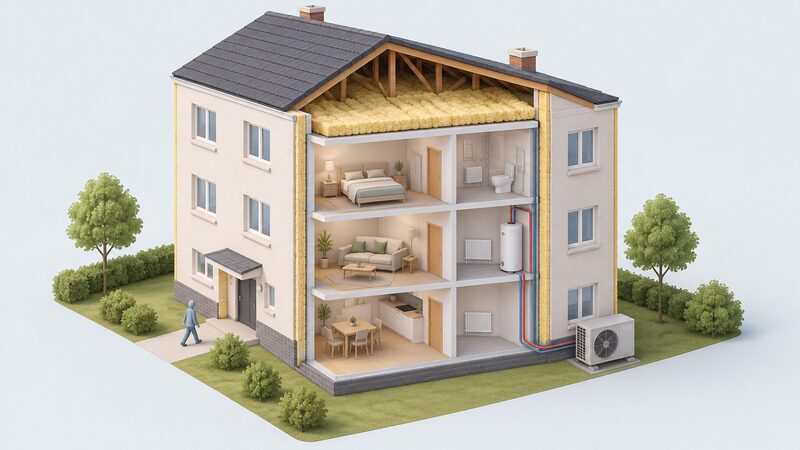
The scheme provides funding for energy performance improvements and low carbon heating improvements to social homes1. In practice that means a package of fabric measures and heating measures assembled to take a home from its current band up to EPC C4. The money is capital grant held by the landlord, described in scheme documents as the grant recipient, with a lead grant recipient responsible where a consortium bids together6.
Eligibility runs to four categories of organisation: local authorities, combined authorities, registered providers of social housing, and registered charities that own social housing in England2. Charities qualify only where they own the stock, not where they merely manage or advise on it. The combined authority route matters because it changes where a landlord applies rather than whether it can: in Greater Manchester, constituent local authorities and housing associations seek funding through the combined authority, which has received a proportionate share of national scheme funding, and "will not be permitted to access funding via the national scheme for their stock in Greater Manchester"1.
Within Wave 3 the addendum guidance draws some sharp lines about what grant can and cannot cover. Digitalisation costs can no longer be grant funded, while smart heating controls remain eligible1. Void properties can be included where they are receiving low carbon heating measures, which allows landlords to sequence work around lettings1. Ancillary and administrative grant is provided as a fixed 10 per cent of the capital grant, a change that gives landlords a predictable overhead allowance rather than a negotiated one1.
A separate incentive exists for homes still on the gas grid. Under the on gas grid low carbon heating incentive offer, up to 10 per cent of the homes included in an application can gain access to a £20,000 grant fund per home9. That cap is deliberate: the fund's main weight sits on fabric and on off-gas or communal heat, with a bounded allowance for gas grid heat pump conversions.
The figures: £1.3 billion in Wave 3 and 12,900 homes reported so far

The headline commitment for Wave 3 is £1.3 billion, and government states this "has been more than matched by the sector, meaning over £2.6 billion is currently in delivery"6. An indicative national pot of £1,300m is used in combined authority allocation documents, where the Warm Homes: Social Housing Fund represents 7.8 per cent of the devolved retrofit quantum modelled7. Additional money has followed: £295 million for financial year 2026/27, and a further £100 million announced in April 2026 with a focus on solar PV and battery installation10. Earlier, £374 million was allocated for 2025 to 2026, with government stating that up to 60,000 homes could be upgraded through grant funding alongside social housing provider co-funding11. The fund sits within a wider Warm Homes Plan commitment of £5 billion for low-income households, delivered through this fund, the Warm Homes: Local Grant and a future consolidated scheme5.
Delivery figures are published as Official Statistics. The August 2026 release, published 27 August 2026 and reporting activity to the end of July 2026, records around 25,770 measures in around 12,900 households2. Those two numbers together imply an average of roughly two measures per home, consistent with a package approach rather than single-measure installs.
| Figure | Value | Period |
|---|---|---|
| Wave 3 grant commitment | £1.3 billion6 | Wave 3 |
| Total in delivery with sector match | over £2.6 billion6 | Wave 3 |
| Additional allocation | £295 million10 | FY 2026/27 |
| Solar PV and battery focused allocation | £100 million10 | announced April 2026 |
| Allocation for 2025 to 2026 | £374 million11 | 2025/26 |
| Measures reported | around 25,7702 | to end July 2026 |
| Households treated | around 12,9002 | to end July 2026 |
| Challenge Fund projects | 12112 | Wave 3 |
Readers comparing releases should note the methodology and background note published alongside the August 2026 statistics, which sets out the data sources used, quality assurance processes, data limitations and the factors that may affect interpretation of published figures13. It covers both this fund and the Warm Homes: Local Grant, and applies to England13.
What drives the numbers
Two forces set the pace. The first is fuel poverty policy: the Warm Homes family of schemes exists to reduce or eliminate fuel poverty, and is targeted at those most likely to be in it, including low-income and vulnerable households14. The second is the shape of the social rented sector itself, where a landlord holds whole blocks and can treat many homes under one contract, so progress per pound of grant is easier to plan than in owner-occupied streets. Together they explain why the funding is routed through landlords rather than tenants, and why a tenant cannot apply directly.
The second is match funding. The expectation of at least 50 per cent landlord contribution means every pound of grant has to find a pound of landlord capital before a home is treated7. That is why the £1.3 billion commitment translates into over £2.6 billion in delivery6, and it is also why delivery is uneven: a landlord with constrained borrowing, competing fire safety or damp obligations, or stock in poor condition, may simply not bid. The grant is a subsidy on a programme the landlord must already be able to afford in part.
Timing pressure is the third driver, and it is visible in the Greater Manchester rules, where both grant and co-funding must be spent by the end of each financial year, Year 2 Phase 1 costs are covered from 1 April 2026, and completion runs to 31 March 2027 at the latest1. Annual spend deadlines against multi-month construction programmes push landlords towards measures that can be installed quickly and in volume. At national level, the Challenge Fund route allows lead grant recipients to exceed per property cost caps in individual phases, but holds them responsible for ensuring the project as a whole averages within the caps9. That flexibility exists precisely because hard-to-treat homes cost more than the average.
Rules a landlord has to satisfy

Applications are assessed against minimum requirements rather than ranked competitively in the first instance. Scheme guidance states that "All applications that meet the minimum requirements of the scheme will be awarded funding in-principle", and that where an application meets some but not all the minimum requirements the lead applicant will be given the opportunity to address the shortcomings9. Individual questions are assessed on a two-way basis: a pass where the answer provides adequate assurance that the applicant will comply with the requirements of the scheme, and a flag where it does not9.
The operating rules that follow from a successful bid:
- Properties must be social housing at EPC G to D, targeted to band C3.
- Landlords are expected to provide at least 50 per cent match funding7.
- Ancillary and administrative grant is fixed at 10 per cent of the capital grant1.
- Digitalisation costs are no longer grant fundable; smart heating controls remain eligible1.
- Void properties can be included where they receive low carbon heating measures1.
- The on gas grid low carbon heating incentive is limited to up to 10 per cent of homes in an application, at £20,000 per home9.
- All Wave 3 grant funding must be transferred to recipients and spent by 31 March 2028, with the wave running to September 20286.
Retrofit work of this kind is delivered under PAS 2035, described as the overarching UK retrofit standards framework15. It was introduced in 2019 as a framework for best practice in the energy retrofit of domestic properties, and work under it has to be managed by a qualified retrofit coordinator16. ECO4 delivery guidance has updated its references from PAS 2035:2019 to PAS 2035:2023, indicating the current version in scheme use17. Building regulations work also leans on it: PAS 2035 is already referenced in the current Approved Document as a means to assess background ventilation in an existing dwelling, and that reference is retained in the 2026 edition18.
Geographic rules bite too. In Greater Manchester, properties should be within the combined authority boundary, though properties in adjoining areas that form part of the same estate can also be considered for inclusion1. Landlords there request an application pack from the combined authority rather than applying nationally1.
England only: how the other three nations fund social housing upgrades
The scheme covers England only, stated plainly in the statistical release and repeated in Wave 3 guidance and the methodology note8. The same is true of the Warm Homes: Local Grant, which is only available in England and serves low-income households in the worst quality privately owned homes20. Social housing is largely excluded from that grant, permitted for in-fill purposes only and capped at 10 per cent of a project's total homes treated21. The two schemes are designed to be complementary rather than overlapping.
| Nation | Main route for social housing energy upgrades | Key terms |
|---|---|---|
| England | Warm Homes: Social Housing Fund | £1.3bn Wave 3, 50% match expected, EPC G to D to C6 |
| Scotland | Social Housing Net Zero Heat Fund | Capital support of up to 50% for energy efficiency; clean heating systems and energy efficiency measures for social landlords22 |
| Wales | Welsh Housing Quality Standard 2023 | Legally binding standard all social landlords must meet24 |
| Northern Ireland | Warm Healthy Homes Fund (in development) | Targeted at lower-income owner-occupied and private rented homes25 |
Scotland's Social Housing Net Zero Heat Fund is designed to accelerate the delivery of energy efficiency and clean heat to existing social housing, through capital grant funding to social landlords for clean heating systems and energy efficiency measures22. It provides capital support of up to 50 per cent for energy efficiency22. A condition attaches: homes benefiting from fabric first support install or connect to zero emissions heating by 203226. Comparable routes are set out on the Scotland grants page.
Wales works primarily through regulation rather than a competitive fund. The Welsh Housing Quality Standard, introduced in 2002, applies to registered social landlords and local authorities with social rented housing stock, and not to other housing developed by RSLs or to the private sector27. It is a legally binding standard, and local authorities must comply pursuant to section 111 of the Housing (Wales) Act 2014; as of 31 March 2022, 100 per cent of social homes met the standard24. The evaluation framework covers 42 individual elements within 7 over-arching categories, and concluded the standard had been instrumental in improving social housing quality and should be continued27. The 2023 revision, which included changes to energy efficiency requirements, was published for consultation from Wednesday 11 May 2022 for 12 weeks, and Welsh Government described it as "a standard which is more demanding than in the other home nations"28. All social landlords in Wales are legally obliged to meet it30. See also home energy grants in Wales.
Northern Ireland has no equivalent social housing fund in the material available. The Warm Healthy Homes Fund is being developed with support targeted at lower-income households in owner-occupied and private rented homes, to improve energy efficiency, reduce fuel poverty, improve thermal comfort, support health and wellbeing outcomes, contribute to carbon reduction and provide a longer-term framework for investment in private sector home energy efficiency25. In April 2026 the responsible minister described "actively progressing work on a Warm Healthy Homes Fund"32. Northern Ireland routes are covered on the Northern Ireland grants page.
What it means for a household's energy independence
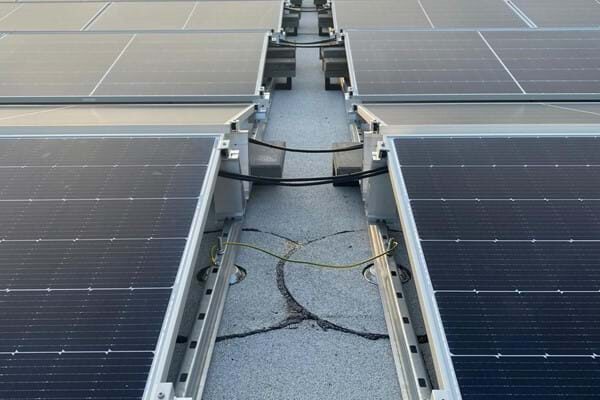
The honest position is that this fund moves a home's energy performance without moving any decision-making power to the household. The tenant is not the applicant, does not hold the grant, does not choose the measures and is not named in the delivery statistics, which are not disaggregated by grant recipient2. Independence here is delivered indirectly: a home taken from EPC G to D up to band C needs less energy to stay warm, which reduces exposure to tariff movements and to the cost of whatever fuel it burns3.
Where low carbon heating is installed, the dependence shifts rather than disappears. A home converted from gas to a heat pump moves from a gas supplier to an electricity supplier and to the grid. The £100 million announced in April 2026 with a focus on solar PV and battery installation is the part of the programme most directly relevant to self-supply, since generation and storage on the roof and in the cupboard reduce imported units in a way insulation alone cannot10. Even then the household does not own the asset: the landlord does, and the tenant's benefit depends on how the landlord passes on the output. Wider context on this trade-off is set out under grants and energy independence and solar panel grants.
Three dependencies remain firmly in place. The first is the landlord: no bid, no upgrade, and no route for the tenant to force one through this scheme. The second is the funding cycle: Wave 3 spend must complete by 31 March 2028 with the wave closing in September 2028, and what follows is described only as a future consolidated scheme6. The third is the quality regime, where the coordinator checking the work may be contracted by the installer doing it19.
Comparable support for households outside social housing is not equivalent. In Wales, the Nest scheme offers free, impartial advice and potentially free home energy efficiency improvements such as insulation, a heat pump or solar panels to people on low incomes living in cold, damp homes33. In England, the Warm Homes: Local Grant funds energy efficiency improvements and low carbon heating upgrades for low-income households in energy-inefficient homes35. For social tenants, though, the route runs through the landlord, and the sensible expectation is a programme delivered block by block over several financial years rather than an individual application with a decision date.
Sources35 cited
- Warm Homes: Social Housing Fund, Greater Manchester guidance, Greater Manchester Combined Authority, 2026-09-17
- Warm Homes: Social Housing Fund statistics, August 2026, GOV.UK, 2026-08
- POSTnote on home retrofit funding, UK Parliament, 2026-06-25
- UK Solar Roadmap, Department for Energy Security and Net Zero, 2025-06
- Reforming consumer protection for home upgrade schemes, GOV.UK, 2026-06-17
- Energy efficiency schemes research briefing, House of Commons Library, 2026-05-13
- Devolved retrofit pilot FAQs, West Midlands Combined Authority, 2026-09-17
- Warm Homes: Social Housing Fund statistics release page, GOV.UK, 2026-08-27
- Warm Homes: Social Housing Fund Wave 3 scheme guidance addendum, Department for Energy Security and Net Zero, 2026-06
- Carbon Budget and Growth Delivery Plan, heat and buildings factsheet, GOV.UK, 2026-06-23
- Help to save households money and deliver cleaner heat to homes, GOV.UK, 2024-11-21
- Wave 3 successful social housing landlords, GOV.UK, 2025-03-11
- Statistics methodology and background note, GOV.UK, 2026-08-27
- Impact on health of Welsh Government Warm Homes schemes, Welsh Government, 2019-10-11
- Green Homes Wales, Development Bank of Wales, 2026-09-17
- Home energy efficiency key terms explained, Development Bank of Wales, 2024-10-17
- ECO4 delivery guidance version 3.2 summary of updates, Ofgem, 2025-08-07
- Future Homes and Buildings Standards consultation response, GOV.UK, 2026-03
- Public Accounts Committee report on home upgrade schemes, UK Parliament, 2026-01-23
- Apply for the Warm Homes: Local Grant, GOV.UK, 2026-09-17
- Warm Homes: Local Grant, county guidance, Surrey County Council, 2026-09-17
- Scottish Government response to the Green Heat Finance Taskforce, Scottish Government, 2025-12-17
- Heat in Buildings progress report 2024, Scottish Government, 2024-10-10
- Welsh Housing Quality Standard 2023 integrated impact assessment, Welsh Government, 2024-08-02
- Warm Healthy Homes Fund, Department for Communities, 2026-09-17
- Heat Networks Delivery Plan, Scottish Government, 2022-03
- Summative evaluation of the Welsh Housing Quality Standard, Welsh Government, 2021-06-30
- Time to raise the bar for Wales' housing standards, Welsh Government, 2022-05-10
- Welsh Housing Quality Standard 2023 consultation, Welsh Government, 2022-05-11
- Welsh Housing Quality Standard 2023, Welsh Government, 2022-05-11
- Warm Healthy Homes Fund screening document, Department for Communities, 2026-05-19
- Minister announces agreement on home heating oil support, Department for Communities, 2026-04-16
- Heating your home guidance, Carmarthenshire County Council, 2026-04-04
- Written statement on fuel poverty, Welsh Government, 2025-08-07
- Warm Homes: Local Grant 2025 to 2028 decision, Greater London Authority, 2025-04-03
 Energy in Social HousingWhat must your landlord do if your home is cold, damp or mouldy?
 Controls in Rented HomesCan you change the heating controls in a rented home, and who pays if they break?
 Older People and Home EnergyOlder people often pay more to keep warm and can miss out on help they are entitled to.
 HMOs and Shared HousesWho is responsible for the electrics, the gas and the fire alarms when you rent a room in a shared house?
 Grants and Energy IndependenceCan you get a grant for solar panels or a battery?
 Insulation in Rented HousingWho pays for insulation when you rent, and who has to agree to it?