

In this guide
Older households in the UK sit at the centre of the state's energy support system, and the main instrument aimed at them is the Warm Home Discount: a one-off £150 rebate off the electricity bill, applied by the supplier rather than paid to the household1. It reaches around 6 million households and has been confirmed through to 2030-313. For winter 2026 to 2027 the qualifying date is 23 August 2026, and the conditions that matter are the supplier, the benefit and the name on the bill, all assessed on that single day4.
The discount is not the whole picture. Winter Fuel Payment for winter 2025/26 was £200 per eligible household where the oldest person is under 80, and £300 where someone in the household is 80 or over; the Pension Age Winter Heating Payment in Scotland ran at £203.40 and £305.10 on the same age split5. Northern Ireland sits outside the Warm Home Discount entirely and runs its own routes, including the Affordable Warmth Scheme and a home heating oil support scheme2.
What follows sets out what each scheme does, who qualifies, how the money arrives, and where the gaps are. It also covers the practical problem that runs through all of it: a support system increasingly delivered through online accounts and app-based services, at a point in life when a significant minority of older people are not online at all.
What help exists for older people at home: the schemes at a glance
Support for older households arrives through four separate channels, and they do not talk to each other. The first is the energy bill itself: the Warm Home Discount, a £150 rebate applied to electricity accounts by suppliers with more than 1,000 domestic customers, plus other suppliers who elect to take part2. The second is the winter payment system, which pays cash rather than a rebate and is administered separately from the energy supplier. The third is grant funding for the fabric of the home, delivered through local authorities and, in Wales and Northern Ireland, through devolved programmes. The fourth is advice, which in practice is often what unlocks the other three.
Energy suppliers themselves run schemes and grants covering energy costs, paying off energy debt, and making energy-saving improvements to the home8. Local authority services pull the strands together: East Herts Home Energy Support Service, for example, offers information on grants and eligibility checking, benefits support, supplier switching advice, energy saving advice, debt advice and referral to other organisations or contractors9. In Northern Ireland, NI Energy Advice offers free advice on saving energy in the home, energy efficiency grants and oil buying clubs, plus referrals to energy grants and other sources of help10.
Grant funding for the home is where the picture fragments most. ECO Flex schemes fund necessary home energy improvements12, and the Warm Homes: Local Grant provides energy performance upgrades and low carbon heating to low income households via local authorities13. Home Upgrade Grants have provided energy efficiency upgrades and low carbon heating to low income households in properties off the gas grid and in energy efficiency bands D to G13. In Wales, capital funding for energy efficiency and fuel poverty reduction measures is expected to be made available through Welsh Government Warm Homes funding and schemes available through utility companies15.
For a household, the practical consequence is that no single application covers everything. The discount is automatic for some and applied for by others; the winter payments are automatic for most eligible households; the grant funding is applied for through a council or a devolved programme and depends on the property as much as the person.
Warm Home Discount: £150 off the electricity bill, who gets it and how
The Warm Home Discount is a one-off £150 discount off household electricity bills, described in government statistics as a rebate rather than a payment16. The scheme helps households in, or at risk of, fuel poverty with direct energy bill payments as well as other financial and energy-related support4. It runs in annual scheme years, covers England, Scotland and Wales, and will run until 31 March 20312.
Eligibility rests on three conditions that must all have applied on the qualifying date: the energy supplier is part of the scheme, the householder or their partner gets certain means-tested benefits, and the householder's or partner's name is on the electricity bill1. Housing Benefit appears among the qualifying benefits1. The scheme is funded through a levy on all domestic gas and electricity customers, and suppliers recoup the cost from the bills of all their customers17.
From winter 2026/27, households in England and Wales will be eligible for the rebate if the person named on the energy bill, or their partner or legal representative, was in receipt of the Guarantee Credit element of Pension Credit or a qualifying benefit on the qualifying date17. That is a narrower formulation than the general benefit list and it is the one that governs the coming scheme year.
"The scheme helps households in, or at risk of, fuel poverty with direct energy bill payments as well as other financial and energy-related support"
The discount is worth £150, and published analyses differ on what that represents in proportional terms: one puts it at around 14% of a typical bill and another at around 8%, and the two figures are not reconciled. What is not in dispute is the direction of travel on cost recovery. From April 2026 the recovery of Warm Home Discount costs shifts from the standing charge to the unit rate, which changes how the levy is spread across households according to how much energy they use3.
How the £150 is paid, and when it arrives
The money is not paid to the household. The electricity supplier applies the discount to the bill18. That single design decision shapes everything about how the scheme is experienced: there is no payment to watch for, no bank details to give, and no cash to budget with. It appears as a credit against electricity charges, which means a household that pays by direct debit sees a reduced bill rather than a receipt.
The timing follows the scheme year rather than a fixed calendar date. The Warm Home Discount runs in annual scheme years2, and the qualifying date falls in August, months before the winter the rebate is meant to cover. For winter 2026 to 2027 the qualifying date is 23 August 20264. For winter 2025/26 it was 24 August 20255. The gap between the qualifying date and the arrival of the credit on the account is normal and not a sign that something has gone wrong.
The winter payments work differently and are worth setting beside the discount, because households often conflate them. For winter 2025/26 the standard Winter Fuel Payment amounts were £200 per eligible household where the oldest person is under 80, and £300 for households containing a person aged 80 or over5. The Pension Age Winter Heating Payment in Scotland ran at £203.40 per eligible household where the oldest person is under 80, and £305.10 for households containing a person aged 80 or over5. These are cash payments, not bill credits, and they are assessed on age and benefit receipt rather than on the supplier.
| Payment | Winter 2025/26 amount | Form |
|---|---|---|
| Warm Home Discount | £150 | Rebate applied to the electricity bill by the supplier18 |
| Winter Fuel Payment | £200 under 80; £300 where someone is 80 or over | Cash payment per eligible household5 |
| Pension Age Winter Heating Payment (Scotland) | £203.40 under 80; £305.10 where someone is 80 or over | Cash payment per eligible household5 |
For a household trying to plan, the distinction matters: the discount reduces a bill that has already been incurred, while the winter payments arrive as money. Neither is large enough to change the underlying arithmetic of heating an older, often larger, home through the winter.
Eligibility and the 23 August qualifying date
The qualifying date is the hinge on which the whole scheme turns. For winter 2026 to 2027 it is 23 August 20264. A household that met every condition on 22 August and none on 24 August is not eligible; a household that moved into eligibility on the day itself is. The conditions are cumulative and assessed on that date alone: the supplier must be part of the scheme, the householder or partner must receive certain means-tested benefits, and the householder's or partner's name must be on the electricity bill1.
The benefit list is not the same as the list a household might expect. Housing Benefit is named among the qualifying benefits1. From winter 2026/27 in England and Wales, the formulation shifts to receipt of the Guarantee Credit element of Pension Credit or a qualifying benefit by the person named on the bill, or their partner or legal representative, on the qualifying date17. Pension Credit Guarantee Credit is therefore the anchor for the coming year, and it is the benefit most directly associated with older households.
The practical implication for older households is that a change in circumstances in the wrong week can cost the discount for a whole year. A partner moving in or out, a benefit award starting or stopping, or a switch to a supplier outside the scheme all take effect against that single date.
Applying, or checking you were included automatically
Some households receive the discount without doing anything. If you receive Pension Credit Guarantee, the payment is automatic19. For other eligible households it is not paid automatically, and the advice is to ring the utility provider and check whether the household qualifies19. That split between automatic and applied-for routes is the single most common source of confusion, because two neighbours on the same benefit can have entirely different experiences of the scheme.
The automatic route depends on data matching between the Department for Energy Security and Net Zero, which publishes the statistics, and the suppliers20. Where the match works, the rebate is applied and the household may receive a letter confirming it. Where it does not, the household has to make contact. The Warm Home Discount helpline number is 0800 030 932220.
For households that fall outside the automatic route, local advice services are the practical route in. The Local Energy Advice Programme arranges a free telephone advice service to help with benefits, money and bill problems, and once eligibility is checked the household gets a free home visit from a qualified Home Energy Advisor19. That model, telephone first and visit second, suits older households who are not comfortable with online forms.
Switching supplier without losing the discount

Switching is permitted at any time for anyone who pays a supplier directly for the electricity or gas they use at home21. The same applies in rented properties where the tenant pays the bills: if you have to pay your energy bills, you can choose to switch your supplier or tariff at any time21. The discount does not lock a household into a supplier, but it does attach to the supplier relationship on the qualifying date.
That creates a timing question rather than a switching question. Because eligibility requires being a customer of a participating supplier on the qualifying date4, a switch completed before that date changes which supplier assesses the household, and a switch to a supplier outside the scheme removes eligibility for that year. Suppliers with more than 1,000 domestic customers, plus other suppliers who elect to take part, offer the discount and recoup the costs from the energy bills of all their customers5. The list of participating suppliers is published alongside the scheme rules1.
If a supplier stops trading, the household does not need to do anything. Ofgem states that the household is moved automatically to a new supplier and supply is not interrupted21. The discount depends on being a customer of a participating supplier on the qualifying date, so a household moved to a supplier that takes part remains in scope for that scheme year. Where the receiving supplier does not take part, the position for that year is less certain and worth checking with the helpline.
Suppliers also offer advice on more efficient use of energy that could help cut bills22. That is separate from the discount and is not means-tested, which makes it one of the few universally available forms of support in the system.
Prepayment meters, park homes and other cases that need a different route
Three groups sit outside the standard route: households on prepayment meters, park home residents, and households in Northern Ireland.
Prepayment meters carry their own protections, and they matter disproportionately to older households. A supplier must not install a prepayment meter without permission if there are any vulnerable people in the household, including terminal illness or severe health condition, dependence on a continuous energy supply for medical equipment, everyone 75 or over with no support, a child under 2, no one able to top up due to a physical or mental health condition, or temporary circumstances such as pregnancy or bereavement23. Before installing one, the supplier must visit the home to understand the circumstances and check whether a prepayment meter is safe and suitable for the household23. The "everyone 75 or over with no support" condition is the one most likely to apply to the households this page is about.
Park home residents who pay the site owner for electricity use a separate scheme. The Park Homes Warm Home Discount Scheme is for permanent residents of park homes who pay the site owner for their electricity, are paying council tax and are receiving certain benefits or on a low income; they need to apply each year and only one application per household is considered5. For 2026/27, applicants must be a permanent resident of a park home, pay the park site owner for electricity usage, and be on a relevant qualifying benefit or demonstrate household income or fuel poverty criteria4.
Northern Ireland is outside the Warm Home Discount altogether. The scheme does not run there, and the Affordable Warmth Scheme is available instead2. The Northern Ireland Affordable Warmth Scheme is delivered by the government of Northern Ireland13. A home heating oil support scheme also operates there: in one qualifying period, eligibility required residence in Northern Ireland and a qualifying benefit or income below £30,000, with the qualifying period running from 1 April to 30 April 20266. A second document gives a qualifying period of 1 November to 30 November 2026 on the same conditions, and the two are not reconciled.
| Situation | Route |
|---|---|
| Standard domestic customer in England, Scotland or Wales | Warm Home Discount, £150 rebate via the supplier1 |
| Park home resident paying the site owner for electricity | Park Homes Warm Home Discount Scheme, annual application4 |
| Northern Ireland resident | Affordable Warmth Scheme; home heating oil support scheme2 |
| Household with vulnerable occupants and a prepayment meter | Supplier must not install without permission; pre-install visit required23 |
Disabled Facilities Grant: adapting the home through the council
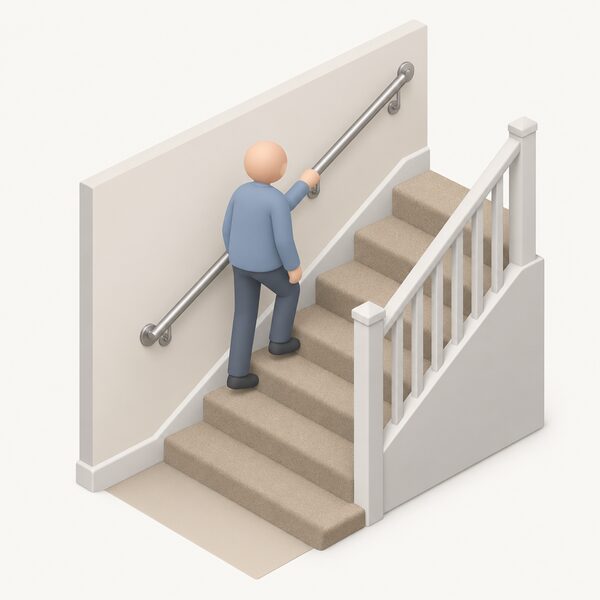
The Disabled Facilities Grant is administered by the council and is available to disabled people who need to make changes to their home24. The eligible group is wider than many households assume: it includes people who are physically disabled, have a learning disability, have age-related needs, are autistic, have a cognitive impairment like dementia, have a progressive condition like motor neurone disease, have a terminal illness, or have a mental health condition24. The age-related needs and dementia categories are directly relevant to older households.
What the grant funds includes widening doors and installing ramps or grab rails, improving access to rooms and facilities such as a stairlift or level access shower, improving access to the garden, building an extension such as a downstairs bedroom, providing a heating system suitable for the applicant's needs, and adapting heating or lighting controls to make them easier to use24. The heating and controls elements are where the grant overlaps with energy work, and they are the parts most often overlooked by households applying purely for access adaptations.
How much is awarded usually depends on household income25. Disabled children under 18 can get a grant without their parents' income being taken into account25. In Wales, the eligibility definition is set out in scheme rules: an owner, private tenant or Council tenant who is disabled or has a disabled person living in the property, with disability defined in Section 100 of the Housing Grants, Construction and Regeneration Act 199615.
For older households, the grant is one of the few funding streams that can pay for controls work, which matters where a household can no longer operate a standard programmer or thermostat. It is administered locally, so timescales and assessment practice vary by council, and it is separate from the energy bill support described above.
What the discount is worth in practice: the shrinking real value of £150
The Warm Home Discount has been fixed at £150 for the current scheme period, and large domestic energy suppliers are required to provide an annual discount of £150 to eligible households20. The scheme has been confirmed through to 2030-313. A fixed cash amount against a bill that moves is a declining real value, and that is the central fact about the discount as a long-term support mechanism.
The scheme's reach is substantial: around 6 million households benefit from the £150 rebate off their winter energy bill26. The Department for Energy Security and Net Zero publishes the statistics20. The scheme is funded through a levy on all domestic gas and electricity customers, which means the cost is spread across the customer base rather than met from general taxation17.
The change to cost recovery from April 2026 shifts the levy from the standing charge to the unit rate3. For a household that uses a lot of energy, including an older household heating a larger home for longer hours, that shift changes the effective cost of the scheme as well as the benefit. It does not change the £150.
For a household's energy independence, the discount is a partial offset and nothing more. It reduces a bill by a fixed sum once a year. It does not change the fabric of the home, the heating system, or the household's exposure to wholesale prices. The grant funding described above does more for the underlying position, but it is slower, means-tested on the property as well as the person, and delivered through councils.
Age UK: advice lines, local advisers and the digital exclusion problem
Age UK runs a free Advice Line on 0800 678 1602, open 8am to 7pm, 365 days a year7. The charity also has specialist advisers at over 120 local Age UKs7. For older households navigating a support system split between automatic and applied-for routes, a local adviser is often the difference between receiving the discount and not.
The digital exclusion problem is the structural issue underneath. Age UK published fresh analysis in September 2026 finding 1.6 million over-65s in England digitally included, 1.4 million digitally excluded and 7.9 million in the middle. That middle group is the one that matters for energy support: people who can use a phone or a laptop with difficulty, or who can manage a simple task but not a supplier portal, an online eligibility checker and an app-based account in combination.
Energy suppliers increasingly deliver account management, meter readings and support applications through online channels. A household in the middle group can be pushed towards a channel it cannot use reliably, at exactly the point where the support is most needed. The telephone routes exist and are the reason they matter: the Warm Home Discount helpline on 0800 030 932220, the Age UK Advice Line7, and the Local Energy Advice Programme's free telephone advice service covering benefits, money and bill problems19.
In Northern Ireland, the NI Energy advice line offers free comprehensive advice on saving energy in the home, energy efficiency grants and more help that may be available22. NI Energy Advice offers independent and impartial energy advice to domestic householders in Northern Ireland10. Belfast City Council's cost of living and winter support pages are a further local route11.
"We also have specialist advisers at over 120 local Age UKs"
The dependence that remains for older households is therefore twofold. The first is the ordinary one: the grid, a supplier, and for many households gas or heating oil. The second is administrative. Support is delivered through a system that assumes a level of digital access and confidence that a significant minority of older people do not have, and the advice organisations exist precisely because that assumption fails.
Sources26 cited
- Warm Home Discount: if you live in England and Wales, GOV.UK, 2026-09-17
- Warm Home Discount, Ofgem, 2026-09-17
- Warm Home Discount statistics 2025 to 2026, Department for Energy Security and Net Zero, 2026-09-17
- Warm Home Discount eligibility statement, England and Wales, 2026 to 2027 scheme year, Department for Energy Security and Net Zero, 2026-09-17
- Warm Home Discount and winter payments: research briefing, House of Commons Library, 2026-02-26
- Home heating oil support, nidirect, 2026-09-17
- Getting the best energy deal, Age UK, 2026-09-10
- Get help with your energy bills, Ofgem, 2026-09-17
- Home and business grants, schemes and advice, East Hertfordshire District Council, 2026-09-17
- Energy saving grants in your area, nidirect, 2026-09-17
- Cost of living and winter support, Belfast City Council, 2026-09-17
- Minimum Energy Efficiency Standards, Carmarthenshire County Council, 2026-09-20
- Fuel poverty and energy efficiency: research briefing, House of Commons Library, 2026-09-17
- Warm Homes: Local Grant and Home Upgrade Grants, House of Commons Library, 2026-09-17
- Private Sector Housing Renewal and Disabled Adaptations Policy, Swansea Council, 2026-09-20
- Warm Home Discount statistics 2025 to 2026: summary, Department for Energy Security and Net Zero, 2026-09-17
- Continuing the Warm Home Discount Scheme: government response, Department for Energy Security and Net Zero, 2026-01-30
- Warm Home Discount: if you live in Scotland, GOV.UK, 2026-09-17
- Grants and funding for energy saving, Tameside Council, 2026-09-17
- Warm Home Discount: contacts, guidance and resources, Ofgem, 2026-09-17
- Switching your home energy supplier, Ofgem, 2026
- Advice if you're struggling to pay your energy bills, nidirect, 2026-09-17
- Check energy suppliers can install prepayment meters without household permission, Ofgem, 2026
- Disabled Facilities Grants, GOV.UK, 2026-09-20
- Disabled Facilities Grants: what you'll get, GOV.UK, 2026-09-17
- DESNZ annual report and accounts 2025 to 2026: performance report, Department for Energy Security and Net Zero, 2026-09-17
 Vulnerable Households EnergyIf someone in your home relies on powered medical equipment, or needs extra warmth because of a health condition, what help is available?
 Cold Homes and HealthCold homes cause real harm, especially to older people and anyone with a heart or lung condition.
 Closed Energy PoliciesIf a scheme you used has closed, do you still get paid?
 New Electricity ConnectionWho do you contact for a new or upgraded electricity connection, and what will it cost?
 Unit Rates by RegionWhy do electricity and gas prices differ depending on where you live?
 Flexibility Payments for HomesCan you really get paid for using less electricity at peak times, and how much would a household actually earn?