

In this guide
- What The Certificate Tells You
- The A To G Scale
- Rental Home EPC Standards
- Reading The Recommendations
- What Tenants Can Change
- The Right To Request
- What Only The Landlord Can Do
- Certificate Limits For Tenants
- Validity, Cost And Finding One
- Support Schemes And Bill Help
- Exemptions And Cold Lets
- Changes Ahead For Rented Homes
A tenant in a privately rented home controls very little of the building that determines the bills. Walls, roof, windows, boiler, hot water cylinder and meter are all the landlord's fixtures. What a tenant does control is the certificate they are entitled to see before signing, the right to request consent for improvements, and the behaviour and portable equipment inside the property. The minimum legal standard for domestic private rented property in England and Wales is an Energy Performance Certificate rating of band E or above, and a property rated F or G must be improved to at least an E before it can be rented out, unless a valid exemption is registered1.
That floor is low. Twenty per cent of private rented housing has a poor rating of E, F or G, compared with just 6 per cent of social housing3. Governments across the UK have proposed lifting the bar: for England and Wales, the equivalent of band C, with a single compliance date of 1 October 2030 proposed for the new standard, and a cost cap of £10,000 per property with a ten-year validity period for exemptions4. Scotland has consulted repeatedly on a minimum standard for private rented homes, at one point framed around the end of 20285.
For independence, the honest summary is that renting caps how far a household can go. The fabric and the heating system stay in someone else's ownership, grid and supplier dependence remain, and any measure a tenant funds usually has to come out again at the end of the tenancy. What renting does not remove is the right to information, the right to ask, and in England and Wales a rule that a landlord must not unreasonably refuse a request where the work costs the landlord nothing1.
What the certificate tells you before you view
An Energy Performance Certificate provides an assessment of a home's energy efficiency8. Certificates must be provided when a building is advertised for sale or for let to a new tenant9, and the requirement traces back to the Energy Performance of Buildings Directive, which required certificates to be made available when buildings are constructed, sold or rented out10. Any property let, rented, sold or bought since autumn 2008 will have come with one11. In Northern Ireland the position is stated plainly: when you first ask about a property which is for sale or rent, the owner or estate agent must show you its certificate12.
In Scotland a certificate is required when a new building has been constructed, at the completion stage of the building warrant process, and when a building is to be sold or rented to a new tenant13. Each individual dwelling that is rented out needs its own certificate14, which matters in converted houses and shared houses where a single certificate for the whole building does not discharge the duty.
The certificate is a document recording the estimated energy performance of a building and its main heating system or systems, and is a legal requirement whenever a home or non-domestic building is advertised for sale or let15. The Energy Efficiency Rating is the first rating to appear, and it is required in adverts, showing both the current and the potential rating16. The potential figure is the more useful one for a prospective tenant: it indicates what the building could reach if the recommended measures were installed, which is a rough measure of how much scope the landlord has.
Certificates also carry a substantial data record. For a residential building the register holds the address and postcode, the energy rating and potential energy rating, building type and built form, inspection date, total floor area, energy tariff, gas network connection, floor level, glazing, extensions, rooms, fuel type, heating systems and controls, insulation, lighting, wind turbines, ventilation, solar water heating, construction age band, tenure type and air permeability, among many further items17. The address of the building is a required content item of the certificate itself18.
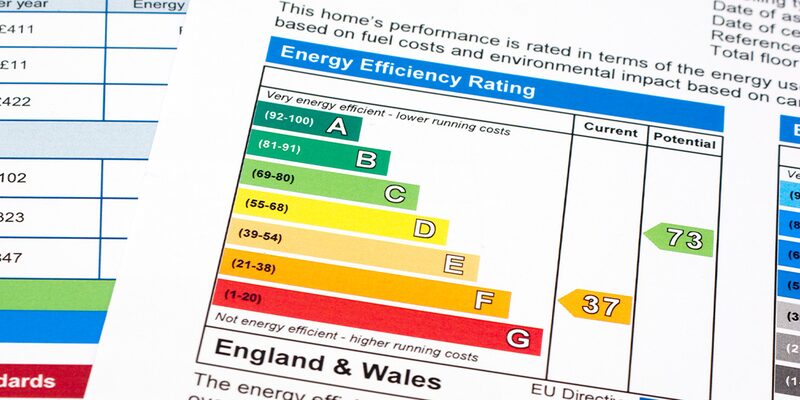
The A to G scale, and what counts as good
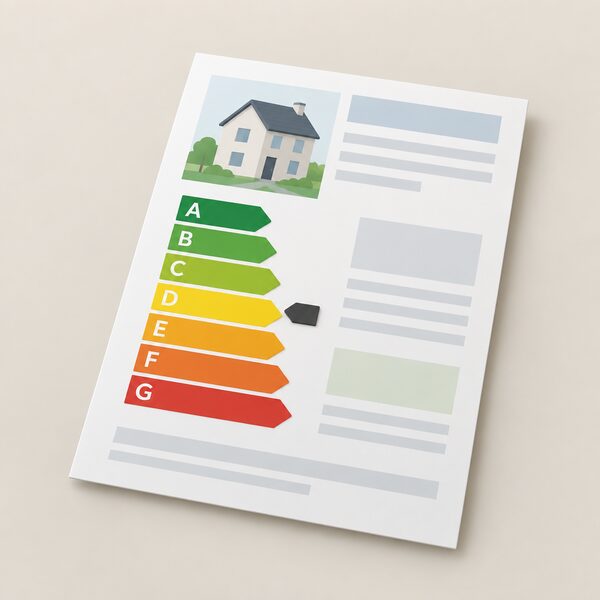
Ratings run on a sliding scale from A, very efficient, to G, least efficient7. Underneath the letters sits a numerical score: both the energy efficiency and the environmental impact ratings are scored 1 to 100 and split into bands A to G19. For non-domestic buildings an A+ band exists; for dwellings the scale is A to G, with G representing the least energy efficient rating20. Official statistics describe assessments as banded A to G where A, or A+ for non-domestic property, is the most efficient22. Ofgem's supplier guidance uses the same framing23.
Scotland's private rented regulations of 2019 defined energy efficiency using the certificate's Energy Efficiency Rating band A to G, where G is the least efficient and A the most, based on the 2012 Standard Assessment Procedure methodology24. That dependence on a particular methodology version is one reason ratings from different years are not strictly comparable.
Two rounds of reform are changing what "good" means. A new rating system for domestic buildings is intended to give clearer information on the fabric energy efficiency of a property, the emissions, efficiency and running costs of its heating system, and the cost of energy to run the home to standardised conditions25. Scotland's 2025 regulations set out, for a domestic property, a heat retention rating, a heating system rating and an energy cost rating26. A single letter will no longer carry the whole answer.
The minimum standard for rented homes: E now, C proposed
The current floor in England and Wales is a rating of band E or above for domestic private rented property1. Guidance for landlords is framed around that minimum level of energy efficiency, band E27. Landlords may not grant a tenancy to new or existing tenants where the rating is F or G, and must not continue letting an already tenanted property at F or G, unless an exemption applies1. The standard matters because the certificate rating sits at the centre of the regime: EPCs are the basis of many energy efficiency policies in the domestic built environment7, so a single assessment decides whether a home can lawfully be let.
| Nation | Standard in force | Proposed change |
|---|---|---|
| England and Wales | Band E or above for domestic private rented property1 | EPC C equivalent, single compliance date of 1 October 20304; government has proposed preventing landlords letting homes below a C rating or equivalent by 203029 |
| Scotland | Minimum standards introduced under Section 55 of the Energy Act 20115 | EPC C equivalent at change of tenancy from regulations in 202530; Heat in Buildings consultation proposed a standard by the end of 20286; a further consultation ran from 6 June to 29 August 202531 |
| Northern Ireland | Certificates required on sale or rent, shown on first enquiry12 | Not stated |
The direction of travel in England and Wales is a dual-metric standard: a fabric performance standard first, followed by landlord discretion to meet either a heating system standard or a smart readiness standard4. Landlords would be required to ensure properties meet a minimum score of EPC C against the fabric performance metric and either the heating system or smart readiness metric32. Properties with a current EPC C would be recognised as compliant under the future standard until that certificate expires4.
Scotland's plans have shifted. The Heat in Buildings Strategy stated an intention to require all private rented sector properties to reach a minimum standard equivalent to EPC C by 2028 where technically feasible and cost-effective at change of tenancy, with a backstop of 2028 for all remaining existing properties30. The 2023 Heat in Buildings Bill consultation proposed requiring landlords to meet a standard by the end of 2028, with properties failing it not allowed to be leased to a new tenant6. The Climate Change Committee said in February 2026 that Scotland's plan should include minimum energy efficiency standards for privately rented homes34, which indicates the standard was not yet settled. An analysis of proposals in 2025 recorded new proposals for private and social rented homes to meet EPC C by 203035, while a parliamentary committee report in May 2025 described the proposal as the equivalent of EPC C by 2030 for privately rented homes in England and Wales36. Where dates differ between documents, the differences reflect successive rounds of proposal rather than settled law.
Reading the recommendations report

Alongside the rating, a domestic certificate carries a recommendations report: information on measures which could be made to improve energy efficiency, with an indication of cost and typical savings for each improvement over three years16. For a tenant this is the most practical page in the document, because it names the specific weaknesses of that building rather than generic advice.
Two things limit it. First, the savings are modelled over a three-year window under standardised assumptions, not measured. Second, almost everything listed is a fixture. Loft and wall insulation, glazing, a new heating system and a hot water cylinder all belong to the landlord. A tenant reading the report is reading a list of things to ask about rather than a list of things to buy. Scotland's reform intends to use the reformed domestic certificate's new Heat Retention Rating as the basis for setting the rented sector standard9, which would push fabric measures up the list relative to heating swaps.
What a tenant can change without the landlord's consent
Official guidance for Scotland is blunt about the boundary: tenants should speak to their landlord first, and should not make any changes without the landlord's consent14. That covers anything fixed, drilled, plumbed or wired. Within that boundary, what remains to a tenant is the reversible and the portable: how the heating controls are set, how rooms are used and ventilated, curtains and removable draught excluders, LED lamps in existing fittings, and appliance choices where the appliances belong to the tenant.
It is worth naming one safety-relevant exception in the landlord duty list for Northern Ireland, because it applies equally to anything a tenant might do: draught proofing external doors and windows is listed as a landlord measure, but not in rooms containing an open-flue gas appliance37. Sealing a room that feeds an open-flue appliance is not a neutral act.
Anything beyond that, including solar, a battery or a different heating system, is covered on the page on energy independence when you rent or live in a flat and turns on consent rather than technology. Reinstatement at the end of the tenancy, and the effect on a deposit, is the practical constraint on tenant-funded fixtures: a measure that cannot be removed cleanly is a measure the tenant cannot install unilaterally.
The right to request, and how far it goes

Private domestic tenants in England and Wales have a right to request consent for energy efficiency improvements. The purpose of the tenants' energy efficiency improvement regulations was described as empowering private domestic tenants to request consent for energy efficiency measures that may not unreasonably be refused by their landlord38. Current guidance states that landlords must not unreasonably refuse such requests where the improvements can be funded at no cost to the landlord, for example through grants or third-party funding1. The certificate itself is the natural starting point for a request, since each EPC comes with a report setting out cost effective measures such as low energy bulbs or upgrading insulation7.
The funding test is the hinge. A recommended measure counts as a relevant energy efficiency improvement only where third-party funding covers the full cost, or the cost is £3,500 or less inclusive of VAT, or a combination of landlord self-funding and third-party funding totals £3,500 or less inclusive of VAT1. Above that, the obligation falls away, subject to the proposed higher cap of £10,000 under the future standard4. Because the recommendations on a certificate are cumulative and are meant to be installed in the order they appear to reach the potential rating7, the point at which the cap bites depends heavily on which measures a home has already had.
Consent runs both ways. Where a landlord has, within the preceding five years, been unable to raise the property's energy performance indicator to the minimum level because a tenant refused consent to a relevant improvement, or because third-party consent was refused or granted subject to a condition the landlord cannot reasonably comply with, the letting prohibition does not apply39. A third party consent exemption is registered by demonstrating that consent for a relevant measure was required and sought, and was refused or granted subject to a condition the landlord was not reasonably able to comply with40. In a flat, that third party is often the freeholder, which is dealt with under leasehold consent for energy work. The mechanics of making a request are set out on the page on asking a landlord for energy improvements.
What only the landlord can do: insulation, heating and bigger measures
Guidance for Northern Ireland lists what a landlord should do in a property rented to tenants: make sure roof spaces are insulated; replace draughty, ill fitting windows and doors; draught proof external doors and windows, excluding rooms with an open-flue gas appliance; insulate exposed water pipes; and fit the hot water tank with a good quality insulation jacket37. Welsh guidance on fitness for human habitation frames the heating question in terms of the building: an efficient heating system appropriate for the fabric, meaning the thermal properties, of the building is important41. At the start of a tenancy in England, the landlord or letting agent must provide a gas certificate if there is gas supplied, and an Energy Performance Certificate42.
Two important limits sit alongside these duties. Guidance for Scotland states that landlords are not required by the minimum standard regulations to carry out improvement works14: the regulations restrict letting rather than compel retrofit, and an exemption is an alternative to doing the work. And in Scotland's Heat in Buildings Bill consultation, private rented properties would still have been required to meet the minimum energy efficiency standard even if a clean heating system had already been installed6, so a heat pump alone would not have substituted for fabric work.
Where a cold home crosses into disrepair or hazard, the route is not the certificate but the relevant housing standard: the repairing standard in Scotland, fitness for human habitation in Wales, and the housing health and safety rating system for excess cold in England. Damp and mould in a poorly insulated let is covered separately under damp and mould in rented homes, and the wider duty set under landlord duties on energy, heating and home safety.
Where the certificate falls short as a guide for tenants

Ratings are produced using the standard assessment procedure, with reduced SAP used for existing homes where information may not be available19. Reduced SAP fills gaps with assumptions drawn from the construction age band and built form, so two identical-looking terraced houses can rate differently on the strength of what the assessor could and could not see. Assessors must carry out energy assessments with reasonable care and skill, a duty enforceable by the relevant person, by prospective or actual buyers or tenants, and by the occupier of the building20. That enforceability is the formal route where a certificate appears wrong.
The second shortfall is delivery. Written evidence to a parliamentary inquiry recorded that only 31 per cent of tenants who moved in the past two years received the certificate or other information on energy efficiency, compared with 79 per cent of owner occupiers43. That figure dates from 2011, and predates the current minimum standard, but it describes a gap between the entitlement and the experience that a tenant should expect to have to assert.
The third is scope. The rating describes the building against standardised conditions, not the household. It says nothing about the tariff a tenant is on, whether a prepayment meter is fitted, or what a room actually costs to keep warm when someone is home all day. Nor does a band E rating mean a home is warm; it means it clears the lowest lawful step. A related structural point is set out on the page on the new build performance gap, where measured performance departs from the rating.
Validity, cost and finding a certificate
A certificate is valid for a maximum of ten years, or until another certificate is commissioned for the same building, whichever comes sooner7. Guidance for Scotland confirms that a new certificate does not need to be produced when the ten-year validity period expires, unless the property is being sold or let to a new tenant14. A home can therefore be occupied for years on an expired document without breach.
Where a property is being rented, providing the certificate is the responsibility of the landlord7, and it must be given to a new tenant free of charge14. In Scotland the owner must make a valid certificate and the related property report available free of charge to prospective buyers or tenants, and provide copies free of charge on sale or letting26. Where a building is leased to an agency which then rents it on to its own tenants, responsibility for the certificate depends on the contract between the building owner and the agency14. For furnished holiday lets, guidance notes that the occupier is responsible for meeting the energy costs for the property7.
| Item | Figure | Nation |
|---|---|---|
| Register fee, entering data for a domestic certificate and property report | £6.0044 | Scotland |
| Register fee, entering data for a non-dwelling certificate, display energy certificate or inspection report | £1.70, from 1 April 202245 | Northern Ireland |
| Proposed cost cap per property under the future standard | £10,0004 | England and Wales |
| Funding threshold for a relevant energy efficiency improvement | £3,500 including VAT1 | England and Wales |
Assessment prices themselves are quoted by the assessor: a certificate is obtained from an accredited tradesperson46, and no published national price exists. The register fees above are lodgement fees payable in the certificate process, not the price of an assessment.
Support schemes and help with bills as a renter
Most retrofit funding reaches a rented home through the landlord rather than the tenant, which is why the split incentive persists. Warm Homes: Local Grant supports local authorities in England to improve the energy performance of low-income owner-occupied or private rented sector households47. The earlier Green Homes Grant voucher scheme provided grants to homeowners and landlords to make energy efficient improvements to homes in England48. The Energy Company Obligation rates a property A to G, with G the least energy efficient, as part of its targeting49, and referral routes are covered under ECO4 Flex.
In Scotland, the Private Rented Sector Landlord Loan Scheme provides private registered landlords with interest free and low interest loan funding to invest in improving the energy efficiency of their properties and installing clean heating systems, and had supported landlords to install over 350 energy efficiency and clean heating or renewable measures as at October 202550. Area based schemes include councils working with registered social landlords to assist owners in mixed tenure blocks where a housing association is planning to deliver measures to blocks of flatted properties51, which is often the only practical route in a mixed-tenure tenement. Green Homes Wales offers access to grant funding alongside loans for specific energy efficiency measures, reducing out-of-pocket expenses52. Ofgem points households to energy supplier schemes and grants for making energy-saving improvements to a home53.
On bills rather than fabric, a tenant paying the supplier directly is the customer and can use the standard support routes; a tenant on a rent-inclusive arrangement generally cannot. Funding from the landlord's side is set out under funding energy upgrades as a landlord, and household-level help under help for low-income households in England, Warmer Homes Scotland, Nest and the Warm Homes Programme in Wales and help for low-income households in Northern Ireland.

Exemptions, and why a cold let can stay legal

Exemptions are the reason a poorly performing property can continue to be let. A temporary exemption applies where someone has recently become a landlord; after six months the exemption expires and the landlord must either have improved the property to at least band E, or have registered another valid exemption where one applies, if they intend to continue letting40. A high cost exemption also expires, after which the landlord must try again to improve the rating to meet the minimum level, and if it still cannot be achieved a further exemption may be registered40.
Separately, the regulations exclude certain property types: listed or officially protected properties where the requirements would unacceptably alter them; temporary buildings used for two years or less; places of worship; low-energy industrial sites, workshops or non-residential agricultural buildings; detached buildings under 50 m2 of total floor space; buildings occupied less than four months a year with expected energy consumption under 25 per cent of all-year use; properties due for demolition with consents; and certain houses in multiple occupation not sold or let as a single rental in the past ten years1.
The cost of the gap is contested but has been quantified in at least one study cited to Parliament: the delay in confirming new energy efficiency standards for the private rented sector could cost private renters an additional £1bn in energy bills, according to an Energy and Climate Intelligence Unit study54. That is a modelled figure from an independent body, not an official estimate.
Changes ahead for rented homes and their certificates
Three strands of change are in motion. The certificate itself is being reformed, with a new domestic rating system giving clearer information on fabric energy efficiency, the emissions, efficiency and running costs of the heating system, and the cost of energy to run the home to standardised conditions25; in Scotland the 2025 regulations set out a heat retention rating, a heating system rating and an energy cost rating for domestic property26. The minimum standard is being raised, on current proposals to a dual-metric EPC C with a single compliance date of 1 October 2030 in England and Wales4. And the exemptions regime is being widened at the same time, with proposals for increasing the number of exemptions available and amending current ones, a cost cap of £10,000 and a ten-year exemption validity period4. Short-term lets were left over, with more engagement required before any further consideration4. The impact assessment for the 2022 amendment regulations was green-rated and judged fit for purpose55.
In Scotland, the Heat in Buildings Strategy described work to set rules for private rented properties so that they use energy the best way they can56, and the equalities assessment for the 2020 regulations confirmed that minimum standards in the private rented sector affect landlords and tenants, and owners responsible for making improvements required to meet the standard57. A consultation on regulations introducing a private rented sector minimum standard ran between 6 June and 29 August 202531.
For a household weighing how much energy independence is achievable while renting, the shape of the answer does not change with these reforms. The tenant gains better information and, in time, a higher floor under the building. The fabric, the heat source and the meter stay with the landlord; the grid and the supplier stay where they are. What tenure determines is not whether a home can be efficient, but who decides.
Sources57 cited
- Minimum energy efficiency standards for domestic private rented property, Isle of Anglesey County Council, May 2026
- Minimum Energy Efficiency Standards guidance, Planning Portal, 2026
- Heat in Buildings Strategy consultation: private rented housing standard, Scottish Government, 5 February 2021
- Improving the energy performance of privately rented homes: 2025 update, GOV.UK, 21 January 2026
- The Energy Efficiency (Private Rented Property) (Scotland) Regulations 2019: analysis of responses, Scottish Government, 31 January 2020
- Delivering net zero for Scotland's buildings: Heat in Buildings Bill consultation, Scottish Government, November 2023
- Energy Performance Certificates: consumer guidance, Isle of Anglesey County Council, September 2025
- Energy efficiency advice and assessment, London Borough of Bromley, 2026
- Energy Performance of Buildings (Scotland) Regulations 2025: response to EPC reform consultations, Scottish Government, 10 October 2025
- Energy Performance of Buildings Directive explanatory note, legislation.gov.uk
- How energy efficiency data can help reduce our carbon footprint, Office for National Statistics, 23 September 2020
- Energy Performance Certificates leaflet, Building Control Northern Ireland, 2014
- Energy Performance Certificates: an introduction, Scottish Government, December 2015
- Energy Performance Certificates guide: buildings for let, Scottish Government, 29 November 2023
- Proposals for a Heat in Buildings Bill: consultation paper, Scottish Government, November 2023
- Domestic EPC reform consultation, Scottish Government, 23 July 2021
- Energy Performance of Buildings (England and Wales) Regulations 2012, Schedule B1, legislation.gov.uk, 25 April 2024
- Energy Performance of Buildings Regulations 2012, regulation 9, legislation.gov.uk
- Energy Performance Certificates research briefing, House of Commons Library
- Energy Performance of Buildings (England and Wales) Regulations 2012, legislation.gov.uk, 17 December 2012
- Energy Performance of Buildings Regulations 2012 as amended, legislation.gov.uk, 1 April 2021
- Energy Performance of Buildings Certificates statistical release, January to March 2023, GOV.UK, 27 April 2023
- Energy Company Obligation guidance for suppliers, Ofgem, August 2021
- Energy Efficiency (Private Rented Property) (Scotland) Regulations 2019: equalities impact assessment, Scottish Government, 17 June 2019
- Reforming Energy Performance Certificates, Scottish Government, 21 January 2025
- Energy Performance of Buildings (Scotland) Regulations 2025, legislation.gov.uk, 2025
- Minimum Energy Efficiency Standards for landlords, Carmarthenshire County Council, 20 September 2026
- Domestic private rented property minimum energy efficiency standard: landlord guidance, GOV.UK, 1 October 2017
- Accelerating to net zero: government response to the CCC progress report, GOV.UK, 17 December 2024
- Heat in Buildings Strategy: summary document, Scottish Government, 7 October 2021
- Proposals for a Heat in Buildings Bill consultation, Scottish Government, 6 June 2025
- Clean Flexibility Roadmap, July 2026 update, GOV.UK
- Energy efficiency in homes, Scottish Government
- Scotland's plan means immediate climate targets are now within reach, Climate Change Committee, 25 February 2026
- EINAS 2025: heat and buildings, GOV.UK, June 2025
- Retrofitting homes for net zero: committee report, UK Parliament, 9 May 2025
- Checking your home is fit to live in, nidirect
- Domestic Private Rented Sector Regulations Working Group report to government, GOV.UK, 22 July 2014
- Energy Efficiency (Private Rented Property) Regulations 2015, regulation 31, legislation.gov.uk
- Guidance on PRS exemptions and exemptions register evidence requirements, GOV.UK, 5 May 2026
- Fitness of homes for human habitation: guidance for landlords, Welsh Government, 13 January 2022
- Landlord and tenant rights and responsibilities in the private rented sector, GOV.UK, 9 April 2019
- Written evidence on fuel poverty, UK Parliament, 30 December 2011
- Energy Performance of Buildings (Scotland) Regulations 2025: register fees, legislation.gov.uk, 2025
- Energy Performance of Buildings (Certificates and Inspections) Regulations (Northern Ireland) 2008, legislation.gov.uk, 1 April 2022
- Boilers and heating: sustainability guidance, Planning Portal, 2026
- Reforming consumer protection for home upgrade schemes, GOV.UK, 17 June 2026
- Heat pump deployment quarterly statistics, UK 2025 Q3, GOV.UK, 4 December 2025
- Energy Company Obligation ECO4 scheme, Derbyshire County Council
- Heat in Buildings progress report 2025, Scottish Government, 2 October 2025
- Area Based Schemes, Glasgow City Council, 8 June 2026
- Green Homes Wales, Development Bank of Wales
- Get help with your energy bills, Ofgem
- Written evidence on private rented sector energy standards, UK Parliament, 24 May 2023
- Energy Efficiency (Private Rented Property) (Amendment) Regulations 2022: RPC opinion, GOV.UK, 22 April 2024
- Heat in Buildings Strategy: easy read, Scottish Government, 7 March 2022
- Equalities impact assessment: private rented sector regulations, Scottish Government, 31 January 2020
 Social and Rented Home StandardsWhat condition is your landlord legally required to keep your home in?
 Where to Start If You RentRenting means you can switch supplier or get a smart meter yourself, but insulation, glazing and heating need your landlord's agreement.
 Rented Homes and Landlord MetersWho is responsible for the energy in your rented home?
 Controls in Rented HomesCan you change the heating controls in a rented home, and who pays if they break?
 UK Private Rented SectorHow many homes in the UK are rented privately, and how do they compare with homes people own or rent from a council or housing association?
 The Full Your Type of Home GuideLiving in a flat, an old listed house or somewhere off the gas grid changes what energy help you can get and what you are allowed to install.