

In this guide
Renting does not remove a household from the energy system, but it does change who can decide what. A tenant who pays the bills can switch supplier or tariff at any time, and can apply for a smart meter, including where the meter sits outside the property in a communal box1. What a tenant cannot do unilaterally is alter the fabric of the building: insulation, glazing, heating systems and anything fixed to the structure normally need the landlord's agreement3.
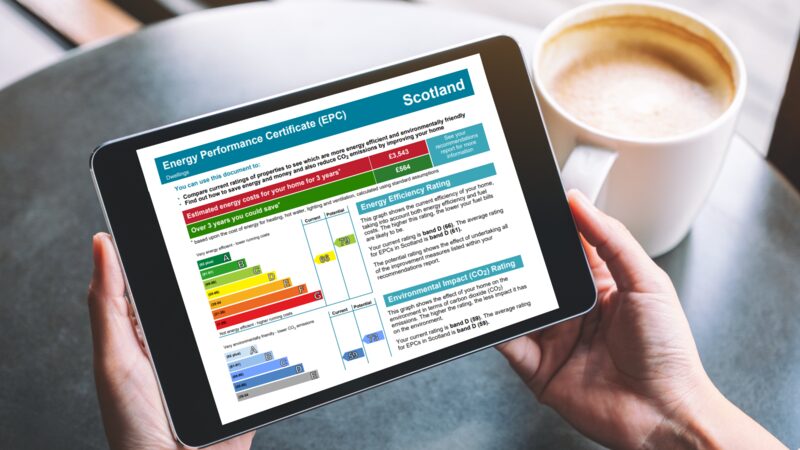
The starting point is the Energy Performance Certificate. It explains how energy efficient a building is and how it could be improved, and it comes with a report setting out cost effective measures such as low energy bulbs or upgrading insulation4. Each EPC is valid for 10 years and can be used multiple times during that period4. The landlord must provide it, at no cost to the prospective tenant4.
The legal floor for rented homes in England and Wales is EPC band E. A property rated F or G must be improved to at least an E before it can be rented out, and landlords may not grant a tenancy to new or existing tenants at F or G unless an exemption applies5. The direction of travel is upward: the government has confirmed privately rented homes in England and Wales must reach a minimum EPC rating of C by 1 October 2030, where an EPC is required.
What a renter can and cannot change
The dividing line is between the tenancy and the building. Anything that touches the structure, the heating system or the metering arrangement is a matter for the landlord; anything that is behaviour, appliances you own, or a supplier contract in your name is yours.
If you pay the energy bills, you can choose to switch your supplier or tariff at any time1. That is a genuine lever on cost and on where the electricity comes from, and it does not require permission. Smart meters sit closer to the line: official guidance states you can apply for one if you are renting, are a prepay customer, or if the meter is located outside your property, such as flats with communal meter boxes2. The same guidance adds that if you rent your home, the position on changes is one to discuss with your landlord, as each meter may form part of your tenancy agreement2.
At the start of a tenancy, the landlord or letting agent must provide a copy of the How to rent guide, a gas certificate if there is gas supplied, and an Energy Performance Certificate9. Those documents are the tenant's baseline record of what the property is and what it costs to run.
The regulations themselves do not cover every letting. They apply only to properties let on assured, regulated and agricultural tenancies that are legally required to have an EPC, and there are exceptions for listed or officially protected properties where the requirements would unacceptably alter them, temporary buildings used for two years or less, places of worship, low-energy industrial sites, workshops or non-residential agricultural buildings, detached buildings under 50 m2 total floor space, buildings occupied less than four months a year with expected energy consumption under 25% of all-year use, properties due for demolition with consents, and certain HMOs not sold or let as a single rental in the past ten years5. Private, local authority and other public body landlords are all covered, as well as a tenant who sub-lets a property falling within scope5.
For a household's independence, the position is mixed. A tenant controls consumption, tariff and supplier, which is real. A tenant does not control the fabric, the heating system or whether the home ever gets a heat pump, and that is the dependence that remains.
Start with the EPC: your home's efficiency report
Looking at your Energy Performance Certificate is a good starting point to help improve the energy efficiency of your property10. An EPC provides an assessment of your home's energy efficiency, and it explains how energy efficient a building is and how it could be improved11. With each EPC is a report that sets out the cost effective measures that homeowners or businesses can take to improve the energy efficiency and energy rating, such as low energy bulbs or upgrading insulation4.
That report is the document to work from, because it is specific to the property rather than generic. It tells a tenant which measures the assessor considered worthwhile, and it gives the landlord a defensible list to act on. For a renter, the practical move is to read the recommendations and separate them into three groups: things you can do yourself, things that need the landlord, and things that are already covered by a grant.
The certificate is the landlord's to provide. Where a building is being rented, it is the responsibility of the landlord to provide the EPC to the potential tenant, and the owner or landlord must make sure they have an EPC, make it available to potential buyers or tenants, and give a copy to the new owner when selling4. The EPC should be made available at no cost, and if you buy the property you will be given a copy by the seller that can be reused within the period of validity4.
Where a building is leased to an agency which then rents it on to its own tenants, responsibility for the EPC depends on the contract between the building owner and the agency12. That is worth knowing if you rent through a managing agent and cannot get a straight answer about who holds the certificate.
Scotland is changing the instrument itself. A new EPC rating system for domestic buildings will give clearer information on the fabric energy efficiency of a property, the emissions, efficiency and running costs of its heating system, and the cost of energy to run the home to standardised conditions13. The Scottish Government is also reducing the validity period of EPCs from ten to five years14. For a Scottish tenant, that means the certificate you are handed may be more informative and shorter-lived than the one a tenant in England receives.
No-cost habits that cut energy use

Behaviour is the one category of saving that needs no permission, no capital and no landlord. It is also the category with the clearest evidence of what households actually do when bills rise. In a period running from 22 November to 4 December 2022, 63% of those who reported a rise in the cost of living said they were using less energy in their home and 28% reported making energy efficiency improvements at home15.
Those two numbers describe different things. Using less energy is a habit: shorter showers, washing cooler, heating fewer rooms, switching off at the wall. Making improvements is a change to the property or its equipment. The first is available to every tenant immediately; the second usually is not.
Energy suppliers themselves offer advice on more efficient use of energy that could help you to cut your bills16. That advice is free and does not depend on tenure. Ofgem publishes guidance on getting help if you cannot afford your energy bills, which is the route to take when the problem is affordability rather than efficiency17.
The limit of habit is that it cannot change the building. A tenant can reduce the hours the heating runs, but cannot stop a solid wall losing heat. Habit lowers the bill on the home you have; it does not change the home. That distinction matters when deciding whether to spend effort on behaviour or on persuading a landlord to act.
For a household's independence, habits are the most portable asset a renter has. They survive a move, they need no consent, and they reduce exposure to whatever the price cap does next. What they do not do is reduce the amount of energy the building demands in the first place.
Low-cost measures that do not need landlord permission
The measures a tenant can take without asking are the ones that travel with the tenant or attach without altering the property. Draught-proofing around doors and windows, secondary glazing film, radiator reflector panels, cylinder insulation where a cylinder is accessible, LED bulbs, and appliance choices are all in this group. None of them requires a change to the structure, and none of them needs the landlord's signature.
The planning position supports this. Permitted development guidance is intended to help householders know which energy efficiency and renewable energy measures can be installed without the need to submit a planning application18. That is about planning consent rather than a tenancy agreement, but it establishes that a range of small measures sits outside formal approval processes. A tenancy agreement can still be stricter than planning law, so the agreement itself is the document that governs.
The evidence on what tenants actually install is thin, because most schemes are aimed at owners. The Scottish Private Rented Sector Landlord Loan Scheme provides private registered landlords with interest free and low interest loan funding to enable them to invest in improvements, and by October 2025 it had supported landlords to install over 350 energy efficiency and clean heating or renewable measures14. An earlier progress report recorded that since 2020 the scheme had supported landlords to install over 300 energy efficiency and 34 renewables or clean heat measures19. Those are landlord-side installations, not tenant ones, but they show the volume of work that flows through a rented property when funding exists.
The honest limit is that low-cost tenant measures are small. They reduce waste, not demand. A household that draught-proofs a leaky flat will feel the difference on a windy day, but the EPC rating will not move, and the heating system will still be whatever the landlord installed.

What needs your landlord's agreement
Anything fixed to the building, anything that changes the heating or hot water system, and anything that alters the meter arrangement needs the landlord's consent. The schemes that fund this work say so explicitly. Under the Affordable Warmth Scheme, a private tenant must have the landlord agree to the energy efficiency measures being carried out, and the landlord must pay 50% of the total cost of the energy efficiency measures to improve their property3. Under the proposed Warm Healthy Homes Fund, a private tenant needs the landlord's consent for work to be carried out on the property, and the landlord must be registered on the Landlord Registration Scheme20.
The counterweight is that a landlord cannot simply refuse everything. Landlords must not unreasonably refuse tenant requests for energy efficiency improvements funded at no cost to the landlord, for example through grants or third-party funding5. That is the lever a tenant has: find a scheme that covers the cost, and the refusal has to be reasonable.
There is also a consent exemption written into the regulations. Regulation 31 provides that regulation 23 does not apply at any time when the landlord has, within the preceding five years, been unable to increase the energy performance indicator for the property to not less than the minimum level of energy efficiency as a result of the tenant refusing consent to any relevant energy efficiency improvement21. A parallel provision covers regulation 27, and adds third party consent being refused or granted subject to a condition with which the landlord cannot reasonably comply21. In plain terms, a tenant who blocks an improvement can leave the property outside the minimum standard for five years.
The Energy Act 2011 minimum energy efficiency standard was framed subject to there being no upfront financial cost to landlords8. That principle runs through the current regime: the landlord's obligation to improve is bounded by what can be funded without them paying up front, and the cost cap for F and G properties is £3,5007. Landlords are not required by these regulations to carry out improvement works12.
Where a tenant has a right to renew under the Landlord and Tenants Act 1954, non-compliance cannot be used as justification for refusing renewal or terminating the lease early5. That protects a tenant who has pressed for improvements from losing the tenancy as a result.
Grants and schemes: who qualifies when you rent

Renting does not automatically exclude a household from grant funding, but it usually adds a consent condition. The pattern is consistent across the four nations, with different schemes and different rules.
ECO4 Flex is the clearest example. Under ECO4, obligated energy suppliers are required to reduce heating costs for low income and vulnerable households by funding energy efficiency, insulation and heating measures23. To benefit from ECO4 Flex, you must own your own home or have the permission of your landlord23. ECO4 is set to end on 31 December 2026, so the window is closing.
In Northern Ireland, the grants are available to homeowners and private tenants24. The Affordable Warmth Scheme allows tenants who privately rent from a landlord and who satisfy the eligibility criteria to apply to the scheme with agreement, and the landlord must agree to pay half the cost of the energy upgrades20.
In Scotland, the Energy Efficient Scotland Area Based Scheme requires you to be a homeowner or a privately rented landlord or tenant and to be in Council Tax Band A, B or C25. The Private Rented Sector Landlord Loan Scheme provides private registered landlords with interest free and low interest loan funding to enable them to invest in improvements and install clean heating systems14.
In England, the Bristol Bright Green Homes scheme is available to homeowners and those in private rented accommodation26. The Leeds Home Upgrade Grant scheme covers homeowners, renters, and landlords of properties without gas central heating19. The Green Homes Grant voucher scheme provided grants to homeowners and landlords to make energy efficient improvements to homes in England14.
| Nation | Scheme | Tenant position |
|---|---|---|
| England and Wales | ECO4 Flex | Own the home or have the landlord's permission23 |
| England | Bright Green Homes (Bristol) | Open to private rented accommodation26 |
| England | Home Upgrade Grant (Leeds) | Open to renters without gas central heating19 |
| Scotland | Energy Efficient Scotland Area Based Scheme | Privately rented tenant, Council Tax Band A, B or C25 |
| Northern Ireland | Affordable Warmth Scheme | Private tenant may apply with landlord agreement; landlord pays half3 |
The practical consequence is that a tenant's route to a grant almost always runs through the landlord. A tenant who wants insulation or a heating upgrade needs to bring the landlord a scheme that covers the cost, because that is what makes a refusal unreasonable.
Minimum EPC ratings for rentals, now and ahead
The current standard in England and Wales is band E or above. The minimum standard of energy efficiency of certain domestic rented property is a rating of E or above, and landlords of domestic private rented properties, including public sector landlords, may not grant a tenancy to new or existing tenants if the property has an EPC rating of band F or G, unless an exemption applies5. Guidance for landlords sets out how to comply with the 2018 Minimum Level of Energy Efficiency standard, which is EPC band E6. No property which has not at least got an Energy Performance Certificate rating of E or above can be rented out unless an exemption applies, and if the property's rating is F or G then it must be improved to at least an E7.
The exemptions are registered and searchable. The private rented sector energy standards exemptions register exists to find private rental properties that are registered as exempt from the minimum standard of energy efficiency27. A tenant in a property rated F or G can check whether an exemption has been lodged.
The future standard is C. The government has confirmed privately rented homes in England and Wales must achieve a minimum EPC rating of C by 1 October 2030, where an EPC is required. The 2025 consultation sets out transitional recognition: private rented homes graded C or above against the Energy Efficiency Rating on EPCs before 1 October 2029 are recognised as compliant, and properties with a current EPC C are recognised as compliant under the future standard until the EPC expires22.
Scotland is moving on a different track. The Energy Performance of Buildings (Scotland) Regulations 2025 come fully into force on 31 October 2026, having been partially in force from 1 January 2026. The Scottish Government has also set out a new EPC rating system covering fabric energy efficiency, the emissions, efficiency and running costs of the heating system, and the cost of energy to run the home to standardised conditions13.
For a tenant, the 2030 date is the one that matters. It creates a deadline by which a landlord has to act, and it gives a tenant a reason to ask now rather than later, because the work will have to happen at some point.
Where to get free help: Citizens Advice and Home Energy Scotland
Free, impartial advice is available in every nation, and it is the correct first stop when the problem is understanding what applies rather than buying something.
Citizens Advice offers information and support on a range of topics, including struggling to pay bills, problems with your energy supplier or energy supply, saving energy at home, and getting a better energy deal17. In England and Wales, the telephone number is 0808 223 1133, with a Welsh language line on 0808 223 1144, open Monday to Friday, 9am to 5pm28. In England, you can also call 0808 144 884417. In Northern Ireland, nidirect sets out advice if you are struggling to pay your energy bills16.
In Scotland, Home Energy Scotland, funded by the Scottish Government, provides free and impartial advice and support to help you stay warm and reduce bills, and acts as the referral partner for Area Based Scheme eligibility enquiries25. In Wales, Nest provides free, impartial energy advice to help you lower your energy bills and improve your health and wellbeing29.
These services are the ones that can tell a tenant what their landlord is obliged to do, what funding exists, and how to escalate a property that is below the minimum standard. They are funded by government and independent of any installer or supplier, which is why they are the right starting point rather than a sales visit.

Sources29 cited
- Switch your home energy supplier, Ofgem, 2026
- How to get a smart meter, Smart DCC, 2026
- Affordable Warmth Scheme, Northern Ireland Housing Executive, 2026-09-17
- Energy Performance Certificates, nidirect, 2026-02-26
- Trading standards guidance: other consumer problems, Isle of Anglesey County Council, 2026-05
- Minimum energy efficiency standards, Carmarthenshire County Council, 2026-09-20
- Minimum energy efficiency standards, Planning Portal, 2026
- CCC assessment of recent announcements and developments on net zero, Climate Change Committee, 2023-10-12
- Landlord and tenant rights and responsibilities in the private rented sector, UK Government, 2019-04-09
- Low carbon heating, nidirect, 2026-09-17
- Solar photovoltaic (PV) panels, London Borough of Bromley, 2026-09-17
- Energy Performance Certificates: buildings for let, Scottish Government, 2023-11-29
- Reforming energy performance certificates, Scottish Government, 2025-01-21
- Heat in buildings progress report 2025, Scottish Government, 2025-10-02
- Energy efficiency and the cost of living, House of Commons Library, 2022-11-22
- Advice if you're struggling to pay your energy bills, nidirect, 2026-09-17
- Get help with your energy bills, Ofgem, 2026-09-17
- Permitted development checklist, Bath and North East Somerset Council, 2015-01
- Heat in buildings progress report 2024, Scottish Government, 2024-10-10
- Warm Healthy Homes Fund consultation, Department for Communities, 2026-05
- The Energy Efficiency (Private Rented Property) (England and Wales) Regulations 2015, regulation 31, legislation.gov.uk, 2026-09-17
- Improving the energy performance of privately rented homes: 2025 update, UK Government, 2025-02-07
- ECO flexibility funding, Ceredigion County Council, 2026-09-17
- Home heating, Belfast City Council, 2026-09-20
- Home energy efficiency, Argyll and Bute Council, 2026-09-17
- Get a grant or loan to improve your home energy efficiency, Bristol City Council, 2026
- View private rented sector energy standards exemptions, UK Government, 2026-05-05
- Consumer protection rights, UK Government, 2026-09-17
- Energy price cap explained, Climate Action Wales, 2026-03-04
 Rented Homes and Landlord MetersWho is responsible for the energy in your rented home?
 Renting and Home EnergyThe position of a tenant in a privately rented home: which measures need no permission, which are fixtures the landlord controls, and what the law says about heating, insulation, certificates and bills across the four UK nations.
 Landlord Energy PermissionHow a tenant raises a request for insulation, heating, glazing or ventilation work in a rented home, what the EPC and the minimum band E rule mean, which grant schemes need landlord consent, and what happens when a landlord refuses.
 Controls in Rented HomesCan you change the heating controls in a rented home, and who pays if they break?
 Monitoring in Flats and RentalsCan you get a smart meter in a rented flat, and who decides?
 Social and Rented Home StandardsWhat condition is your landlord legally required to keep your home in?