
In this guide
If you rent a flat and the energy bill is in your name, the smart meter is your decision, not your landlord's. You can choose to have one installed, and you do not need to seek permission. It is worth telling your landlord before the change, and worth reading the tenancy agreement, because some leases contain rules about how energy is supplied, including the type of meter that can be installed1.
The installation itself is free at the point of fitting, takes about 90 minutes in a typical home, and comes with an in-home display that shows near real-time energy use4. Where the meter sits in a communal cupboard or basement, or where the building is older, the supplier may take longer to reach you, and the appointment may need access arrangements that a house would not2.
What follows is the position for renters and flat dwellers specifically: who decides, what the display does, what happens when it fails, what you can and cannot take with you when you move, and how prepayment changes the picture. The limits matter as much as the rights. A smart meter does not make a flat independent of the grid, the supplier or the building's shared infrastructure, and in some blocks it cannot be fitted at all without changes to the communal metering arrangement.
Tenants can have a smart meter if the bills are in their name
The rule is simple and it turns on who pays. If you are a private renter and the energy bills are in your name, or you prepay for your energy, you can choose to have a smart meter installed, after checking the tenancy agreement and letting the landlord know1. If your energy bill is in your name, it is your choice to have a smart meter installed2. The bill payer at the property ultimately makes the decision, so if you pay the bills, you can request one3.
If the bill is in your landlord's name, it is their decision6. Where the landlord pays the energy bills for the home, it is their decision whether or not to install a smart meter2. Renters whose bill is not in their name need to consult their landlord4.
Where a lease requires landlord permission to change the meter, Ofgem, the energy regulator, says a landlord should not unreasonably prevent this2. That is the key protection for a tenant whose agreement contains a clause about metering. It does not override the lease, but it sets an expectation about how such a clause is applied.
"If your lease says that you need your landlord's permission to change the meter, Ofgem, the energy regulator, says they shouldn't unreasonably prevent this."
The practical sequence for a renter who pays the bills is short. Check the tenancy agreement for any clause on metering or energy supply. Tell the landlord what is planned. Then book with the supplier. Guidance for renters who pay the bills recommends telling the landlord before getting one3.
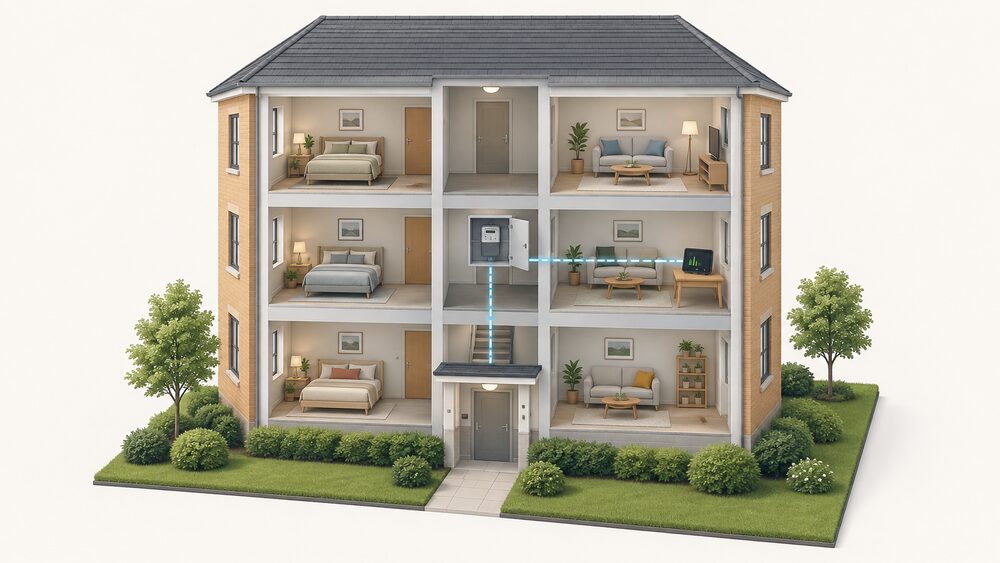
There is a wider right behind this. Any household that pays for energy, whether owning or renting, should be able to book a smart meter installation where it is expected to work in the property5. That includes renters, prepay customers, and homes where the meter is located outside the property, such as flats with communal meter boxes4.
What a smart meter and in-home display give you
A smart meter sends meter readings automatically to your energy supplier, so you do not have to read the meter yourself, and it offers real-time monitoring through an in-home display4. With every smart meter installation, the customer is provided with an in-home display7. Everyone who gets a smart meter installed will be provided with one10.
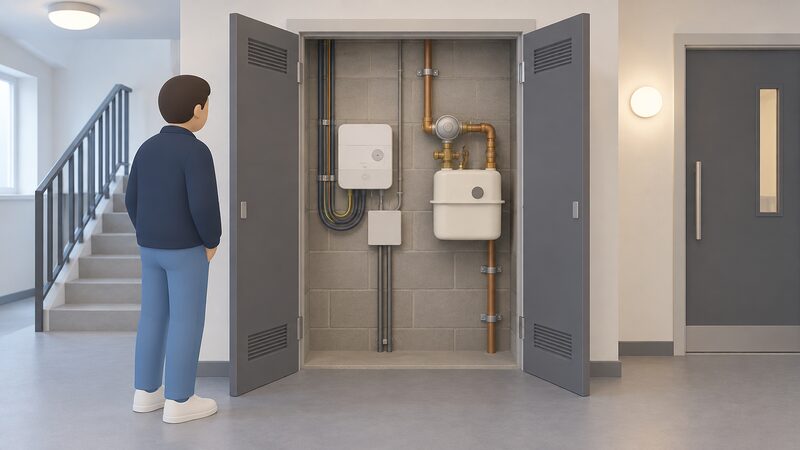
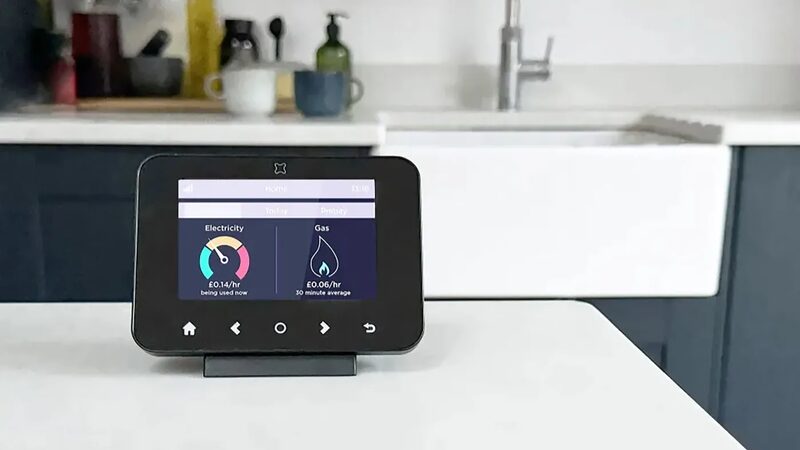
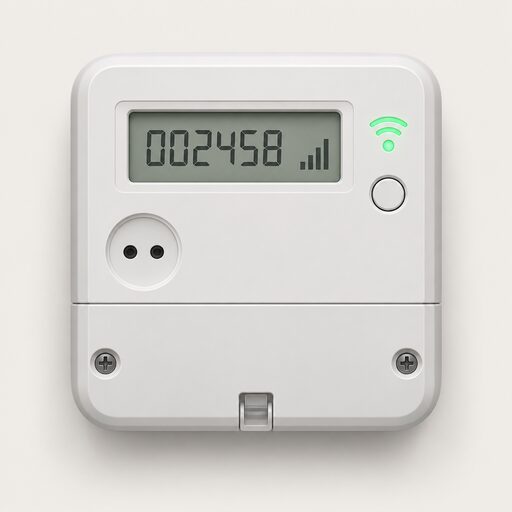
The display is a portable touchscreen device that shows near real-time energy usage data11. It shows how much energy you are using during the day12. Equipped with an in-home display screen, smart meters help you monitor and manage your energy consumption4.
The data the meter carries does more than feed the display. It is used to bill you for the energy you use, to offer new products and services such as new tariffs where you have given permission, and to help make the energy system more efficient by recording demand more accurately14.
For a flat dweller, the display is the part that matters most day to day, because it is the only element of the system that lives inside the home. The meter itself may be floors away in a communal cupboard. The display is what turns an inaccessible meter into something a household can actually read and act on.
Prepay or credit: how the display changes with how you pay
Smart meters can be either prepayment, also known as pay as you go, or for people who pay by direct debit or another billing schedule10. A smart meter offered to a prepayment customer works in prepayment mode rather than credit mode6.
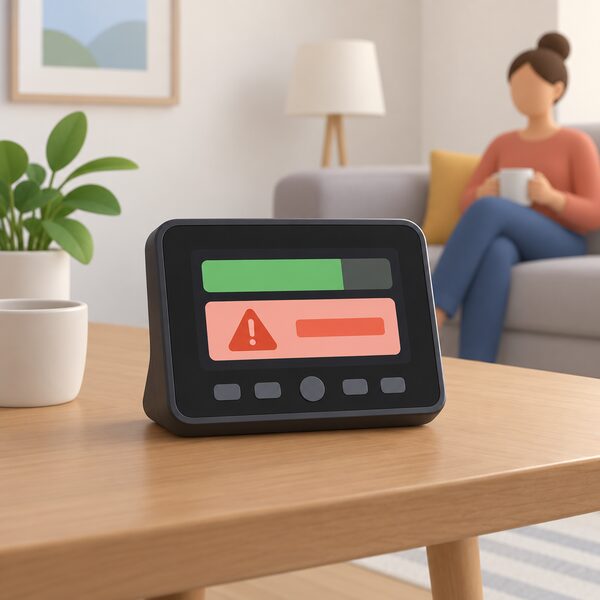
In prepayment mode the display carries more information. It shows the price of your tariff, your credit balance, and whether there is any debt on the account, and it alerts you when credit is low10. That is a meaningful difference for a renter on a prepay meter, because the balance and the debt position are visible in the home rather than only at the meter or through a supplier app.
Prepayment itself means paying in advance rather than after use15. With a traditional prepayment meter you use a smart card, key or token, or sometimes coins, to pay for gas or electricity as you use it16. A smart prepayment meter changes the top-up method: credit can be added automatically or without having to visit a shop, and top-up can be done online or using a supplier's mobile app17. The in-home display shows the tariff price, the credit balance, any debt on the account, and alerts when credit is low5.
There is a further advantage for renters in receipt of support. Government or energy supplier support can be added to a smart prepay meter automatically, without needing a voucher through the post2. For a tenant who has moved recently, or who has had post go astray at a shared address, that removes a common failure point.
Cost: free at the point of installation, with rare exceptions
You can get a smart meter installed by your energy supplier at no extra cost4. Smart meters are completely free, and there is no upfront charge for the installation6. Getting a smart meter installed is free for UK energy customers20. Contact your supplier to get a smart meter for free12.
That is the position for the meter and its installation. The costs that can arise later are narrow and specific, and they concern the display rather than the meter. After 12 months, your energy firm does not have to repair the monitor and can charge you for a new one8. Where a replacement is bought, the expected cost of a new in-home display is in the region of £30 to £508.
| Item | Cost position | Source |
|---|---|---|
| Smart meter installation by the supplier | At no extra cost | 4 |
| Upfront charge for installation | None | 6 |
| In-home display repair within 12 months | Free of charge, if not customer damage | 1 |
| Replacement in-home display after 12 months | £30 to £50 expected | 8 |
There is no published price for a smart meter itself, because it is not sold to households. The meter is supplied and fitted under the supplier's rollout obligations, and the household does not receive an invoice for it. Where a landlord or a managing agent proposes any charge for a meter exchange in a rented flat, that is not a charge the sources describe.
Blocks of flats and older meters: where installation can be harder
Many homes can upgrade to a smart meter right now, but where you live, the type of home you live in, and the age and type of your existing meter may mean that your energy supplier will take a little longer to get yours to you4. The same conditions are described for rented houses and blocks of flats2.
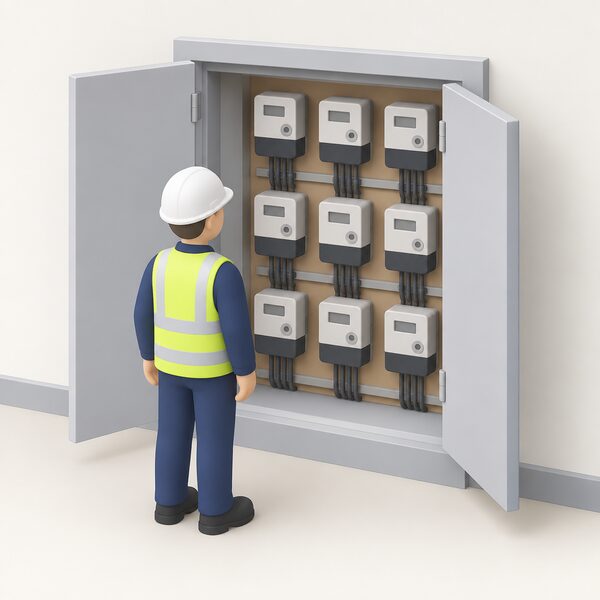
The reasons are structural rather than administrative. A flat may have its meter in a communal cupboard, a basement or an external bank of meters, and the engineer needs access to that location as well as to the flat. Older metering arrangements may not match the standard installation. Older meters may not switch easily between suppliers or give access to future data services such as advanced time of use tariffs6.
There is also a contractual layer in rented homes. There might be rules in your contract about how energy is supplied, including the type of meter that can be installed4. That does not prevent an installation where the tenant pays the bills, but it is the reason the tenancy agreement is worth reading before booking.
For a household in a block, the independence question is sharper than for a house. The meter may be physically outside the home, the communications hub may be in a shared riser, and the display is the only part of the system the household controls. That is workable, but it means the flat's energy monitoring depends on the building's infrastructure as well as the supplier's.
Living with an in-home display: what it shows and what it costs to run
The display shows how much energy you are using during the day12. It is a portable touchscreen device showing near real-time usage data11. In prepayment mode it also shows the tariff price, the credit balance, any debt on the account, and alerts when credit is low10.
The display does not need the home's broadband. With every smart meter installation, the customer is provided with an in-home display7, and the meter communicates over its own network rather than over Wi-Fi. That matters in a rented flat where the broadband account belongs to the tenant and may change, or where there is no fixed line at all.
Running costs are not a feature the sources describe in detail. The display is a small mains-powered device, and no figure for its electricity consumption appears in the guidance. What is documented is the replacement cost if it fails outside the warranty window: £30 to £50 expected for a new one8.
For a renter, the display is also the main route to appliance-level understanding without any installation at all. Fitting reflectors behind radiators on external walls is one low-cost measure suggested for renters2. The display shows the effect of that kind of change immediately, which is the point of having it in the home rather than at the meter.
When the display stops working: faults, fixes and the 12-month rule
If your smart meter stops working, contact your supplier. They are responsible for maintenance and will fix or replace your meter as needed4. Energy suppliers are required to maintain smart meters for 12 months after installing them6.
The display has its own rule. If you report a fault with the in-home display within 12 months of the date of installation, and your supplier is satisfied that it is not due to your failure to keep it in good working order, the supplier must repair or replace it free of charge1. If you have had your smart meter monitor for less than 12 months and it has broken or is not working as it should be, the supplier should fix or replace it free of charge under Ofgem rules, though you may pay if you damaged it8. After 12 months, your energy firm does not have to repair it and can charge you for a new one8.
There is a compensation rule behind the reporting process. If the supplier does not tell you how it plans to resolve a reported smart meter problem within five working days, it owes you £40 compensation, under new rules from energy regulator Ofgem8.
A separate standard covers meters that stop operating in smart mode. If a consumer's smart meter is not operating in smart mode for over 90 days, due to an issue within the energy supplier's control to resolve, that triggers the Guaranteed Standards21. Ofgem intends to review the outcomes of these standards in the first quarter of 202721.
Moving out: the display stays with the property
After you move out, you leave your in-home display in the property, as it will be connected to that property's smart meter2. If you have a smart meter, leave the in-home display unit there for whoever will be moving in22. Leave your in-home display behind: it is designed to work with the smart meter installed at that property10.
This is the single most common misunderstanding among renters. The display is paired to the meter at the address, not to the person or the account. Taking it to a new flat leaves you with a device that cannot see the new meter, and leaves the next occupant without one.
The meter itself also stays. What travels with you is the account, not the hardware. If you are moving to another rented property, the position on getting a smart meter there is the same as it was at the old one: if the bill is in your name, it is your choice2.
Prepayment meters: top-ups, emergency credit and switching limits
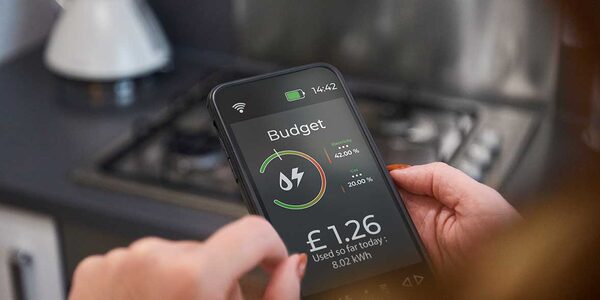
Smart prepayment changes how a renter tops up. You can top up online, on the go or at home2. The prepayment service allows consumers to add credit to their meters through an over-the-air top-up over the network16. If you have a smart prepayment meter, you may be able to top up online or using your supplier's mobile app17.
Switching between payment modes is also easier than it once was. Switching from an existing gas or electricity prepay meter to a smart credit meter is straightforward for customers who want to4. Whether you are on a prepayment plan or renting, you can benefit from a smart meter4.
Where a supplier installs a prepayment meter without permission, the rules are specific. Your supplier can get a warrant to enter your property and install a prepayment meter, or remotely switch your existing smart meter to prepayment mode9. Your supplier must give you £30 credit once it has installed the meter or remotely switched your existing meter to prepayment mode9.
Switching supplier with a smart meter is possible, with a caveat. You can switch suppliers if you have a smart meter, but your new supplier might not offer all the smart meter services such as remote meter readings, and the meter may need replacing25. For a renter, that is a reason to check the position before switching, particularly where the meter is in a communal location and a replacement visit would need building access.
Where to get free help: Citizens Advice and national services
Free advice exists and it is worth knowing where it sits, because the questions that follow a smart meter problem are often about money rather than metering.
In Wales, Nest can be called free on 0808 808 2244, Monday to Friday from 9am to 6pm, or you can request a callback online26. In Northern Ireland, NI Energy Advice is on freephone 0800 111 445527. Local Energy Advice Programme services offer a free telephone advice service to help with benefits, money and bill problems28.
On the metering side, the Data Communications Company has worked with Citizens Advice to provide a tool that allows you to check if your smart meter has been migrated onto the network18. That is relevant to renters in older blocks, where a first-generation meter may have been installed years ago and may not have been upgraded.
There is also a legislative layer reaching into rented homes. Under the ECO4 scheme, advice on the benefits of using a smart meter includes guidance on arranging installation and an invitation to make a non-binding pledge to arrange installation, for measures where installation is completed on or after the Order coming into force29.
For a household in a flat, the practical route is: supplier first for anything to do with the meter or display, because the supplier is responsible for maintenance4; then the national advice services for the money questions that sit alongside it.
Sources29 cited
- Smart meters, Energy Ombudsman, 2026-09-20
- Smart meters for renters, Smart Energy GB, 2026-03-16
- Guide to smart meters, Energy Saving Trust, 2026-07-15
- Smart meters, Welsh Government, 2026-03-16
- Smart meters: your rights and expectations, GOV.UK, 2025-08-08
- How to get a smart meter, Data Communications Company, 2026
- Does a smart meter need Wi-Fi?, Data Communications Company, 2026
- Smart meter problems and solutions, Which?, 2026-08-24
- Installing a prepayment meter without your permission, Ofgem, 2026
- Understanding smart meters, National Energy Action, 2026-04-21
- Smart meters and decarbonisation, Data Communications Company, 2026
- Getting a smart meter, Ofgem, 2026
- Get help with your smart meter, Ofgem, 2026
- Get help with your smart meter, Ofgem, 2026-09-17
- Prepayment meters: consumer guidance, Ofgem, 2026
- Overdue utility bills, nidirect, 2026-09-17
- Get help with your prepayment meter, Ofgem, 2026
- Do you have to have a smart meter by law?, Data Communications Company, 2026
- How accurate are smart meters?, Data Communications Company, 2026
- Does a smart meter save money?, Data Communications Company, 2024
- Smart Meter Guaranteed Standards statutory consultation, Ofgem, 2025-08-08
- Moving house energy checklist, Energy Saving Trust, 2026-05-01
- Check energy suppliers can install prepayment meters without household permission, Ofgem, 2026
- Problems with services, Isle of Anglesey County Council, 2025-10
- Local Energy Advice Programme, Tameside Council, 2026-09-17
- Apply for Nest, Welsh Government, 2026
- Energy, Northern Ireland Housing Executive, 2026-09-17
- How do smart meters send readings?, Data Communications Company, 2026
- Upgrading Britain's first generation smart meters, Data Communications Company, 2026
 Controls in Rented HomesCan you change the heating controls in a rented home, and who pays if they break?
 Smart Meter Data and Who Sees ItWhat does your smart meter actually record, and who gets to see it?
 Meters and Energy IndependenceDo smart meters really save you money, and can you still get one fitted for free?
 The Full Smart Meters GuideDo smart meters really save you money, and how do you use one to cut your bills?
 Why You Cannot Get a Smart MeterWhy can some homes not have a smart meter fitted, and what counts as a good enough reason?
 Take Control of Your EnergyHow do you read your own energy use and keep hold of your meter readings?