
In this answer
Short answer
A smart meter does not need WiFi, broadband, a router or an internet package to send readings1. It communicates over its own secure data network, built solely for metering, which does not use the internet or home WiFi2. That single fact answers most of the confusion around smart meters and connectivity: the meter is not a device on your home network, and it never has been.
The practical consequence is that a household with no broadband at all can still have a fully working smart meter, with readings arriving at the supplier automatically at least once a month3. Nothing about billing, tariffs or the in-home display depends on your router being switched on. What the meter does depend on is a signal path to the outside world, and that path is made of mobile phone or radio masts rather than fibre or copper into your home4.
How smart meters actually send readings
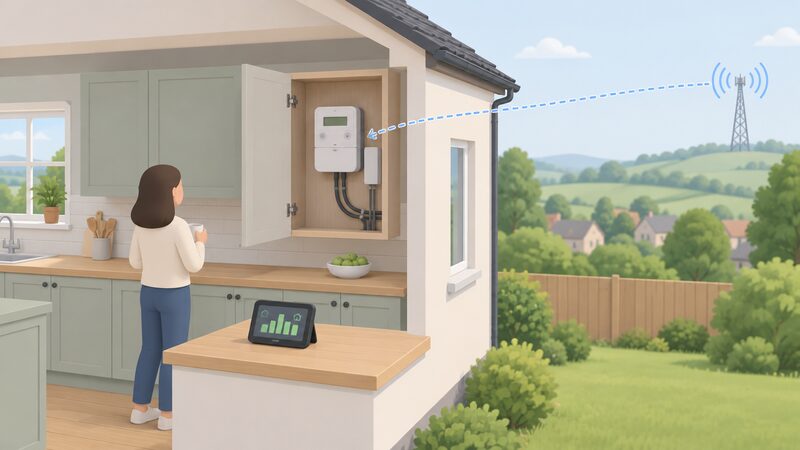
The meter talks to a wide area network made up of mobile phone or radio masts, and from there the reading travels to the supplier4. This is the Data Communications Company network, a closed system used only for metering. Smart meters do not use the internet, and they have their own closed, dedicated communications system6. The meter itself is defined in the industry conventions as a meter that communicates wirelessly with the meter network9.
That architecture explains why the reading arrives without anyone doing anything. With a smart meter you may no longer need to submit meter readings, because the meter sends them automatically and wirelessly to your supplier10. The same point appears in official guidance: households do not need to submit meter readings themselves11. The frequency is at least once a month, though many meters send far more often than that3.
For a household, this is the first layer of energy independence: the measurement of what you use no longer depends on you remembering to read a dial and type it into an app. It also does not depend on your broadband contract. The dependence that remains is on the meter network itself, which is operated centrally rather than by the household, and on the supplier receiving the data. If the signal path fails, the meter still measures and still displays, but the automatic reading does not arrive, and that is a fault to report rather than something a homeowner can fix.
What happens if your home WiFi or broadband goes down
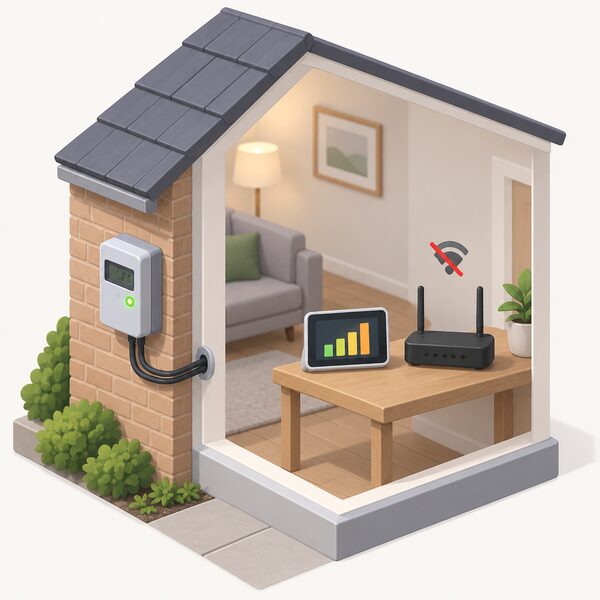
Nothing happens to the meter. A smart meter does not use your WiFi, connect to your router or affect your broadband speed1. If the broadband drops, the meter carries on measuring and carrying on sending readings over its own network. The in-home display does not need WiFi either, so it keeps showing usage through the outage5.
The one moment when the router genuinely matters is installation day, and only incidentally. During installation, the electricity supply is turned off for up to an hour, which means the WiFi router will be off during that time, but once it is switched back on the smart meter will not impact the WiFi connection5. There is no pairing step, no password to enter, and no app that must be connected before the meter will work.
Where a household does lose automatic readings, the cause is usually the meter's own signal rather than the broadband. Signal loss happens when the signal has to pass through the walls of a building, which is why a meter in a basement or an internal cupboard can struggle while one on an external wall does not12. The remedy sits with the supplier: if a smart meter stops working, the supplier is responsible for maintenance and will fix or replace it as needed13. For the household, the fallback is straightforward, since the meter can still be read manually and readings can still be submitted, as set out in our guide to what to do when a smart meter is not sending readings.
Smart meters and WiFi interference: what the evidence says
The claim that a smart meter interferes with home WiFi does not hold up. Because smart meters do not use WiFi, a smart meter should not cause any delays or issues with your WiFi connection5. The two systems operate on separate paths: the meter on its dedicated network, the router on the broadband line. There is no shared channel to congest.
The wider point about home connectivity is different, and worth separating. Guidance on smart homes advises checking that you have a strong WiFi and internet connection, because limited bandwidth may struggle to support multiple devices14. That is a statement about the number of connected devices in a home, not about the meter. A household running several smart plugs, cameras and a thermostat on one router can experience congestion, and the meter is not part of that count.
Smart meters also emit far less radiation than everyday devices. Emissions are much lower than other everyday devices such as your mobile phone, or your WiFi router15. The meter uses radio waves to send the information it collects to your supplier, and that is the extent of its transmission15.
"Smart meters do not use wi-fi to send your data; they use their own secure data network."
Mobile and radio signals: how coverage varies by location
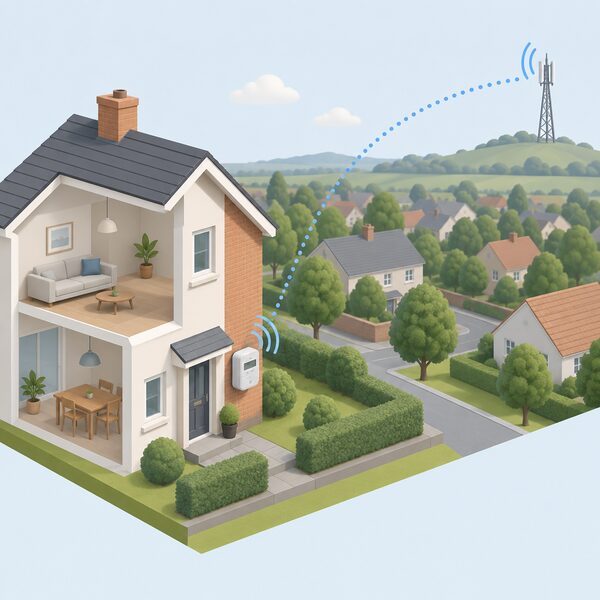
Coverage is the real variable, not broadband. The meter's reading travels from the home to a wide area network made up of mobile phone or radio masts, so the strength of that signal at the meter's position determines whether automatic readings arrive reliably4. Ofgem publishes performance statistics for suppliers with over 150,000 customers covering England, Scotland and Wales, which is where the systematic picture of coverage and reading success sits16.
In practice, the difference between a working and a struggling installation is often physical. Signal loss happens when the signal has to pass through the walls of a building12. A meter in a cellar, a basement flat or a metal-clad cupboard is at a disadvantage compared with one on an outside wall. This is a property of the building and the local mast network, not of the household's internet service, and it is why two neighbours on the same street can have different experiences.
Northern Ireland sits outside the Great Britain supplier performance reporting, and the smart meter programme there has followed its own path, which we cover in smart meters in Northern Ireland. Wales has its own public guidance on what a smart meter does, including that the meter automatically sends energy usage data to the supplier using a secure network13. Scotland is covered within the Great Britain statistics and within the same DCC network.
For a household, the honest position is that the meter's independence from your broadband is complete, but its independence from the mobile and radio network is not. That network is national infrastructure, operated centrally, and a household cannot substitute its own connection for it. The compensation is that a signal problem is a supplier's problem to resolve, not a cost the household carries.
Will my in-home display work if I have no internet?
Yes. The in-home display does not need WiFi to work5. It receives data from the meter over its own local link, so it continues to show usage during a broadband outage. An in-home display is also optional: you do not need to have one if you do not want to17. Households that prefer to see data in an app or on a computer can do so, and our guide to in-home displays covers what they show.
There is a warranty position worth knowing. If a smart meter display breaks or goes missing in the first 12 months, the household can get a free replacement from the energy supplier18. After that period, replacement terms are a matter for the supplier, and our page on broken in-home display replacement sets out the position.
The display is where the independence argument becomes tangible. It gives a household a live view of electricity and gas use without any cloud service, any app subscription or any broadband connection. That is a genuinely local device reading a genuinely local meter. What it does not do is control anything or store history in the way a connected home energy management system can, which is a different category of product.
Will my smart meter stop working when 2G and 3G are switched off?
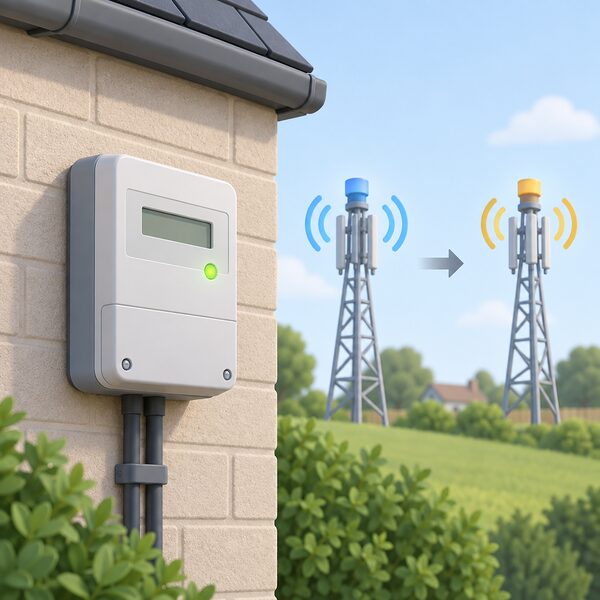
No. Following the 3G switch-off, smart meters switch seamlessly to the 2G network and continue to operate as normal7. The meter does not need replacing because a mobile generation is retired; it falls back to the network that remains.
The longer timetable is set out in government analysis. Mobile Network Operators are expected to close 2G and 3G services by the end of 2033, and the transition from 2G and 3G networks to 4G is treated as a separate technological upgrade from the original rollout19. That distinction matters for how the work is funded and reported, but for a household the practical effect is continuity of service rather than a deadline to act on.
Switching energy supplier is a separate question from the mobile network, and the answer depends on the meter generation. With a second-generation meter, a household can switch and keep all smart functions with no interruption, while a first-generation meter may lose some smart functionality5. Our guides to SMETS1 and SMETS2 meters and to switching supplier with a SMETS1 meter explain the difference.
Smart thermostats are different: where WiFi does matter
Everything above concerns the meter. A smart thermostat is a different device with a different dependency. A smart thermostat connects to WiFi, which allows it to form part of a more connected home heating system8. That connection is what enables app control, scheduling from a phone and integration with other connected devices. Without it, the thermostat may still control heating locally, but the connected features are what the household paid for.
The distinction between smart and merely wireless is worth holding on to. A wireless thermostat is not always smart; smart thermostats usually add app control, internet connectivity, automation or other connected features8. A wireless thermostat that simply talks to a receiver by radio is not dependent on the home network in the same way.
Installation is where this becomes practical. A lot of boilers are not WiFi-enabled, so many smart or wireless thermostat systems still include a wired element, and systems often include a receiver or hub that must be wired to the boiler, with wiring done by a trained professional8. Official guidance on one approved thermostat measure is explicit that the homeowner must already have a WiFi connection for it to be installed, while another uses GSM connectivity rather than WiFi20. That contrast shows the point plainly: for thermostats, connectivity is a design choice, and for meters it is not a requirement at all.
What the meter does and does not depend on
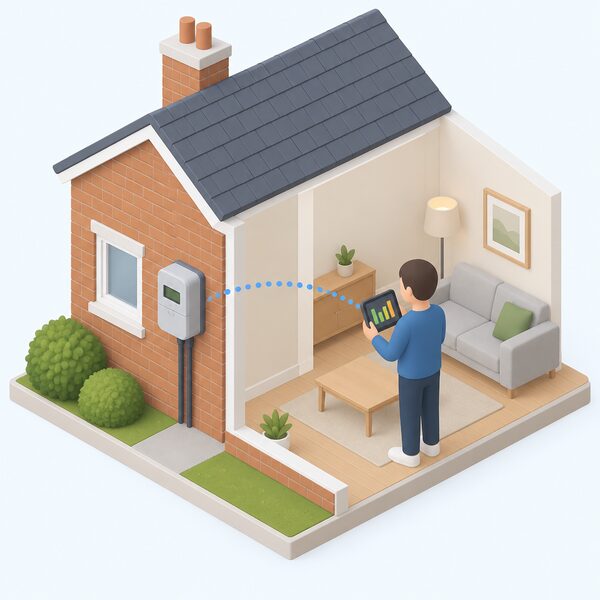
The meter's independence is real but bounded. It does not depend on your broadband, your router, your data allowance or your supplier's app. It does depend on the DCC network, on mobile and radio coverage at the meter's position, and on the supplier maintaining the equipment. Data from the meter is used to bill for the energy used, to offer new products and services such as new tariffs where permission has been given, and to help make the energy system more efficient by recording demand more accurately11.
Control over that data sits with the household. You have control over who can access the energy use data from your smart meter, including how often and for what purpose, except where it is required for regulated purposes such as billing21. That is a meaningful degree of sovereignty over the information, even though the network itself is not household-owned.
Two limits are worth stating plainly. A smart meter will not automatically save you money, and it does not automatically save energy or money without practical changes to how energy is used22. And the meter is not a route to independence from the grid or from a supplier: it measures and reports, it does not generate or store. Where it does open a door is flexibility. A smart meter working in smart mode is needed to take part in flexible schemes, and a smart meter is needed for most flexible tariffs24. Smart meters are also needed to access most time-of-use tariffs25, and in most cases a smart meter plus a smart tariff is what allows a household to take part in flexibility26. Our pillar guide, Smart Meters and Home Energy Management, sets out how those pieces fit together.
Sources26 cited
- How do smart meters work?, Smart Energy GB, 2026-08-27
- Does a smart meter need Wi-Fi?, Smart DCC, 2026
- What is a smart meter?, Smart Energy GB, 2026-08-10
- How do smart meters send readings?, Smart DCC, 2026
- Smart meters and WiFi: does a smart meter need WiFi?, Smart Energy GB, 2026-03-16
- Protecting data on the smart meter network, Smart DCC, 2026
- Do smart meters use 3G?, Smart DCC, 2024
- What is a smart thermostat?, Smart Energy GB, 2026-08-19
- RDSAP Conventions v12, BRE Group, 2025-05-15
- Understanding your gas or electricity bill, Centre for Sustainable Energy, 2026-02
- Get help with your smart meter, Ofgem, 2026
- Smart meters not sending readings, Energy Ombudsman, 2023-07-31
- Smart meters, Welsh Government, 2026
- Smart homes, Electrical Safety First, 2026-09-19
- Smart meters and health, Smart Energy GB, 2026-03-16
- Smart meter performance, Ofgem, 2026
- How to read your gas meter, National Energy Action, 2026-07-13
- Understanding your home energy usage, ivie, 2026-09-20
- Smart Metering 2025 Costs and Benefits Report, Department for Energy Security and Net Zero, 2025
- ECO4 innovation approved measures, Ofgem, 2026-02
- Smart meters: your rights and expectations, Department for Energy Security and Net Zero, 2025-08-08
- Getting a smart meter installed, Citizens Advice, 2026-09-17
- How carers could prepare for higher energy bills, Smart Energy GB, 2026-03-16
- Using energy flexibly, Smart Energy GB, 2026-04-14
- Time of use tariffs: the benefits, Smart Energy GB, 2026-04-24
- For homes, Flex Assure, 2026-09-19
 How Smart Meters CommunicateSmart meters send readings without using your home wifi or broadband, so they still work if your internet goes down.
 Smart Meter Faults and FixesYour smart meter has stopped working.
 Can a Smart Meter Be Hacked?Can someone break into your smart meter, see your personal details or switch off your power?
 The Full Smart Meters GuideDo smart meters really save you money, and how do you use one to cut your bills?
 Meters and Time-of-Use TariffsDo you need a smart meter for a time-of-use tariff, and does it have to send readings every half an hour?
 Zigbee, Matter, KNX and Wi-FiWill your smart thermostat and radiator valves keep working if the broadband goes down, and can gear from different brands talk to each other?