
In this guide
Northern Ireland has no smart meters installed yet. The region sits outside the Great Britain smart metering programme and outside the national communications network that carries smart meter data, so the meter in a Northern Irish home today is a traditional meter or a digital display meter fitted by NIE Networks under its routine replacement programme. A rollout is planned, and initial installations of smart electricity meters are expected to begin in early 2028.
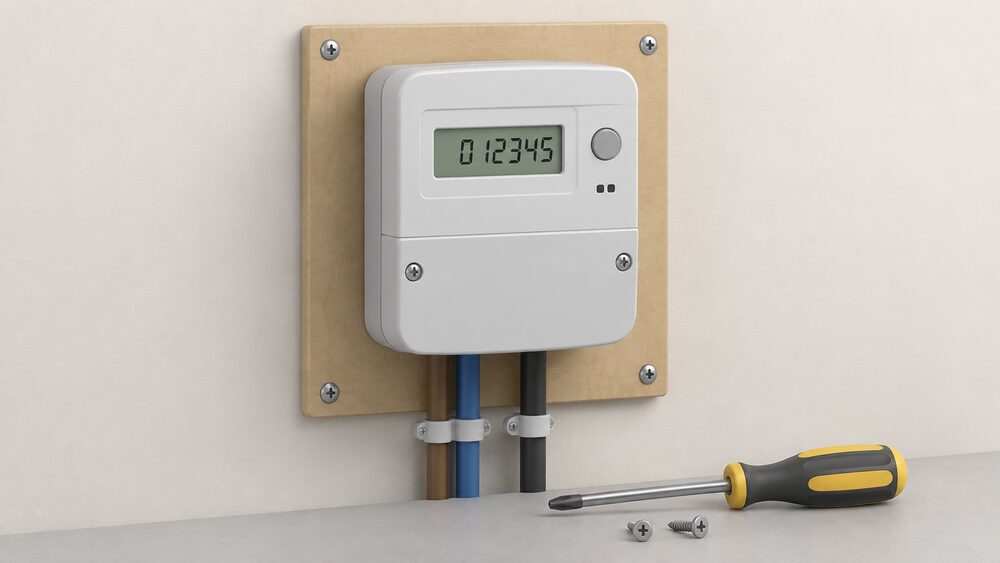
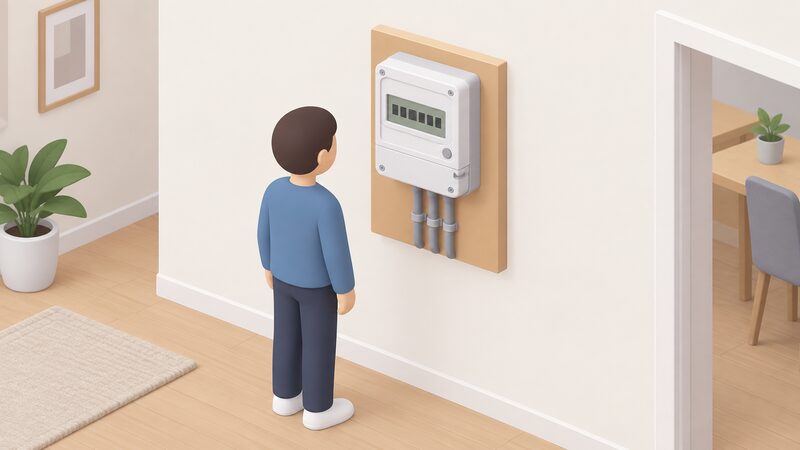
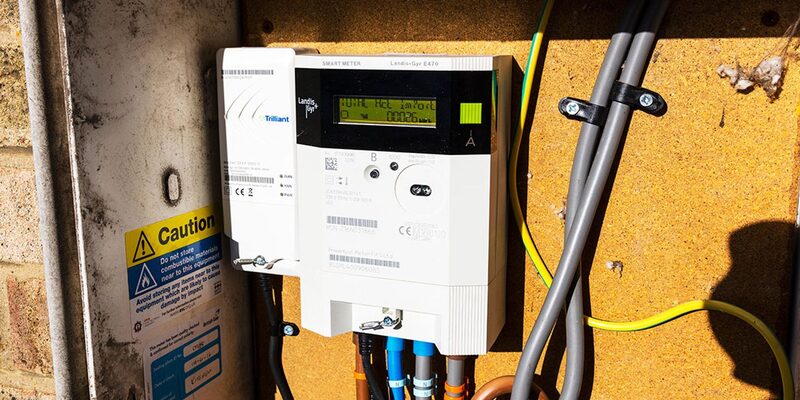
What is happening now is meter replacement, not smart metering. NIE Networks maintains the meters at the properties of all customers across Northern Ireland no matter who your supplier is, and it replaces all types of domestic and commercial meters after a prescribed period of time1. The meters being installed under that programme are digital display meters approved to European Standards, not smart meters1. They give a clear digital readout and nothing more: no two-way communication, no remote reading, no time of use tariffs.
The practical consequence for a household is that the monitoring and tariff options built on smart metering are not available yet. There is no in-home display from a supplier, no half-hourly data, and no route into demand flexibility schemes that depend on a smart meter. What a household can do in the meantime is monitor consumption with standalone equipment, which is covered on our pages on home energy monitors and consumer access devices.
No smart meters are installed in Northern Ireland yet, but a rollout is planned
The gap between Northern Ireland and the rest of the UK is structural rather than a matter of pace. Great Britain's smart metering programme was built around a central communications body and a national network, and Northern Ireland was not part of that design. The result is that a household in Belfast or Derry cannot ask a supplier for a smart meter in the way a household in Manchester can, because the infrastructure and the regulatory framework that would support it are not in place.
The plan, when it comes, is not being written from scratch. The Republic of Ireland has run a rollout that reached 1.8 million smart meters installed to date out of around 2.4 million total meters, and the phased approach there avoided situations where someone's neighbour receives a smart meter but they cannot, because of different suppliers2. A checkpoint review after the first phase informed the next phase's activities, considering legislative and regulatory changes, customer sentiment, adoption rates and changes in technology2. During the initial phase one of that rollout, those who requested a smart meter or who need theirs replaced were prioritised2.
The stated objective for Northern Ireland is broader than a partial upgrade. The consultation response is explicit that the objective should be for all consumers to have smart meters2. That is a commitment to universal coverage rather than a scheme that reaches only those who ask, and it shapes the design questions that follow: how the rollout is sequenced, how prepayment households are handled, and how the data is governed.
For a household's energy independence, the position is straightforward. A smart meter does not generate or store anything, but it is the metering layer that makes time of use tariffs, accurate billing and detailed consumption data possible. Without it, a Northern Irish household is dependent on manual readings and on whatever monitoring it installs itself. Our guide to how smart meters work sets out what that layer does elsewhere.
What the rollout covers: electricity meters only, for all homes and businesses
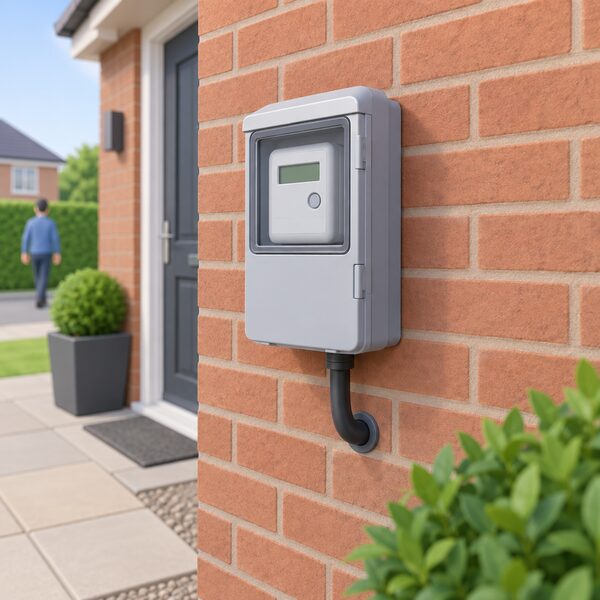
The planned rollout covers electricity meters, for all homes and businesses. That is a narrower scope than Great Britain's programme, which covered both gas and electricity, and it reflects the shape of Northern Ireland's energy market: gas is available in parts of the region but not universally, and the metering arrangements differ accordingly.
The commitment to the non-domestic sector is specific. Consumer representatives have underlined the need to start the smart meter rollout with SMEs2, on the reasoning that small firms are the least able to absorb the cost of a delayed or poorly sequenced upgrade and the most likely to benefit from accurate consumption data. In Great Britain, 63% of non-domestic meters were smart or advanced meters at the end of Q1 20255, which gives a sense of the ground Northern Ireland would be making up.
For domestic consumers, the classification of a meter matters for how statistics and protections apply. Electricity meters are classified as domestic meters based on their tariff type6, so a household on a domestic tariff is counted as a domestic meter regardless of the technology fitted.
When the rollout starts and when it should finish
Initial installations of smart electricity meters are expected to begin in early 20282. That is the first firm date in the published material, and it is a start date rather than a completion date. The sequencing after that has not been published in the same detail.
The Great Britain programme offers the closest available timetable, and it has been revised repeatedly. In 2011, government set out a vision for every home and small business in Great Britain to have smart meters and set an original target of completion in 20197. By 2016 the main installation phase was described as due to be completed in 20208, and by 2017 the commitment had become that by 2020 every home and business in Britain will have been offered a smart meter9. A 2019 proposal would have given suppliers until the end of 2024 to install smart meters in at least 85% of consumers' homes and small businesses, and that framework was withdrawn10. The current framework ran between 1 January 2022 and 31 December 202511, and the rollout is now to be complete by the end of 20304.
The lesson for Northern Ireland is that published completion dates in this field move. A household should treat early 2028 as the point at which installations begin, not as a date by which every home will have been contacted.
| Milestone | Date | Source basis |
|---|---|---|
| Initial smart electricity meter installations expected to begin | Early 2028 | Consumer Council factsheet2 |
| GB rollout framework period | 1 January 2022 to 31 December 2025 | Ofgem installation targets11 |
| GB rollout completion | End of 2030 | Smart DCC4 |
| 2G and 3G services switched off | By 2033 | Government news12 |
Who provides the meters: NIE Networks and your supplier
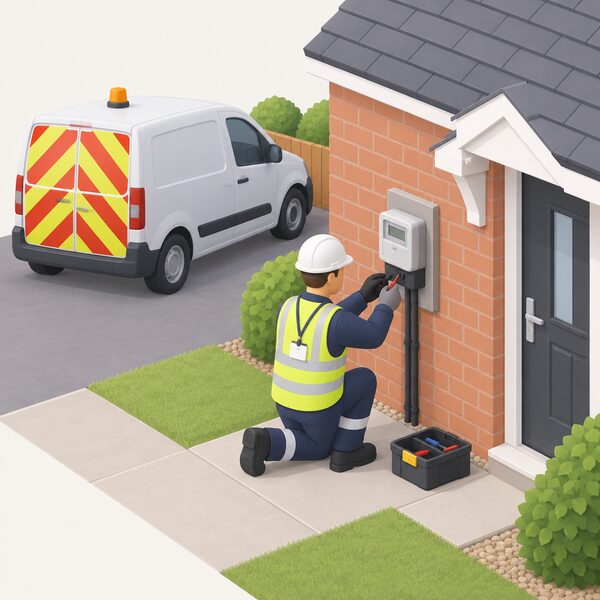
The division of responsibility in Northern Ireland is between the network company and the supplier, and it is worth understanding because it determines who a household deals with at each stage.
NIE Networks maintains the meters at the properties of all customers across Northern Ireland no matter who your supplier is1. That means the physical meter belongs to the network side of the arrangement, and the replacement programme is run by NIE Networks rather than by an energy supplier. NIE Networks staff carry out the work: all meter installers have completed comprehensive training and are fully qualified electricians1. All employees of NIE Networks will carry identification, wear identifiable uniforms and drive marked vehicles, and a household unsure about an installer can confirm identity through the PSNI's Quick Check scheme1.
The supplier's role is the commercial one: billing, tariffs and the customer relationship. In Great Britain, under their licence conditions, energy suppliers are required to take all reasonable steps to install a smart meter where a meter is fitted for the first time or a traditional meter needs replacing due to a fault13. The equivalent obligations for Northern Ireland will sit with suppliers once the framework is in place.
For a household's independence, this split matters in one practical way: the meter is not something a household can shop around for or buy. It is network infrastructure, replaced on the network's schedule. What a household controls is the monitoring equipment inside the home, which is a separate purchase and a separate decision.
What smart meters are expected to do for households
The benefits claimed for smart metering fall into three groups: billing accuracy, consumption visibility, and system-level flexibility. Each has a different weight for a Northern Irish household.
On billing, the stated benefit is bills based on accurate meter readings and not estimates14. That removes the cycle of estimated bills followed by a reconciliation, and it removes the need for a household to read and submit a meter. It depends on the meter communicating reliably, which is why the reliability record matters: in 2024, 9% of smart meters were not operating in smart mode3.
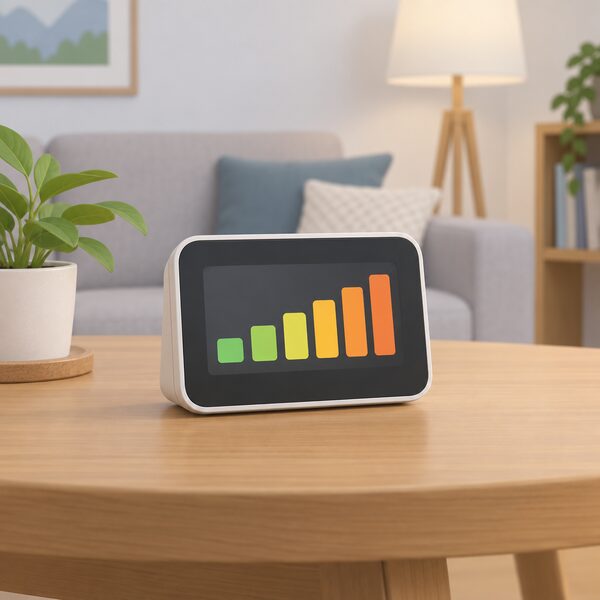
On visibility, smart meters come with a useful In-Home Display (IHD) so consumers can see and manage energy use to save money on bills16. The display shows consumption in near real time, which is the feature most households actually use. Our page on in-home displays covers what they show and how to read them.
On system flexibility, smart meters help the country plan a more flexible and resilient energy system for the future, supporting energy security and reducing carbon emissions towards net zero17. Smart meters can help to create a more efficient energy market where there are benefits for consumers as well as the environment18. For Northern Ireland, where a high proportion of households use prepayment keypad meters, the flexibility case is closely tied to how prepayment is handled.
What you need to do: nothing until NIE Networks or your supplier contacts you
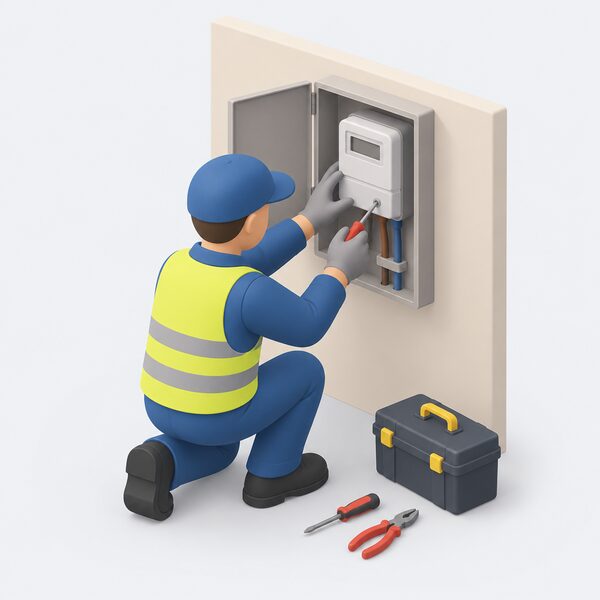
There is no application process for the planned rollout. A household does not need to register interest, and there is nothing to arrange in advance. The contact comes from NIE Networks or from the supplier when the work reaches that property.
For the meter replacement programme that is running now, the practical preparation is set out by NIE Networks. A household needs to ensure the area around the meter is clear and there is good access, and the meter installer will ask you to turn off all electrical appliances before power is switched off1. The appointment takes approximately 30 minutes to one hour to replace the meter and carry out all relevant safety checks, during which power to the property is disrupted, and the power itself is off for approximately 20 minutes1. NIE Networks can offer customers three-time bands for appointments, AM, PM or All day, Monday to Friday, and appointments can be booked by calling 028 9575 72831. When the work has been completed the installer will show you how to read and use the new meter1.
How the NIE Networks meter replacement programme differs from the smart meter rollout
These are two different things, and conflating them is the most common misunderstanding about smart metering in Northern Ireland.
The replacement programme is routine asset management. NIE Networks has an ongoing meter replacement programme and replaces all types of domestic and commercial meters after a prescribed period of time, with different types of meter required to be changed at different intervals1. The meters being installed are digital display meters that are approved to European Standards1. They are certified, accurate and modern, but they are not smart meters.
A smart meter differs from a traditional meter in that it offers two-way communication, which means it can wirelessly send and receive information19. That two-way channel is what enables remote readings, remote switching between credit and prepayment modes, and the half-hourly data that time of use tariffs need. A digital display meter has none of it.
The distinction has a direct consequence for a household's options. A digital display meter gives a reading at the meter and nothing else, so any monitoring inside the home has to come from separate equipment. A smart meter would feed data to a supplier and, with consent, to the household. Until the rollout reaches a property, the second category is not available.
No smart gas meters: what that means for gas customers
The planned rollout covers electricity meters only. There is no published plan for smart gas meters in Northern Ireland, which means a household with a gas supply will have a smart electricity meter and a traditional gas meter, and the two will not be integrated in the way they are in Great Britain.
That has practical effects. In Great Britain, a smart meter installation can cover both fuels, and an in-home display can show gas and electricity together. In Northern Ireland, a household would see electricity consumption in detail and gas consumption only by reading the gas meter. The experience in Scotland, where smart meters were in some cases connected to both gas and electricity and in others to electricity only20, shows that mixed arrangements are workable but produce an uneven picture for the household.
There is also a lesson about installation quality. In one official case study, due to the location of the meter screen on the new gas meter the consumer was unable to check the reading on the meter21. A meter that cannot be read easily is a meter that generates estimated bills, which is the opposite of the intended benefit. Where a gas meter is not being replaced, that particular risk does not arise, but the general point about checking that a new meter is readable before the installer leaves applies to any replacement.
For energy independence, the absence of smart gas metering means gas consumption remains opaque unless a household installs its own monitoring. Gas is also the fuel most exposed to import prices, so the visibility gap is largest where the dependence is greatest.
Consumer support and the case for a fair rollout
The design of the Northern Ireland rollout is being shaped by an explicit fairness argument. Consumers must be at the heart of the roll out of smart metering to ensure a just transition that is inclusive of all demographics2. That principle is not decorative: it determines decisions about sequencing, about how prepayment households are migrated, and about what happens to households that cannot or will not engage.
Two mechanisms are proposed to give it effect. Consumer representatives should be involved in the co-design of the requirements for data systems and procurement2, which puts consumer bodies inside the specification process rather than in a consultation response at the end. And trusted organisations should have access to aggregated and anonymised data from smart meters for lawful purposes, without insurmountable barriers to accreditation2, which is what allows advice bodies and researchers to identify households in difficulty.
The evidence from elsewhere suggests why this matters. Among those without a smart meter in fuel poor households in Scotland, there was little appetite to get one20. A rollout that waits for households to ask will therefore miss the households with the most to gain. The Republic of Ireland's approach, prioritising those who requested a meter or needed a replacement during the initial phase2, is one model; a proactive sequenced rollout is another.
What happens to older meters when 2G and 3G networks close
Northern Ireland's late start has one unintended advantage: it will not inherit the communications problem that Great Britain is now working through.
Smart meters in Great Britain communicate over cellular networks, and the 2G and 3G services those meters rely on are being switched off. Suppliers are required to replace all smart meters that are still connected to 2G and 3G before the services are switched off by 203312. An estimated seven million communications hubs, part of the electricity smart meters, will also need to be replaced, because they will lose functionality when the 2G and 3G mobile communications networks are closed22. Second-generation smart meters that rely on 2G/3G will require a replacement Communications Hub in order to communicate with 4G networks, and any remaining first-generation SMETS1 smart meters which have not been upgraded to SMETS2 will need to be physically replaced prior to 2033, in line with SMETS1 communication provider contracts, as these have been designed with an integrated 2G Communications Hub23.
The cost accounting reflects the scale of it. The government has maintained a distinction between the original rollout and the technological upgrade from 2G/3G networks to 4G, excluding costs related to the transition and reducing the benefits for 2034 to reflect the 2G/3G switch-off24.
A Northern Ireland rollout beginning in early 2028 would be installing 4G-capable equipment from the outset, avoiding a repeat of that replacement cycle within its first decade. For a household, that is the difference between a meter that will need swapping again and one that will not.
Monitoring a Northern Irish home in the meantime
Until the rollout reaches a property, the options for detailed energy monitoring are the same as they are for any home without a smart meter: standalone equipment installed inside the home.
The categories are well established. A whole-house monitor with a clamp around the incoming supply gives a live picture of electricity consumption without any involvement from the supplier. Circuit-level monitoring splits that picture across individual circuits. Plug-level monitoring covers individual appliances. Our pages on home energy monitors, current transformers and energy sensors and smart plugs and appliance monitoring set out how each works.
The limits are worth stating plainly. None of this equipment can read a meter remotely, switch a tariff, or feed data to a supplier. It measures consumption inside the home and reports it to the household. That is genuinely useful for finding waste and for sizing a solar or battery system, and our guide to using energy data to size a system covers that use. But it does not substitute for the metering layer, and it does not change the billing relationship.
For a household on a keypad prepayment meter, the position is different again. A prepayment meter lets you pay for electricity or gas in advance rather than after you have used it25, and the top-up routine is well understood. What a smart prepayment meter would add is remote switching between prepayment and credit modes, and the ability to change tariff without a visit. Smart meters can work in both prepayment and credit modes17, and smart prepayment meters are not automatically more expensive: what you pay depends on your tariff and supplier17. Those are the features a Northern Irish prepayment household is waiting for.
Sources26 cited
- Meter Replacements, NIE Networks, 2026
- Smart Electricity Meters NI, Energy Saving Trust, 2025
- Smart meter Guaranteed Standards of Performance Draft Impact Assessment, Ofgem, 2025
- How we're working to support customers to address non-communicating smart meters, Smart DCC, 2026
- Smart metering policy framework post-2025 consultation document, Department for Energy Security and Net Zero, 2025
- Domestic electricity consumption, Office for National Statistics, 2026
- Update on the rollout of smart meters, Public Accounts Committee, 2023
- Retail energy markets in 2016, Ofgem, 2016
- Best practice guidance for the delivery of energy efficiency advice during smart meter installation visits, GOV.UK, 2017
- Update on the rollout of smart meters summary, National Audit Office, 2023
- Supplier smart metering installation targets, Ofgem, 2026
- Tough new rules force suppliers to fix faulty smart meters, GOV.UK, 2026
- Get help with your smart meter, Ofgem, 2026
- Get help with your smart meter, Ofgem, 2026
- Data protection and smart meter data, Open Energy, 2026
- Smart meters: your rights and expectations, GOV.UK, 2025
- Benefits for prepay customers, Smart Energy GB, 2026
- Smart means a more efficient, innovative market, Ofgem, 2015
- Smart meters, Energy Ombudsman, 2026
- Research on the lived experience of fuel poverty in Scotland, Scottish Government, 2020
- Installation of smart meters case study, Energy Ombudsman, 2026
- Delayed smart meter programme fails to hit targets, Public Accounts Committee, 2023
- Do smart meters use 3G?, Smart DCC, 2024
- Smart Metering 2025 Costs and Benefits Report, Department for Energy Security and Net Zero, 2025
- Get help with your prepayment meter, Ofgem, 2026
- What happens if your energy supplier goes out of business, Ofgem, 2026
 Smart Meters in ScotlandWhen will you get a smart meter in Scotland, and what happens if yours still runs on the old radio signal that switches heating and hot water?
 Why You Cannot Get a Smart MeterWhy can some homes not have a smart meter fitted, and what counts as a good enough reason?
 Meters and Energy IndependenceDo smart meters really save you money, and can you still get one fitted for free?
 Monitoring in Flats and RentalsCan you get a smart meter in a rented flat, and who decides?
 The Full Smart Meters GuideDo smart meters really save you money, and how do you use one to cut your bills?
 Smart Meters in WalesCan you get a smart meter fitted free in Wales, and will it work if you live in a rural area or an older home?