
In this guide
Great Britain has two generations of smart meter. SMETS stands for "Smart Metering Equipment Technical Specifications"1, the technical rulebook each meter is built to. First generation SMETS1 meters were rolled out from 20132; second generation SMETS2 meters started being installed in 20183. The practical difference is how each one talks to your supplier, and that decides whether the meter stays "smart" when you change supplier.
A SMETS2 meter was designed to connect directly to the Data Communications Company's (DCC) secure national network, so a household can switch supplier and keep smart functions such as automatic readings4. Many SMETS1 meters were tied to their original supplier's communications and could lose smart functions after a switch. The DCC has since moved them onto its network remotely: about 12 million first generation meters have now been connected through over-the-air software updates3. Any SMETS1 meter that is not upgraded will need to be physically replaced before 2033, because it relies on an integrated 2G communications hub5.
Either type is installed by your energy supplier for free6. Neither makes a home self-sufficient: a smart meter measures and reports, and the household still depends on its supplier, the national data network and, for older meters, the mobile network. What a meter does offer is accurate information, which is the starting point for any household trying to take control of its energy use.
What a smart meter does in your home
A smart meter measures how much gas and electricity you are using and what it is costing, shows this on an in-home display, and sends the usage information securely to your supplier8. Readings go automatically, at least once a month9, which is why Ofgem describes the main benefit as bills based on accurate meter readings rather than estimates6.
For the household, the value is information. Energy UK describes smart meters as giving real-time information about energy use, helping customers avoid wasting energy and avoid estimated readings and bills10. For suppliers, the same data shows when and how much energy is being used11. The DCC's own framing is that the data "puts you in control of your energy usage"12; the meter itself does not reduce consumption, it shows where consumption happens so that the household can act on it.
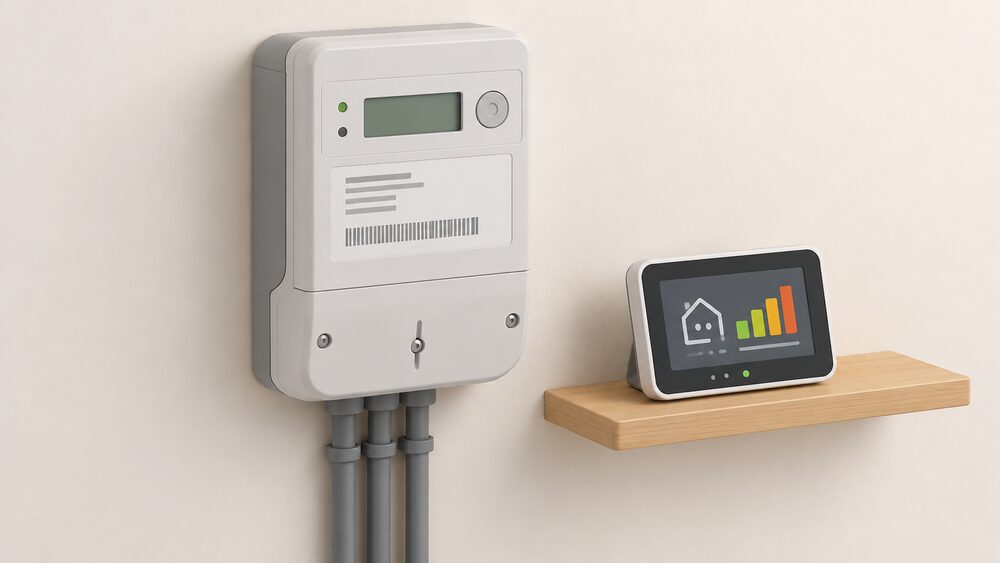
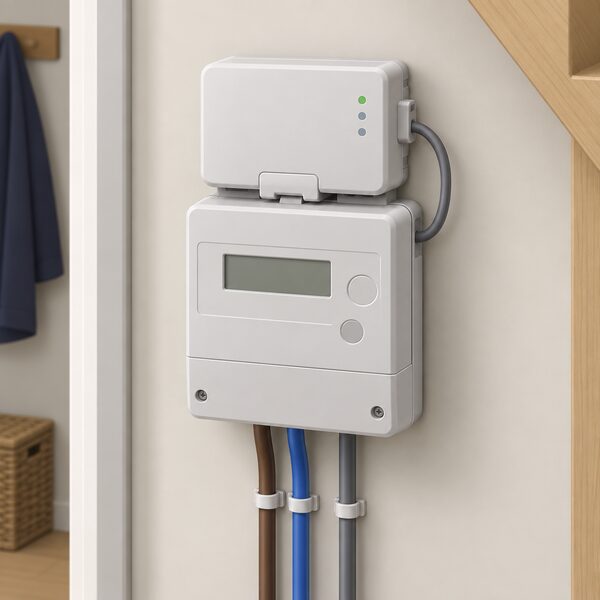
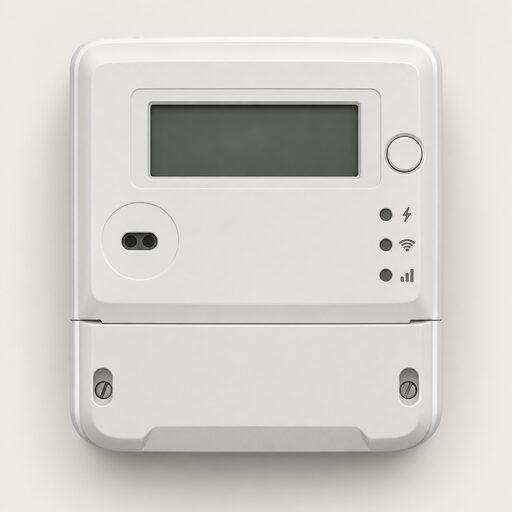
Typically, a smart meter shows its data on an in-home display unit13. The display is the part most people interact with; the meter on the wall does the measuring and the communicating. For a fuller explanation of the hardware and signal path, see how smart meters work.
In independence terms, a smart meter is a measuring instrument, not a source of energy. It does not store power, generate it or keep the lights on in a cut. Its contribution is visibility: a household that knows its own load profile is better placed to judge solar, battery or heat pump sizing, move use to cheaper times, or spot waste. The data flows first to the supplier, though, and a household that wants its own copy in real time needs a display or a consumer access device.
SMETS1 and SMETS2: what the two generations mean
The two specifications differ mainly in how the meter communicates. Older SMETS1 meters use the mobile network, while newer SMETS2 meters, installed from 2018, have their own network7. Ofgem's ombudsman scheme describes SMETS1 as using "a third-party communications network to send metering information to the energy supplier"14; in practice that third party was chosen by the supplier that fitted the meter, which is why a later supplier could not always read it.
| SMETS1 | SMETS2 | |
|---|---|---|
| Introduced | 20132 | 20183 |
| Communications | Mobile network, via a third-party provider7 | DCC's own secure national network7 |
| Keeps smart functions after a switch | Only once enrolled on the DCC network4 | Yes, by design4 |
| Share of installs today | No longer the standard fit | The vast majority of installs15 |
| Future of communications | Physical replacement before 2033 if not upgraded5 | Communications hub replacement before the 2G switch-off5 |
SMETS2 is now the meter type for any new smart meter installation14, and Smart Energy GB described it in 2024 as making up the vast majority of installs15.
How to tell which you have
Energyhelpline states that a meter serial number beginning with 19M indicates a SMETS2 meter16. The DCC provides a tool, built with Citizens Advice, to check whether a smart meter has been migrated onto the DCC network4. A meter that has stopped sending readings after a switch is also a clue: Smart Energy GB notes that an older SMETS1 meter may not be working in smart mode if the household has switched supplier since installation1.
A SMETS2 meter connects directly to the DCC, so switching keeps smart functions
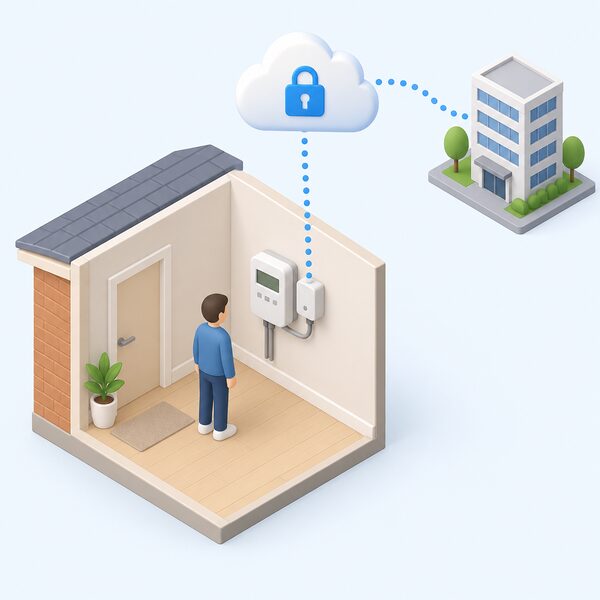
The design goal of SMETS2 was interoperability. Second generation meters connect directly to the DCC's secure national network, allowing supplier switching while retaining smart functionality4. The DCC states that SMETS2 meters let consumers switch supplier while keeping automatic meter readings17, and Which? describes them as automatically connected to the smart meter network so all energy suppliers should be able to operate them18.
Because every supplier uses the same network, there is no need to reprogramme or replace the meter when a customer moves. Smart Energy GB states that with a SMETS2 meter a household should be able to switch without any interruption to energy readings, bill payments or gas and electricity supply19, and that SMETS2 meters keep their full smart functionality following a switch20. The DCC summarises the route in one line: readings are sent via the DCC's secure network to the energy supplier21.
A second consequence is that SMETS2 does not depend on good mobile reception. Smart Energy GB states that SMETS2 meters use "a bespoke secure smart data network called the DCC", so a home does not need good mobile signal1. By the end of the SMETS2 rollout, that network is expected to cover 99.25% of Great Britain7. The small remainder is one reason some homes still cannot get a working smart meter (see why you might not be able to get a smart meter).
For independence, SMETS2 shifts the dependence rather than removing it. A household is no longer locked to the supplier that installed the meter, which widens tariff choice. It does rely on a single national operator, the Data Communications Company, and on its communications hub, which itself will need replacing before the 2G switch-off5. More on the networks is in how smart meters communicate.
Where SMETS1 falls short, and how it is being upgraded
The weakness of SMETS1 was portability. The DCC states that some SMETS1 meters could lose smart functionality when a consumer switched energy supplier4. Which? reported in 2023 that suppliers failing to get readings was more common among meters fitted early in the rollout, the SMETS1 meters, and that most of these should by then have been upgraded to solve the problem22.
The fix was enrolment: bringing SMETS1 meters onto the DCC network so any supplier could reach them. This is a software upgrade managed remotely by the DCC23, with no visit needed in most cases. Progress figures differ by date:
| Date | Figure | Source |
|---|---|---|
| January 2019 (plan) | Enrolment expected to conclude by the end of 2020 | 24 |
| June 2023 | Government said it might not be possible to enrol 500,000 SMETS1 meters, which might then need replacing | 25 |
| August 2023 | Over 11 million SMETS1 meters connected to the DCC network | 23 |
| Current DCC guidance | About 12 million first generation meters connected | 3 |
The 2020 finish date in the 2019 document was not met; the programme ran for years longer. The DCC now states that almost all SMETS1 meters it can proactively identify and upgrade have been migrated, restoring smart functionality17. Energyhelpline describes the effect: the DCC network restores SMETS1 smart functions, lets the meter submit readings automatically again, and "ensures it won't be lost if you switch suppliers in future"16. Which? agrees that most SMETS1 meters are now connected and should keep their smart functions after another switch, while those that cannot be connected need replacing18.
The ombudsman scheme states that suppliers had until the end of 2023 to enrol first generation meters or replace them with second generation meters14. Where migration is not possible, the DCC states that a supplier may replace the meter with a SMETS2 meter17.
There is also a longer horizon for all meters: the DCC states that the 2G network will be switched off in 2033, with SMETS1 meters needing physical replacement and SMETS2 meters needing a replacement communications hub5. See will my smart meter stop working when 3G closes.
What happens when you switch supplier
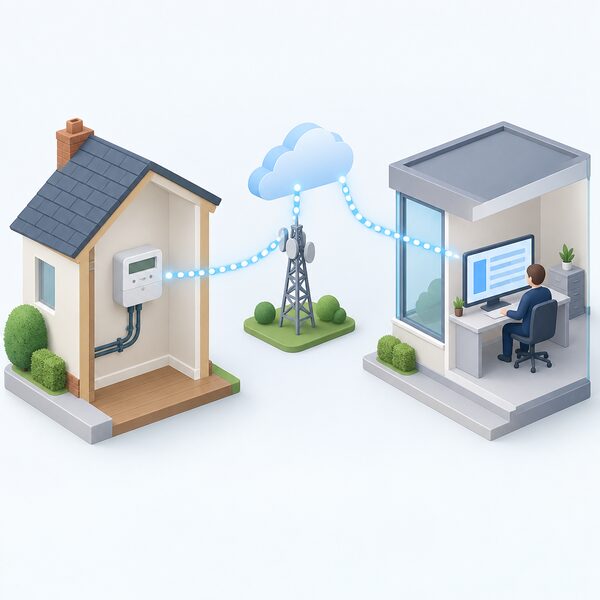
With a SMETS2 meter, Which? states "there shouldn't be an issue with switching"26, and there should be no disruption to power supply15. The meter stays on the wall and the new supplier reads it over the same national network.
With a SMETS1 meter that has not been enrolled, the picture is weaker. The DCC states that such meters could temporarily go "dumb" and lose automatic readings after a switch17, and that SMETS1 meters "don't always allow the consumer to change energy supplier without losing the ability to send meter readings automatically"3. In that case the household may need to send readings to both old and new suppliers27. Smart Energy GB frames this as a loss of some functionality "for a short time"20.
The same can happen when a supplier fails. Ofgem's guidance for customers moved after a supplier goes out of business warns that the meter may not work in smart mode with the new supplier and manual readings may be needed instead28. A Welsh council's trading standards guidance adds that a new supplier might not offer all smart meter services, such as remote readings, and the meter may need replacing29.
What to expect in practice after a switch with an older meter:
- The display may carry on showing usage, but readings may stop reaching the new supplier.
- Manual readings may be needed until the meter is enrolled or replaced.
- Where migration is not possible, the supplier may fit a SMETS2 meter17.
More detail is in will my SMETS1 meter stop working if I switch supplier and why is my smart meter in dumb mode.
Cost: free from your energy supplier
Ofgem states plainly: "Contact your supplier to get a smart meter for free."30 The DCC says the same, that a smart meter is installed by the energy supplier at no extra cost31, and repeats it in its guidance on whether smart meters are required by law32. The Energy Saving Trust states that households losing Radio Teleswitch meters should be upgraded to a smart meter for free33.
No household pays an upfront charge for the meter, the in-home display or the fitting. The cost of the national rollout is recovered across the industry rather than billed per installation; the household's ongoing costs are its energy bills. Detail is at smart meter cost and do you have to pay for an in-home display.
Free installation matters for independence in a narrow way: a household does not have to invest to get accurate data. It does mean the meter belongs to the supplier's metering arrangements, not the household, and replacing or upgrading it is the supplier's decision.
Data, security and how readings reach your supplier
Smart meters send readings automatically and wirelessly to the supplier at least once a month over a secure smart data network34. Smart Energy GB repeats the same monthly minimum35, and the Welsh Government's guidance describes the meter sending usage data "using a secure network"36.
The route depends on generation. SMETS2 meters use the DCC network; enrolled SMETS1 meters now use it too; un-enrolled SMETS1 meters still send data over a third-party communications network14.
None of this touches the household's internet. Smart Energy GB states that a smart meter "does not use your Wi-Fi, connect to your router or affect your broadband speed"37, and the DCC states that a smart meter "doesn't need, or connect to the public internet or your home Wi-Fi"38. Sending a reading needs no internet connection because smart meters work on the DCC's secure, standalone network3.
For a household concerned with digital dependence, the separation cuts both ways. The meter keeps working if the broadband fails, and the home router is not part of the chain. The data, though, goes to the supplier first; getting real-time data into the household's own systems takes a display or a consumer access device. See smart meter data, smart meter security and do smart meters need WiFi.
Prepayment, tariffs and what a smart meter unlocks
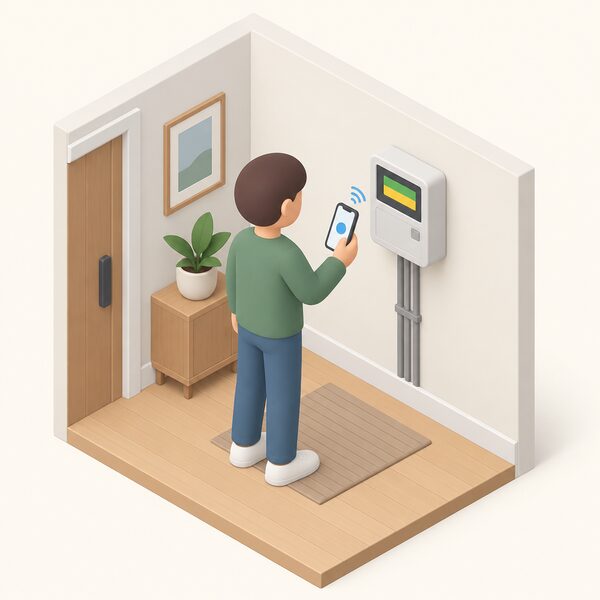
Both generations work for credit and prepay customers. The DCC states that smart meters are free to use and available for payment-on-account or prepay customers17, and Smart Energy GB states they are "set up to work for both prepay and credit customers"19. Age UK notes that for someone who already prepays, a smart meter can be set to prepayment mode2. Smart Energy GB states that smart prepay customers pay the same rates as everyone else, because smart meters remove the need for prepay to be more expensive39.
Topping up changes with a smart prepayment meter:
- Online, or through the supplier's mobile app40
- By telephone or text message, with no gas card or electricity key41
- In cash at a Post Office, Payzone, or any shop with a PayPoint logo, with the credit added immediately42
- At a PayPoint store or Post Office using a barcode40
The Citizens Advice guidance on cash top ups is written for England42. Rules on moving customers onto prepayment are covered at can my supplier force me onto a prepayment meter and smart prepayment meters.
On tariffs, Ofgem states that a smart meter gives access to more flexible tariffs, including dual-rate tariffs6. A time-of-use tariff needs readings for each part of the day, which a meter read once a quarter cannot supply. This is where a working smart meter, of either generation, starts to matter for a household with a battery, an electric vehicle or solar panels: shifting use to cheaper periods depends on the meter recording when energy was used. See smart meters and time-of-use tariffs and household flexibility and reward schemes.
Where a smart meter may not work, and your right to refuse
Not every home can get a working smart meter straight away. Smart Energy GB lists among the barriers that a supplier "is not currently installing smart meters in your area"43. In areas with poor mobile reception, it states a household can either request a first generation meter, which may have difficulty sending readings automatically, or insist the supplier installs a SMETS2 meter39. Homes with solar panels can usually have one: smart meters are designed to work with solar panels43, though some suppliers have not yet been ready to supply customers who generate electricity35. See smart meter with solar panels.
Working meters can also fail. Ofgem states a smart meter "may stop recording the energy you use, or may no longer send readings to your supplier"6. Where a meter is not operating in smart mode, manual readings remain possible44. Ofgem has consulted on a guaranteed standard for meters not operating in smart mode, covering both gas and electricity SMETS1 and SMETS2 meters, including unenrolled SMETS1 meters45. Proposed exemptions include where the consumer asked for no communication or no appropriate technical solution exists45, and the standard would apply only where the consumer has not agreed to the meter running outside smart mode46. See smart meter guaranteed standards.
The right to refuse
"you do have the right to refuse a smart meter if you don't want one"
The Energy Saving Trust confirms a smart meter is not compulsory34. The ombudsman scheme adds a condition: if a traditional meter needs replacing because it is faulty or unsafe, replacement options may be limited14. Suppliers may also offer smart meter technology with the communications disabled, so it does not send readings automatically33.
The rules reflect refusal. Under the supply licence regulations, the requirement on a first-time smart meter appointment does not apply where the supplier reasonably concludes a meter cannot be installed, remote readings would not be received, or the customer has actively refused one or more offers on or after 23 February 202647.
Renters who pay their own bills can choose a smart meter, after checking the tenancy agreement and telling the landlord14. See are smart meters compulsory and smart meters in flats and rented homes.
The rollout programme and what happens next
The Government's original target was to effectively complete the rollout by 201949. That slipped. Ofgem's 2020 impact assessment set out a 6-month extension to the existing obligation followed by a new 4-year framework from July 202144. Ofgem describes this four-year obligation50 as having now concluded51.
The SMETS1 migration covered suppliers across Great Britain4; Northern Ireland is outside this programme, and its arrangements are covered at smart meters in Northern Ireland. For Scotland and Wales, see smart meters in Scotland and smart meters in Wales.
The dates now shaping the next phase:
| Date | What happens |
|---|---|
| May 2027 | Market-wide Half-Hourly Settlement on track to migrate all meters52 |
| End of 2030 | Suppliers required to offer smart meters to all households and small businesses2 |
| 2033 | 2G network switched off; remaining SMETS1 meters physically replaced and SMETS2 communications hubs replaced5 |
The Government's 2025 costs and benefits report committed to reviewing opportunities to use observed data in place of model assumptions ahead of reporting on the rollout to the end of 202553. Half-hourly settlement is the step that makes each household's actual timing of use count in the market, which is why a working smart meter increasingly matters for flexible tariffs. See half-hourly settlement and the UK smart meter rollout.
For the household, the direction is clear: SMETS1 is being retired, SMETS2 is the standard, and both depend on communications equipment that will change again before 2033. A smart meter strengthens a household's knowledge of its own energy and its freedom to switch supplier; it does not reduce reliance on the grid. The wider picture is at smart meters and energy independence and the smart meters and home energy management guide.
Sources53 cited
- Do I already have a smart meter?, Smart Energy GB, 2026-03-16
- A guide to smart meters, Age UK, 2026-08-24
- How to get a smart meter, Smart DCC, 2026
- Upgrading Britain's first generation smart meters, Smart DCC, 2026
- Do smart meters use 3G?, Smart DCC, 2024
- Get help with your smart meter, Ofgem, 2026-09-17
- Smart meters advice, Centre for Sustainable Energy, 2025-05
- An introduction to smart meters and prepay, Smart Energy GB, 2026-03-16
- Saving energy and money with smart meters, Home Energy Scotland, 2026-09-20
- Support with energy bills, Energy UK, 2025-09-03
- What are wind farms all about?, Smart Energy GB, 2026-03-16
- Smart meters and decarbonisation, Smart DCC, 2026
- How do smart meters reduce my bills?, Smart DCC, 2025
- Smart meters, Energy Ombudsman, 2026-09-20
- Switching suppliers, Smart Energy GB, 2024-02-22
- Energy meters, Energyhelpline, 2026-09-20
- How do you know if you have a smart meter?, Smart DCC, 2026
- Smart meter problems and solutions, Which?, 2026-08-24
- What is a smart meter?, Smart Energy GB, 2026-08-10
- Switching supplier with a smart meter, Smart Energy GB, 2026-03-16
- How do smart meters save energy?, Smart DCC, 2026
- Energy supplier not getting readings from your smart meter?, Which?, 2023-02-16
- What happens to my smart meter when I change supplier?, Smart DCC, 2023
- The future for small-scale low-carbon generation, UK Government, 2019-01
- Public Accounts Committee report on smart meters, UK Parliament, 2023
- Do I have to accept a smart meter?, Which?, 2026-05-12
- What is a smart meter? (easy read), Smart Energy GB, 2026-03-16
- What happens if your energy supplier goes out of business, Ofgem, 2026
- Problems with services, Isle of Anglesey County Council, 2025-10
- Get help with your smart meter, Ofgem, 2026
- How accurate are smart meters?, Smart DCC, 2026
- Do you have to have a smart meter by law?, Smart DCC, 2026
- RTS meter switch-off, Energy Saving Trust, 2026-05-08
- Guide to smart meters, Energy Saving Trust, 2026-07-15
- Myth-busting smart meter problems, Smart Energy GB, 2026-09-17
- Smart meters, Welsh Government, 2026
- How do smart meters work?, Smart Energy GB, 2026-08-27
- Does a smart meter need Wi-Fi?, Smart DCC, 2026
- Smart meter FAQs, Smart Energy GB, 2025-08-08
- Prepayment meters consumer guidance, Ofgem, 2026
- Smart meters and carers, Smart Energy GB, 2026-08-19
- Problems getting to or topping up your prepayment meter, Citizens Advice, 2026-09-17
- Can I get a smart meter?, Smart Energy GB, 2026-03-16
- Self-disconnection and self-rationing final impact assessment, Ofgem, 2020-10
- Smart meter guaranteed standard statutory consultation, Ofgem, 2025-08-08
- Smart meter guaranteed standards of performance, Ofgem, 2025-03-28
- Smart Meters regulations, SI 2015/1544, legislation.gov.uk, 2026-02-23
- ECO4 and Great British Insulation Scheme mid-scheme changes consultation, UK Government, 2024-11-14
- Delayed smart meter programme fails to hit targets, UK Parliament, 2023-10-20
- Supplier smart metering installation targets, Ofgem, 2026-09-17
- Supplier smart metering installation targets (Welsh), Ofgem, 2026-09-17
- Clean Flexibility Roadmap: July 2026 update, UK Government, 2026-07
- Smart Metering 2025 Costs and Benefits Report, Department for Energy Security and Net Zero, 2025
 The Full Smart Meters GuideDo smart meters really save you money, and how do you use one to cut your bills?
 Meters and Time-of-Use TariffsDo you need a smart meter for a time-of-use tariff, and does it have to send readings every half an hour?
 Meters and Energy IndependenceDo smart meters really save you money, and can you still get one fitted for free?
 Smart Meter RulesCan your supplier make you have a smart meter?
 Smart Meter Faults and FixesYour smart meter has stopped working.
 Meter Standards and AccuracyHow UK smart meters are certified for accuracy, how their readings become a bill, what happens when a meter stops communicating, and how a metering or billing dispute is escalated to a supplier and then to the Energy Ombudsman.