
In this answer
Short answer
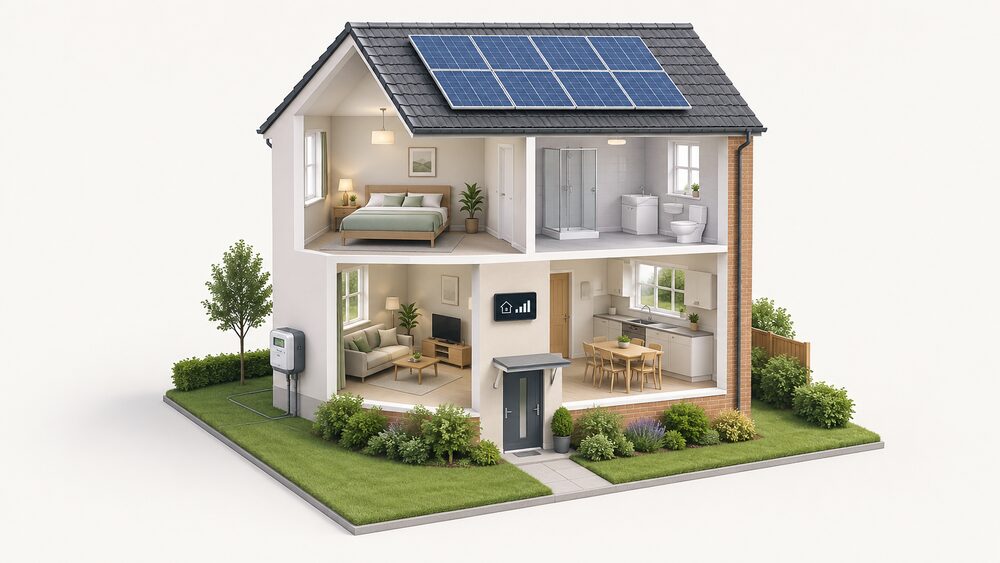
Yes, a household with solar panels can get a smart meter. In most cases having solar panels does not stop a household getting one, and smart meters are designed to be able to work with solar panels, with the supplier expected to be able to offer one as part of the rollout1. The qualification is practical rather than technical: some suppliers are not yet ready to supply smart meters to customers with solar panels, and a supplier may not currently be installing in a given area3.
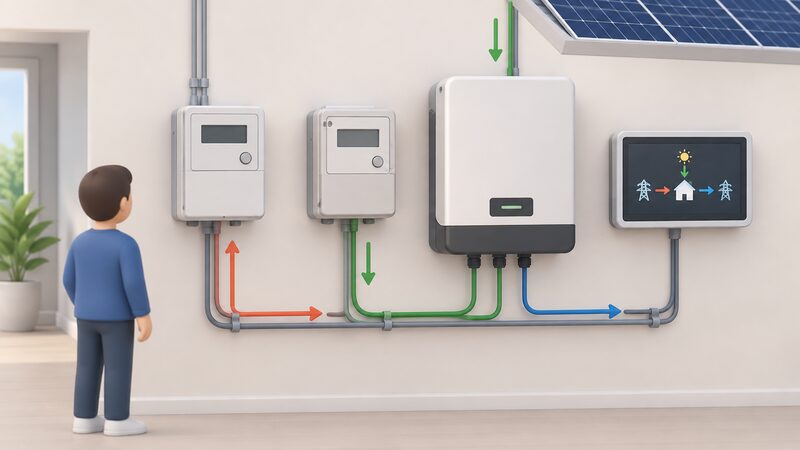
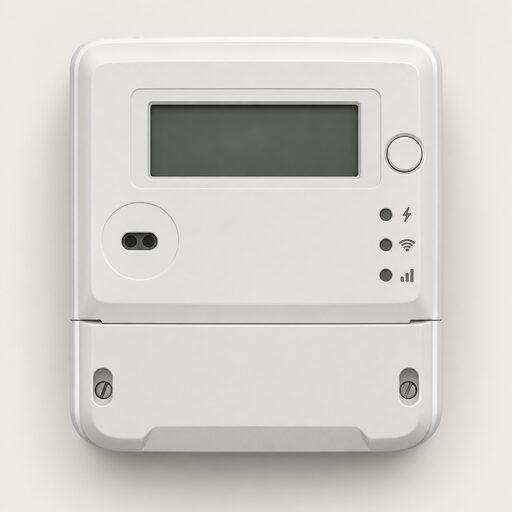
What a smart meter will not do is show generation on the in-home display. The display currently shows only the energy being used and will not show how much power the solar panels are generating4. The metering system underneath is more capable than the display suggests: it can support up to four smart electricity meters per household, and those can be used as generation meters5.
For a solar household, the smart meter is the meter for the supply side of the property. It measures gas and electricity use and sends the data to the supplier, which produces accurate rather than estimated bills6. Export and generation are separate functions, and the sections below set out what each part can and cannot do.
Why a smart meter matters if you have solar panels
A smart meter is the foundation of a smarter energy system, helping integrate renewable power such as wind, solar and hydropower and reduce reliance on fossil fuels8. That system-level role matters to a solar household because the value of a home's panels depends partly on what the wider network can do with the power they produce. Smart meters gather the information the energy networks require to react to the amount of energy needed, which is what allows supply and demand to be matched as more variable generation comes online9.
At household level, the data a smart meter provides puts the householder in control of energy usage, which supports energy-saving steps and reduces CO2 emissions10. For a home with panels, that data is the record of what the property drew from the grid and when, which is the other half of the picture that generation data alone cannot give.
Smart meters also allow suppliers to offer incentives for households that can reduce energy use during peak hours, helping balance supply and demand and reduce pressure on the grid11. Time-of-use and tracker tariffs depend on this: a supplier needs a working smart meter to charge the right amount for the energy used in each period12. For a solar household, that is the mechanism by which shifting consumption into the middle of the day, when panels are producing, can be reflected in what is paid.
The dependence that remains is worth stating plainly. A smart meter does not make a home independent of the grid or of a supplier. It measures the connection to both, and it depends on the supplier to install it and on the communications network to send readings. The independence it supports is informational: knowing what the panels, the battery and the household are each doing, and being able to act on it.
What a smart meter can measure: generation, consumption and export
The core function is consumption. A smart meter collects data about gas and electricity use, and measures how much gas and electricity is being used and sends those readings automatically to the supplier7. That is the supply side of the property, and it is what the standard installation delivers.
Export is a separate capability, and the system supports it. Smart meters can measure exported energy from microgeneration, and the smart metering system can support up to four smart electricity meters per household, which can be used as generation meters5. Any excess electricity generated by the panels can be exported to the grid14. So the architecture allows a household to have its import, its generation and its export metered as distinct flows, rather than inferring generation from a reduction in import.
| What is measured | Where it sits | Notes |
|---|---|---|
| Gas and electricity consumption | Household supply meter | Readings sent automatically to the supplier7 |
| Exported energy from microgeneration | Export metering | The system can measure exported energy from microgeneration5 |
| Generation | Up to four smart electricity meters per household | Smart electricity meters can be used as generation meters5 |
The intended outcome of the programme is a more efficient energy market with benefits for consumers as well as the environment15. For a solar household, the practical consequence is that the metering can distinguish what the home took from the grid from what it sent back, which is the basis of any export payment and of any honest account of how much of the home's own generation it actually used.
Where problems have been reported with solar and smart meters
The reported problems fall into two groups: issues specific to solar, and issues with smart metering generally.
On the solar side, people with solar panels might experience their electricity meter running backwards, which can lead to inaccurate energy billing16. Separately, the most common and most serious problem solar owners face is with the inverter16. Neither is caused by a smart meter, but both affect the accuracy of what any meter records, and an inverter fault can stop generation altogether.
On the smart metering side, the evidence is mixed and should be read with its dates. Citizens Advice research on smart meter requests found that 33% of consumers who proactively contacted their supplier about getting a smart meter were told they were unable to have one17. In the period from 1 January to 31 October 2024, 49% of those Citizens Advice helped with an estimated or inaccurate billing issue had a smart meter18. A Which? survey reported that 6% of those who reported a problem had installation issues19.
Geography matters. In the Western Isles, signal is poor for smart meter connections, which affects whether readings can be sent at all20. Reporting from Orkney describes meter issues around the Radio Teleswitch Service switch off, including issues around new smart meters being fitted, incorrect electricity billing, inefficient housing and heating systems21. These are areas where the communications and metering transition has been harder, and they are the clearest illustration that a smart meter's usefulness depends on a network the household does not control.
Plug-in solar and smart meters: do they work together?
There is no interdependence between the two. Smart plugs and smart meters are both about energy, but they do different jobs, and neither one depends on the other22. The same separation applies to a smart meter and a plug-in solar installation: the meter measures the household supply, the panel feeds the home, and neither device needs the other to operate.
What the smart meter contributes is the record. The data shared through a smart meter is used for billing, for offering new products and services with permission, and for helping make the energy system more efficient by recording demand more accurately23. A plug-in solar setup changes what that record shows, because the home's import falls while the panels are producing, but it does not change how the meter works.
For a household considering a fuller system, the components are solar panels on the roof, a battery, and intelligent controls to manage the system24. That is a different scale of installation from a plug-in panel, and it is the configuration in which generation metering and export metering become worth having, because there is enough output to export and enough storage to shift.
The limit to state is that a smart meter does not reduce energy bills automatically, though it can help householders understand usage patterns more clearly25. A plug-in panel reduces import while it is producing; the smart meter records that reduction. Neither is a substitute for the other, and neither makes the home independent of the grid.
Getting a smart meter installed: what to expect if you have solar
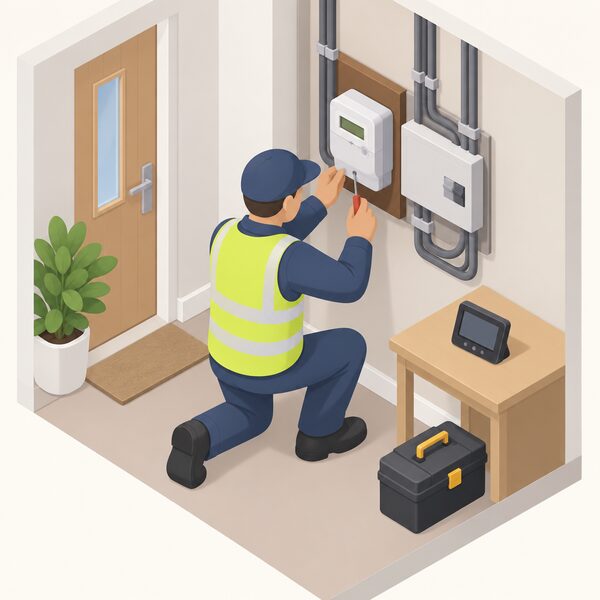
Installation is arranged through the supplier. The rollout of smart meters is being led by energy suppliers, and they are the route to booking one26. Any household that pays for energy, whether owning or renting, should be able to book a smart meter installation where it is expected to work in the property27. Renters can have a smart meter installed, and pre-payment customers and renters can benefit from one4.
The cost position is consistent across the guidance: installation is free of charge, typically taking about 90 minutes4. It should not cost anything, though an appointment in the area may need to become available first28. If a smart meter has not already been offered, one can be requested from the supplier29.
On the day, the installer will give a guide to using the meter and display30. Once installed, meter readings are sent automatically to the supplier, so bills are accurate rather than estimated6. Installers also look for potential problems with electricity and gas while on site, such as defective wiring, broken fuses or faulty boilers; from the start of 2017 to the end of December 2025, over 3,076,000 safety issues unrelated to smart metering were identified in Great Britain31.
For a solar household, the practical sequence is to tell the supplier about the panels when booking, because supplier readiness for solar customers varies and the appointment may need a different engineer or a different meter configuration. Where a supplier is not ready, the household can ask again later or approach the process through a different supplier, since the rollout is supplier-led26. The installation process and the reasons a booking may be refused are covered in more detail elsewhere; the export metering side is the part that matters most for a home that generates.
Sources32 cited
- How do smart meters work?, Smart Energy GB
- Smart meter FAQs, Smart Energy GB
- Can I get a smart meter?, Smart Energy GB
- Smart meters, Welsh Government
- Written evidence on smart meters, UK Parliament Science and Technology Committee, June 2016
- The installation process, Smart Energy GB, April 2026
- Guide to smart meters, Energy Saving Trust, July 2026
- How to get a smart meter where you live, Smart Energy GB, March 2026
- A smarter future: the smart energy system revolution, Smart Energy GB, April 2026
- Smart meters and decarbonisation, Smart DCC, 2026
- How does tidal energy work and how could it impact your energy use, Smart Energy GB, August 2026
- Energy tariffs explained, Uswitch, February 2026
- The best way to start saving energy and money, ivie, September 2026
- Research briefing CBP-8090, House of Commons Library, September 2026
- Infographic guide: smart means a more efficient, innovative market, Ofgem, March 2015
- Most common solar panel problems, Which?, September 2026
- Smart Meter Guaranteed Standards of Performance, Ofgem, March 2025
- Citizens Advice helps with an energy billing issue every two minutes, Citizens Advice, November 2024
- Energy supplier not getting readings from your smart meter? You're not alone, Which?, December 2022
- Remote islanders waiting on energy switch, British Gas Energy Trust, March 2025
- Scottish charity saves clients thousands in energy bills, British Gas Energy Trust, August 2025
- What are smart plugs and do energy saving plugs work, Smart Energy GB, August 2026
- Get help with your smart meter, Ofgem, 2026
- Batteries in the home, Solar Energy UK, September 2026
- Smart meters and carers, Smart Energy GB, August 2026
- Smart meters, National Grid, September 2026
- Smart meters: your rights and expectations, GOV.UK, August 2025
- How to read your gas and electricity meter, Confused.com, December 2025
- How accurate are smart meters?, Smart DCC, 2026
- Johnny Vegas: getting a smart meter installed, Smart Energy GB, March 2026
- Making your home safer, Smart Energy GB, April 2026
- Smart meters, Energy Ombudsman, September 2026
 Why You Cannot Get a Smart MeterWhy can some homes not have a smart meter fitted, and what counts as a good enough reason?
 Monitoring in Flats and RentalsCan you get a smart meter in a rented flat, and who decides?
 Smart Meter RulesCan your supplier make you have a smart meter?
 Meters and Energy IndependenceDo smart meters really save you money, and can you still get one fitted for free?
 Smart Meter Faults and FixesYour smart meter has stopped working.
 Consumer Access DevicesHow do you get your smart meter readings into your own app instead of the supplier's display?