
In this guide
- Why Some Households Cannot
- Coverage Signal and Home Type
- Renters Landlords and Flats
- Arranging Installation and Costs
- Checking Eligibility and Booking
- On the Day Timing and Safety
- Cost Free at Installation
- If Smart Mode Will Not Work
- Opting Out and Traditional Mode
- Older Meters and 2G 3G
- Household Energy Independence
Most homes in Great Britain can have a smart meter fitted on request, but a significant minority are told they cannot, at least not yet. The reasons fall into a short list: the property sits outside the wide area network that carries meter readings, the meter is too far from where the communications hub can reach, the meter position is awkward (a metal cupboard, a basement, a communal meter room or a remote outbuilding), the existing installation is unsafe, or the supply arrangement is non-standard and the supplier's systems do not yet support it. Around 0.75% of homes in Great Britain sit outside wide area network coverage, described by government as "not-spots" and numbering a few hundred thousand homes1. The communications network has been reported at 95% coverage2.
Refusal is not always technical. Citizens Advice research found that of consumers who proactively contacted their supplier about getting a smart meter, 33% were told they were unable to have one, and separate DESNZ research following 274 consumers found only 73% were able to book an appointment3. Suppliers must offer smart meters to all households and small businesses by the end of 2030, and government proposals would require every supplier to take all reasonable steps to reach full domestic coverage by 31 December 20304.
Where an installation cannot go ahead, the supplier should explain why and indicate when it may become possible6. New Guaranteed Standards now put timings and automatic compensation behind some of that: a first time installation appointment must be offered within six weeks of a request, unless the supplier is physically unable to install a smart meter at the premises7.
Why some households are told they cannot get a smart meter yet
There are certain homes and locations where a smart meter will not currently work8. Some property types and locations temporarily prevent installation, and in those cases the supplier should explain the reason and say when it may be possible6. The barriers are practical rather than a judgement about the household: where you live, the type of home you live in, and the age and type of the existing meter can all mean the supplier takes longer to reach you9.
One supplier's own account groups the reasons into three: installers may not have reached the area yet, the meter type may not be supported by a smart meter yet, or the property may have physical barriers such as poor signal strength10. Another states that the only reasons a customer might not be able to get one are that the company is not installing in that area yet, or a smart meter will not work with the current set-up11; where the booking option does not appear in an online account, that can indicate the supplier cannot offer a meter at that time11.
Non-standard supply arrangements matter too. Households with solar panels can still have a smart meter installed, but some suppliers are not yet ready to supply smart meters to customers who generate their own electricity12. Households on a Radio Teleswitch Service meter face a related queue: in some situations an electricity supplier cannot yet offer an appointment for a smart meter upgrade and will get in touch when it can13. Earlier policy work acknowledged that some customers' property types prevent the successful installation and use of smart meters at all3.
The scale of the backlog is not trivial. A consumer body has noted that so many consumers who have requested or agreed to a smart meter do not yet have one14, and a sluggish rollout means a significant number of households cannot use smart energy products even if they want to2. For a household pursuing energy independence, that is the first dependence to be honest about: the meter is the supplier's asset, fitted on the supplier's schedule, and a household cannot install one for itself.
Coverage, signal and the type of home you live in
Smart meters do not use home wifi or broadband15. They communicate over a separate national network, so the question is not whether the house has an internet connection but whether the meter can reach the wide area network and whether the gas meter and in-home display can reach the communications hub inside the property.
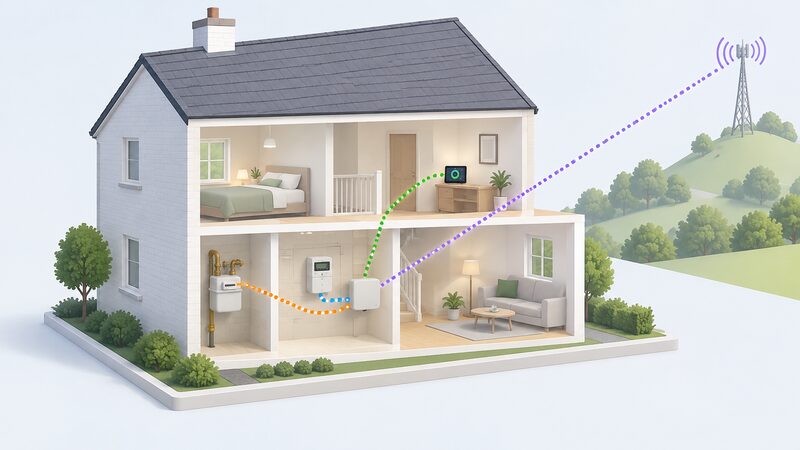
Coverage is uneven. Installation rates in London were only 43% as at March 2023, well behind the national picture16. Devices being deployed in 2018 could connect smart meters to in-home displays in up to 70% of premises, a reminder that the in-home link is a separate constraint from the network link16. Thick walls, metal meter cupboards, basements and meters positioned outside the dwelling all attenuate the signals involved.
Where mobile reception is poor, options narrow rather than disappear. One route is a first generation meter using the mobile network, which may have difficulties sending readings automatically; another is to insist on a second generation SMETS2 meter17. Where the meter is outside the property, for example a flat with a communal meter box, an application can still be made18. Meter position can create problems of its own after installation: an ombudsman case records a consumer unable to check the reading because of where the screen sat on the new gas meter19. Households in flats and shared buildings may find the page on monitoring in flats and rented homes and the explanation of how smart meters communicate useful alongside this one.
Government has been looking into options for the 0.75% of homes outside wide area network coverage1. For those households the dependence is stark: no meter communications means manual readings, and the flexible tariffs and schemes that reward shifting demand remain closed.
Renters, landlords and blocks of flats: who decides and who can book
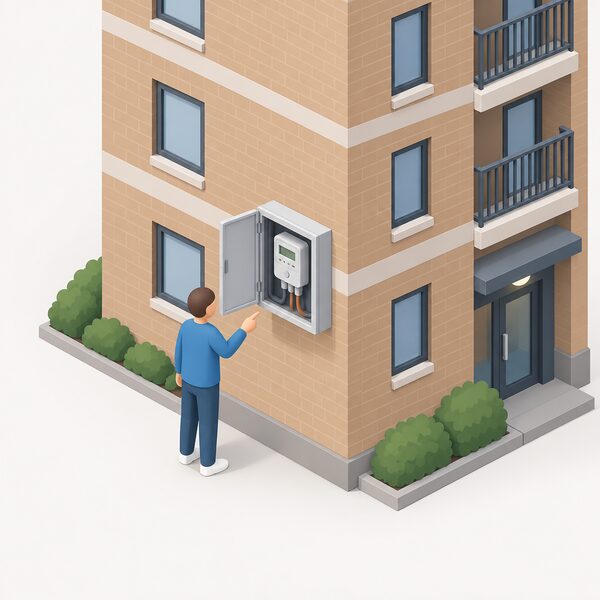
The rule is simple and it follows the money. Whoever pays the energy bills organises the smart meter installation20. Any household that pays for energy, whether owning or renting, should be able to book an installation where it is expected to work in the property21.
| Situation | Who can request | Conditions |
|---|---|---|
| Tenant is the energy account holder | The tenant22 | Entitled to ask without the landlord's permission; Ofgem recommends telling the landlord12 |
| Landlord pays the bills directly | The landlord14 | It is the landlord's decision whether to install9 |
| Prepayment customer or meter outside the property | The bill payer18 | Flats with communal meter boxes can still apply18 |
Even where the tenant is the bill payer, the tenancy agreement can intervene: there might be rules in the contract about how energy is supplied, including the type of meter that can be installed9. Private renters whose bills are in their own name, or who prepay for energy, can choose a smart meter after checking the tenancy agreement and letting the landlord know19. Where the landlord pays, a tenant can still end up with a smart meter, but the landlord has to organise it23.
This is a real limit on a renter's control of their own energy data. The meter, the display and the data pathway all belong to an account the tenant may not hold. A household in that position cannot fix it by buying hardware: only the account holder can start the process.
How installation is arranged and what it costs
Suppliers run the rollout, so the offer comes to the household rather than the other way round: it will always be the energy supplier or a third party working on its behalf that comes to the house to change the meter, and they telephone or email to agree a time1. A household that wants to bring the date forward can contact its energy provider to ask about a smart meter installed at no extra cost, and suppliers' free phone and text phone numbers are published for those who prefer to book by telephone2. An installation covers an electricity and/or gas smart meter, an in-home display and a communications hub3.
There is no additional cost for installation, the cost having been covered through everyone's bills rather than charged at the door4. The exception is narrow: occasionally a supplier might need to carry out some extra work that requires the homeowner to cover the costs2. On the day, the installer should present a valid identity card including the company name and phone number, as well as their name and photograph, and where a gas meter is being fitted the installer will also perform a visual safety check on the gas appliances as part of the installation5. Power goes off briefly, which means the wifi router will be turned off during this time, but once it is switched back on the smart meter will not affect the wifi connection6.
None of this removes the supplier from the picture. The meter reports to the national communications network, which has been reviewed by the National Cyber Security Centre; only the energy supplier can see how much energy is used and when, and the network operator can access consumption data only with explicit permission7.
The obligation has moved more than once. The Rollout Framework ran as a four-year obligation from 1 January 2022 to 31 December 202524. Earlier still, the obligation was extended to the end of 2020 and then to the end of 2021 in response to the COVID-19 pandemic16. With the framework due to expire at the end of 20255, government consulted on a successor: completing the domestic rollout by installing smart meters in remaining domestic premises by the end of 203025, with every supplier required to take all reasonable steps to reach 100% domestic penetration by 31 December 20305.
The consumer-facing summary is that suppliers are required to offer a smart meter to all households and small businesses by the end of 20304, and that the deadline has been pushed back to the end of 203014. What the obligation does not do is force a supplier to fit one on demand: there is currently no requirement for suppliers to install a smart meter on request19. The duty is to offer and to take reasonable steps, not to guarantee a date for any one address.
In practice that means a household in a not-spot or with an unsupported meter type may wait years without breaching any rule, while a household in a well-covered area can usually book within weeks. Progress and targets are set out in more detail on the page covering the UK smart meter rollout.
Checking eligibility and booking an installation
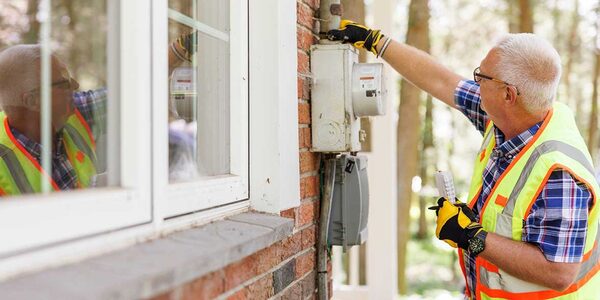
Getting a smart meter starts and ends with the supplier. Contact the energy supplier, which will say when one can be installed23. Network operators do not handle this: a distribution network operator will direct a household back to the electricity supplier, the company the bills are paid to, for smart meter upgrades and for help reading a meter18. Booking can be done online or by phone, and free phone and text phone numbers for a range of suppliers are published by the rollout campaign body23. Suppliers then telephone or email to agree a time to change the meter over23.
Eligibility may vary, and the published eligibility statements exclude Northern Ireland15. Northern Ireland runs a separate programme; initial installations of smart electricity meters there are expected to begin in early 2028, and the position is covered on the page for smart meters in Northern Ireland.
Where gas and electricity come from different suppliers, each supplier is responsible for its own meter, so two separate installations are needed17. The suggested order is the electricity smart meter first, then the gas18.
- Confirm who the energy account holder is, since only the bill payer can request an installation15.
- Contact the supplier, or each supplier where gas and electricity are separate17.
- Agree an appointment; for first time installations this should be offered within six weeks7.
- Arrange for someone aged 18 or over to be on the property26.
On the day: timing, power cuts and safety checks
The visit is short. It usually takes approximately one hour to install each smart meter, and the supply is switched off for typically 30 minutes for each meter fitted, gas and electricity26. Other accounts put the whole appointment at a couple of hours with each supply off during the changeover18, at about 90 minutes27, and one states the electricity supply will need to be turned off for up to an hour26. A wifi router will be off while the electricity is down, and works normally once the power returns26.
Key safety checks should be carried out during the appointment, and an in-home display should be offered and demonstrated21. Installers look for potential problems with electricity and gas, such as defective wiring, broken fuses or faulty boilers26, and where a gas meter is fitted a visual safety check on gas appliances forms part of the visit20. Those checks can find unsafe situations unrelated to smart meters28. This is also a common reason an installation is abandoned on the day: if the installer thinks there could be a major risk to safety, they can decide not to install the smart meter until it is fixed28.
No selling is permitted. No sales transactions can be carried out at the installation visit for domestic customers29, a code of conduct forbids installers from selling other products during installation30, and the supplier must have consent before the visit to discuss any purchasable goods or services, with marketing stopping on request29. Installers must provide energy efficiency advice as part of the visit14, and some providers offer a free energy efficiency inspection27. A fuller account of the appointment is on the page about smart meter installation.
Cost: free at the point of installation, with rare exceptions
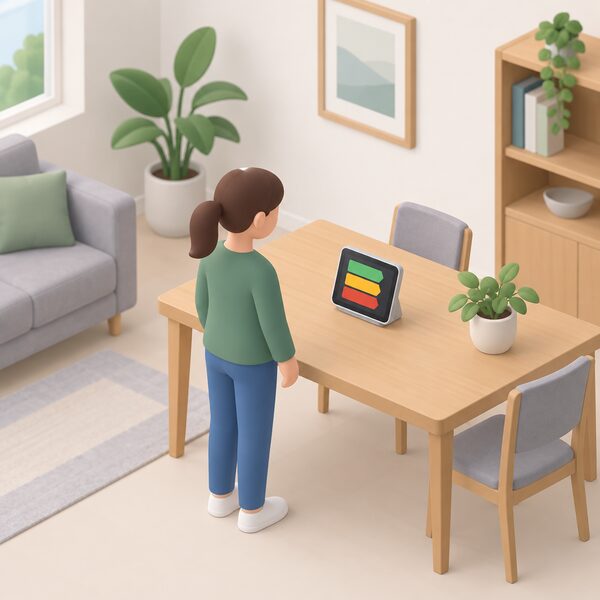
Suppliers must install smart meters at no extra cost, so a household should not be asked to pay to have one fitted4. Ofgem's own wording is direct.
"Contact your supplier to get a smart meter for free."
What is funded is the electricity and/or gas smart meter, an in-home display and a communications hub29. There is no upfront charge for the installation32, and the cost has been covered through everyone's bills20. That distinction matters: one consumer body argues energy companies should not call smart meters "free", because ultimately customers pay for them indirectly through bills32. Both statements are true at once, and the page on how much a smart meter costs sets the position out further.
The exceptions are narrow. Occasionally a supplier might need to carry out extra work that requires the homeowner to cover the costs29. Going the other way, only under exceptional circumstances would a supplier be expected to change a smart meter back to a traditional meter, and where it agrees it may charge the costs19.
If the meter will not work in smart mode: the Guaranteed Standards
Four new Guaranteed Standards of Performance introduce automatic compensation for consumers where a standard is not met33. The first covers appointment availability: for first time installations, where a smart meter is not already installed, the supplier must offer an appointment within six weeks of the request7. A supplier that is unable to physically install a smart meter is exempt from that timing requirement7. The second covers failed installations: where an installation fails due to a fault within the supplier's control, compensation is payable7.
| Standard | Trigger | Notes |
|---|---|---|
| Appointment availability | Appointment not offered within six weeks of request7 | First time installations only7 |
| Failed installation | Failure due to a fault within the supplier's control7 | Exemption where installation is physically impossible7 |
| Reported fault not addressed | Supplier does not give a resolution plan within five working days | £40 compensation, under rules from 23 February 202634 |
| Not operating in smart mode | Meter not in smart mode for over 90 days due to an issue within the supplier's control25 | Compensation payable7 |
"Not operating in smart mode" means a smart meter where the supplier cannot obtain automatic meter readings as expected, so the meter needs to be read manually3. The standard applies where no other party's action is needed to resolve the issue, the consumer has not agreed to the meter not operating in smart mode, and a solution exists3. Exemptions cover a consumer who requested no communication, cases where no appropriate technical solution is available, and situations turning on the consumer's own role in booking appointments or interacting with the meter25. The new standards were limited in scope to microbusiness customers among non-domestic users, excluding larger non-domestic customers and advanced meters7. Ofgem intends to review the outcomes in Q1 202733.
Compensation of £40 is owed where a supplier does not tell a household how it plans to resolve a reported smart meter problem within five working days35. Separately, a household may be eligible for compensation where it had to wait more than six weeks for an installation appointment, or the appointment failed because of a fault within the supplier's control30. For meter change appointments more generally, compensation applies where the supplier misses the appointment, changes it without agreement at less than one working day's notice, or sends an unqualified engineer without the right tools30. More detail sits on the page about smart meter guaranteed standards.
Opting out, and running a smart meter in traditional mode
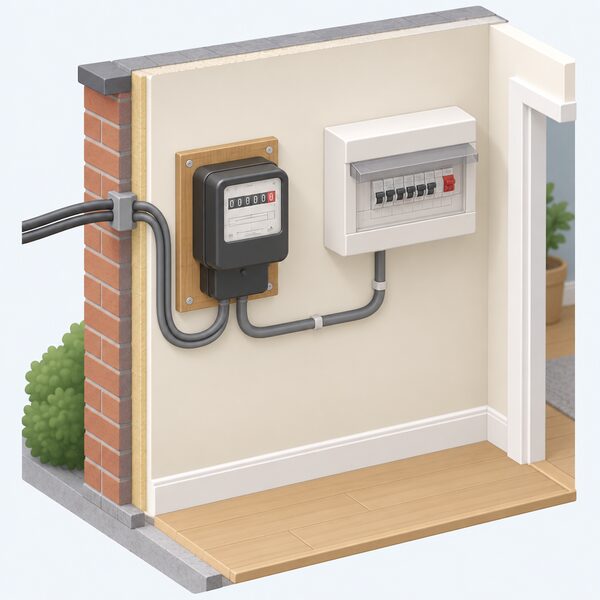
Refusing is a right. It is the household's right to refuse the installation of a smart meter19, there are no provisions allowing anyone to enter a property by force to install one, and consumers retain the right to refuse19. Smart meters are optional27.
The practical caveat is supply. Replacement options may be limited if a traditional meter is faulty or unsafe19, and most energy companies no longer stock traditional meters, so in practice a supplier will fit a smart meter when the existing one needs replacing30. A household can ask its supplier to fit a smart meter with its communications switched off, so that it operates as a traditional meter30. Suppliers may also offer to install smart meter technology with the communications function disabled, so it will not send readings automatically13. For households losing a Radio Teleswitch meter, a supplier may install a meter with the tariff pre-programmed: manual readings are needed and the full benefits are lost, but heating continues to work36. Where there is no signal at all, a non-communicating smart meter preset to switch between tariffs is the usual answer36.
Running in traditional mode is common, not exotic. Around 3 million domestic smart meters, 8.2% of the total, were working in traditional mode as at May 202634; a separate figure of 3.5 million not sending readings automatically was reported for August 202532. Manual readings remain possible throughout37. Causes include losing connection with the supplier, losing connection after changing supplier, and installation without connection to the national communication system37, as well as a supplier going out of business31. There is a cost to opting out beyond convenience: refusing may make it hard to access all tariffs34, and time of use tariffs and flexibility schemes require a smart meter29. The trade-off is set out on the page asking whether smart meters are compulsory.
Older meters and the 2G and 3G switch-off
Some smart meters rely on 2G or 3G mobile networks, and those networks are being phased out across the UK region by region, replaced by 4G38. Suppliers must replace all smart meters still connected to 2G and 3G before the services are switched off by 203339, and the smart meter network will transition to 4G before that date14. Costs of the 2G and 3G to 4G transition have been treated separately from the original rollout in the programme's cost and benefit accounting, with 2034 benefits reduced to reflect the switch-off5. On the 3G switch-off specifically, the network operator states that meters will continue to operate as normal because they will switch seamlessly to the 2G network40.
First generation SMETS1 meters carry a related problem. They can lose their smart functions when a household switches supplier, although the majority have now been reconnected to the smart meter network32; an older meter may stop sending automatic readings after a switch22, and a wireless update in 2022 was meant to fix this but some problems may remain36. First generation meters will either be migrated into the new smart data network or replaced with a second generation meter by the end of the rollout12. With a second generation meter, switching supplier keeps all smart functions without interruption12. Older meters may also not give access to future data services such as advanced time of use tariffs32. The differences are covered on the page comparing SMETS1 and SMETS2 meters.
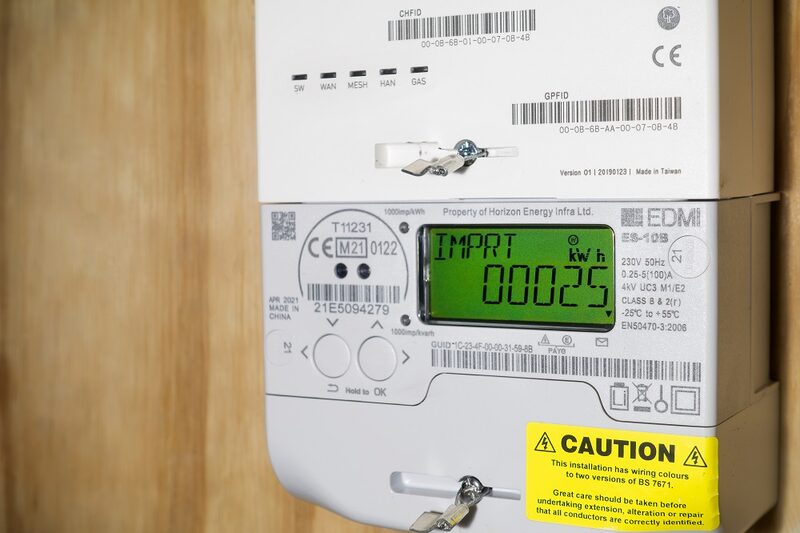
What this means for household energy independence
A smart meter is a measurement and communications device, not a source of supply. It does not generate electricity, store it or reduce consumption on its own: it measures household energy use and does not know when individual appliances are turned on or off32. A smart meter will not automatically save money34, and practical changes are needed to save energy20. Bills can appear to rise after installation where previous bills were based on low estimates and the meter is now tracking use accurately12.
What it does buy is visibility and access. It enables accurate rather than estimated bills20, though the first bill after installation may still be estimated12, and it is the gateway to time of use tariffs and flexibility schemes that are otherwise closed29. Data flows through the Data Communications Company network, which has been reviewed by the National Cyber Security Centre; only the energy supplier can see how much energy a household is using and when, and the DCC can only access consumption data with explicit permission40.
The dependencies are worth naming plainly: the meter belongs to the supplier, the appointment depends on the supplier's coverage and stock, the communications depend on a national network a household does not control, and the readings depend on a mobile technology that is being retired by 2033. A household that wants its own copy of the data, independent of the supplier's systems, has other routes, described on the pages covering consumer access devices and home energy monitors, and the wider picture sits on the smart meters and home energy management pillar.
Sources40 cited
- Delayed smart meter programme fails to hit targets, UK Parliament Public Accounts Committee, 2023-10-20
- Consumer-led flexibility: engagement proposals, Energy Saving Trust, 2025-12-19
- Smart Meter Guaranteed Standards of Performance consultation, Ofgem, 2025-03-28
- A guide to smart meters, Age UK, 2026-08-24
- Smart Metering Policy Framework: Post 2025 consultation, GOV.UK, 2025-08
- Understanding smart meters, National Energy Action, 2026-06-12
- Final decision: smart meter Guaranteed Standards, Ofgem, 2026-01-30
- The best way to start saving energy and money, ivie, 2026-09-20
- Help me decide on a smart meter, Smart Energy GB, 2026-03-16
- Smart meter FAQs, ScottishPower, 2026-09-17
- How do I change my smart meter, EDF Energy, 2026-09-17
- Smart meter myth busting, Smart Energy GB, 2026-09-17
- RTS meter switch-off, Energy Saving Trust, 2026-05-08
- Fully operational: consumer protection in smart metering, Which?, 2026-05-12
- Can I get a smart meter?, Smart Energy GB, 2026-03-16
- Update on the rollout of smart meters, UK Parliament, 2023-03
- Smart meter FAQs, Smart Energy GB, 2025-08-08
- How to get a smart meter, Data Communications Company, 2026
- Case studies: installation of smart meters, Energy Ombudsman, 2026-09-20
- Smart meters for landlords, Smart Energy GB, 2026-03-16
- Smart meters: your rights and expectations, GOV.UK, 2025-08-08
- Smart meters explained, Uswitch, 2026-07-29
- How to get a smart meter, Smart Energy GB, 2026-08-03
- Supplier smart metering installation targets, Ofgem, 2026-09-17
- Smart Meter Guaranteed Standard statutory consultation, Ofgem, 2025-08-08
- Getting a smart meter installed, Smart Energy GB, 2026-04-01
- Smart meters, Welsh Government, 2026
- Smart meter disadvantages, Smart Energy GB, 2026-03-16
- Do I have to get a smart meter?, Smart Energy GB, 2026-04-01
- Smart meter installation, Which?, 2026-02-26
- Get help with your smart meter, Ofgem, 2026-09-17
- Guide to smart meters, Which?, 2026-04-07
- Smart meter Guaranteed Standards draft impact assessment, Ofgem, 2025-08
- Smart meter problems and solutions, Which?, 2026-05
- Top energy company issues and how to solve them, Which?, 2026-03-03
- Important reminder for Economy 7 and 10 meters, Centre for Sustainable Energy, 2026-06
- Smart meter performance, Ofgem, 2026
- SMETS1 and SMETS2 smart meter generations, OVO Energy, 2026-04-21
- Tough new rules force suppliers to fix faulty smart meters, GOV.UK, 2026-03-10
- Do smart meters use 3G?, Data Communications Company, 2024
 Smart Meter RulesCan your supplier make you have a smart meter?
 Smart Meter InstallationCan your supplier make you have a smart meter, and how long should you wait for an appointment?
 Smart Meter Faults and FixesYour smart meter has stopped working.
 Monitoring in Flats and RentalsCan you get a smart meter in a rented flat, and who decides?
 Meters and Energy IndependenceDo smart meters really save you money, and can you still get one fitted for free?
 The Full Smart Meters GuideDo smart meters really save you money, and how do you use one to cut your bills?