In this guide
The UK smart meter rollout is the national programme to replace analogue gas and electricity meters with smart meters, run by energy suppliers under a licence obligation rather than by government directly. As of the end of March 2025 there were 39 million smart meters in domestic and non-domestic premises across Great Britain, and 67% of all meters were smart or advanced meters, with 35 million operating in smart mode1.
The programme has missed every completion date it has been given. The original vision, set out in 2011, was for every home and small business in Great Britain to have smart meters with the rollout complete in 20193. That became the end of 2020, then a 2022 to 2025 framework with binding annual supplier targets, which has now concluded4. The government has consulted on a post-2025 framework that would require suppliers to take all reasonable steps to reach 100% domestic smart meter penetration by the end of 20306.
For a household, the rollout is the mechanism by which a home gets the meter that makes half-hourly consumption data available, and it is the precondition for time-of-use tariffs, demand flexibility payments and accurate billing without manual reads. It is also a programme a household cannot drive: the pace is set by suppliers, the network is national, and the meter remains dependent on a communications infrastructure the household does not own.
The rollout in short
The rollout is a supplier obligation, not a consumer one. Energy suppliers have been rolling out smart meters since 2012, and in 2012 the government placed a legal obligation on suppliers requiring them to take "all reasonable steps" to install smart meters3. The obligation sits in the supply licences, and the current wording still requires suppliers to take all reasonable steps to complete the smart meter rollout10.
The scope is broad. The rollout is part of a national government programme to replace all old meters with new smart meters, including prepayment versions11. It covers domestic and smaller site non-domestic customers, and the original ambition was over 50 million meters to be installed in 30 million premises12. Around 3 million of the meters in scope belong to small businesses9.
There is no legal requirement for a household to have a smart meter. The programme is framed as an offer: by 2020 every home and business in Britain was to have been offered a smart meter8. The distinction matters, because it means the completion date is a target for suppliers' activity, not a deadline a household is obliged to meet.
Progress: 39 million meters, 67% of the total
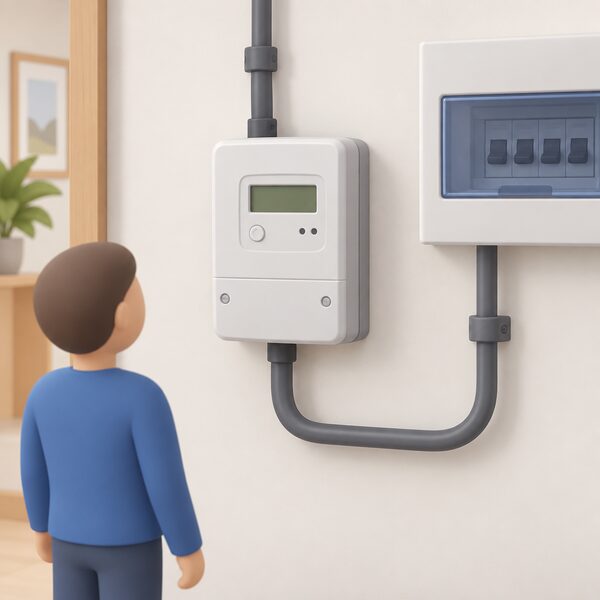
The published numbers come in two forms: how many meters exist, and what proportion of the total they represent. Both matter, because the second is the one the targets are written against.
At the end of March 2023 there were 57,053,996 meters in total in households and small businesses, of which 32,362,992 (57%) were smart meters9. By the end of March 2025 the count had reached 39 million smart meters in domestic and non-domestic premises, over two-thirds of all meters1. The March 2025 position was 67% of all meters smart or advanced, with 35 million (61%) operating in smart mode2. Non-domestic meters lagged slightly, at 63% smart or advanced at the end of Q1 20256.
| Measure | Figure | Date | Source |
|---|---|---|---|
| Smart meters installed, Great Britain | 39 million | End March 2025 | 1 |
| Share of all meters smart or advanced | 67% | March 2025 | 2 |
| Meters operating in smart mode | 35 million (61%) | March 2025 | 2 |
| Non-domestic meters smart or advanced | 63% | End Q1 2025 | 6 |
| Total meters, households and small businesses | 57,053,996 | End March 2023 | 9 |
| Smart meters at March 2023 | 32,362,992 (57%) | End March 2023 | 9 |
The gap between "installed" and "operating in smart mode" is the number that most affects households. A meter that has lost its communications link still measures and bills, but it does not deliver the remote readings and tariff functions the programme was built around. The national network operator runs a programme to address non-communicating smart meters, and the 2G and 3G to 4G transition is being handled separately from the original rollout, with costs related to that transition excluded from the benefits calculation and benefits for 2034 reduced to reflect the 2G and 3G switch-off13.
Consumer experience of the programme has been more positive than the delivery record. Government reporting found that 9 in 10 are satisfied with the installation process, 4 out of 5 people with a smart meter say it gives them a better idea of their energy costs, and nearly two-thirds of people would recommend one to friends and family10.
What drives the pace of installation
The pace of installation is set by supplier performance against annual targets, and the record is one of consistent shortfall. In 2022, 13 large suppliers installed 3.7 million meters against their combined target of nearly five million9. The Public Accounts Committee described the programme as delayed and failing to hit targets and secure public support, noting that only 57% of all meters in Great Britain were smart at March 2023, over a decade after the rollout began14.
Several forces explain the gap. The programme has run for over 12 years, and the technical architecture changed mid-course: the government's stated priority became for suppliers to commence a rollout of SMETS2 meters following DCC Live, which reset installation plans for suppliers that had already deployed first-generation equipment16. The energy retail market also contracted sharply, with 29 suppliers exiting the market in 2022, removing installation capacity and leaving their customers to be absorbed by surviving suppliers9.
"In total, these 13 suppliers installed 3.7 million meters against their combined target of nearly five million."
The framework itself has been repeatedly rebuilt. A six-month extension to the existing obligation was followed by a new four-year framework from July 2021, setting minimum annual installation targets for energy suppliers17. The 2022 to 2025 framework then replaced that arrangement with binding annual targets, and the government set strict future annual targets that could result in fines if missed4. The amendments were designed to prompt suppliers to keep their plans under review, on the basis that suppliers will develop their approach to the installation of smart meters as the programme progresses19.
The result is a programme whose targets are enforced through the licence rather than through consumer demand. Uptake among consumers rose from 62% in August and September 2023 to 68% in January 2025, which is a measure of household acceptance rather than of supplier delivery20.
Great Britain, and Northern Ireland separately
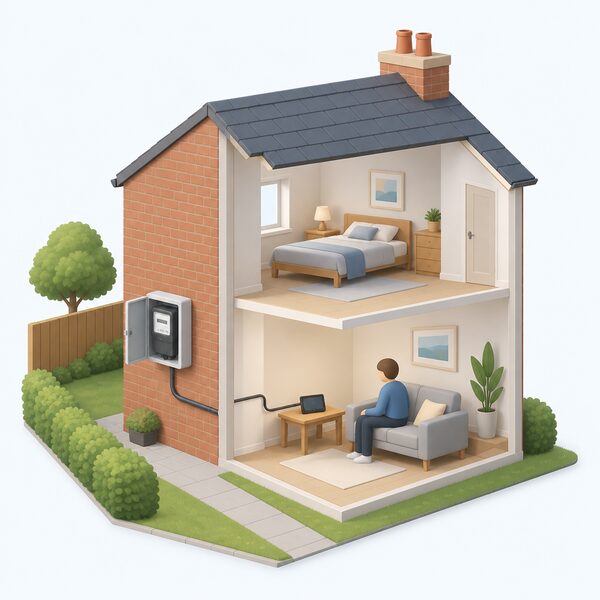
The rollout is a Great Britain programme. The statistics are published as quarterly updates on the roll-out of smart meters in Great Britain, covering meters operating and meters installed, and the releases report the number of smart meters installed in the last quarter and the total in operation by the larger energy suppliers21. England, Scotland and Wales are covered by the same supplier obligation and the same national communications network.
Northern Ireland is not part of that arrangement. The published figures for the programme are consistently framed as Great Britain, and the 57% figure for March 2023 is explicitly given as England, Scotland and Wales combined15. A household in Northern Ireland therefore sits outside the targets described on this page, and the installation timetable there is set separately.
Within Great Britain, the differences that matter are practical rather than regulatory. Scotland has a distinct policy interest in the rollout's relationship with fuel poverty, and Scottish Government research on the lived experience of fuel poverty examines how households manage energy in constrained circumstances23. Ofgem has also worked on protections for households that self-disconnect and self-ration, which bear directly on how prepayment smart meters are used in practice24.
The four nations also differ in how the meter interacts with support. The smart meter is the enabling device for prepayment functionality, time-of-use tariffs and flexibility payments, and access to those varies by supplier and by network area rather than by nation. Where a household cannot get a smart meter at all, the reasons are typically technical, such as the property's location or the meter's position, rather than a national policy difference.
The rules: licence conditions and annual milestones
The rules are set through supply licence conditions and Ofgem decisions, not through consumer legislation. The core obligation is that suppliers must take all reasonable steps to complete the smart meter rollout, and the framework around it sets annual milestones that suppliers must meet10.
The 2022 to 2025 Rollout Framework ran from 1 January 2022 to 31 December 2025 as a four-year obligation, and it has now concluded5. Ofgem's decision on amending the framework for regulating large energy suppliers in respect of their smart meter rollout plans and annual milestones marks the transition to a new phase in the smart meter programme4.
The post-2025 arrangements are the subject of consultation rather than settled rules. The consultation proposes that every energy supplier would be required to take all reasonable steps to reach 100% domestic smart meter penetration by the end of 2030, with annual rollout milestones running to 20306. It also sets out a communications deadline: communications hubs using 2G or 3G, and associated metering devices as relevant, would need replacement with 4G-capable devices by the end of 2033, ahead of the 2G and 3G services closing by the end of 20336.
Once the Department considers the rollout complete, responsibility for smart metering will pass to Ofgem and the Smart Energy Code governance3. That handover is the point at which the programme stops being a delivery project and becomes a regulated steady state.
What the rollout means for energy independence
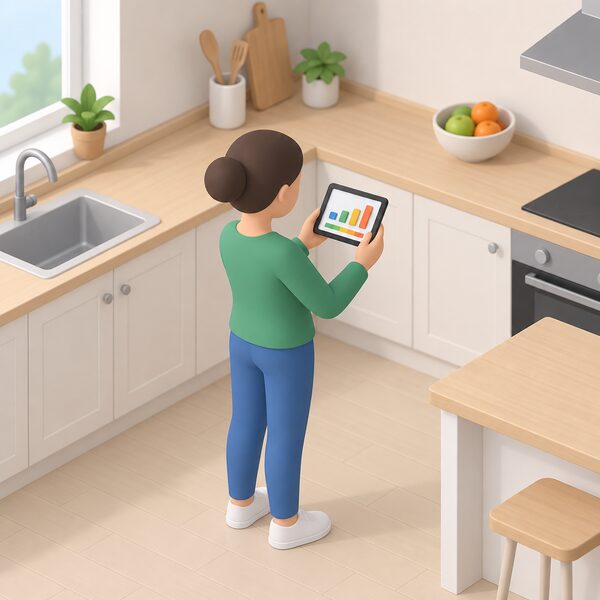
A smart meter changes what a household can do with its own consumption data, and that is the substance of its contribution to energy independence. The data provided by a smart meter puts a household in control of its energy usage, meaning energy-saving steps can be taken to reduce CO2 emissions26. Government has framed the same point as smart meters putting consumers in control of their energy use, allowing energy efficiency measures that help save money on bills, offset price increases and reduce carbon emissions12.
The scale of the claimed national benefit is £5.7 billion, the figure the government has stated the rollout will save Britain8. The 2019 estimate of the benefits of the smart meter rollout over the period 2013 to 2034 was £19.5 billion in 2011 prices9. Both figures are modelled programme benefits rather than a household's bill reduction, and the 2034 benefits have since been reduced to reflect the 2G and 3G switch-off1.
What remains dependent is substantial. The meter communicates over a national network rather than the household's own broadband, and readings are routed through that infrastructure27. The meter is supplied and maintained by an energy supplier, so the household's access to data runs through a commercial relationship it does not control. The rollout is implemented by energy suppliers across the country, who are installing millions each year, which means the pace of a household's own upgrade is set by a supplier's programme rather than by the household28.
The independence gain is therefore informational and tariff-based rather than physical. A smart meter does not generate energy, store it or disconnect a home from the grid. It makes consumption visible at half-hourly resolution and makes the home addressable by flexibility schemes and time-of-use pricing. For a household pursuing genuine self-sufficiency, the meter is the measurement layer that makes the rest of the system legible, and it is worth reading alongside how smart meters work and smart meters and energy independence.
The brands and product ranges in UK homes
The meters themselves are made by a small number of manufacturers and installed under supplier brands. The rollout is not a consumer product market: a household does not choose a meter, and the model installed depends on the supplier's procurement and the property's requirements.
The national communications infrastructure is operated by the Data Communications Company, which also runs the programme addressing non-communicating smart meters13. Smart Energy GB is the not-for-profit campaign helping everyone in Britain understand the importance of smart meters and their benefits to people and the environment, and it is the body behind most public information about the rollout28.
For households wanting detail on specific suppliers and equipment, the site covers British Gas smart meters, EDF smart meters, E.ON Next smart meters and ScottishPower smart meters, along with the meter manufacturers Landis+Gyr and Secure Meters. The generation of meter a household has, and what it can do, is covered in SMETS1 and SMETS2 smart meters explained.
Sources29 cited
- Smart meters statistics collection, GOV.UK, 2025
- Smart meter Guaranteed Standards of Performance draft impact assessment, Ofgem, 2025
- Update on the rollout of smart meters, National Audit Office, 2023
- Supplier smart metering installation targets, Ofgem, 2026
- Supplier smart metering installation targets (Welsh language), Ofgem, 2026
- Smart metering policy framework post-2025 consultation, Department for Energy Security and Net Zero, 2025
- Does a smart meter save money?, Smart DCC, 2024
- Best practice guidance for energy efficiency advice during smart meter installation visits, GOV.UK, 2017
- Update on the rollout of smart meters: report, Public Accounts Committee, 2023
- Government sets out plans to drive up smart meter installations, GOV.UK, 2020
- What happens to my smart meter when I change supplier?, Smart DCC, 2023
- Second annual progress report on the roll-out of smart meters, GOV.UK, 2013
- How we're working to support customers to address non-communicating smart meters, Smart DCC, 2026
- Delayed smart meter programme fails to hit targets and secure public support, Public Accounts Committee, 2023
- Smart metering rollout strategy, GOV.UK, 2015
- Smart meter rollout and the default tariff cap working paper, Ofgem, 2021
- Statutory consultation on extending protections for non-E7 restricted meter customers, Ofgem, 2020
- Decision to amend the framework regulating large energy suppliers' smart meter rollout plans, Ofgem, 2017
- Decision to amend the framework regulating large energy suppliers' smart meter rollout plans (Welsh language), Ofgem, 2017
- What drives consumer satisfaction with energy suppliers, Ofgem, 2025
- Statistical release and data: smart meters, Great Britain, quarter 4 2014, GOV.UK, 2015
- Research on the lived experience of fuel poverty in Scotland, Scottish Government, 2023
- Self-disconnection and self-rationing final impact assessment, Ofgem, 2020
- Smart meters and decarbonisation, Smart DCC, 2026
- How do smart meters send readings?, Smart DCC, 2026
- Do you have to have a smart meter by law?, Smart DCC, 2026
- Smart meters: your rights and expectations, GOV.UK, 2024
- Retail energy markets in 2016, Ofgem, 2016
- Final proposals and statutory consultation on data privacy, Ofgem, 2014
 Why You Cannot Get a Smart MeterWhy can some homes not have a smart meter fitted, and what counts as a good enough reason?
 Smart Meters in Northern IrelandWhen are smart meters coming to Northern Ireland?
 The Full Smart Meters GuideDo smart meters really save you money, and how do you use one to cut your bills?
 Smart Meter RulesCan your supplier make you have a smart meter?
 Meter Standards and AccuracyHow UK smart meters are certified for accuracy, how their readings become a bill, what happens when a meter stops communicating, and how a metering or billing dispute is escalated to a supplier and then to the Energy Ombudsman.
 Smart Meter Faults and FixesYour smart meter has stopped working.