

In this guide
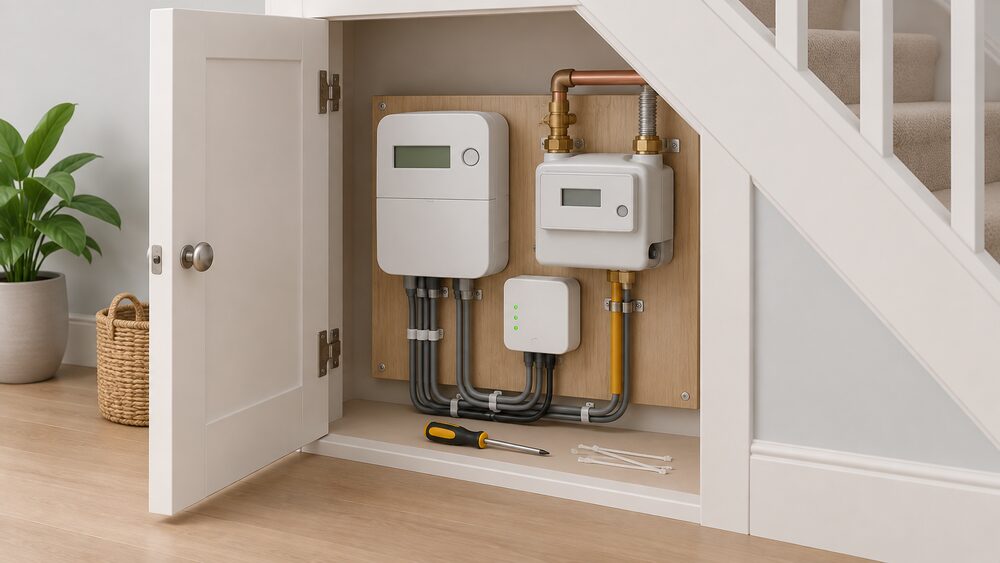
E.ON Next installs SMETS2 smart meters free of charge, and states that it aims to change a meter in about an hour, so a visit covering both gas and electricity takes a couple of hours1. The meters send gas and electricity readings to the supplier automatically, which is what moves a household from estimated bills to monthly billing based on what was actually used1.
The obligation behind the visit is national rather than commercial. E.ON Next states it has "an obligation to install smart meters as part of a government-led nationwide upgrade programme", and that the Government requires suppliers to roll out smart meters as standard to homes and small businesses across Britain1. Ofgem's own guidance is simpler: contact your supplier to get a smart meter for free2.
What a household gains is accurate billing without manual readings and, with a smart prepayment meter, the ability to top up remotely. What remains is dependence: on E.ON Next as the supplier, on the national communications network that carries the readings, and on the supplier's systems for billing and top-up. A smart meter does not generate energy or reduce reliance on the grid. It changes how the relationship with the supplier is measured and administered.
What E.ON Next offers: a free SMETS2 meter and what it does
E.ON Next fits SMETS2 meters, and its technician checks the mobile signal and sets the meter up during the visit1. SMETS2 is the second generation of the national specification, and the practical point of it is that the meter can be operated across suppliers through the national network rather than being tied to the company that installed it. The differences between the two generations are set out in SMETS1 and SMETS2 meters.
The function is narrow and specific. A smart meter automatically sends electricity and gas meter readings to the supplier2. Independent guidance describes the same mechanism: smart meters send gas and electricity readings straight to the energy supplier, which uses the information to produce an accurate bill based on how much energy has been used5. That replaces the manual read and the estimate that follows a missed one.
The cost position is consistent across official and independent sources. Ofgem states that a householder contacts their supplier to get a smart meter for free2, and independent guidance repeats that changing to a smart meter is free7. There is no separate charge at installation; the rollout is funded through the wider cost base of energy supply.
For a household thinking about independence, the honest summary is that a smart meter is an accounting and communications device. It does not reduce consumption by itself, and it does not remove the need for a supplier. What it does is give the supplier a continuous, accurate picture of use, which is the precondition for time-of-use tariffs, half-hourly settlement and flexibility payments. Those are covered in smart meters and time-of-use tariffs and half-hourly settlement.
Eligibility and how to book

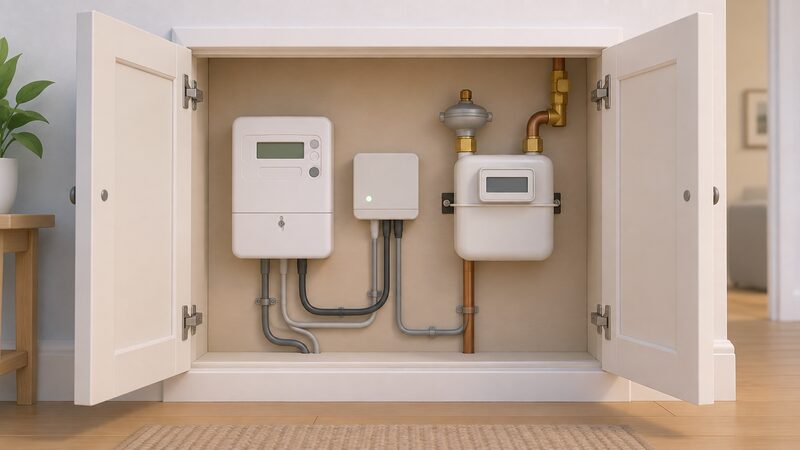
The offer is open to E.ON Next's domestic customers, and booking runs through the supplier. Independent guidance is direct on the route: you can contact your supplier to request a smart meter8. Smart Energy GB's request tool works by searching for the supplier, selecting it, and being sent to that supplier's website to take the request forward, which may require logging into an account9.
E.ON Next asks customers to flag circumstances at the point of booking. The list it publishes covers households where anyone is of pensionable age, over 80, under 5 or under 17; where there are medical conditions or a dependency on energy supply; sheltered accommodation; an appointment with someone else present; and where British Sign Language is needed to declare something when booking1. These are conditions the supplier wants to know about in advance, not eligibility tests that exclude a household.
| Circumstance to declare at booking | Detail |
|---|---|
| Age | Anyone of pensionable age, over 80, under 5 or under 171 |
| Health | Medical conditions or a dependency on energy supply1 |
| Housing | Sheltered accommodation1 |
| Visit | An appointment with someone else present1 |
| Communication | British Sign Language needed to declare something when booking1 |
There is a national limit worth stating plainly. Smart Energy GB notes that eligibility may vary and that the scheme excludes Northern Ireland10. The arrangements in Scotland, Wales and Northern Ireland differ from England, and the position in each is set out in smart meters in Scotland, smart meters in Wales and smart meters in Northern Ireland.
Where a property genuinely cannot take a meter, the practical outcome is a place on a future contact list rather than a refusal. One supplier explained that customers who cannot currently have smart meters would need to agree to be contacted about having one in future11. The reasons a property may not be suitable are covered in why you might not be able to get a smart meter.
Installation: what happens on the day
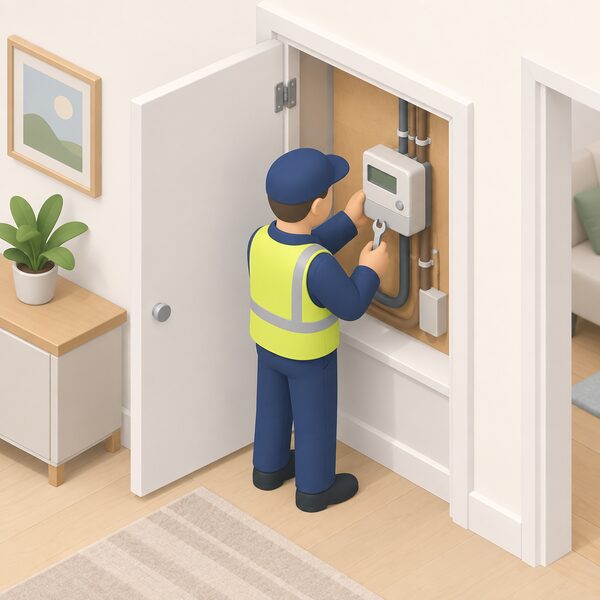
The visit is short. E.ON Next states it aims to change a meter in about an hour, and that a visit covering both meters takes a couple of hours1. The technician checks the mobile signal and sets up the new meters during that time1. The old meters are removed: E.ON Next states that it takes them away to be recycled1.
The work is governed by a code. E.ON Next states it installs smart meters "in accordance with the Smart Metering Installation Code of Practice, which is the industry standard for smart meters"1. That code covers how the visit is conducted and what the householder is told, and it sits alongside the technical standards every meter must meet. All smart meters must meet strict accuracy standards monitored by the Office for Product Safety and Standards, and must have undergone checks to ensure they meet UK and EU safety standards12.
Two practical consequences follow from the installation. The first is billing: E.ON Next states that once a smart meter is fitted, the household starts to benefit from monthly billing1. The second is the reading schedule. For customers whose smart meter was installed before November 2022 and who have not agreed a new tariff since, the default settlement data is daily3. Those customers can choose to opt into half-hourly readings or opt out to monthly readings, and customers who agreed a new tariff or had a meter installed after November 2022 can choose to opt out to daily readings3.
A fuller account of the visit, including what the installer needs access to and what happens afterwards, is in smart meter installation.
Timescales: appointments, responses and the standards E.ON Next must meet
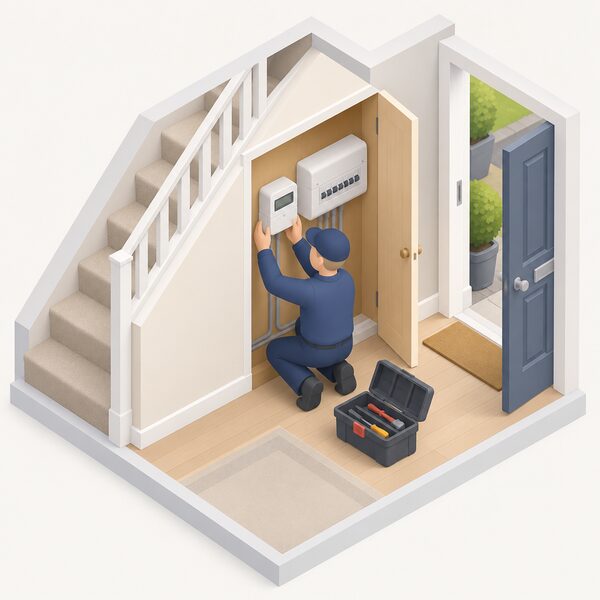
The published timescale is for the visit itself, not the wait for one. E.ON Next gives about an hour for a single meter and a couple of hours for both1. The interval between requesting an appointment and being offered one is not published in the material available, and it varies with engineer availability in the area.
What is published is the regulatory backdrop. The Rollout Framework ran between 1 January 2022 and 31 December 2025, described by Ofgem as a four-year obligation, and it has now concluded4. That framework set supplier installation targets; the current position is set out in smart meter rules and supplier obligations and the UK smart meter rollout.
On failures, Ofgem's Guaranteed Standards of Performance for smart metering provide that if a smart meter installation fails due to a fault within the energy supplier's control, the consumer will receive compensation14. Ofgem has consulted on automatic compensation for smart metering consumers where their energy supplier fails to meet certain expectations15. The scope of the standards as finalised is limited: the decision was to limit the scope of the new Guaranteed Standards to microbusiness customers with smart meters, excluding larger non-domestic customers and advanced meters14. Ofgem intends to review the outcomes of the standards in the first quarter of 202714.
The wider consumer framework is set out in the government's guide, which "sets out the standards energy suppliers should follow at each stage of the customer's smart meter journey"16. Faults are the supplier's responsibility: if a smart meter stops working, the householder contacts the supplier, which is responsible for maintenance and will fix or replace the meter as needed17. Fault handling is covered in more detail in smart meter faults and troubleshooting and smart meter guaranteed standards.
Smart PAYG: topping up, emergency credit and reconnection
A smart prepayment meter changes the mechanics of paying for energy in advance. Ofgem states that with a smart prepayment meter, you may be able to top up online or using your supplier's mobile app18. Independent guidance gives the same three routes: the supplier's app, website or by phone8.
That matters most when the alternative is a shop. A traditional prepayment meter needs a key or card taken to a payment point, which is a physical journey and a delay before credit lands. Remote top-up removes both, and it is the single clearest practical gain a smart prepayment meter offers a household managing a tight budget.
The conditions attached to prepayment, including emergency credit and the rules on self-disconnection, are covered in smart prepayment meters and smart pay as you go and how to check credit on a smart prepayment meter. The comparison with an older meter is set out in smart meter vs prepayment meter.
The dependence here is worth naming. Remote top-up depends on the supplier's app or website being available, on the communications network carrying the instruction to the meter, and on the supplier's systems processing it. When those work, the household is better off than with a key meter. When they do not, the fallback is the supplier's phone line.
Billing and data: how readings change your bills and how your data is used
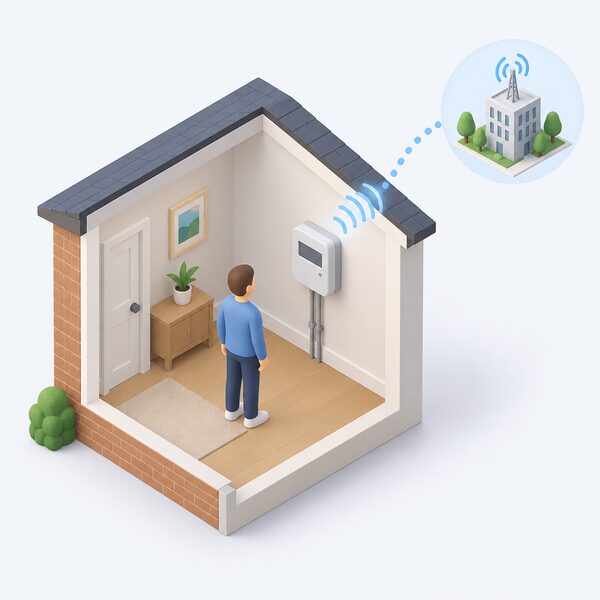
The billing effect is the point of the meter. Ofgem states that the data shared through a smart meter is used to bill you for the energy you use, to offer you new products and services such as new tariffs if permission has been given, and to help make the energy system more efficient by recording demand more accurately2. The billing use is repeated across official guidance2.
Where a reading does not arrive in time, the bill falls back on an estimate, and the correction follows. Independent guidance states that any differences between the estimate and actual energy use will be corrected on the next bill20. E.ON Next's own bill format shows "Customer reading" and "Estimated reading" labels where a customer does not have a working smart meter and has sent a manual reading21.
The reading schedule is a choice within limits. Customers with a meter installed before November 2022 and no new tariff since default to daily settlement data, and can opt into half-hourly or out to monthly readings; those who agreed a new tariff or had a meter installed after November 2022 can opt out to daily readings3. The frequency question is covered in how often do smart meters send readings.
Consent and access are separate matters from billing. The data a household generates, who can see it and what consent covers are set out in smart meter data and what consent you give for smart meter data readings. Independent work has looked at widening access to smart meter data through existing mechanisms, with a timescale of development through Smart Energy Code modifications over 12 to 18 months22.
The rollout deadline and the 2G and 3G switch-off
The framework that governed installations from 2022 has ended. Ofgem describes the Rollout Framework as running between 1 January 2022 and 31 December 2025, a four-year obligation that has now concluded4. What replaces it is a longer horizon: the government's cost and benefits work maintains a distinction between the original rollout and the technological upgrade from 2G and 3G networks to 4G, with costs related to that transition excluded and benefits for 2034 reduced to reflect the 2G and 3G switch-off23.
The communications change is the live issue. The smart meter network will transition to the 4G communications network before the 2G and 3G communications networks are switched off by 203324. The government's position is that suppliers must replace all smart meters still connected to 2G and 3G before the services are switched off by 203325. The Smart DCC states that smart meters will switch seamlessly to the 2G network following the 3G switch-off26.
The rollout itself has a completion target. The Smart DCC states the aim is to complete the rollout by the end of 203027. Once complete, responsibility for smart metering passes to Ofgem and the Smart Energy Code governance28. The transition is covered in will my smart meter stop working when 3G closes and how smart meters communicate.
For a household, the practical reading is that a meter fitted now is a 4G-capable device, and the replacement obligation falls on the supplier rather than the customer. The dependence on a communications network, however, does not go away.
E.ON Next as a supplier: status, complaints and contact
E.ON Next is an active domestic supplier. It appears in independent listings of suppliers participating in the Demand Flexibility Service as a domestic participant29. There is no administration or failure to report.
Contact routes are published but not entirely consistent. E.ON Next gives 0808 501 5200 for opting out of smart metering, changing data preferences or setting a passphrase1. Its published contact hours differ between pages: one states 8am to 10pm, seven days a week, while another gives 8am to 10pm, seven days a week for email, WhatsApp and social channels, with phone lines running 9am to 5pm Monday to Thursday and 9am to 4pm on Friday.
On satisfaction, the published figures also disagree. One independent source gives a Trustpilot score of 4.5 out of 5 based on over 162,000 reviews, while another gives 4.3 stars out of 5, both dated 20 September 2026.
The regulatory position is clearer. Ofgem's Guaranteed Standards of Performance provide compensation where an installation fails due to a fault within the supplier's control14, and Ofgem has consulted on automatic compensation for smart metering consumers where suppliers fail to meet certain expectations15. The government's guide sets out the standards suppliers should follow at each stage of the smart meter journey16, and the supplier is responsible for maintaining and replacing a faulty meter17.
For a household, the independence question is straightforward. A smart meter from E.ON Next keeps the home on the grid and on a supply contract, and adds a dependence on the supplier's systems, the national communications network and the supplier's app for prepayment top-up. What it removes is the manual reading and the estimate that follows it, and what it enables is accurate billing, remote top-up and access to tariffs and flexibility schemes that require half-hourly data. The wider picture is in smart meters, monitoring and energy independence and the full UK guide to smart meters and home energy management.
Sources29 cited
- Smart meter installation, E.ON Next, 2026-09-17
- Get help with your smart meter, Ofgem, 2026-09-17
- Market-wide half-hourly settlement, E.ON Next, 2026-09-17
- Supplier smart metering installation targets, Ofgem, 2026-09-17
- Easy read: what is a smart meter, Smart Energy GB, 2026-03-16
- Get prepared, National Energy Action, 2026-06-02
- Smart meters, Centre for Sustainable Energy, 2025-05
- How to read your gas meter, National Energy Action, 2026-07-13
- Don't know your supplier, Smart Energy GB, 2026-03-16
- Get a smart meter, Smart Energy GB, 2026-06-10
- Can you get a cheaper energy deal with a smart meter, Which?, 2019-11-28
- Smart meters and health, Smart Energy GB, 2026-03-16
- Energy UK explains smart meters, Energy UK, 2024-11-14
- Final decision: smart meter Guaranteed Standards of Performance, Ofgem, 2026-01-30
- Smart meters: your rights and expectations, Department for Energy Security and Net Zero, 2025-08-08
- Smart meters: your rights and expectations, Department for Energy Security and Net Zero, 2025-08-08
- Smart meters, Welsh Government, 2026
- Get help with your prepayment meter, Ofgem, 2026
- Getting a smart meter, Ofgem, 2026
- Troubleshooting smart meter issues, Smart Energy GB, 2026-04-01
- How do I read my E.ON Energy bill, Uswitch, 2025-09-10
- Data for good: smart meter data access, Energy Systems Catapult, 2023-10-03
- Smart Metering 2025 costs and benefits report, Department for Energy Security and Net Zero, 2025
- Smart meters explained, Uswitch, 2026-07-29
- Tough new rules force suppliers to fix faulty smart meters, Department for Energy Security and Net Zero, 2026-03-10
- Do smart meters use 3G, Smart DCC, 2024
- How we're working to support customers to address non-communicating smart meters, Smart DCC, 2026
- Public Accounts Committee report on the smart meter rollout, House of Commons Public Accounts Committee, 2023-10-20
- How does the Demand Flexibility Service work, Uswitch, 2025-09-04
 E.ON NextE.ON Next supplies gas and electricity to millions of UK homes, so what are its fixed and variable tariffs like, and how do they compare on price?
 E.ON Next TariffsE.ON Next offers fixed deals, a standard variable called Next Flex, an electric car tariff and rates that pay you for solar power you send back.