
In this guide
E.ON Next is the household-facing retail brand of the E.ON group in Great Britain, supplying electricity and gas to over 5 million customers1. It is a majority-owned subsidiary of E.ON SE of Germany, headquartered in Coventry, and it trades under the licensed entity E.ON Next Energy Limited2. For a household, that structure matters: the brand on the bill is British-facing, but the parent, the capital and the ultimate commercial decisions sit in Germany.
The company sells two main fixed fuel energy tariffs, both dual fuel, alongside variable tariffs that carry no term limit4. It runs a Smart Export Guarantee scheme for solar households, with the Next Flex Export v1 tariff paying 6p per kWh for exported electricity as recorded in April 20266. It also carries guaranteed standards obligations: a £40 payment where a reconnection takes longer than 24 hours and the delay was within its control, and a further £40 if that first payment is late7.
What follows sets out the tariffs, the prepayment and billing mechanics, the service standards and compensation, the published complaints figures, the export and energy technology offers, and how to reach the company. The lens throughout is what the supplier relationship does for a household's energy independence, and what dependence it leaves in place.
E.ON Next at a glance: who they are and what they supply
E.ON Next supplies electricity and gas to domestic customers across Great Britain. The brand sits inside a group of licensed entities: E.ON Next Energy Limited, E.ON Energy Solutions Limited, E.ON UK plc and Npower Commercial Gas Limited all appear under E.ON's encompassing licences2. A new domestic account is supplied by E.ON Next Energy Limited once the account is ready2. The company's history runs back to Powergen in 1989 and to a 2002 acquisition, and its headquarters are in Coventry3.
The customer base is stated by the company as over 5 million, delivering electricity and gas1. Independent guidance describes the majority owner as E.ON SE of Germany3. E.ON Next also participates in the domestic demand flexibility service, the scheme that pays households for shifting consumption away from peak times9.
For a household, the practical meaning is straightforward. E.ON Next is a large, established supplier with the scale to offer fixed, variable and export tariffs, and it is one of the suppliers named in independent guidance as helping customers with in-home displays older than a year10. It is also, like every licensed supplier, a counterparty a household depends on for billing, metering, reconnection and complaint handling. Switching away is possible on a variable tariff at any time, and the switching process itself is governed by the same guaranteed standards that apply across the market11.
The independence question is not whether E.ON Next is a good or bad supplier, but what the relationship leaves the household reliant on: a centralised grid, a national gas network, a billing and metering relationship, and a parent company's commercial strategy. A supplier can change tariffs, service levels and product lines; a household cannot change the wires or pipes.
Tariffs: fixed, variable and time-of-use options
E.ON Next's two main fixed fuel energy tariffs are both dual fuel4. Fixed tariffs can be started right away or at the end of the current tariff, giving a household control over when a new price period begins5. Variable tariffs carry no term limit, so a customer can switch supplier or move to a fixed dual fuel tariff at any time, and the price of each unit changes every 6 months5.
The company has run a series of fixed products through collective switching schemes. The USWCSS-APR26 collective switch ran from 1 to 13 April 2026 with E.ON Next's Next Fixed 14m Collective v1 as the winning tariff, and later rounds in May, June and September 2026 also produced winning E.ON Next tariffs12. These are scheme-specific products rather than the standard range.
On standing charges, the facts available do not show a zero standing charge tariff from E.ON Next. From June 2026 some suppliers, including British Gas, EDF, E.ON and Octopus, offer tariffs with a lower standing charge as part of a one-year Ofgem trial13. The Next Flex tariff, which applies to new residential gas connections while an account is set up, carries no exit fees14.
A household weighing independence should read the tariff structure rather than the headline rate. A fixed tariff fixes the unit price for a term but not the standing charge, and it does not change the fact that supply comes from the grid. A time-of-use tariff can reward shifting load, but it requires a smart meter and a willingness to move consumption. The Next Export Exclusive v3 tariff requires an E.ON Next import tariff, excluding time of use tariffs such as Next Drive, and is open to new and existing customers15.
| Tariff type | Term | Key condition |
|---|---|---|
| Fixed dual fuel | Fixed term | Two main fixed fuel tariffs, both dual fuel4 |
| Variable | No term limit | Unit price changes every 6 months5 |
| Next Flex | No exit fees | Default for new residential gas connections14 |
| Next Export Exclusive v3 | Export | Requires an E.ON Next import tariff, excludes time of use15 |
Prepayment and smart PAYG: topping up, emergency credit and reconnection
E.ON Next supports smart PAYG meters for both electricity and gas. Top-ups can be made online, through the E.ON Next app, or at a PayPoint or Payzone outlet16. On a smart prepayment meter the top-up travels over the national smart meter network rather than requiring a trip to a shop, which is how the DCC describes its prepayment service: end consumers add credit to their meters through an over-the-air top-up17.
If a household is struggling to top up, emergency credit can be activated to get the power back on temporarily16. Independent guidance describes the same mechanism: an emergency credit button that can be pressed for a bit of extra time before a top-up is possible18. Where a replacement key or card is needed, the meter reconnects once the new key or card is inserted with enough credit to cover any emergency credit used and any standing charges19.
Reconnection after disconnection for non-payment is covered by a guaranteed standard. E.ON Next states it will restore supply within 24 hours where it has agreed to turn the supply back on after disconnecting for non-payment7. The company's own reconnection guidance says it aims to restore supply within 24 hours of receiving the required payment or information16.
The dependence here is real and worth naming. A prepayment household depends on the meter, the top-up network and the supplier's credit rules. Emergency credit is temporary, and it is recovered from the next top-up. The smart meter network reduces the physical dependence on a shop, but it does not remove the dependence on having credit available.
Billing and Direct Debit: how bills are calculated and paid

E.ON Next bills a customer whenever a meter reading is submitted20. For customers paying a fixed amount by Direct Debit, an estimated bill is sent if no meter reading has been received for three months; for customers who pay when they get their bill, an estimated bill is sent every month if no reading has been received21.
The monthly fixed Direct Debit is calculated as an estimate of total yearly energy use split into 12 equal monthly payments, factoring in any credit or debt on the account21. The company describes the same method more broadly as 12 months of usage divided into equal payments, plus an amount to help build up a healthy credit balance20. Payments are deliberately calculated to build up credit in the summer to help pay for energy in the winter21. The amount is reviewed regularly and adjusted if energy use changes or prices change21.
New customers have their monthly payment estimated from the quote and the previous supplier, because actual data is only accessed after the switch under data protection guidelines21. A fixed energy tariff carries a discount for paying by Direct Debit4.
Where a credit refund is requested, E.ON Next checks first whether a bill has been issued within the last week or two, and whether the meter reading is up to date if the bill is based on estimates21. Direct Debit customers are entitled to a full and immediate refund of any erroneous payment from their bank or building society20.
| Billing point | E.ON Next rule |
|---|---|
| Billing trigger | Billed whenever a meter reading is submitted20 |
| Estimated bill, fixed Direct Debit | Sent if no reading for three months21 |
| Estimated bill, pay on bill | Sent every month if no reading21 |
| Direct Debit basis | Yearly use split into 12 equal payments21 |
| Seasonal pattern | Credit built in summer for winter use21 |
Service standards: guaranteed timescales and £40 compensation
E.ON Next publishes a set of guaranteed standards under the Electricity and Gas (Standards of Performance) Regulations 2015, covering domestic and Microbusiness customers7. The core promise is a £40 compensation payment within 10 working days where a standard is broken, and a further £40 Guarantee of Guarantee payment if the first £40 is not paid within 10 working days7.
On switching, E.ON Next states it will get everything sorted within 5 working days once the supply is ready to move over7. The company also commits to telling a customer who they should be supplied by within 20 working days if the customer contacted E.ON Next instead of the other supplier in an erroneous transfer case7. Ofgem's guidance on switching sets out the wider framework, including the supplier's obligation to pay £40 extra compensation if it takes more than 20 working days to reply after being told about a switching mistake11.
On appointments, E.ON Next gives at least 24 hours' notice if an appointment needs to be rearranged7. On reconnection, the aim is to restore supply within 24 hours of receiving the required payment or information16.
In Northern Ireland the network standards are separate and set by NIE Networks, not by the supplier. NIE Networks states that a missed response deadline attracts £25, and that supply restoration failures attract £50 for a home or £125 for business premises, then £25 for every 12 hour period after that22. Ofgem's guidance on power cut payments gives worked examples: a power cut lasting more than 12 hours and interrupted for 36 hours could attract 2 additional £45 payments, adding up to £90, and a cut lasting more than 24 hours and interrupted for 72 hours could attract 4 additional £45 payments, adding up to £18023.
Complaints performance: what the published figures show

E.ON Next publishes quarterly complaints data. In Q2 2026 the company opened 59,276 complaints and resolved 59,138, a rate of 760 complaints received per 100,000 customers and 758 resolved per 100,000 customers8. The largest single reason was customer service, at 32.28% of total complaints received, followed by payments at 12.16%, general billing and meter reading issues at 11.19%, and debt and debt-related disconnections at 10.40%8.
Over a longer window, E.ON Next states that between 1 October 2024 and 30 September 2025 it received 114,511 customer complaints that it could not resolve by the end of the next working day8.
Independent assessments are less flattering than the company's own presentation. In Which?'s assessment, E.ON Next scored 8 out of 15 on complaints10. Citizens Advice's comparison of domestic supplier customer service gives E.ON Next an overall rating of 3.71 out of 5 for January to March 202624. Ofgem's January 2026 supplier-level findings report a significantly lower proportion of E.ON and E.ON Next customers satisfied or very satisfied with customer service than the average25.
For a household, the practical reading is that complaint volumes are substantial and that the independent satisfaction measures are the ones to weigh when comparing suppliers. The wider context on how complaints are escalated is covered in complaining about an energy supplier, and the comparative picture sits in energy supplier customer service ratings.
Solar, SEG export and heat pumps for existing customers
E.ON Next runs a Smart Export Guarantee scheme for households with solar panels. The Next Flex Export v1 tariff pays 6p per kWh for exported electricity, for E.ON customers with solar panels and an installer capacity of up to 5MW, as recorded in April 20266. The Next Export Exclusive v3 tariff requires an E.ON Next import tariff, excluding time of use tariffs such as Next Drive, and is open to new and existing customers15.
The Next Solar Storage Steady product requires the household to be on an E.ON Next Smart Export Guarantee tariff, and carries zero exit fees, so a customer is free to switch to another E.ON Next tariff if circumstances change26. The company also offers energy technology for new homes, such as solar panels and EV chargers, with discounts for E.ON Next customers27.
The export rate is the point where a household's independence is most directly affected. A solar household that exports to the grid depends on the supplier for the payment, and the rate is set by the supplier rather than by the network. The 6p per kWh figure is a snapshot from April 2026 and is not a guarantee of future rates. The comparison of rates across suppliers is covered in green energy tariffs.
Heat pumps are not covered by the facts available for this page. What can be said is that E.ON Next's export and energy technology offers are aimed at existing customers, and that the Smart Export Guarantee tariff is the mechanism through which a solar household is paid for what it does not use.
Contacting E.ON Next: phone, WhatsApp, email and emergencies
The main home customer phone number is 0808 501 5200, and the home customer email address is hi@eonnext.com2. The Smart Export Guarantee team can be reached on 0808 501 5218, and home related emails go to hi@eonnext.com15. WhatsApp is available on 44808501520020.
For customers with speech or hearing difficulties, E.ON Next supports text relay: dial 18001 in front of the phone number you wish to call, and it connects automatically, at no extra cost2. The same prefix applies to the main phone number20. Independent guidance lists the refund line as 0808 501 5200, with a text telephone option for those with hearing difficulties, open Monday to Thursday 9am to 5pm and Friday 9am to 4pm28. A separate independent listing gives the contact number as 0808 501 520029.
The company states it is available 8am to 10pm, 7 days a week, with a response within hours via email or WhatsApp20. A separate E.ON Next page gives phone lines as 9am to 5pm Monday to Thursday and 9am to 4pm Friday, with email, WhatsApp and social channels running 8am to 10pm, 7 days a week2. The two documents disagree on phone hours, so a household should treat the shorter window as the safer assumption for a call.
On moving home, if E.ON Next is the supplier to a new home, a customer can give a few details and get set up online27. Existing customers can take their existing energy tariff to a new home, subject to exclusions: a new property linked to a prepaid or complex meter, different tariffs for electricity and gas, a single fuel to dual fuel change, gas only supply, or less than 20 days remaining on the fixed tariff contract term on the move-in date30. Independent guidance notes that a supplier might let a customer keep the same contract and tariff at a new home without charging a fee31.
On meter moves, E.ON Next can move a gas or electricity meter depending on where it is going, but cannot move a gas meter more than 90cm or an electricity meter more than 3m32. Only the current energy supplier can move a meter, so a cheaper quote from another supplier would require switching first32.
On final credit, E.ON Next refunds any credit left on the account within 10 days of sending the final bill, and states that a refund normally takes about 10 working days, longer for a large credit balance7. Compensation is paid into the energy account or sent as a refund if the customer has left7. The process for recovering credit after switching is set out in final bills and credit refunds.
Sources32 cited
- E.ON Next homepage, E.ON Next, 2026
- E.ON and E.ON Next explained, E.ON Next, 2026
- Which energy suppliers are British?, Uswitch, 2026
- Fixed tariffs, E.ON Next, 2026
- Electricity and gas, E.ON Next, 2026
- Smart Export Guarantee rates, Which?, 2026
- Standards of service, E.ON Next, 2026
- Our performance, E.ON Next, 2026
- How does the demand flexibility service work?, Uswitch, 2025
- Which? energy survey results, Which?, 2026
- Switch your home energy supplier, Ofgem, 2026
- The great energy savings switch, Uswitch, 2026
- Switching energy supplier, Scope, 2026
- Gas, E.ON Next, 2026
- Smart Export Guarantee, E.ON Next, 2026
- Reconnect your home energy supply, E.ON Next, 2026
- How do smart meters send readings?, Smart DCC, 2026
- Smart meter benefits for you, Smart Energy GB, 2026
- Lost key or card, E.ON Next, 2026
- Billing and payments, E.ON Next, 2026
- Fixed Direct Debits, E.ON Next, 2026
- Customer standards, NIE Networks, 2026
- Check if you can get payment for a power cut, Ofgem, 2026
- Compare domestic energy suppliers' customer service, Citizens Advice, 2026
- Customers' satisfaction with their supplier, Ofgem, 2026
- Next Solar Storage Steady, E.ON Next, 2026
- Moving home checklist, E.ON Next, 2026
- Energy refunds, Uswitch, 2025
- Help if you're struggling to pay your energy bill, Which?, 2026
- Moving home, E.ON Next, 2026
- Moving home: dealing with your energy supply, Citizens Advice, 2026
- Moving your meter, E.ON Next, 2026
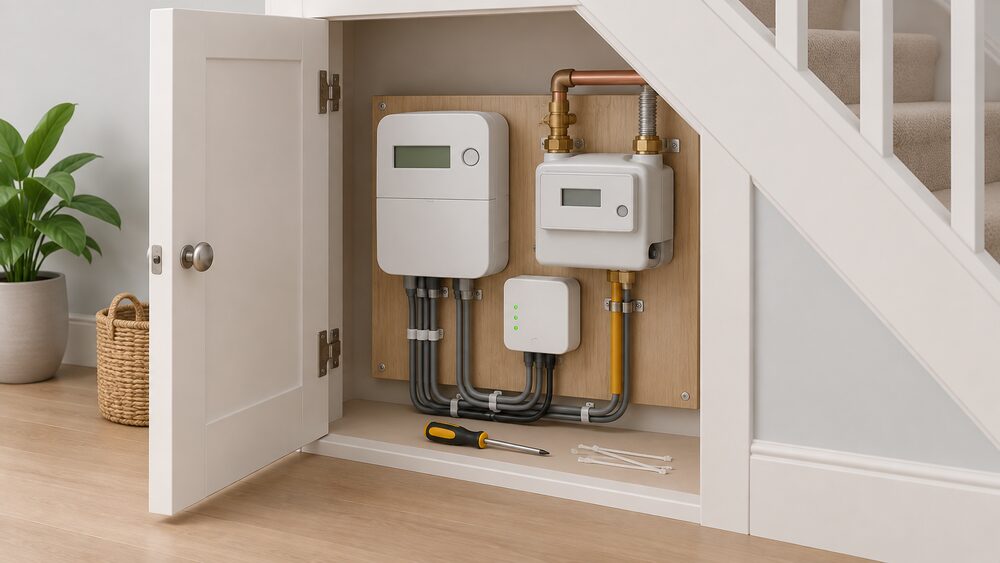 E.ON Next Smart MetersE.ON Next smart meters are fitted free, and most homes get both gas and electricity done in one visit of a couple of hours.
 E.ON Next TariffsE.ON Next offers fixed deals, a standard variable called Next Flex, an electric car tariff and rates that pay you for solar power you send back.