
In this guide
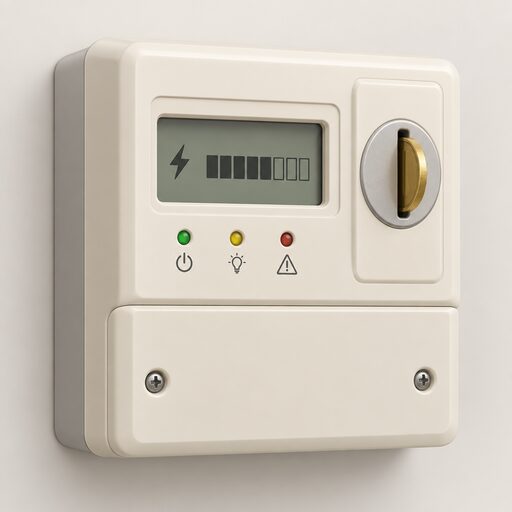
A prepayment meter is a meter that lets a household pay for electricity or gas in advance rather than after use1. Credit is loaded onto a key, a card or, on newer meters, an online account, and the meter releases energy until the balance reaches zero. Once credit runs out, no energy can be used until the meter is topped up again2.
The practical shape of pay as you go energy is simple: you buy credit before you consume, the meter deducts the daily standing charge and any debt repayment automatically, and the in-home display or meter screen shows what is left. Most suppliers provide emergency credit of around £10 to cover a gap between running out and the next top-up, and most prepayment meters have an emergency credit budget that works like a limited overdraft3.
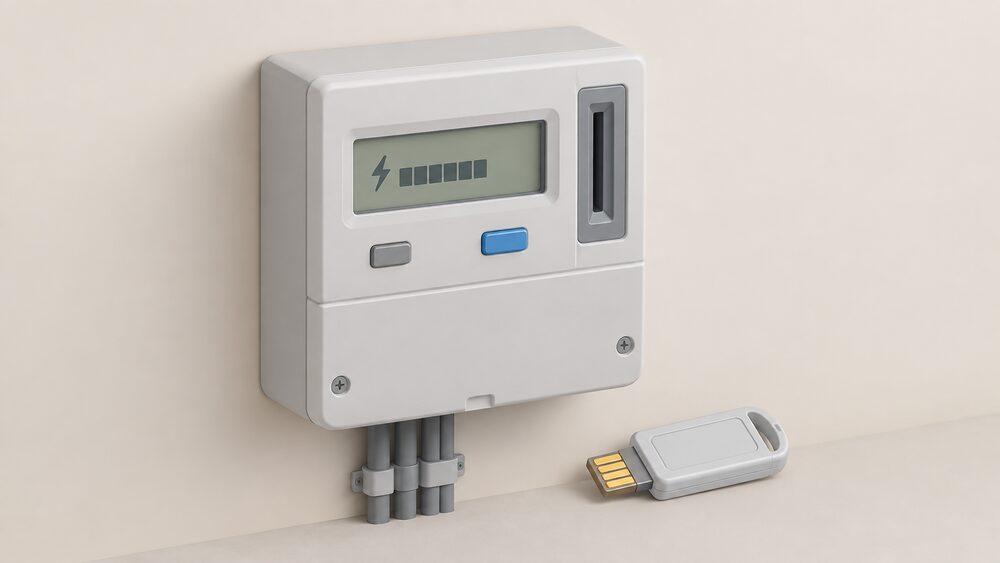
Prepayment is not a single product. There are three main types of prepayment meter: key meters, smart card meters and smart prepayment meters4. The first two are traditional, topped up at a shop with a physical token; the third is a smart meter set to prepayment mode, which can send readings automatically and be topped up remotely5. Which one a household has changes almost everything about how topping up, switching and reading the meter work.
What a prepayment meter is and how it works
A prepayment meter is used to pay for the electricity or gas you use in advance of using it10. The payment model is pay-as-you-go: money goes onto the meter before energy is drawn, and the meter stops supplying when the credit is exhausted. With a traditional meter, that means a smart card, key or token, and sometimes coins, used to pay for gas or electricity as it is used11.
The meter does more than count units. It deducts a standing charge, which is a fixed daily amount payable no matter how much energy is used, and it can also deduct any unpaid standing charge or fuel debt at the same time as credit is added12. That is why a top-up of a given size does not always translate into the same amount of usable credit.
Prepayment suits some households and is imposed on others. Ofgem's consumer guidance describes it as helpful for people on a tight budget who do not want to pay for what they use all at once, for those who want more control, and for those struggling with debt2. Suppliers often recommend a prepayment meter for customers already in fuel debt, set up to repay a specific amount each week based on affordability4.
For a household's energy independence, a prepayment meter is a mixed instrument. It removes the risk of a large catch-up bill and makes the cost of energy visible in real time, but it ties supply to a continuous act of topping up. The household depends on the meter, on the shop or network that carries the credit, and on the supplier's debt-recovery settings. It is independence from billing surprises, not independence from the grid or the supplier.
Key, smart card or smart prepay: the three meter types
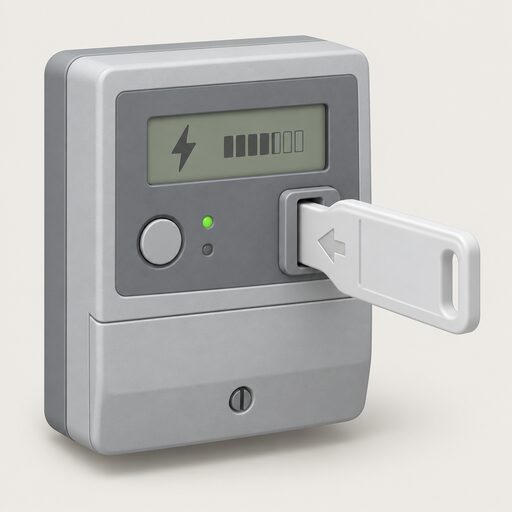
The three meter types differ in how credit reaches them and what the meter can do once it is there. Almost all traditional prepayment meters use either a key or a smart card, bought or loaded at an official PayPoint or Payzone outlet4. The token carries the credit to the meter, which is why a lost key or card interrupts supply until a replacement arrives.
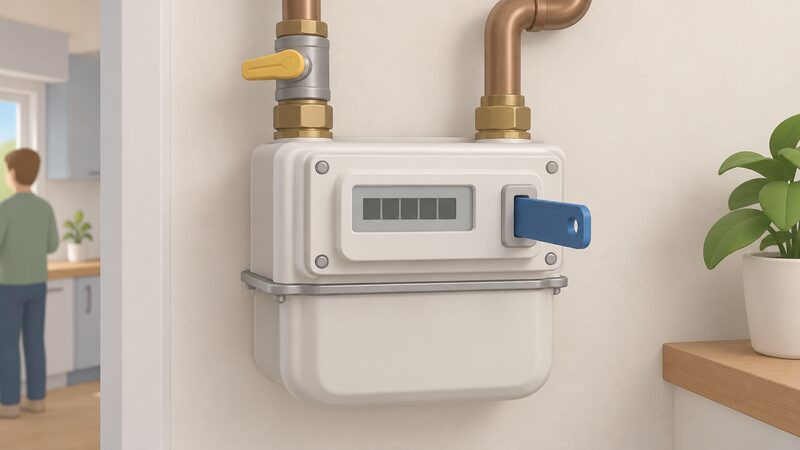
Smart prepayment meters are different in kind. A prepayment smart meter is a smart meter set to prepayment mode, so energy is still paid for in advance, but the meter measures gas and electricity use and can send readings automatically to the supplier5. Smart meters can operate in credit or prepayment mode, and the mode can be changed without a new meter being fitted13.
That flexibility matters for households that move between payment methods. If a household would prefer to change between credit and prepay, the supplier can make the change without a whole new meter being installed5. Eligibility is broad: whether on a pre-payment plan or renting, a household can benefit from a smart meter14.
| Meter type | How credit arrives | Key features |
|---|---|---|
| Key meter | Key loaded at a PayPoint or Payzone outlet | Traditional; token unique to the meter4 |
| Smart card meter | Card loaded at an outlet | Traditional; card unique to the meter4 |
| Smart prepayment meter | Online, app, phone or shop | Smart meter in prepayment mode; sends readings automatically5 |
Topping up: shops, online, app and phone
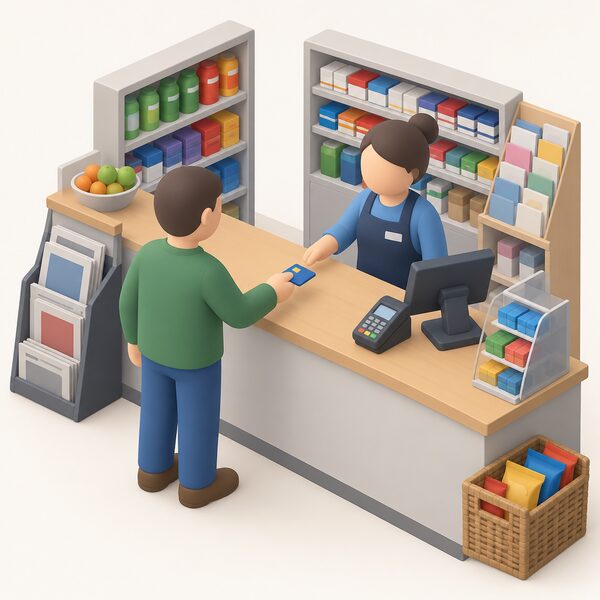
Where a household can top up depends entirely on the meter type. Traditional prepayment customers top up at a local PayPoint store or Post Office using the meter's key or card, or a barcode for smart prepayment meters1. Recognised PayPoint or Payzone shops and Post Offices are the standard network for electricity and gas meters4. In Northern Ireland, cards and keys are recharged at PayPoint outlets such as newsagents and Post Offices11.
Smart prepay widens the options considerably. Prepayment customers can top up in a shop or on their phones if they have a smart meter, whenever they choose15. Credit can be added online, on the phone, as well as in a shop16. Many suppliers allow customers to top up remotely using websites, apps, or phone services17. No gas card or electricity key is necessary for these top-ups, unlike traditional prepayment meters17.
The mechanism behind remote top-up is the smart meter network. The prepayment service allows end consumers to add credit to their meters through an over-the-air top-up over the network18. Cash remains an option for smart meters in prepayment mode: a Post Office, Payzone, or any shop with a PayPoint logo will take it19.
Suppliers can also agree alternatives where the standard routes do not work. A supplier might agree to give another way to top up a prepayment meter, for example by text message, a smart meter in prepayment mode that can be topped up online, or a credit meter that lets bills be paid monthly or quarterly19. That last option is the bridge out of prepayment altogether.
Emergency credit and friendly credit: what happens when the credit runs out
When regular credit runs out, the meter stops. Once credit runs out, no energy can be used until a top-up is made2. That is the defining risk of pay as you go energy, and it is why emergency credit exists.
Prepayment meters give a small amount of emergency credit designed to maintain supply after regular credit runs out, reclaimed from the next top-up4. Most suppliers provide emergency credit of around £10 in case a top-up cannot be made for any reason3. Most prepayment meters have an emergency credit budget that can be used like an overdraft, but it is limited4. Most pay as you go smart meter systems include emergency credit if the balance reaches zero, usually activated directly through the meter or the in-home display17.
Emergency credit is a loan, not a gift. Emergency credit and friendly credit usually need to be repaid in full before they can be used again16. A household that repeatedly leans on emergency credit will find it unavailable until the balance is cleared.
Friendly credit is a separate arrangement that keeps supply on outside normal hours. Power NI Keypad customers get £3 emergency credit when the low-credit warning sound is turned off6. If that emergency credit runs out after 4pm Monday to Thursday, supply stays on until 8am the following day; if it runs out after 4pm on a Friday, supply stays on until 8am the following Monday6. Friendly credit does not run out on 1 January, 17 March, 12 July or 25 December, with supply staying on until 8am the following working day6. All times are GMT, with an hour added during Summertime, and the 8am figure becomes 11am with Economy 7 and for other tariffs on request6.
Standing charges and debt: what your top-up actually pays for
A top-up is not simply credit. The meter takes the standing charge first, then any agreed debt repayment, and only the remainder becomes usable credit. The standing charge is a fixed daily amount payable no matter how much energy is used, deducted automatically along with any unpaid standing charge or fuel debt when credit is added12.
If a meter is not topped up, the daily standing charge starts to build as a debt, and later top-ups may be used to pay off previous weeks' unpaid daily standing charges21. A gas meter left idle over summer is the classic case: the household returns to a balance that has fallen without any gas being burned.
Debt repayment is set by agreement and can work in two ways. If the debt repayment is set at 30%, every £10 top-up means £3 goes towards the debt and £7 is added as credit21. If the debt repayment is set at £6 a week and £10 a week is topped up, £6 goes towards the debt and £4 is added as credit, with missed payments added up and deducted from the next top-up21.
Debt can also arrive on the meter from elsewhere. Debt from a credit meter account may be transferred onto a prepayment meter by the energy company, with automatic repayments taken each time the meter is topped up21. A household can owe money on a prepayment meter by using some or all of the emergency credit, missing a standing charge payment, or being on a repayment plan4.
Power NI Keypad sets a ceiling on recovery. The meter collects some arrears with each top-up, and this will not be more than 20% of each top-up6. At a 20% recovery rate, a £10 top-up gives £8 credit on the meter and £2 paid off the outstanding balance6. Customers with arrears are sent an annual account statement6.
Costs: the price cap, discounts and the budgeting trade-off
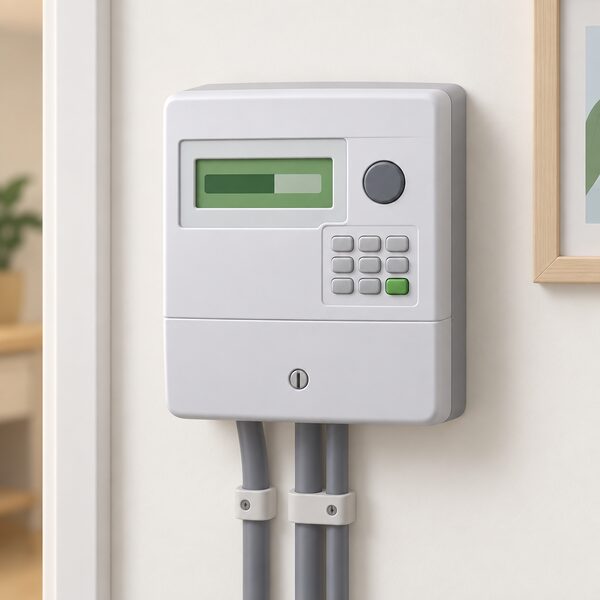
Prepayment tariffs are subject to the price cap in the same way standard variable credit tariffs are4. The cap is not one number: it is calculated depending on a number of factors, including a customer's location and, for electricity, whether their tariff uses a multi-register or single-rate metering arrangement22. Ofgem lists the variation factors as where you live, payment method (Direct Debit, standard credit or prepayment meter), fuel type, and meter type23.
The prepayment cap level moved with the rest of the cap. From 1 October 2025 the prepayment figure rose from £1,672 to £1,707, a £35 (2%) increase compared to the previous level for cap period 14b9. That is the cap on unit rates and standing charges for a typical prepayment household, not a cap on what any individual household pays.
The standing charge treatment is the part that most affects the comparison with Direct Debit. As part of the February 2024 price cap announcement, the government applied a discount on prepayment standing charges, which means prepayment bills overall will be comparable to or slightly cheaper than Direct Debit bills4. That reverses the older assumption that prepaying always costs more.
The cap methodology itself is under review. Ofgem consulted on its review of the operating cost allowances in the cap, covering core operating costs, debt-related costs, smart metering costs and pass-through industry charges24. A separate consultation sought views on a potential simplification of the methodology to set the Contracts for Difference allowance, to improve accuracy of the allowance25. None of this changes the current cap; it changes how future caps are built.
The budgeting trade-off is real in both directions. Prepayment makes the cost of energy visible and prevents a single large bill arriving, but it also means the household carries the working capital: money sits on the meter before it is spent on energy. For a household's independence, that is a shift of risk from the supplier to the home.
Switching away from prepayment, and when prepayment is not suitable
Being on a prepayment meter does not prevent customers from switching tariff or supplier4. Tenants responsible for paying bills have the right to switch provider4. Many customers can switch supplier while keeping their smart meter17, and the debt position determines whether the switch can proceed.
The debt limit is the key condition. A household on a prepayment meter cannot switch supplier if its debt is more than £5005. Independent guidance puts it as: you can only switch supplier if you owe your current provider less than £500, and the debt transfers with you3. One source states the limit as £500 for gas and £500 for electricity, with owing more preventing a switch26. The documents give the threshold slightly differently, and the practical reading is that a debt at or near £500 blocks a move.
There are routes out of prepayment that do not depend on clearing the balance. If it is not safe and practical to be on prepayment, the supplier should move the household to paying by credit, meaning energy is paid for after it is used19. A household can ask to switch if it is not safe or practical to have a prepayment meter, for example if the meter cannot be physically accessed, if someone is disabled or has a health condition, if there are young children in the home, if someone is 75 or over, or if the household cannot afford to top up3. No credit check is needed to switch to a prepayment meter3.
The rules on involuntary installation are strict. A supplier must not proceed with installing or switching to a prepayment meter unless it has made the necessary arrangements to ensure it would be safe and reasonably practicable for the consumer to use one27. Before installation, the supplier should explain why it made its decision, tell the household when it plans to install the meter, explain what will happen during the installation, and tell the household how to contact it if circumstances have changed or the decision is thought to be wrong8. Suppliers must visit the home to understand circumstances and check whether a prepayment meter is safe and suitable29.
Where the rules are broken, the consequences are financial. Compensation for inappropriate installation, switching or use of a prepayment meter is £1,0007. Suppliers also wrote off a further £13 million of debt from customers who had a prepayment meter installed without permission during the assessment period7. A household given an involuntary prepayment meter must be given £30 credit once the meter is installed or the existing meter is remotely switched to prepayment mode8.
Power NI Keypad: the Northern Ireland pay-as-you-go option
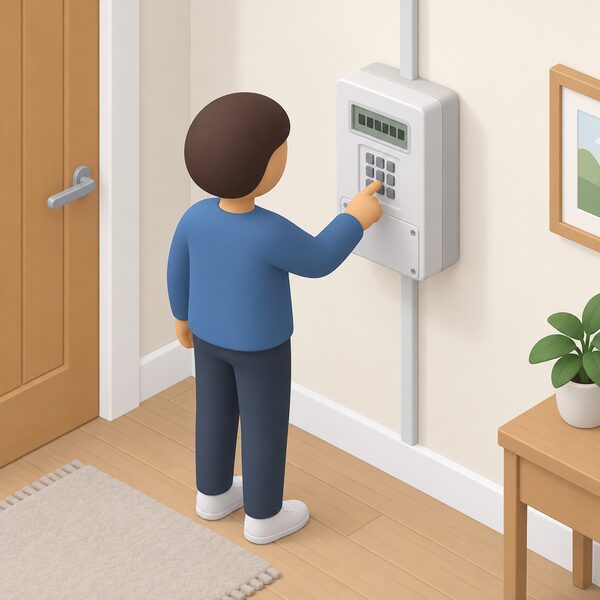
Northern Ireland runs a separate electricity market, and Power NI Keypad is the pay-as-you-go product within it. Keypad+ is a new offering in NI available to Power NI customers6. The commercial terms are set by the maker: a 2.5% discount off the standard rate, ongoing, with no rental fee, no security deposit and free installation6. Keypad customers do not receive a quarterly bill6, and Power NI provides 21 days' notice of any tariff change6.
Top-ups are made with a Powercode, usually a 20-digit number6. After a change in electricity prices, a top-up comes with a special 40 or 60-digit Powercode instead6. That longer code carries the new price settings into the meter and must be entered when issued.
Guest top-up needs no account. All that is required is the 19-digit Keypad Premise Number (KPRN), which usually begins with 9826908501, and the postcode30. An online account adds features: saving payment details for faster future top-ups, viewing previous top-up codes and letters, managing the account, and access to the Power NI Perks rewards scheme30. Keypad customers can get a Keypad Reward by topping up online or via the Power NI App, buying £50 and getting £1 free6.
Replacement cards carry no charge6. Where meter work is needed, it is completed by Northern Ireland Electricity Networks within 10 working days6. Most meters store up to 13 months' data6. On debt, Power NI states that installation of prepayment meters without express agreement will only be used as a last resort in the debt recovery process6.
Meter information feeds the account. If a household has a pay-as-you-go or keypad meter, the information is used to keep the account up to date31. For a Northern Ireland household, the independence question is narrower than in Great Britain: the meter removes billing uncertainty, but supply, price setting and the network remain outside the household's control.
Reading the meter display: buttons, codes and error messages
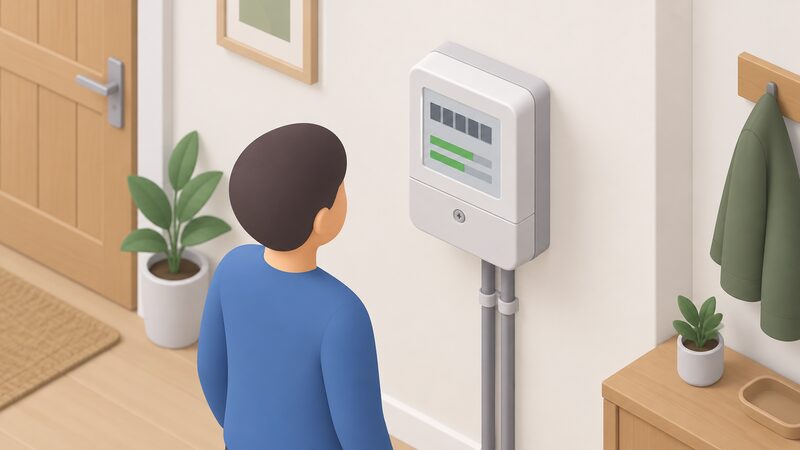
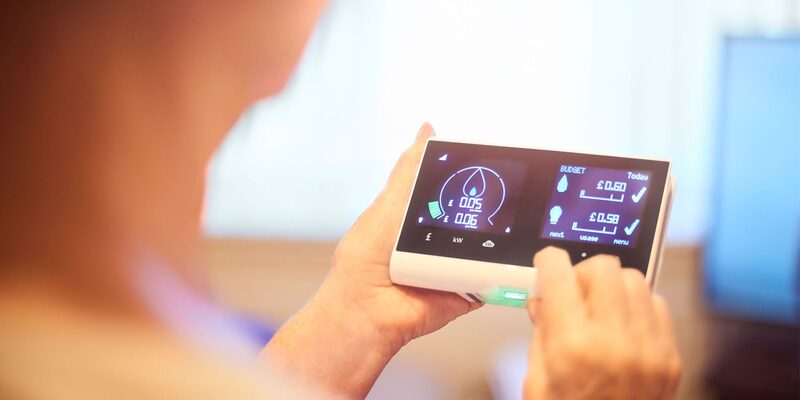
The meter display is the household's main source of information, and on smart prepay it is supplemented by the in-home display. Smart prepayment meters have all the same functionality as standard smart meters, allowing usage information to be viewed at any time using the in-home display4. That display shows real-time energy usage, daily costs, and remaining credit for prepayment customers15.
On a Power NI Keypad meter, the messages are specific and worth knowing before they appear. Duplicate means the top-up code has already been added to the Keypad; pressing the star button allows a new code to be entered, and pressing button 4 shows the last five top-up codes entered32. Incorrect means the wrong top-up code was entered; the household should wait until the message clears, press the star button and re-enter the number32. Kblock means the top-up code has been rejected five times in a row, and the message must clear before another attempt32.
| Message | Meaning | Action |
|---|---|---|
| Duplicate | Top-up code already added | Press star, enter a new code; button 4 shows the last five codes32 |
| Incorrect | Wrong top-up code entered | Wait for the message to clear, press star, re-enter32 |
| Kblock | Code rejected five times in a row | Wait until the message clears, then re-enter32 |
Lost keys and cards are handled by the supplier. Contacting the supplier gets a new one sent out, and in the meantime the supplier should be able to authorise a temporary card from the nearest PayPoint, PayZone or Post Office4. Suppliers will probably replace a lost or damaged key or card for free, but if replacements happen often they may charge4. Each key is exclusive to a particular meter and will not work with any other, including keys left by a previous occupant4. Where a supplier has gone out of business, the new supplier gives information on how to get new key cards and tokens33.
Sources33 cited
- Get help with your prepayment meter, Ofgem, 2026
- Prepayment meters consumer guidance, Ofgem, 2026
- Change prepayment meter to credit meter, Confused.com, 2026-04-20
- Prepayment meters, Centre for Sustainable Energy, 2025-08
- Benefits for prepay customers, Smart Energy GB, 2026-08-19
- Services for prepayment meter customers, Power NI, 2026-09-20
- Compensation for installing prepayment meters without permission, Ofgem, 2025-05-28
- Installing a prepayment meter without your permission, Ofgem, 2026
- Summary of changes to energy price cap 1 October to 31 December 2025, Ofgem, 2025-08-27
- Energy: your questions answered, Confused.com, 2026-07-03
- Overdue utility bills, nidirect, 2026-09-17
- Understanding your gas or electricity bill, Centre for Sustainable Energy, 2026
- Smart meters: your rights and expectations, GOV.UK, 2025-08-08
- Smart meters, Welsh Government, 2026
- Prepayment meters, Uswitch, 2026-08-26
- Advice for those worried about energy bills, Smart Energy GB, 2026-08-19
- How to use a smart meter in prepay mode to save money, Smart Energy GB, 2026-08-17
- How do smart meters send readings?, Smart DCC, 2026
- Problems getting to or topping up your prepayment meter, Citizens Advice, 2026-09-17
- Energy Bills Support Scheme, House of Commons Library, 2026-09-20
- Energy debt on prepayment meters, Centre for Sustainable Energy, 2026-08
- Supplier compliance with price cap requirements for customers with restricted meters, Ofgem, 2025-05-09
- Energy price cap, Ofgem, 2026-09-17
- Energy price cap operating cost allowances review, Ofgem, 2024-05-14
- Energy price cap: proposed changes to the Contracts for Difference cost allowance, Ofgem, 2026-07-30
- A step by step guide to setting up gas and electricity in a new home, Energy Helpline, 2026-09-20
- Heat networks consumer protections draft guidance, Ofgem, 2025-09-05
- Installing a prepayment meter without your permission, Ofgem, 2026
- Check energy suppliers can install prepayment meters without household permission, Ofgem, 2026
- I need a new Keypad card, Power NI, 2026-09-20
- What will the meter information reading be used for?, Northern Ireland Electricity Networks, 2026-09-20
- I've got a message on my Keypad, what does it mean?, Power NI, 2026-09-20
- What happens if your energy supplier goes out of business, Ofgem, 2026
 Top Up a Prepayment MeterHow to top up by card, key, app and code, how to enter a vend code by hand and how emergency credit and friendly-hours protection work.
 Prepayment Meter DebtHow debt repayment is set on a prepayment meter, the limits on the share of a top-up that can be taken, and how to have a rate reviewed.
 Smart Prepayment MetersHow prepayment mode works on a smart meter, remote switching between credit and prepay, topping up, emergency and friendly credit, the prepayment price cap, the £500 debt limit for switching, and the free help available when a household cannot top up.
 Prepayment and Pay As You GoHow prepayment and pay as you go energy tariffs work in the UK: meter types, top-ups, emergency credit, debt repayment through the meter, price cap treatment and how households move to a credit meter.
 Prepayment Meters and DebtCan your energy supplier force you onto a prepayment meter because you owe them money?
 Ways to Pay an Energy SupplierHow you pay for gas and electricity changes what you are charged, and by how much.