In this guide
Backup Power for UK Homes: Power Cuts, Generators, Batteries and the Priority Services Register
Home backup power in the UK means any equipment that keeps some or all of a household's electrical loads running when the grid supply fails. The options run from a power bank for a phone, through portable power stations and uninterruptible power supplies (UPS), to fuel generators and fixed home batteries that can disconnect the house from the network. The local network operator is responsible for fixing the cut, not the company that sends the bill. In England, Scotland and Wales the operator is reached on the free number 1051. In Northern Ireland the number is 03457 6436432.
The rules set the baseline for how long a household may be left without supply. In Great Britain the network operator has 12 hours to restore power outside severe weather, 24 hours in a category 1 storm and 48 hours in a category 2 storm. A home can get £100 if the normal-weather deadline is missed, with £45 for each further 12-hour period3. Backup equipment fills that gap: it covers the hours, and in a bad storm the days, before the network returns.
Costs vary widely. A maker's guide gives a typical UK price of £400 to £3,000+ for a portable power station4. Which? reports that portable generators start at around £160 and can reach £2,000 or more5. The Energy Saving Trust gives £1,500 to £10,000 for home battery storage, depending on the type and size of battery6.
What backup power means for a UK home
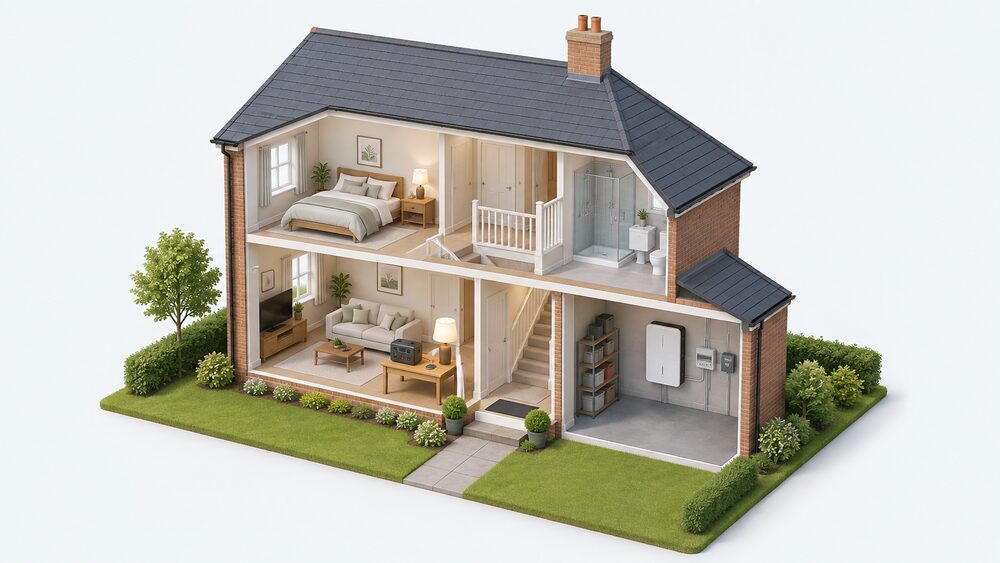
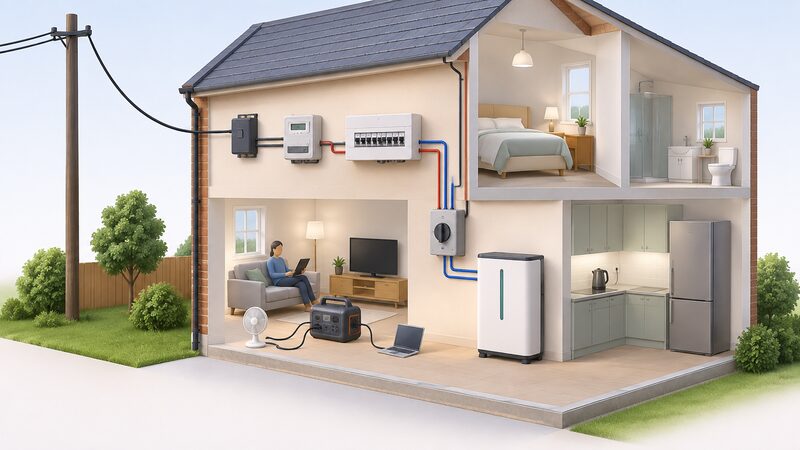
Most houses in the UK have a single-phase electricity supply, and backup equipment sold to households is designed around that7. The supply arrives through the network operator's cable and cut-out, passes through the meter and is distributed by the consumer unit. A power cut is normally a failure upstream of all of that, on the operator's network. Backup power therefore sits on the household side of the meter and takes one of two forms.
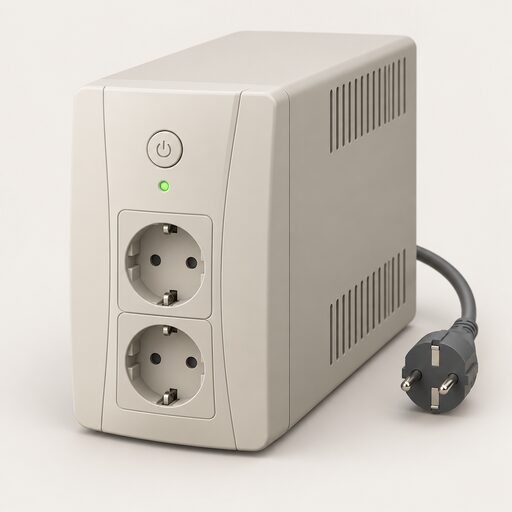
The first is standalone equipment that appliances plug into directly. A power bank, a portable power station and a UPS all work this way. UK Power Networks describes the UPS role plainly: it "will provide backup power to your computer until your electricity supply is restored"8. Nothing is connected to the house wiring, so there is nothing to isolate from the grid. The subject pages on home UPS systems and portable power stations cover these in detail.
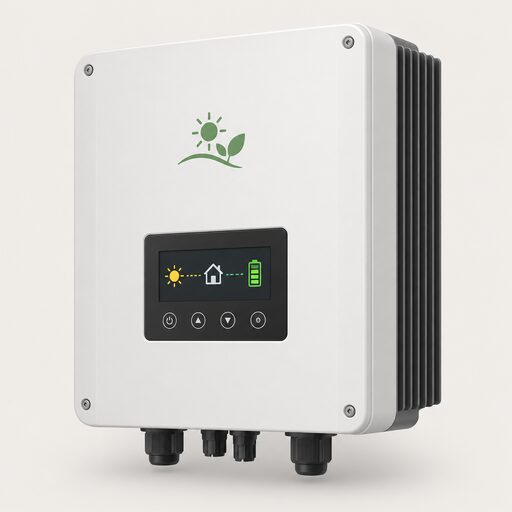
The second form is equipment wired into the home's circuits, such as a generator on a changeover switch or a home battery with a backup function. Here the wiring rules apply. One maker's UK guidance states that an automatic isolation and changeover mechanism is mandatory under BS 7671 to isolate the home from the grid during a blackout9. The reason is that a house feeding power back into a dead network endangers the engineers repairing it. The pages on island mode and black start and on transfer switches and the connection rules set out how this is done.
A home battery does not automatically provide backup. Which? states that "not all systems are suitable" for protecting against power cuts. It says the question to put to an installer is whether the battery will work in an outage, and for how long10.
Backup rarely needs to cover the whole house. One maker's UK guidance is that for basic needs (lighting, a fridge and communication) a 5 kW to 6 kW generator should be sufficient, a manufacturer's estimate and not an independent figure11. Most households keep only a small set of circuits running, which is the subject of essential loads and backup circuits.
Power cut? Call 105: the free national number
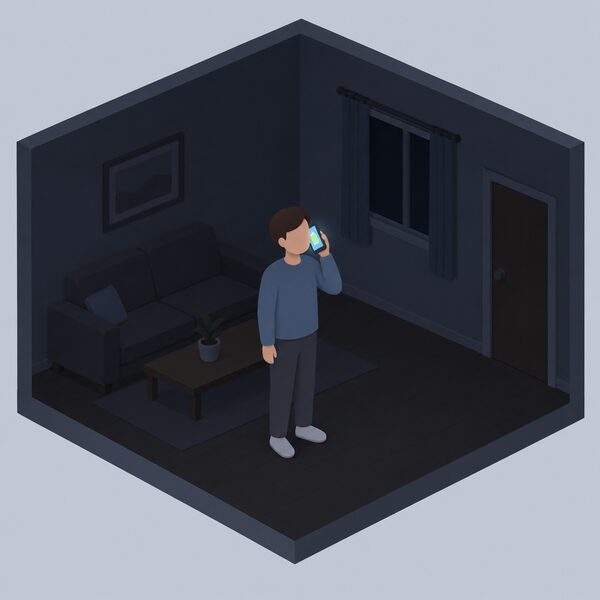
105 is the national power cut number for England, Scotland and Wales. The Met Office describes it as "an easy-to-remember number to call that will put you through to the local people who can help during a power cut", meaning the network operator for the area1. The caller does not need to know which company that is. Smart Energy GB confirms that the line is free and is available 24 hours a day, for reporting a cut or getting updates12.
The number has a second purpose. Scottish and Southern Electricity Networks states that 105 can also be called immediately by anyone who spots damage to power lines or substations that could put someone in danger13. The service reached its tenth anniversary in September 2026. The pages on the 105 number and on who fixes a power cut explain how calls are routed and which operator covers which region.
Northern Ireland uses a different number
105 does not cover Northern Ireland. The Energy Networks Association gives the numbers as 105 in England, Scotland and Wales and 03457 643643 in Northern Ireland2. NIE Networks accepts reports through its website, WhatsApp and Facebook as well as the helpline14.
| Nation | Who to contact | Number |
|---|---|---|
| England, Scotland and Wales | Local network operator, through the national line | 105 (free, 24 hours)1 |
| Northern Ireland | NIE Networks helpline, website, WhatsApp or Facebook | 03457 6436432 |
Regional detail is on the pages for Scotland, Wales and Northern Ireland. Finding out whether a cut affects the property alone or the wider area is covered under checking for a power cut in your area.
Dependence remains here. A call to 105 reports the fault and gets updates, but it restores nothing, and the repair is entirely in the operator's hands. The line is also only reachable while a phone has charge. That makes keeping a phone charged the first job of any backup plan, however small.
Compensation for long power cuts: the Guaranteed Standards of Performance
The Guaranteed Standards of Performance are the rules that require network operators to pay customers when supply is not restored in time. Ofgem states that the rules cover England, Scotland and Wales. It also says the payment amounts are reviewed and updated each year based on inflation, so older articles often quote figures that no longer apply3.
For an unplanned cut in normal weather, Ofgem's current figures are:
| Situation | Payment to a home |
|---|---|
| Fewer than 5,000 properties affected, off for more than 12 hours | £100 |
| More than 5,000 properties affected, off for more than 24 hours | £100 |
| Each additional 12-hour period without electricity | £45 |
| Maximum where the cut affects 5,000 or more properties | £400 |
| Power off more than 4 times between 1 April and 31 March, each cut at least 3 hours | an extra £100, claim required |
All of the figures in this table are Ofgem's3. Ofgem also gives worked examples. A cut of more than 12 hours that runs to 36 hours could bring 2 additional £45 payments, adding up to £90. A cut of more than 24 hours that runs to 72 hours could bring 4 additional £45 payments, adding up to £18015.
Storms are treated separately. For a category 2 storm, Ofgem gives £90 for the first 48 hours and an extra £45 for every 6 hours after that15. For a category 1 storm, Citizens Advice gives £90 if the power was off for 24 hours, then £45 for every 6 extra hours, up to a maximum of £2,23516. For a planned cut, Citizens Advice gives £40 if the operator did not give 2 days' notice or cut the supply on a different day from the one it gave17.
What is paid automatically and what must be claimed
The Energy Networks Association states that payments are typically made automatically, with a cheque sent to the property which has been without power18. The repeated-cuts payment is the exception. Ofgem's wording is:
The payment for repeated power cuts is not automatic. Ofgem's rule is that a claim has to be made with the local network operator, which then decides whether the payment is due.3
Operators' own storm announcements show how the annual update changes the figures. After Storm Amy in October 2025, SSEN said customers without power for more than 48 hours continuously would receive £85, then £45 for each continuous 6-hour period thereafter19. Ofgem's current category 2 figure is £9015.
Few people know these payments exist. Research published by Ofgem in June 2026, commissioned to inform its review of supplier standards, found that participants "had low awareness of Guaranteed Standards of Performance". It also found that service failings related to loss of supply were typically seen as the most severe20. The full rules are on the page about power cut compensation and the Guaranteed Standards. Because Ofgem's rules cover Great Britain only, compensation in Northern Ireland is treated separately.
Restoration deadlines: 12 hours in normal weather, 24 or 48 in severe storms

The deadlines are the most useful planning figures on this page, because they show how long backup may need to last. Ofgem states that the local network operator has:
- 12 hours for interruptions outside of severe weather
- 24 hours in severe storm category 1 weather
- 48 hours in severe storm category 2 weather3
These limits trigger compensation. They do not guarantee that power will be back. If an operator misses a deadline it owes the household a payment, but nothing in the standards gets the supply restored faster. The storm payment structure, with £45 for every 6 hours beyond the first 48 in a category 2 storm, is there because cuts of several days do happen15. SSEN's Storm Amy statement in October 2025 addressed customers who had been off supply for more than 48 hours continuously19.
In practice there are three tiers. A cut of a few hours is the common case, and the rules treat it as within normal service. A cut of 12 to 24 hours is the point where a freezer, a heating system's controls and phone batteries start to matter. For a fridge and freezer, food safety in a power cut sets out the timings. For heating, see keeping heating running and keeping warm during a power cut. A storm cut of 48 hours or more is the third tier, and rural homes at the end of overhead lines are most exposed to it. Backup power by home type looks at that difference.
The exclusion for national shortage also matters. Ofgem's standards make no payment for blackouts caused by a national power shortage3. A household relying on compensation as its only cushion has none in that scenario. The page on rota power cuts explains how planned emergency disconnections would work.
The Priority Services Register: free support if you depend on electricity
The Priority Services Register (PSR) is a free service. The Met Office describes it as provided by water and power suppliers, and it links the register directly to power cut preparation1. A House of Commons Library briefing lists the services it funds: regular personal meter readings, advance warnings of power cuts, priority support in an emergency, and accessible information21.
What registration provides
The detail varies between operators. Across the network operators' own descriptions the register provides:
- early warning of planned power cuts and accessible communication, including British Sign Language Video Relay and textphone22
- extra support during interruptions, and a password scheme so that a caller at the door can be verified22
- a free personalised Power Cut Plan, included with the welcome letter once registered22
- a direct number to get straight through, and free 24-hour power cut alerts and text updates for medically dependent customers23
- help through partner organisations with income and benefit support, tariff advice and energy efficiency23
Who can join, and joining for someone else
Citizens Advice gives the eligibility groups for England. They are people of State Pension age, people who are disabled or have a long-term health condition, and people considered vulnerable by their energy network24. SSEN describes the register as "a free service for anyone who may need additional support during a power cut", and lists the use of medical equipment reliant on electricity or water among its criteria. It states that a registrant's details are also shared with their energy supplier and their local gas and water networks25. SSEN also confirms that registration can be made on behalf of a family member, friend or someone the applicant cares for, and that joining does not change who the household pays for its energy22. Fuller detail is on the pages about the register itself, eligibility and how to join.
Registration does not bring faster reconnection in Great Britain
"Our teams work hard to restore power to affected areas but can't prioritise individual households."
The register does place a duty on operators. Ofgem states that for both planned and unplanned cuts they must offer priority service register customers extra help, "for example, giving them battery packs so that they can still charge phones or medical equipment"15.
Northern Ireland works differently. NIE Networks states that if a property on its Medical Customer Care Register loses power, it can arrange for crews to prioritise getting the power back on26. The page on priority services in Northern Ireland has the detail.
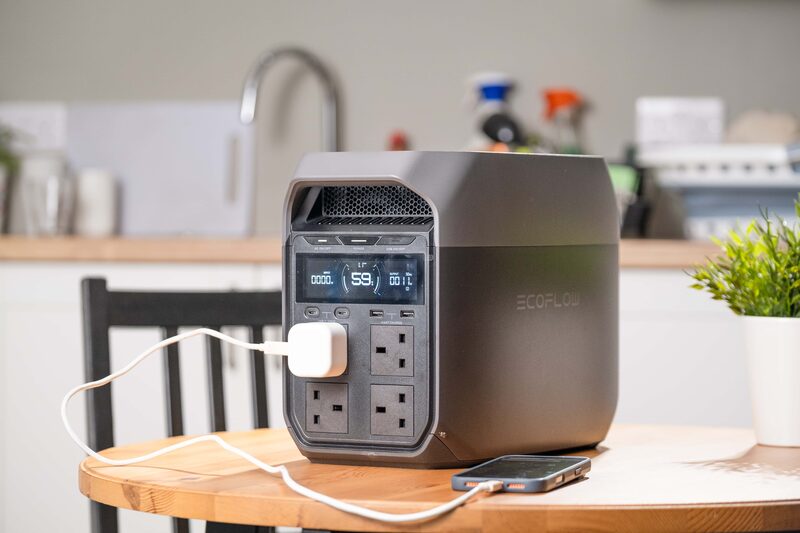
One operator scheme supplies equipment. SSEN's home battery pack scheme provides an EcoFlow Delta 3, and SSEN states that the battery may keep devices operating for longer in a cut, subject to approval from the manufacturers of specialist in-home medical equipment27. The pages on the SSEN Home Battery Pack scheme, on network operator support schemes and on medical equipment cover this.
Portable power stations: what they run and what they cost (£400 to £3,000+)
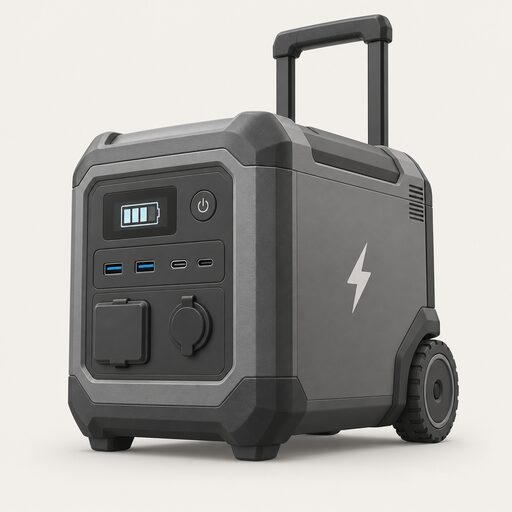
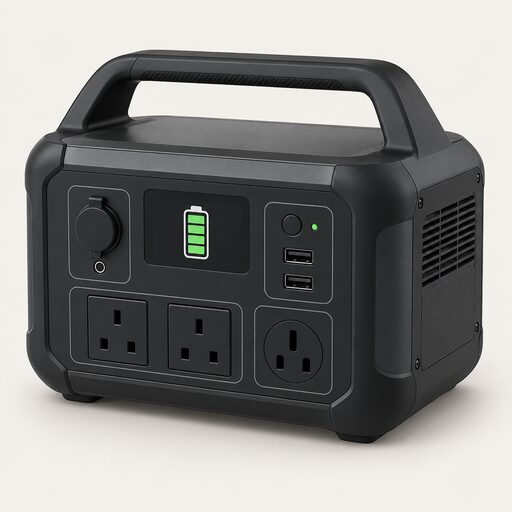
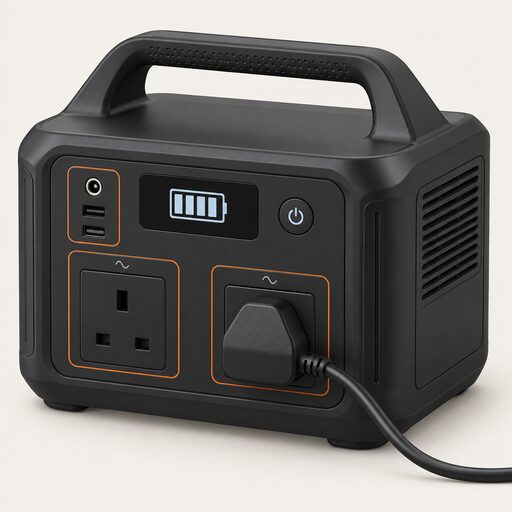
A portable power station is a rechargeable battery with a built-in inverter and mains sockets. It is the simplest form of household backup because it involves no installation, no fuel and no connection to the house wiring. The headline range of £400 to £3,000+ is one maker's estimate of typical UK cost, published in June 20264. Actual listed prices reach below that floor as well as into the range.
The table shows prices on one maker's UK site on 19 September 2026. The pages do not state the VAT position. Consumer prices on UK retail sites are normally shown including VAT.
| Model | Listed price |
|---|---|
| BLUETTI EB3A portable power station | £219.00 |
| BLUETTI AC240 portable power station | £1,699.00 |
| BLUETTI Elite 400 portable power station | £1,799.00 |
| BLUETTI AC300 + B300K home battery backup | £1,999.00 |
These are one manufacturer's list prices, shown to illustrate the spread and not as a market survey28. Capacity and inverter output drive the price, and the units at the top of the range are modular systems with add-on batteries.
The alternatives bracket this range on both sides:
| Option | Price range | Source type |
|---|---|---|
| Portable generator | around £160 to £2,000 or more5 | Independent (Which?, January 2026) |
| Portable power station | £400 to £3,000+4 | Maker's estimate (June 2026) |
| Home battery storage | £1,500 to £10,0006 | Independent (Energy Saving Trust, August 2026) |
A generator is cheaper per watt to buy, but it carries fuel, maintenance and noise costs that a battery does not. A fixed home battery costs more, but it also works every day to store solar or off-peak electricity, which a power station kept in a cupboard does not. Backup power costs compared and portable power station cost cover the comparison in depth. What each size can run is covered below and under portable power station sizing.
Fuel generator or solar battery backup: which suits which home
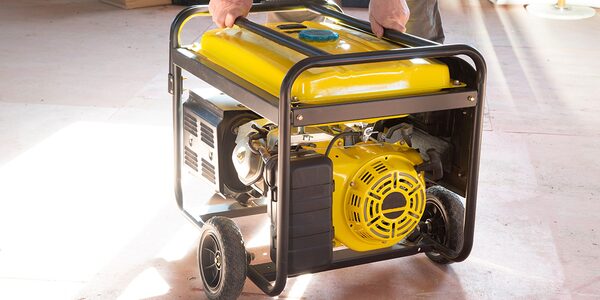
The two technologies differ in three main ways: where they can be used, how long they can run, and whether they do anything outside a power cut.
| Fuel generator | Battery (power station or home battery) | |
|---|---|---|
| Where it runs | Outdoors only29 | Indoors or outdoors29 |
| Duration | As long as fuel is available | Limited by stored capacity unless recharged |
| Noise, maker figures | Honda EU2200i: 57 dB(A) at rated load. Hyundai DHY8000SELR diesel: approx. 70 dB at 7 m11 | BLUETTI Elite 200 V2: 16 dB under low power loads (see brands table) |
| Use outside a cut | None | A fixed battery stores solar or off-peak electricity daily |
A generator suits a home that faces long cuts and heavy loads, typically a rural property with outdoor space, somewhere to store fuel and neighbours far enough away for the noise not to matter. It cannot be used in a flat. It also has to be owned in advance, because the network will not supply one. UK Power Networks states that it "cannot provide individual generators in the event of a national power emergency"30. Types are covered under portable generators and standby generators, and the direct comparisons are at portable power station vs generator and standby generator vs home battery.
Battery backup paired with solar suits a home that wants the equipment to earn its keep every day. A Parliamentary Office of Science and Technology note reports Solar Energy UK's suggestion that rooftop solar combined with a battery could supply 80% of a household's annual electricity. This is an industry body's estimate, not a measured figure31.
Solar panels alone do not keep the lights on, though. Most grid-tied systems shut down in a cut unless they are configured with a battery and a backup function. As already noted, Which? cautions that not all battery systems are suitable for power cuts10. The practical question for any installed system is whether it has a backup output, which circuits that output feeds, and how long it runs them. Solar generator vs fuel generator and home battery vs portable power station take the comparisons further.
Choosing a portable power station: capacity, output ports and recharging
Capacity, measured in watt-hours (Wh), sets how long a unit can run a load. Inverter output, measured in watts, sets which appliances it can run at all. One manufacturer's August 2026 buying guidance sets out capacity bands as follows32:
| Capacity | What the maker says it suits |
|---|---|
| 300 to 700Wh | Phones, tablets, cameras, laptops and LED lights on day trips or short overnights |
| 1,500 to 2,500Wh | Caravans, work equipment or short household outages where several essentials run together |
| 2,500Wh and above | Heavier home backup and longer off-grid stays |
The same maker's home backup guidance uses kilowatt-hours. It gives 1 to 2 kWh for shorter outages and essential devices such as refrigeration, internet, lighting, phones and laptops. It gives 3 to 4 kWh for overnight outages with more reserve, and expandable systems for extended outages29. These are manufacturers' sizing rules of thumb, so they describe what is possible and not what is typical. The sizing page works through the arithmetic for a real set of appliances. Specific cases are covered under running a microwave and Wi-Fi during a power cut.
Three further points shape the choice.
Output. High-draw appliances such as kettles, heaters and microwaves need an inverter rated above their demand, and they drain a small battery quickly. A unit that can power a fridge for many hours may boil only a few kettles.
Recharging. In a long cut a power station is only as useful as its means of recharging: the mains once power returns, a vehicle socket, or solar panels. Charging from solar panels covers realistic yields, and battery chemistry and cycle life explains the difference between LFP and NMC cells.
Medical equipment. SSEN's battery pack scheme attaches a condition that applies generally: backup for specialist in-home medical devices is subject to approval from the device manufacturer27.
Battery units can be used indoors because nothing is burned29. They are still large lithium batteries, and indoor safety and lithium battery safety and recalls set out the precautions and the recall record. For a computer or a router that must not drop out for even a moment, a UPS does the job and a power station does not. UPS vs portable power station explains why.
Brands and product ranges sold in the UK
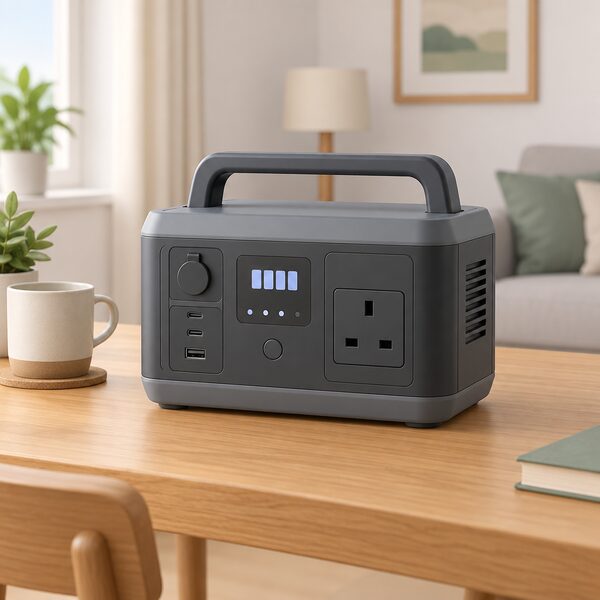
The UK market for plug-in backup is led by a group of battery specialists, with established engine makers on the generator side and power-management firms on the UPS side. The figures below are the makers' own statements about their own products, read on the dates shown, and none has been independently tested here. The brands are listed in no particular order.
| Brand and model | Maker's stated figure | Date read |
|---|---|---|
| BLUETTI Elite 200 V2 | 5-year warranty, 16 dB under low power loads33 | 19 September 2026 |
| Anker SOLIX solar generators | 5-year full device warranty34 | 19 September 2026 |
| Fogstar Portable Power Station | 3-year Fogstar warranty35 | 19 September 2026 |
| EcoFlow DELTA 2 Solar Generator | Five-year warranty11 | 29 October 2025 |
| Honda EU2200i Companion generator | 57 dB(A) at rated load, as low as 48 dB(A) at quarter load11 | 29 October 2025 |
| Hyundai DHY8000SELR diesel generator | Approx. 5.8 kW / 7.25 kVA standby power, approx. 70 dB at 7 m11 | 29 October 2025 |
The Honda and Hyundai figures come from EcoFlow's guide to home generators, not from those makers' own pages, so they carry less weight than a specification sheet.
Each range has its own page: BLUETTI, Anker SOLIX, EcoFlow, Jackery, Fogstar and Zendure for batteries. Honda, Hyundai Power Products and Clarke cover generators. Eaton and APC cover UPS units. Head-to-head pages include EcoFlow vs BLUETTI, BLUETTI vs Jackery and Jackery vs Anker SOLIX.
Availability changes quickly. On 19 September 2026 the BLUETTI Elite 100 V2 was shown on its maker's UK site as discontinued and out of stock36. A model named in a review may not be the one on sale, and a discontinued unit raises the question of future spare batteries and accessories.
Warranties and availability: what to check before you buy
Warranty terms in this market range from 3 to 5 years on the makers' own statements33. Some of those terms have conditions attached. A warranty is a promise from a company, and it is only worth as much as that company's continued presence in the UK market.
Citizens Advice sets out what to establish about any guarantee before work starts or money changes hands37:
- how long the guarantee lasts and what it covers
- whether it covers defects in materials as well as workmanship
- whether it can be passed to future owners of the property
- whether it is insurance-backed, so that it survives the failure of the firm
For portable equipment the equivalent questions are whether the warranty depends on registration or on buying direct from the maker, and who handles a claim in the UK. For installed systems the backup function should be confirmed in writing. Which? notes that some home batteries are sold in the UK only through installers, which makes the installer the route for both supply and support10.
Owning the equipment does not complete the job. NIE Networks states the position for anyone who depends on it:
"Backup power supplies and associated equipment should be regularly checked and maintained by a competent person."
A battery left discharged or a generator with stale fuel can fail when it is needed. Maintaining and testing backup power equipment sets out routines, and backup power safety and standards covers the wiring rules. Surge damage when the power comes back is a separate risk, addressed under surge protection and protecting appliances in a power cut.

How backup power fits into household energy independence
Backup power is the resilience part of energy independence. It does not cut bills or imports by itself. What it does is decide whether the household keeps running when the network fails. The Climate Change Committee's monitoring framework for a well-adapted energy system states that "further innovation in home battery technology, vehicle-to-everything (V2X), and solar can provide households with additional backup options during power outages"39. The technologies that reduce day-to-day dependence on the grid are therefore the same ones that can carry a home through a cut, provided they are configured to do so.
What backup provides. It gives continuity for the loads that matter most: communication, refrigeration, heating controls, medical and mobility equipment. It also gives independence from the restoration timetable. The rules allow the network 12 hours in normal weather and 48 hours in a category 2 storm before it owes anything beyond the base payment3. With a fixed battery and solar, the household also has a daily reduction in grid purchases, estimated by the industry body at up to 80% of annual electricity31.
What dependence remains. A portable power station holds a finite amount of energy and has to be recharged from the grid or from solar. A generator moves the dependence from the electricity network to the fuel supply chain. A home battery with a backup output depends on its installer's configuration and the maker's continued support. Many of these products also rely on an app or cloud service for monitoring and control. No domestic system is designed to run a whole house indefinitely.
The household also remains inside the public system: the operator's repair crews, the 105 line, the compensation rules and the Priority Services Register. A household with backup still needs all of these, because the register and the restoration standards cover the cases where domestic equipment runs out or fails. Backup power and energy independence develops this argument. Preparing a home for a winter power cut turns it into a seasonal checklist of what the rules and the equipment cover.
Sources39 cited
- What to do in a power cut, Met Office, 2026-09-20
- Storms and bad weather, Energy Networks Association, 2026-09-17
- Check if you can get a payment for a power cut, Ofgem, 2026
- Guide to emergency generators, Jackery UK, 2026-06-03
- How to buy the best generator, Which?, 2026-01-20
- Battery storage, Energy Saving Trust, 2026-08-19
- Cascaded heat pumps, Energy Saving Trust, 2024-04-24
- Compensation: a power cut damaged something in my home, UK Power Networks, 2026-09-17
- Emergency backup power guide: solar PV and batteries, Jackery UK, 2026-06-24
- Solar panel battery storage, Which?, 2026-05-14
- Best home emergency generator, EcoFlow UK, 2025-10-29
- Power cuts: what to do if your power goes out, Smart Energy GB, 2026-08-19
- Preparing for a power cut, Scottish and Southern Electricity Networks, 2026-09-19
- Power cut help, NIE Networks, 2026-09-20
- Plan for a power cut, Ofgem, 2026
- Get compensation if you have a power cut (Wales), Citizens Advice, 2026-09-17
- Get compensation if you have a power cut, Citizens Advice, 2026-09-17
- Power cut compensation, Energy Networks Association, 2026-09-17
- Final push to reconnect customers following Storm Amy, Scottish and Southern Electricity Networks, 2025-10-07
- Energy consumer experiences of customer service standards, Ofgem, 2026-06-23
- House of Commons Library briefing SN06163, UK Parliament, 2026-02-26
- Priority Services: sight, Scottish and Southern Electricity Networks, 2026-09-19
- Who can join the Priority Services Register, National Grid Electricity Distribution, 2026-09-17
- Problems getting to or topping up your prepayment meter, Citizens Advice, 2026-09-17
- Priority Services community toolkit, Scottish and Southern Electricity Networks, 2026-09-20
- Medical Customer Care Register and generators, NIE Networks, 2026-09-19
- Home battery packs, Scottish and Southern Electricity Networks, 2026-09-17
- Portable power station price list, BLUETTI UK, 2026-09-19
- Best generator for home backup power UK, BLUETTI UK, 2026-08-31
- Make a plan to be winter ready, UK Power Networks, 2026-09-17
- POSTnote 771, Parliamentary Office of Science and Technology, 2026-06-25
- Best portable power stations, BLUETTI UK, 2026-08-31
- Elite 200 V2 product page, BLUETTI UK, 2026-09-19
- Solar generators, Anker SOLIX UK, 2026-09-19
- Fogstar 1.5kWh Portable Power Station, Fogstar, 2026-09-19
- Elite 100 V2 product page, BLUETTI UK, 2026-09-19
- Before you get building work done, Citizens Advice, 2026-09-20
- People who rely on electrical medical equipment, NIE Networks, 2026-09-19
- Well-adapted energy system monitoring framework, Climate Change Committee, 2026-09-19