In this guide
Hyundai Power Products is a UK retail brand selling petrol, diesel and inverter generators, and it is not part of Hyundai Motor Group. The name is licensed for small power equipment, so a Hyundai generator has nothing to do with the company that builds the Tucson, the Ioniq 5 or the Kona Electric. That distinction matters commercially: the car maker's UK registrations, dealer network and warranty systems do not extend to a generator bought from a garden machinery retailer or an online tool shop.
What the brand does offer is breadth. The range covers small portable petrol sets, larger petrol units with fuel tanks of around 20 litres, diesel models, and inverter generators for electronics. Prices for portable generators generally start at around £160 but can go up to £2,000 or more1, and hire is an alternative: a 1.6kVA portable generator costs around £76 for a day, or £110 for a week1.
For a household, the honest position is that a Hyundai generator is a fuel-dependent appliance. It restores power only while it has petrol or diesel, it needs somewhere safe to run, and it does not reduce a home's reliance on the grid, a supplier or imported fuel. What it does is bridge an outage.
Hyundai Power Products: the brand behind the UK generators
The generators sold in the UK under the Hyundai name come from a small power equipment business rather than a vehicle manufacturer. The brand covers generators, pressure washers, lawn and garden machinery and similar kit, distributed through retail and online channels. That structure shapes everything a buyer deals with: the point of contact for a fault is the retailer or the brand's own support operation, not a car dealership.
The wider UK power context is worth setting out, because it explains why these machines sell. The UK electricity grid is supplied by a mix of sources: wind, nuclear, gas and solar3. Gas remains a large share of generation, at 33.3% of electricity generation by Major Power Producers in the period from September to November 20254. That is a national picture, and it is the reason a household cannot simply assume the lights stay on.
Retail energy in the UK is also concentrated among a small number of suppliers, several of them foreign-owned, which is a separate dependence from the physical network. Ownership varies: Octopus Energy's majority owner is Octopus Group (UK)5. The pattern across the market is that a household's supply relationship is a commercial one, and it can change hands.
Against that background, a generator is a piece of equipment that sits outside the supply relationship entirely. It does not need a supplier, a tariff or a smart meter. It needs fuel, air, oil and somewhere to exhaust.
Who owns the brand, and how it relates to Hyundai Motor Group
The Hyundai name in generators is used under licence, and the practical consequences are worth spelling out because they are the most common source of confusion. Hyundai Motor Group is a vehicle manufacturer with a UK dealer network, a connected car platform and a hydrogen fuel cell programme. Hyundai Power Products is a separate commercial operation selling small engine equipment.
The two do not share warranty administration, parts distribution or service centres. A generator fault is not a car dealer matter. The car side of the business is visible in UK registration data: the Hyundai Tucson recorded 3,082 units in June 20266. That is a measure of the vehicle brand's presence, not of the generator business.
Where the confusion costs money is in warranty and parts. Extended warranty cover sold with small-scale renewable and generation equipment in the UK is underwritten by Hadron UK Insurance Company Limited, administered via IWG as a sub-agent of Warranty Services7. That is the structure behind the insurance-backed warranties in this part of the market, and it is the paperwork that matters if a claim is disputed.
The generator range: what sizes and fuel types are sold in the UK
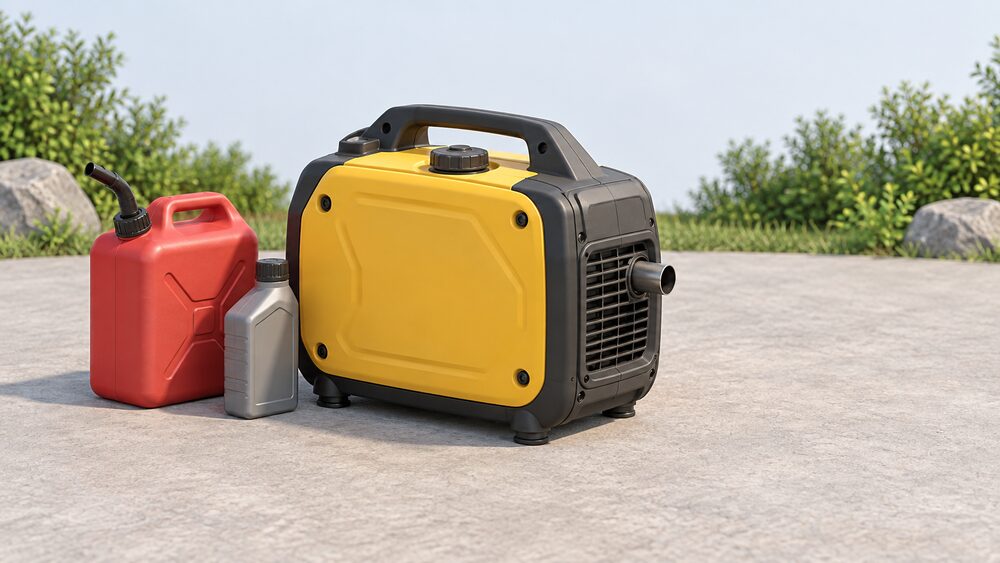
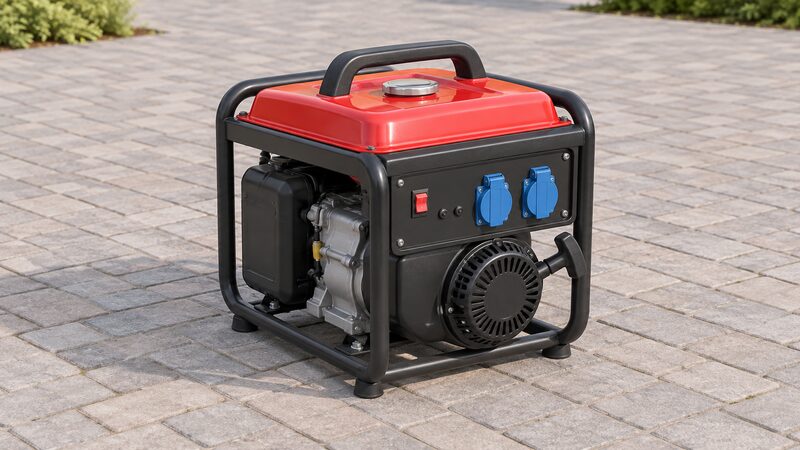
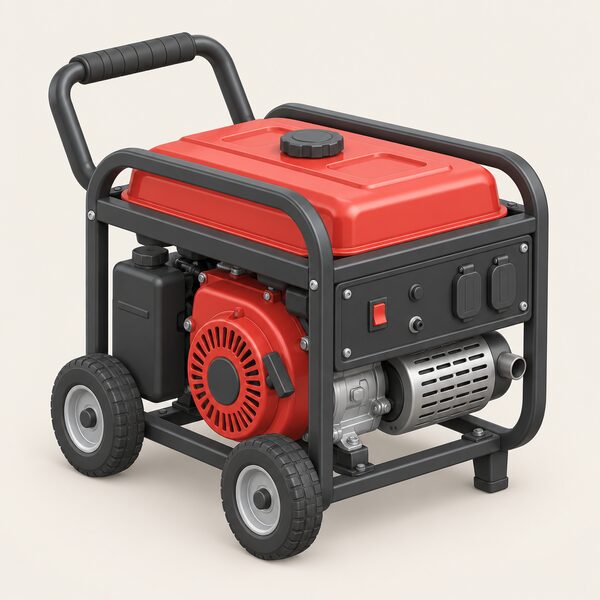
The UK range spans three broad categories. Small portable petrol sets are the entry point, typically with a fuel tank in the region of 3 litres and a claimed run time of around 8.5 hours1. Mid-size petrol units step up in tank size: one petrol model in this class has a fuel tank capacity of around 20 litres1. Diesel models cover the larger end, where longer runs and heavier loads matter more than portability.
Inverter generators are the third category and the one most relevant to a household with electronics. Inverter sets produce a stable electrical output and can be particularly well suited to sensitive electronic equipment2. The inverter stage converts the engine's raw AC output to a clean waveform, and it also lets the engine speed follow the load rather than running flat out.
Dual-fuel capability is offered as a distinct option. Dual-fuel generators give the flexibility to operate using two fuel sources, typically petrol and LPG2. That matters for households already using LPG, which is one of the fuels used by off-gas grid households alongside heating oil, solid fuels, mains electricity and microgeneration8. A household with an LPG bottle already on site has a second fuel route without a separate petrol store.
| Category | Typical fuel | Typical tank | Best suited to |
|---|---|---|---|
| Small portable petrol | Petrol | Around 3 litres1 | Lights, chargers, small tools |
| Mid-size petrol | Petrol | Around 20 litres1 | Longer runs, heavier loads |
| Diesel | Diesel | Not stated | Extended running, larger loads |
| Inverter | Petrol | Not stated | Electronics, lower noise at part load2 |
| Dual-fuel | Petrol and LPG2 | Not stated | Households with an existing LPG supply |
Specifications to compare: output, runtime and noise
Runtime is the figure buyers focus on and the one most often overstated. Claimed run times in this class vary widely: one suitcase inverter generator is listed with a claimed run time of 6 hours, while a dual voltage petrol model is listed at 11.6 hours1. Those figures are claimed, not measured, and they assume a particular load. A set running at half load will last longer than one running a heater or a kettle.
Tank size is the other half of the equation. A 3 litre tank and a claimed 8.5 hour run time implies a light load1; a 20 litre tank supports a much longer run at the same load, or a similar run at a heavier one1. The relationship between tank, load and runtime is the single most useful thing to understand before buying, because it determines how often someone has to refuel in the dark.
Noise is where inverter sets earn their place. Inverter generators run the engine at variable speed, so at low load they are quieter than a conventional fixed-speed set of similar output. For context on what quiet means in domestic equipment, a heat pump marketed as one of the quietest on the market is rated at a sound power level of 49 dB(A) for 12 kW models9. A generator running at close range is a different proposition, and siting matters more than the badge.
Cost and where to buy in the UK
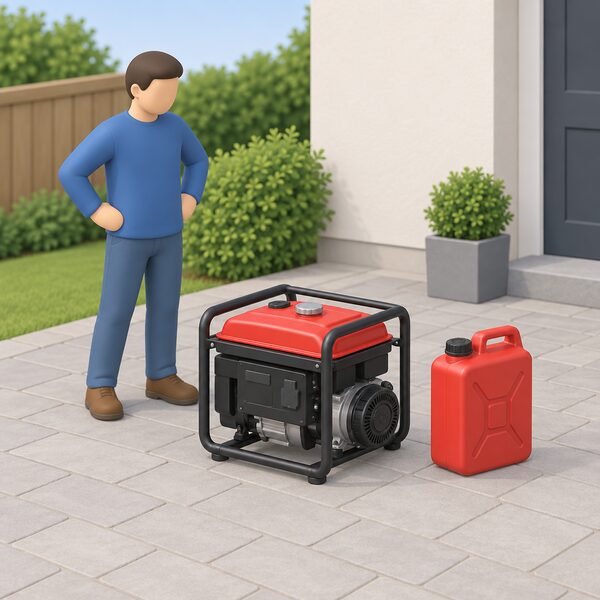
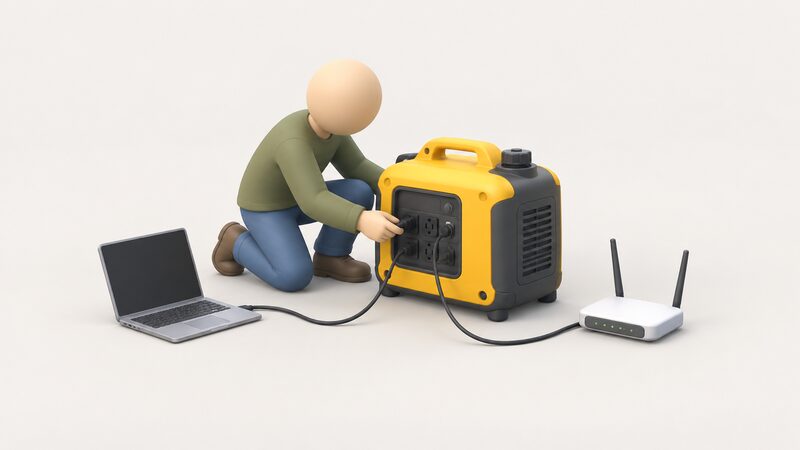
There is no single published price for a Hyundai generator, because the range spans several categories and the brand sells through multiple retail channels. The market-wide figures give the shape of it: prices for portable generators start at around £160 but can go up to £2,000 or more1. Within that band, output, fuel type and whether the set is an inverter drive the number.
Hire is a genuine alternative and worth pricing before buying. A 1.6kVA portable generator costs around £76 for a day, or £110 for a week1. For a household that needs backup a few times a year, or that wants to test whether a generator suits them at all, hire avoids the storage, fuel and servicing obligations of ownership.
VAT treatment is not stated in the published figures, so prices should be read as quoted rather than as confirmed VAT-inclusive. Where a household is buying generation equipment as part of a wider renewable installation, the VAT position can differ: Solar Energy UK's position is that residential energy storage should qualify for 0% VAT when installed as a standalone measure10. That is a policy recommendation about storage, not a statement about generators, and it does not change the price of a portable set.
Fuel is a running cost that never appears on the sticker. Petrol and diesel prices move, and a generator that runs for hours during an outage consumes a meaningful quantity. The generator fuel and running costs page sets out how to work that through, and storing fuel at home covers the legal limits on how much petrol can be kept.
What owning a Hyundai generator means for household energy independence
A generator changes a household's position during an outage and does very little to change it at any other time. It is a fuel-burning appliance that produces electricity on demand, independent of the grid and of any supplier. That is real: it does not care whether the network is up, whether a supplier has failed, or whether a tariff has changed.
The dependence it leaves is fuel. A petrol generator needs petrol, which is refined, distributed and priced by others, and which has a shelf life in storage. A diesel set needs diesel. A dual-fuel set that can run on petrol and LPG2 has a second route, and LPG is one of the fuels already used by off-gas grid households8, but both routes are bought-in.
There is also a regulatory dimension. Connecting a generator to a home's fixed wiring is not a plug-in job, and the network operator may need to be told. The rules on notifying a connection are set out in generator grid connection notification, and the hardware side in generator connection and transfer switches.
For households weighing a generator against alternatives, the comparison pages are the place to start: portable power station vs generator, standby generator vs home battery and backup power costs compared. The wider picture, including what the network operators do themselves, is on the backup power pillar.
Where a generator fits, and where it does not
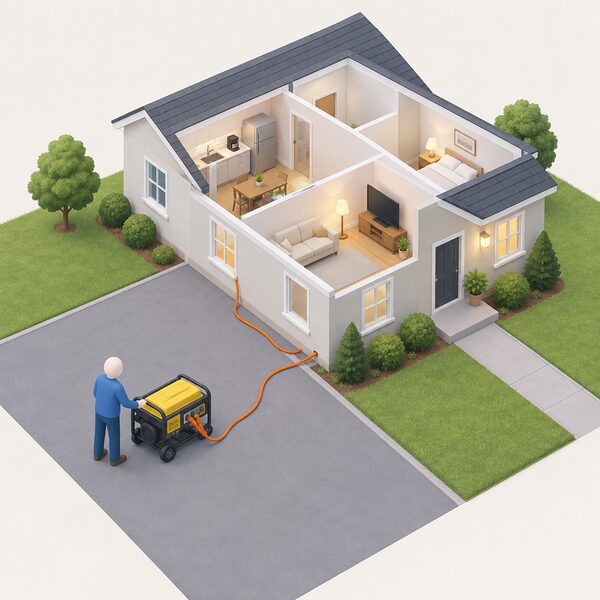
Network operators use generators in their own restoration work, which is a useful benchmark for scale. Generators will sometimes be used for temporarily restoring customers whilst permanent repairs are completed11. A household restored this way stays on the generator until the repair is finished, and may experience a short outage while being connected back to the network11. That is a utility-scale set feeding a street, not a portable unit feeding a house.
For a home battery owner, the equivalent question is whether the battery covers an outage at all. Not all systems are suitable for power cuts, and the advice is to ask an installer whether a battery will work in a power outage, and for how long12. A generator has no such ambiguity: it works when it has fuel and starts.
The limits are practical. A portable set runs selected appliances through extension leads unless a proper changeover arrangement is installed. It must not run indoors or in a garage attached to the house, because of carbon monoxide. It needs fuel stored to the fire service's rules. And it needs servicing, because a generator that has sat unused for a year is not a reliable machine. The safety and maintenance detail sits in generator safety and backup power maintenance and testing.
Hyundai's wider direction: hydrogen, electrification and what it signals
The Hyundai name's activity in hydrogen and electrification belongs to Hyundai Motor Group, not to the generator brand, and it is worth separating the two clearly. The group's hydrogen work is at vehicle and industrial scale. The UK hydrogen strategy could meet up to a third of the nation's energy needs by 2050, with one estimate putting the share at between 20 and 35% of total energy supply by that date13. Industrial hydrogen demand may need to increase up to 50TWh by 203514.
Those are national projections, and they do not describe a fuel a household can buy for a generator. There is no domestic hydrogen supply network. The relevance to a generator buyer is indirect: it signals where large-scale investment is going, not what will come out of a pump at a filling station.
The electrification side is more visible in UK data. Hyundai's electric models carry published prices: the Kona Electric 64 kWh at £38,225, the Ioniq Electric at £31,450 and the Ioniq 5 73 kWh at £41,945, all on-the-road including the Plug-in Car Grant15. Running costs per mile are given as £127, £162 and £151 respectively15. Those figures are from 2024 and are a snapshot of the car market, not of generator pricing.
The direction of travel in UK energy policy is toward electrification of heat and transport, with subsidy reform focused on long-term decarbonisation: promoting the deployment of the right technologies for the right uses, while ensuring the RHI contributes to both decarbonisation targets and the UK's renewable energy target16. A petrol generator sits outside that direction. It is a bridging appliance, not a transition one.
How Hyundai generators compare with other brands sold in the UK
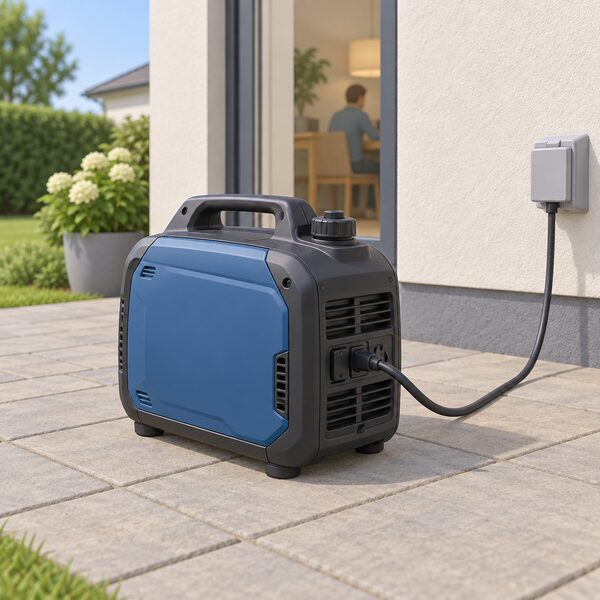
The UK generator market is crowded, and the honest comparison is by category rather than by badge. Inverter sets compete on output quality and noise; conventional sets compete on price and simplicity; diesel sets compete on endurance. Hyundai Power Products competes across all three, which is why it appears in retail comparisons alongside other high-volume brands.
The comparison pages on this site cover the category decisions: inverter generator vs conventional generator, diesel vs petrol generator, solar generator vs fuel generator and whole-home generator vs portable. Brand-level pages for other makers sold in the UK include Honda generators and Clarke generators.
What separates brands in practice is the support chain rather than the specification sheet. Parts availability, the length and conditions of the warranty, and whether a local engineer will touch the machine all matter more over a ten-year ownership than a marginal difference in claimed runtime. On warranty structure, the insurance-backed cover in this market is underwritten by Hadron UK Insurance Company Limited, administered via IWG as a sub-agent of Warranty Services7, and that is the entity behind the paperwork if a claim is refused.
For households that want backup without fuel, the alternatives are covered across the site: portable power stations, home UPS systems and standby generators for homes. Each has a different dependence: a battery depends on having been charged, a UPS on mains supply and battery life, a standby generator on a fuel supply and an automatic transfer switch.
Sources16 cited
- How to buy the best generator, Which?, 2026-01-20
- Home backup guide, Champion Power Equipment, 2026-09-20
- Should I switch to a time of use tariff, Energy Saving Trust, 2026-01-23
- Energy trends and prices statistical release, GOV.UK, 2026-01-29
- How to choose the best energy company, Which?, 2026-06-26
- EV market hits new high but target gap remains, SMMT, 2026-06
- MCS approved financial protection products, MCS Certified, 2026-09-17
- Off-gas grid households, House of Commons Library, 2026-09-17
- LG Therma V R290 Monobloc 12kW, Quiet Mark, 2026-09-17
- VAT on solar and battery storage, Solar Energy UK, 2026-09-17
- Restoration following a power cut, Electricity North West, 2026-09-19
- Solar panel battery storage, Which?, 2026-05-14
- How will the UK's hydrogen strategy help achieve net zero, Carbon Brief
- The UK's net zero strategy, Carbon Brief
- Compare cost per mile, Zapmap, 2024-05-14
- Renewable Heat Incentive: a reformed and refocused scheme, CIBSE, 2026-09-17
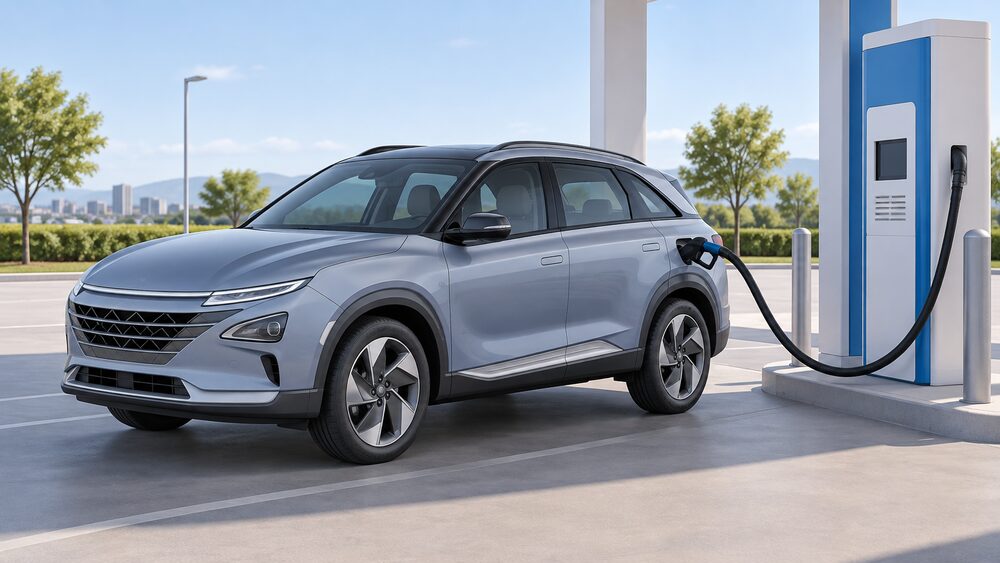 Hyundai NEXO hydrogen fuel cell SUVThe flagship hydrogen car householders search for by name in the UK.