In this guide
A home battery does not automatically keep the lights on. A battery storage system does not normally provide power in a power cut unless additional equipment and configuration is included1. Not all batteries can deliver electricity during a power cut, and not all systems are suitable2. The difference between a battery that dies with the grid and one that carries the house through an outage is a backup function, usually described as an emergency power supply (EPS) output or a backup gateway, plus the changeover hardware that isolates the home from the network.
Where that function is fitted, the reward is real. The more expensive battery systems can also provide electricity during a power cut4. A maker's backup switch is described as triggering an instant switch-over to the in-house battery storage system during a power failure within a few seconds5. What a household gets is a set of backed-up circuits, a defined output limit and a runtime set by usable capacity, not a whole-house guarantee.
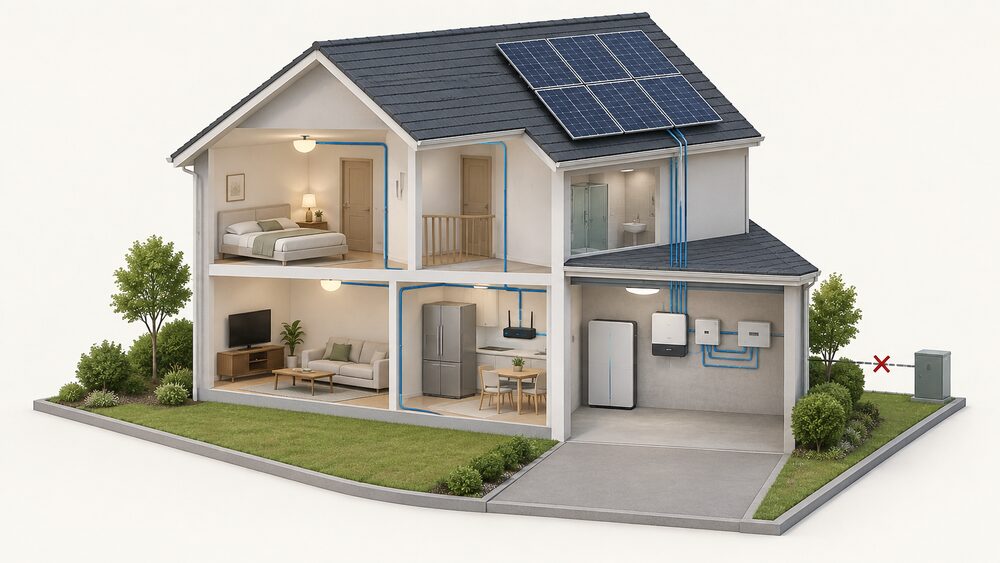
The practical questions are which circuits are wired to the backup output, how much power that output can deliver, how long the battery lasts at that draw, and whether solar can recharge it while the grid is down. This page sets out the equipment, the switching, the sizing, the connection rules and the emergency rota arrangements that apply across the UK.
What a battery does in a power cut, and what it cannot do by itself
The default behaviour of a grid-tied battery is to shut down with the grid. A battery storage system does not normally provide power in a power cut unless additional equipment and configuration is included1. This is not a fault or a limitation of the cells; it is how the inverter is set up. Without a backup output and an isolation device, the inverter has no way to separate the house from the network, and it must not energise wiring that network engineers may be working on.
The position is consistent across independent guidance. Not all batteries can deliver electricity during a power cut2. In some cases storage devices can provide back-up supplies for use in a power cut, but this is not always possible, and households are advised to check with their installer9. Which? puts it in buyer's terms: if a household is looking to protect against power cuts with a home battery, not all systems are suitable, and the installer should be asked whether the battery will work in a power outage, and for how long3.
Solar behaves the same way. Typically solar panels cannot power a home during a power cut unless the home is off the grid or has additional equipment1. Panels switch off automatically during a power cut as a safety feature that prevents electricity being exported to the network, and usually restart on their own once power returns8. Electricity North West states the same rule plainly: solar panels stop working during a power cut for safety reasons10.
What this means for independence is worth stating firmly. A battery without a backup function shifts when a household buys electricity; it does not make the household independent of the grid. The grid remains the source of supply and the reference the inverter synchronises to. Only the addition of a backup output, an isolation device and a changeover mechanism turns stored energy into a supply that survives an outage.
EPS: the backup function that makes a battery work in a cut
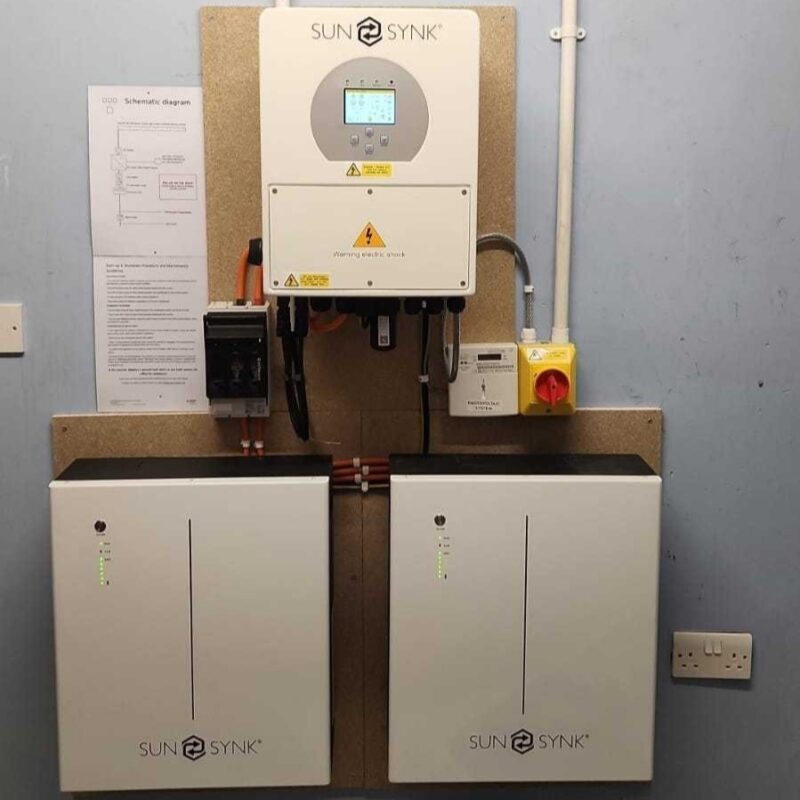
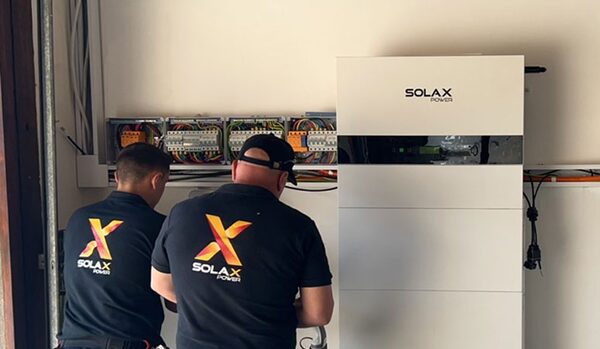
EPS stands for emergency power supply, and in battery systems it describes a dedicated output that stays live when the grid does not. In SolaX systems, EPS is an integrated backup power feature that ensures critical appliances remain powered during grid outages, supplying selected essential loads through a dedicated EPS output11. The word "selected" carries the weight: an EPS output feeds a sub-board of chosen circuits, not the whole consumer unit.
Some makers go further with a separate enclosure. The SolaX EPS Box provides intelligent switching between on-grid and off-grid modes, delivering whole-home backup11. That is a maker's description of its own product, and it describes a design where the backup output is sized to carry the full house load rather than a subset of circuits. Whether a given property can use that arrangement depends on the load and the inverter's output rating.
The distinction matters when comparing quotations. Two systems with the same battery capacity can differ entirely in what they do during an outage: one may have no backup output at all, another may back up a handful of circuits, and a third may be configured for whole-home backup with a gateway. The capacity figure on a quotation says nothing about which of these applies.
Changeover switches and how the switchover actually happens
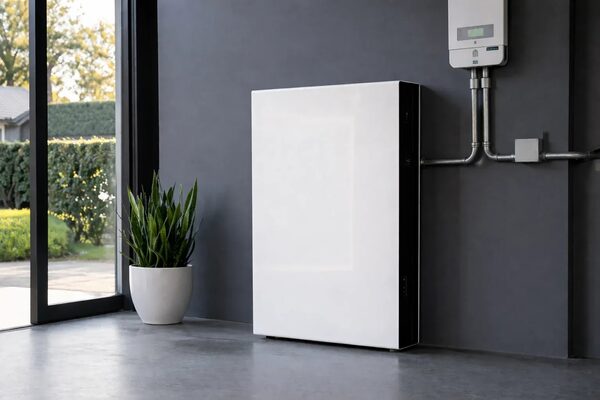
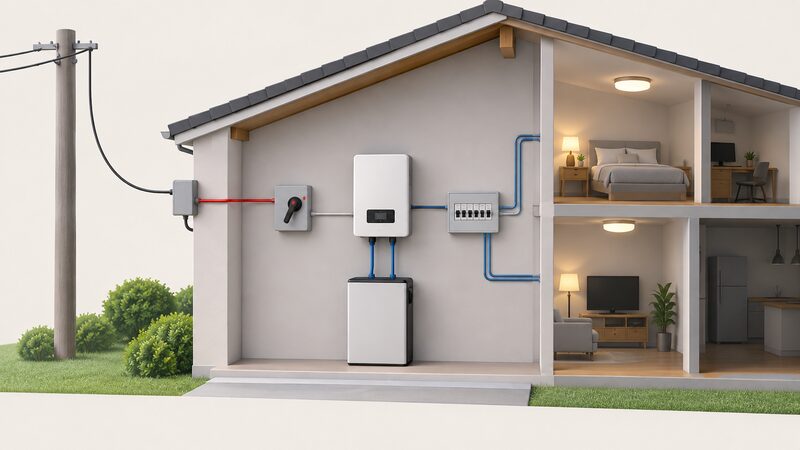
The switchover is the moment that decides whether an outage is noticed. In a system built around a backup switch, the home is automatically disconnected from the mains, and then the back-up power takes over the supply via the in-house battery storage5. The same maker describes the trigger as an instant switch-over to the in-house battery storage system during a power failure within a few seconds5.
Two things are happening in that sequence. First, the installation is isolated from the network, so no energy is pushed onto wiring that may be under repair. Second, the backup output is energised and the backed-up circuits are supplied from the battery. The isolation is not optional and is not a convenience feature; it is the safety condition that allows a grid-tied system to run at all while the network is down.
The speed of changeover determines what survives. A few seconds is enough to keep a fridge, freezer, router, lighting circuit and phone charger running without intervention, but it is not uninterruptible. Equipment that cannot tolerate any gap needs its own uninterruptible power supply: these provide a few minutes emergency battery backup if power fails12. That is a different device with a different job, and it does not replace a battery backup circuit.
For households on a rota disconnection, the switchover also has to cope with repeated events. A system that isolates and restores automatically each time is doing the same thing several times a week in the worst case, and the changeover hardware is the component that carries that duty.
What keeps running and what does not: sizing your essential loads
Backup is a sizing exercise before it is a technology choice. The starting point is the discharge floor: when the battery gets down to a set level, maybe 20% of the total storage capacity, the system will stop taking electricity out6. A 10kWh battery therefore does not offer 10kWh of backup; it offers roughly the capacity above that floor, and less again once conversion losses are counted.
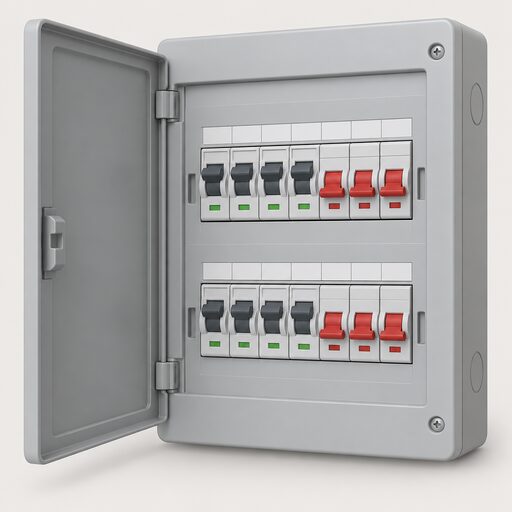
The second constraint is the output rating of the backup supply. A backed-up sub-board carrying lighting, broadband, a fridge, a freezer, a boiler pump and a few sockets draws far less than one carrying an electric shower, an oven or a heat pump. Which circuits are moved to the backup board is the decision that sets both the runtime and the cost.
The third is what stops working regardless. Gas boilers and heating, electrical appliances and a home's internet and landline connections will stop working in a power cut13. A boiler needs mains electricity for its pump and controls even though the gas supply continues. A landline that depends on mains power fails too, though if a landline will not work during a power cut, the landline provider might offer a free solution such as a back-up battery unit, for a minimum of one hour, that would enable a call to the emergency services13.
| Load | Typical backup treatment | What to expect |
|---|---|---|
| Lighting, broadband router, phone charging | Usually on the backed-up board | Runs for the duration of usable capacity |
| Fridge and freezer | Usually on the backed-up board | Food keeps 4 to 6 hours in the fridge and 15 to 24 hours in the freezer if unopened14 |
| Gas boiler and heating controls | Needs mains power for pump and controls | Stops working in a power cut13 |
| Electric cooker, heaters, sensitive electronics | Not usually backed up | Turn off electric cookers, heaters and sensitive equipment such as TVs and computers15 |
| Stairlift | Often has its own battery | Most stair lifts have a battery backup; check expected life with the manufacturer15 |
| Medical equipment, air beds, ceiling hoists | Needs a checked backup supply | Check mains power backup for all critical equipment12 |
For households with care needs, the checks are more specific. Stairlifts often have backup batteries, and the expected life of that battery should be checked with the manufacturer, along with access to a ground floor exit, a telephone and heating for around three hours14. Care and assisted living providers are advised to check mains power backup for all critical equipment12.
AC-coupled, DC-coupled and hybrid systems: which can back up your home
Backup capability is a property of the inverter and the wiring, not of the battery chemistry. The more expensive battery systems can also provide electricity during a power cut4, which is a way of saying that backup is a feature tier rather than a default. A household comparing an AC-coupled system with a hybrid inverter is really comparing how the backup output is provided and how much of the house it can carry.
The direction of travel is towards more options rather than fewer. At household level, further innovation in home battery technology, vehicle-to-everything (V2X), and solar can provide households with additional backup options during power outages16. That is a statement about where the technology is heading, not a description of what is installed today, and it does not change the rule that a system needs the right equipment to run islanded.
For a household weighing independence, the honest position is this. A battery with a backup output reduces dependence on the grid for the duration of an outage, on the circuits it serves. It does not remove dependence on the grid for recharging, for the reference frequency the inverter follows, or for the supply that carries the rest of the house. A system configured for whole-home backup narrows the gap further but still relies on the battery holding charge when the outage begins, and on the sun if the outage is long. Households exploring that trade-off in more detail will find it set out in home batteries and household energy independence.
Cost of backup-capable battery storage: £3,000 to £6,000 typical installed
Published figures for battery storage vary widely because they cover different things: the battery alone, the battery with an inverter, or a full installation with a backup output and sub-board. The Energy Saving Trust estimate, cited in a parliamentary briefing, puts battery storage at up to £10,000 depending on size, with a typical 5kWh system around £4,6007. Energy Saving Trust's own advice gives a range of £1,500 to £10,000, with a 5kWh battery system around £4,6006.
Other independent sources sit in similar territory with different framing. Battery storage tends to cost around £5,000 to £8,00017. Solar battery costs can vary widely, typically ranging from £2,000 to £12,500, depending on several factors18. A battery typically adds £2,500 to £5,000 to a solar installation19. Home Energy Scotland gives a single figure of £8,000 for battery storage20.
| Source | Figure given | Basis |
|---|---|---|
| Parliamentary briefing, citing Energy Saving Trust | Up to £10,000; typical 5kWh system around £4,600 | Battery storage depending on size7 |
| Energy Saving Trust | £1,500 to £10,000; 5kWh system around £4,600 | Type and size of battery6 |
| Energy Saving Trust solar advice | Around £5,000 to £8,000 | Battery storage17 |
| The CPA | £2,000 to £12,500 | Capacity, chemistry and lifespan18 |
| uSwitch | £2,500 to £5,000 | Additional cost on a solar installation19 |
| Home Energy Scotland | £8,000 | Battery storage20 |
The spread is not a disagreement about the hardware so much as a disagreement about scope. A quotation that includes a backup gateway, a separate sub-board, the labour to move circuits and the certification will sit above one for a battery added to an existing hybrid inverter with no backup provision. Backup capability is one of the items that moves a quote within the published range, and it is worth asking which of the published figures a given quotation is being compared against. Broader cost context sits in how much a home battery costs.
Grid connection rules: G98 and G99 and what they mean for backup
Any generating or storage asset connected to a distribution network has to meet protection settings rules. G98 and G99 are technical standards for the protection settings required for generators or storage assets to connect to electricity networks, acting as a safety mechanism to protect both the network and the equipment from faults21. They refer to different kinds of protection settings regulations that generator or storage assets must comply with to connect to the network22.
The thresholds decide which route applies. G98 sets out the requirements for connecting small-scale generation systems to the Distribution Network, and ensures small-scale generation installations connect to the grid safely and do not compromise network stability, safety or power quality23. G98 is a UK engineering standard written by ENA, previously known as G8323. Larger systems over 16A, which includes most hybrid backup inverters, follow a different route22. Since 27 April 2019, all generating equipment connected to any electricity distribution network, whether managed by a distribution network operator or an independent network operator, has had to comply24.
In Northern Ireland the equivalent is G98/NI, a set of rules that apply when connecting generation equipment such as solar panels on a house and exporting any electricity to the electricity network25. The practical consequence for backup is that the protection settings are what allow the inverter to detect loss of mains and disconnect. The same detection that satisfies the network operator is what makes islanded operation possible once a backup output is fitted. Households wanting the full procedural picture will find it in telling the network operator about a home battery.
Planned emergency power cuts: how the rota works and how much notice you get

Rota disconnection is the scenario a backup system is really built for. Planned Emergency Power Cuts are a form of emergency power cut used by energy companies in response to severe shortage of electricity generation in Northern Ireland, previously referred to as load shedding14. In the event of a shortfall in electricity generation in Northern Ireland, SONI may instruct NIE Networks to reduce demand, and SONI, which is responsible for balancing generation with demand, will instruct NIE Networks to reduce electricity demand through planned emergency power cuts when generation is insufficient26.
The mechanics are published. Different block letters are timetabled to be without power for around three hours once or twice a day12. Planned emergency power cuts mean switching power off to at least 5% of NI households at once14. They are a last resort and would not affect everyone at the same time, and are implemented only to protect the electricity network from more damage, which would be more disruptive to customers for a much longer period16.
Notice is short and uneven. The Electricity System Operator plans to hold a press conference and use social media to let people know a few days before cuts are needed, and it is not possible to call, text or email every customer in advance28. Network operators may receive as little as 30 minutes' notice of an instruction to implement a power cut28. The rota will only be published once emergency power cuts have been approved to take place, findable at powercut105.com by postcode28. Each day the issue continues, the next day's rota is issued in the early evening29.
Timing is approximate. Power might be switched off or reconnected around 30 minutes before or after the published time depending on national electricity use30. Those who have had their power disconnected go to the bottom of the timetable and would only be disconnected again if all blocks have had their turn30. Triggering factors include unforeseen forced outages of other plant and managing planned maintenance outages, variable demand between winter and summer and between peak and non-peak, variability of renewable generation, the small-scale nature of the NI grid, and the introduction of new technologies to help facilitate the energy system transition16.
Preparing your household for a three-hour cut
A three-hour block is short enough that preparation is mostly about the first ten minutes. Turn off electric cookers, heaters and sensitive electrical equipment such as TVs and computers15. Keep a torch and batteries in the house15. Keep the freezer door closed to help preserve your food15. Food should keep for between 4 and 6 hours in the fridge and 15 to 24 hours in the freezer if you can avoid opening it14.
For households with a backup battery, the preparation is different in kind. The battery has to be charged when the cut begins, which means the household is relying on whatever state of charge the system happened to be in. A battery that has been discharged to its floor by an evening of peak-rate arbitrage has nothing left to give. Households on a rota can see the timetable in advance and can plan around it, but the notice to the network operator can be as little as 30 minutes28.
For anyone relying on medical or mobility equipment, the checks are specific and should be done before an event rather than during one. Check mains power backup for all critical equipment, including medical equipment, air beds and ceiling hoists12. Stairlifts often have backup batteries, and the expected life of that battery should be checked with the manufacturer, along with access to a ground floor exit, a telephone and heating for around three hours14. An existing backup generator should be checked to confirm it meets the power needs and connections required in an emergency12.
Billing continues to be based on use. You will only be charged for the amount of electricity you use14. If supply has not been restored after four hours, contact the helpline on 03457 643 64314. If power is not restored within an hour of a scheduled rota time, visit Power Check for more information and report the power cut30.
VAT on battery installations: the 0% rate and when it ends
The zero rate applies to qualifying installations and has a fixed end date. The 0% VAT rate on solar and battery installation is currently in place until 31 March 2027, when it is due to increase to 5%8. That is a maker's statement of the position, and it matches the wider published expectation that the rate for energy saving materials reverts to 5% from 1 April 2027 unless the rules are extended or changed.
For a household planning a backup-capable installation, the date is the single most consequential number on this page after the cost range. A system installed before the deadline is zero-rated; the same system installed after it carries 5% VAT on the qualifying elements. The difference on a £4,600 system is not trivial, and it is the kind of figure that moves a decision by a few months.
The rate applies to battery storage installations as part of the qualifying works, and the deadline is the same across the UK. Households wanting the detail, including which elements of an installation qualify, will find it in the VAT rate on home battery storage.
Sources30 cited
- Solar power facts, Energy Saving Trust, 2026-08-13
- Battery storage advice, Centre for Sustainable Energy, 2025-10
- Solar panel battery storage, Which?, 2026-05-14
- Making the most of your solar PV panels, Centre for Sustainable Energy, 2026-08
- Back-up power supply, RCT Power, 2026-09-19
- Battery storage, Energy Saving Trust, 2026-08-19
- Battery storage and grid flexibility, UK Parliament POST, 2026-06-25
- Solar panel installation in East Anglia, Fuse Energy, 2026-09-12
- Renewable energy storage, Electricity North West, 2026-09-19
- Tips to help you during a power cut, Electricity North West, 2026-09-19
- Emergency power supply, SolaX Power, 2025-06-24
- Care and assisted living providers, Energy Networks Association, 2026-09-17
- Storms and bad weather, Energy Networks Association, 2026-09-17
- Emergency power cuts, NIE Networks, 2026-09-19
- Power cut help, NIE Networks, 2026-09-20
- Why would emergency power cuts happen, NIE Networks, 2026-09-19
- Solar panels advice, Energy Saving Trust, 2026-08-27
- Battery storage and solar panels, The CPA, 2026-01-06
- Solar panels guide, uSwitch, 2026-09-16
- Battery storage, Home Energy Scotland, 2026-09-20
- Installations up to 3.68kW per phase at more than one property, SSEN Distribution, 2026-09-17
- Installations above 3.68kW per phase but 50kW or less, SSEN Distribution, 2026-09-17
- Micro generation and storage connections, Electricity North West, 2026-09-19
- Installations up to 3.68kW per phase at a single premises, SSEN Distribution, 2026-09-17
- What is G98/NI, NIE Networks, 2026-09-19
- Planned emergency power cuts, NIE Networks, 2026-09-19
- How do planned emergency power cuts work, NIE Networks, 2026-09-19
- Emergency power cuts, Electricity North West, 2026-09-19
- Emergency planning portal for residential customers, SSEN Distribution, 2026-09-19
- How do I know if or when my power will be switched, NIE Networks, 2026-09-19
 Essential Loads and CircuitsWhich plugs and lights should stay on when the power goes off, and which can safely go without?
 Backup Power and IndependenceA power cut leaves most homes completely dark, so how much backup do you actually need to keep the lights on?
 Maintaining Backup PowerWill your generator actually start when the power goes off?
 Leaving the Electricity GridCan you really cut your home off the grid completely, and what does it cost to have your electricity supply removed for good?
 The Full Backup Power GuideHow long do UK power cuts usually last, and what can keep your fridge, heating or phone going until the power comes back?
 Off-Grid Battery SystemsHow many days of power do you need when there is no sun?