In this guide
A home battery never gives back all the electricity put into it. Typical round-trip losses are around 10 to 15% of the energy moved in and out1, and E.ON Next's own examples show a round-trip efficiency of around 80 to 90%2. Round-trip efficiency is the ratio between the energy charged into a battery and the energy discharged from it, expressed as a percentage, so a higher figure means less is lost on the way3.
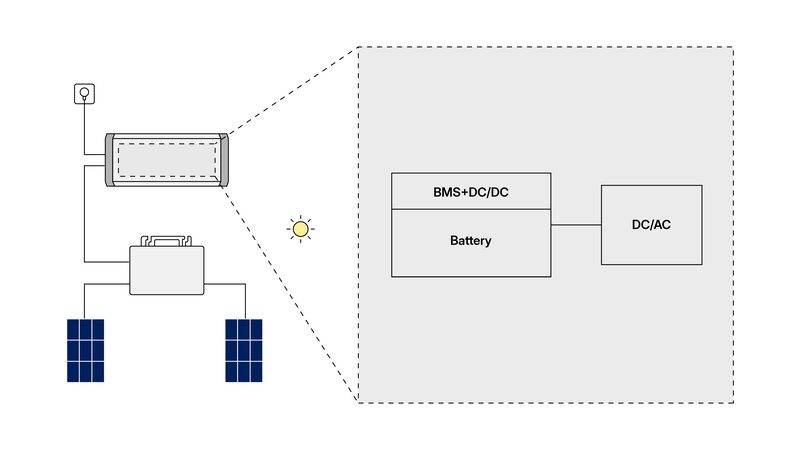
The number printed on a datasheet is often higher than the number a household experiences. Battery pack figures of 95% or more are common on current lithium iron phosphate (LFP) products, for example the Fox ESS EP114 and the BYD Battery-Max LiteIn5. Once the inverter and its conversions are counted, the figure falls: Tesla gives 89% for Powerwall 3 measured from solar, through the battery, to the home or grid6. Older chemistries and retrofitted systems that convert the energy more times sit lower still.
Those few percentage points matter because every stored unit is paid for once, either as imported electricity or as solar that could otherwise have been exported. Losses shrink the gap between cheap and expensive electricity that a battery exploits, and a system that draws power while idle loses a little more each day whether or not it cycles.
What round-trip efficiency means: the 10 to 15% you lose going in and out
Round-trip efficiency compares what goes into a battery with what comes out of it3. The losses happen in two places. Inside the battery, energy is lost to chemical reactions, internal resistance and heat3. Outside it, the electricity is converted: solar panels produce direct current (DC), homes run on alternating current (AC), and batteries store DC, so stored solar energy passes through several conversions, each with a small loss. As one maker's guide puts it:
"These small efficiency losses mean you never get back 100% of the energy you generated or stored."
Electricity North West makes the same point for a network operator: batteries are not 100% efficient, so not all the energy put in comes back out11.
The critical detail is what a quoted figure covers. AlphaESS distinguishes two measures. Battery efficiency usually focuses on the battery's internal losses only3. Round-trip efficiency, properly stated, applies to the entire energy storage system, including both the inverter (or power conversion system) and the battery3. Datasheets do not always make clear which is meant, and many headline figures describe the battery pack.
| Product | Maker's round-trip figure | What it covers |
|---|---|---|
| Fox ESS EP11 | 95% or more | Battery pack4 |
| Fox ESS CQ7 | more than 95% | Battery pack12 |
| Fox ESS EP5 | 95% or more | Battery pack13 |
| Solarwatt Battery vision pack | more than 95% (maximum efficiency) | Battery14 |
| BYD Battery-Max LiteIn | 95% or more | Battery5 |
| Tesla Powerwall 3 | 89% | Solar to battery to home or grid6 |
The figures in the table are not directly comparable. The Solarwatt figure is labelled a maximum, the Fox ESS figures are for the battery pack, and the Tesla figure follows the energy from the panels all the way to the socket or the grid. That last kind of figure is closer to what a household sees in practice. The brand pages for Fox ESS home batteries, BYD Battery-Box, Solarwatt home batteries and Tesla Powerwall 3 give the rest of each specification.
Lithium-ion, LFP and lead-acid compared: 80 to 95% by chemistry
Chemistry sets the ceiling for how much energy a battery can return. Maker guidance consistently places lithium-ion above lead-acid, although the published ranges differ from one document to the next.
| Chemistry | Round-trip efficiency given | Source type |
|---|---|---|
| Lithium-ion (LFP) | 90 to 95% | Maker guidance7 |
| Lithium-ion | 90 to 95% | Maker guidance15 |
| Lithium-ion, "a good lithium battery" | about 90 to 95% | Maker guidance16 |
| LFP, worked example | 95% | Maker guidance17 |
| LiFePO4 (LFP) | over 95% | Maker guidance18 |
| Sodium-sulphur | around 90% | Maker guidance7 |
| Lead-acid | 80 to 85% | Maker guidance7 |
| Lead-acid models | around 80 to 85% | Maker guidance15 |
| Lead-acid (deep cycle), worked example | 85% | Maker guidance17 |
| Lead-acid, average | 50 to 95% | Maker guidance18 |
| Flow batteries | 75 to 85% | Maker guidance7 |
The lead-acid figures show the widest spread. SolaX gives an average range of 50 to 95% and attributes the losses to internal resistance and heat generation18, while the same maker's comparison of battery types, and EcoFlow, settle on 80 to 85%7. The difference reflects how the battery is used and how the figure was framed rather than a contradiction to be resolved; the documents simply disagree on the lower end.
Efficiency is only one reason lithium dominates new home installations. Independent guidance from Plymouth Energy Community gives lithium-ion around 4,000 charging cycles and a typical life of 10 years or more, against around 700 to 1,000 cycles for lead-acid19. Flexi-Orb notes lithium-ion batteries weigh two thirds less than lead-acid20. SolaX's worked example of two batteries both rated at 10 kWh nominal capacity finds the LFP battery can deliver more than 12 times the lifetime energy of the lead-acid one17. Lower losses per cycle, multiplied over many more cycles, compound into a large difference in the energy a household actually gets back over a battery's life.
National Energy Action's best practice guide observed as long ago as 2019 that as battery technologies develop, efficiencies improve and costs reduce21. More on each chemistry is set out in home battery chemistries, lithium-ion vs lead-acid solar batteries and lead-acid, AGM and gel batteries.
For independence, the chemistry question is practical: a lead-acid bank at the lower end of its range can lose a sixth or more of what it stores, which in an off-grid home means more generation, or more generator running, to cover the same evening demand.
AC-coupled retrofits: around 90% once the extra conversion is counted
How a battery is wired into the house matters almost as much as what is inside it. A DC-coupled battery connects directly to the solar panels, while an AC-coupled battery connects on the AC side of the home's electrical system19. In an AC-coupled retrofit, solar energy is converted from DC to AC by the existing solar inverter, back to DC to charge the battery, and to AC again when it is used, which is often described as a triple conversion.
Maker guidance puts the cost of that extra conversion at a few percentage points:
| Configuration | Round-trip efficiency given |
|---|---|
| AC-coupled battery retrofit | around 90%8 |
| AC-coupled retrofit | around 90%22 |
| AC-coupled system | 85 to 90%23 |
| AC-coupled systems | 83 to 88%24 |
| DC-coupled system | 90 to 94% real-world25 |
| DC-coupled systems | 90 to 93%24 |
| DC-coupled hybrid swap | around 95%8 |
Expressed as losses, AC-coupled systems typically lose 12 to 17% per cycle because of the triple-conversion path25. Estimates of the gap vary. Jackery states that swapping to a DC-coupled hybrid improves round-trip efficiency by about 5% by avoiding double conversion22; SolaX puts the gain from a hybrid inverter at an extra 3 to 5%26; AlphaESS states AC-coupled systems lose approximately 8% more energy than DC-coupled ones27. Hoymiles describes the difference as minimal28, and Carbon Co-op's case study describes it as "a bit more conversion losses"29.
These are all maker or case-study figures, and they are not measured the same way. The independent view on retrofits concerns practicality rather than efficiency: the Centre for Sustainable Energy describes AC-coupled batteries as easier to retrofit in homes that already have solar panels30. SolaX states that an AC-coupled battery suits 90% of solar retrofits, with a minor energy loss during conversion26.
What this means in practice is a trade-off. A retrofit keeps a working solar inverter in service and avoids the cost of replacing it, and pays for that in a slightly larger loss on every stored unit. A DC-coupled or hybrid system reduces conversions but ties the solar and the battery to one inverter, so a household depends on a single piece of equipment, and on one maker's continued support, for both. AC-coupled and DC-coupled home batteries covers the wiring in detail.
Standby losses: where power goes when nothing is being drawn
Round-trip figures describe energy lost while charging and discharging. They say nothing about what a system uses while it sits idle. Standby electricity is the energy appliances and devices use while switched off but still plugged in31, and standby mode is a low-power state that a connected appliance enters when not being actively used32. A home battery system is never fully off: its inverter, battery management system and monitoring stay powered so that it can respond when the sun comes up, the tariff changes or the grid fails. Homey notes more generally that many power adapters draw power even when the device itself is not in use10.
No standby consumption figure in watts for a specific home battery on sale in the UK has been verified for this page. What is documented is that system design affects it. SolaX, comparing a "battery-ready" system with a hybrid system, lists the battery-ready arrangement as having higher standby consumption, reducing overall system efficiency, and lower charge and discharge efficiency, leading to energy losses33. That is a maker comparing its own product types, but it confirms that standby draw is a design variable, not a fixed cost.
Two other things reduce what a household can draw from a battery without being losses in the strict sense. The system holds back a reserve: the Energy Saving Trust describes discharging stopping at a set level, "maybe 20% of the total storage capacity"9. That energy is not wasted, but it is not available for daily use either; battery capacity and usable capacity explains how nominal and usable capacity differ. And every hour a charged battery waits before being used is an hour of idle consumption by its electronics.
For comparison, heat stores lose energy differently. Homey states a well-insulated water battery loses less than 1 °C per 24 hours, about 2 to 4% energy loss, with a round-trip efficiency of more than 90%34. The Energy Systems Catapult reported in 2022 that the Q-zeta domestic thermal store has an average round-trip efficiency of 97%35. These are heat, not electricity, stores and are not direct substitutes, but they show that "efficiency" and "loss over time" are separate questions for any store.
How efficiency affects what a battery actually saves you

A battery earns its keep by moving energy in time: storing solar that would otherwise be exported cheaply, or charging on a cheap overnight rate and discharging when electricity is dearer. National Energy Action describes the second use, with Economy 7, Economy 10 or other time-of-use tariffs21, and the Energy Saving Trust describes a battery without panels charging until full and discharging when the cheap period ends, automatically9. Losses eat into both.
For tariff arbitrage, the loss sets a floor on the price gap that is worth exploiting. If 10 to 15% of a stored unit is lost1, a unit bought at the cheap rate costs more per usable unit than its sticker price, and a narrow gap between cheap and peak rates can be largely absorbed by losses and standby draw. For stored solar, the comparison is with export: each unit stored rather than exported gives up an export payment and returns only part of itself to the home. Stacking a home battery with smart tariffs and Economy 7 set out the tariff side.
The overall financial picture is modest. The Energy Saving Trust found in 2026 that adding a battery to solar panels can increase bill savings, but:
"In addition, batteries are not 100% efficient, so you will not get all of the energy out that you put in."
It adds that this is particularly so where households already have a good export tariff36. Efficiency is one reason: every percentage point lost comes straight off the savings a payback calculation assumes. A calculation that uses a pack figure above 95% rather than a whole-system figure nearer 89%6 will overstate what the battery returns. Home battery savings and payback and how installers must calculate self-consumption cover the method.
What this means for independence is straightforward. A battery increases how much of a household's own solar it uses, but losses mean a little more generation, or a little more grid import, is needed to deliver each unit into the home. The household still depends on the grid for top-up and on its supplier's tariff structure for the arbitrage value.
Export payments: losses and standby come out of what reaches the meter
Smart Export Guarantee payments are based only on the electricity a smart meter records going back to the grid37. A battery changes that figure in two ways. It deliberately reduces exports, because more solar is stored for use at home: Home Energy Scotland notes that installing a battery lowers export payments, while stating that overall savings are greater than relying on export payments38. Which? states that exports, and therefore payments, reduce with a storage battery, and that a battery "may render you ineligible for some SEG tariffs"39. And any energy lost in conversion, or consumed by the system while idle, is energy that is neither used in the home nor exported.
Feed-in Tariff households face different rules. Ofgem states that where a smart meter is fitted, deemed export payments stop and are replaced by payments for the electricity the meter records as exported40. Good Energy notes that on deemed export, payments may remain unchanged depending on how the battery is installed, while on metered export a battery may reduce exported electricity and so reduce payments41.
Some tariffs are built around exporting stored electricity, where round-trip losses bear directly on the payment:
- Intelligent Octopus Flux charges the battery when power is cheapest and exports between 4pm and 7pm, with matching import and export prices42.
- Ecotricity's Battery Booster and Earnings Optimiser modes set different export price thresholds at which the battery discharges to the grid43.
- Which? reported in 2020 that Octopus Energy paid for stored electricity later exported, whereas SSE paid only for renewable electricity44.
On such tariffs, a unit bought cheaply, stored and exported returns less than a whole unit to the meter, so the price difference must cover the loss. Virtual power plants and flexibility services covers the wider export-led arrangements.
Chemistry and coupling: what to check on a datasheet
AlphaESS states that round-trip efficiency "can vary significantly depending on the coupling method" between the solar system and the battery3, and that DC-coupled systems generally have the higher figure. Reading a datasheet for efficiency comes down to a few questions:
- What does the figure cover? A "battery pack" figure, as on the Fox ESS EP5 and CQ713, measures internal losses only. A whole-path figure, as on Powerwall 36, includes the inverter.
- Is it a maximum or a typical figure? Solarwatt labels its more than 95% as maximum efficiency14. A maximum reflects ideal conditions.
- Which chemistry? LFP figures generally sit at 90 to 95% or above; lead-acid at 80 to 85%7.
- How is it coupled? An AC-coupled retrofit adds a conversion, typically costing 3 to 5 percentage points in maker estimates26.
- Is standby consumption stated? It is often absent, and it affects annual performance33.
- How much capacity is held in reserve? A reserve, maybe 20% of capacity9, is not lost but is not usable day to day.
A whole-system figure is the one that matches a household's meter readings. Cycle life and degradation, which also shape lifetime energy returned, are covered in home battery cycle life and degradation, and the wider picture in the home battery storage guide and home batteries and energy independence.
Sources44 cited
- Solar energy storage, Jackery, 2026-06-20
- Smart solar battery tracking, E.ON Next, 2026-06-01
- Efficiency decoded: key efficiency metrics for energy storage systems, AlphaESS, 2024-09-12
- EP11 datasheet, Fox ESS, 2025-11-24
- Battery-Max LiteIn datasheet, BYD
- Powerwall 3 datasheet, Tesla
- Types of solar batteries, SolaX, 2026-01-29
- Adding batteries to an existing solar system, Jackery, 2026-06-10
- Battery storage, Energy Saving Trust, 2026-08-19
- AC vs DC home power explained, Homey
- Storage, Electricity North West
- CQ7 datasheet, Fox ESS, 2026-05-26
- EP5 datasheet, Fox ESS
- Battery vision datasheet, Solarwatt
- Solar battery storage, EcoFlow, 2025-05-30
- How many solar panels to power a refrigerator, EcoFlow, 2025-06-05
- Battery throughput and life cycle, SolaX, 2026-07-15
- LiFePO4 vs lead-acid battery, SolaX, 2026-04-20
- Everything you need to know about battery storage, Plymouth Energy Community
- Electrical energy storage systems, Flexi-Orb, 2025-04-22
- Domestic batteries best practice guide, National Energy Action, 2019-03-16
- Adding batteries to an existing solar system, Jackery, 2026-08-26
- Micro-inverter guide, Jackery, 2026-06-16
- Home battery storage UK, Jackery, 2026-07-02
- AC-coupled vs DC-coupled solar battery storage, Jackery, 2026-08-28
- Adding a battery to an existing solar system, SolaX, 2026-06-05
- Understanding PV and BESS coupling methods, AlphaESS, 2024-07-23
- DC-coupled vs AC-coupled vs hybrid solar battery storage, Hoymiles, 2025-09-23
- How flexible power could benefit people and planet, Carbon Co-op, 2022-11
- Battery storage, Centre for Sustainable Energy, 2025-10
- Standby power: the hidden costs of vampire devices, NICEIC, 2026-01-28
- Switching appliances off standby, Smart Energy GB, 2026-04-22
- Battery-ready vs hybrid systems, SolaX, 2024-09-27
- Water battery: storing heat, Homey
- Project BOOST: long-duration energy storage for UK homes, Energy Systems Catapult, 2022-02-23
- Supporting households with low carbon technology combinations, Energy Saving Trust, 2026-07-15
- Switching energy supplier with solar panels, Uswitch, 2026-06-04
- Battery storage, Home Energy Scotland
- Solar panel battery storage, Which?, 2026-05-14
- Feed-in Tariffs: generators, Ofgem
- Adding battery storage to a Feed-in Tariff solar system, Good Energy, 2026-07-24
- Smart Export Guarantee rates, Which?, 2026-04-24
- Understanding SmartShift battery automation, Ecotricity, 2026
- Solar panels and renewable energy: costs and rewards in 2020, Which?, 2020-01-12
 Cycle Life and DegradationHow long will a home battery actually last, and what decides that?
 Self-ConsumptionHow much of the electricity from your own solar panels do you actually use, and how much goes to the grid?
 Capacity and Usable CapacityA battery sold as ten kilowatt hours rarely gives you all ten to use.
 Payback and SavingsHow long until a home battery pays for itself, and why do quoted payback times vary so much?
 What Size Battery?How much electricity does your home use in a day, and how much of that falls in the hours when power is cheap or your solar panels are generating?
 Home Battery WarrantiesHow long does a home battery warranty really last, and what does it actually promise?