

In this guide
A home battery in Northern Ireland sits at the meeting point of two entirely separate approval regimes, and neither one substitutes for the other. Planning control decides whether the structure or the equipment is acceptable on the site. The network connection process, run by NIE Networks, decides whether the local electricity network and the supply into the property can carry the extra load. A battery can clear one and fail the other.
On planning, the position for domestic storage is permissive. The Planning (General Permitted Development) Order (Northern Ireland) 2015 was made under sections 32 and 247(6) of the Planning Act (Northern Ireland) 2011, and its Part 2 covers the installation of domestic microgeneration equipment1. A 2019 Scottish Government consultation document, reviewing permitted development rights across the UK administrations, records the position plainly: "planning permission is not required for domestic battery storage within a residential building"3. That is the general rule for a battery inside the home.
The network side is where the work sits. NIE Networks assesses the new equipment and the existing electricity supply once the installer's application arrives, and it reviews the capacity available at the premises to determine whether the existing supply can safely accommodate the increased loading4. From 1 July 2026, customers applying for a new connection no longer pay for wider network reinforcement costs incurred by their connection, because those costs are now shared across all electricity consumers6.
Planning permission and the network connection: two separate checks
The two regimes ask different questions and are answered by different bodies. Planning asks whether the development is acceptable in land-use terms. The connection process asks whether the wires and the supply can take the load.
The permitted development order grants permission subject to conditions. Any permission granted by the order "is subject to any relevant exception, limitation or condition specified in the Schedule", so the general permission is not unconditional1. Part 2 of the order deals with the installation of domestic microgeneration equipment and Part 37 with non-domestic microgeneration equipment, both extending to Northern Ireland2. A battery installed inside a residential building falls within the domestic position described in the 2019 review3.
Building control is a third strand, distinct from planning. The Northern Ireland Building Regulations 2012 are "designed to further the conservation of fuel and energy", which is the energy purpose behind the technical booklets that stand in place of the Approved Documents used in England10. Where work is notifiable, building control should be notified before the work starts so that a timely inspection can be arranged, the same principle that applies to a stove installation10. A battery installation that involves electrical work and a possible new circuit is the kind of job where the installer's competence scheme and the building control position are settled before work begins, not after.
For a household, the practical consequence is that a battery does not need a planning application in the ordinary case, but it does need a connection application, and the connection application is the one with a queue. NIE Networks has warned that, because of the potential for a high volume of applications in the weeks immediately following 1 July 2026, delays may be experienced6. The planning question is usually answered in a day; the network question is answered in weeks.
The connections process: choose your equipment, nominate an installer, apply
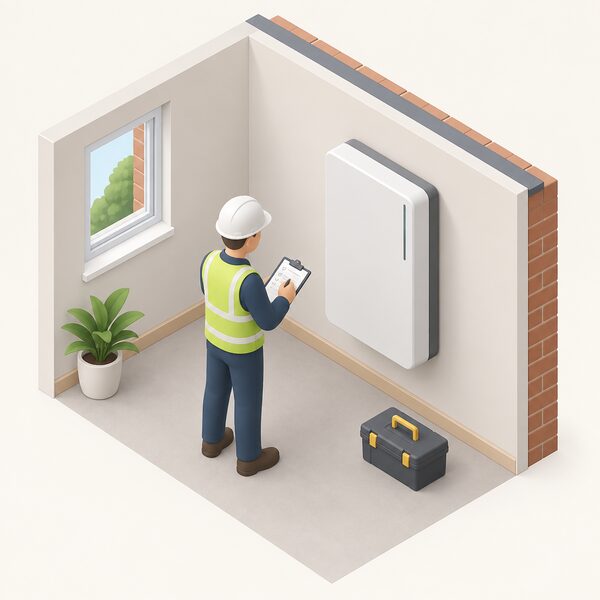
The process is set out in sequence by NIE Networks, and the customer's role is narrower than most expect. The first step is to choose the equipment to be installed4. The second is to nominate an installer, who carries out checks at the property and submits the application, managing the whole application on the customer's behalf4.
Applications are not submitted by householders directly. NIE Networks asks that all applications be submitted through the ENA's Connect Direct website, which is the installer's channel4. For commercial installs, or where help with the application process is needed, NIE Networks takes enquiries by email4.
The sequence runs as follows:
- Choose the equipment to be installed4.
- Nominate an installer, who carries out checks at the property4.
- The installer submits the application through the ENA's Connect Direct website4.
- NIE Networks assesses the new equipment and the existing electricity supply4.
- The customer and installer are notified of the outcome4.
The application process itself is not changing with the charging reform. NIE Networks states directly: "No, the connections application process will remain the same"6. What changes is who pays for reinforcement, not how the paperwork moves. NIE Networks has said it plans to hold customer webinar sessions in the lead up to the go live date to explain the changes in more detail6.
For a household, this structure matters because it puts the installer in the position of gatekeeper. The quality of the installer's survey and application determines whether the assessment runs smoothly. A battery added alongside a heat pump or an EV charger is assessed as increased loading on the same supply, and the installer's checks at the property are the first filter before NIE Networks sees anything.
What NIE Networks assesses: capacity at your premises and the local network
Two assessments run in parallel, and they answer different questions. The first is about the property. NIE Networks "will review the capacity available at your premises and determine if your existing electricity supply can safely accommodate the increased loading"5. The second is about the area. NIE Networks "check how much electricity your area uses and whether it can handle the new equipment like heat pumps or electric cars", to avoid power cuts and keep the supply safe and steady5.
The area-level check exists because local networks are shared. NIE Networks uses the information in the application to assess and monitor the local network, and states that if lots of properties on the same circuit are adding equipment like heat pumps or electric cars, it may need to upgrade cables or equipment to keep everything working5. A single battery on a street is unlikely to trigger that. A cluster of them, added over a few years, can.
The outcome of the premises assessment is binary and communicated clearly. If the assessment shows the existing supply can cope, the customer and installer are notified and the new equipment can be installed safely. If it shows the supply cannot cope, the customer is notified that the new equipment cannot be installed, and NIE Networks advises how to proceed4.
Where multiple generation or demand applications arrive for the same address, NIE Networks will not progress a new application until the applicant confirms which application it wishes to proceed with, and any existing live applications or quotations not proceeding are withdrawn and closed6. That requirement applies only where multiple generation or demand applications are received for the same address, and applicants may continue to progress separate generation and demand applications for the same address6.
For a household, the assessment is the point at which the battery stops being a product decision and becomes a network decision. A battery that charges at a modest rate may pass where a larger one with a high charge rate does not, because the assessment is about loading on the supply, not about the storage capacity in kWh.
Connection costs: quotations, the statement of charges and who pays for reinforcement
The charging methodology changed on 1 July 2026, and the change is significant for anyone connecting new equipment. The Department for the Economy, supported by the Utility Regulator, announced a major change to how new or increased connections to the electricity distribution network are charged in Northern Ireland6. From 1 July, customers applying for a new connection no longer have to pay for wider network reinforcement costs incurred by their connection, and those costs are now shared across all electricity consumers6.
The rules for existing paperwork are set out in detail:
- If a quotation has already been received, it will not change. Applying under the new methodology means submitting a new application6.
- Accepted quotes proceed based on the terms stated on the connection offer at the time of acceptance6.
- Where multiple applications exist for the same site, NIE Networks will not progress a new application until the applicant confirms which one to proceed with, and applications or quotations not proceeding are withdrawn and closed6.
On the planning side, pre-application advice carries a cost. Pre-application advice can be accessed by contacting the local planning authority, at a variable cost depending on the level of information required11. Local authorities may charge a fee for pre-application advice, a note that appears across several permitted development topics12. Where a prior approval route applies, the basic fee for most prior approval applications is £24912.
For a household, the reinforcement change removes the largest single unknown from a connection quotation. The remaining costs are the connection works specific to the property, which are quoted by NIE Networks through the installer. A battery added to an existing supply with adequate capacity is a comparatively small connection job; a battery added alongside a heat pump and an EV charger on a supply that needs upgrading is not.
Batteries among generation connections: where storage sits alongside solar and wind
Storage is treated as part of the generation picture rather than as a separate category. The permitted development order's Part 2 covers domestic microgeneration equipment, and the classes within it are drawn around solar. Class A covers the installation, alteration or replacement of solar PV or solar thermal equipment on the roof of a dwellinghouse or any building within its curtilage. Class B covers the same equipment on a dwellinghouse wall, a wall of a building within the curtilage, or any wall within the curtilage. Class C covers stand alone solar within the curtilage of a dwellinghouse2.
Battery storage sits alongside those classes rather than inside them. The 2019 review records that planning permission is not required for domestic battery storage within a residential building3. Adding storage to an existing solar array is a recognised route: households with existing solar panels can register to have battery storage added to maximise the benefits of the system15.
Incentive schemes treat storage as a supported measure. Battery storage installations are covered by added guidance under ECO4, with paragraph 5.220 added in regard to battery storage installations16. Not every storage technology qualifies: other types of battery storage, such as heat batteries, are not yet compatible with RdSAP or the quality standards required under the scheme and are therefore ineligible17.
In Northern Ireland specifically, the Northern Ireland Sustainable Energy Programme list of schemes for 2026-27 includes a Priority PV Scheme offering a NISEP grant of 50% off a PV system, hybrid inverter and battery storage, with the Housing Executive funding the remainder of costs and no financial contribution required from a NIHE tenant for any measure18. Grants under the programme are allocated on a first come first served basis19.
For a household, the generation connection framing matters because it determines how the application is categorised. A battery added to an existing solar array is a generation connection; a battery added on its own, charging from the grid, is a demand connection. NIE Networks allows separate generation and demand applications for the same address to progress6, which means a household adding both does not have to choose between them.
Batteries and power cuts: what storage can and cannot do during an outage
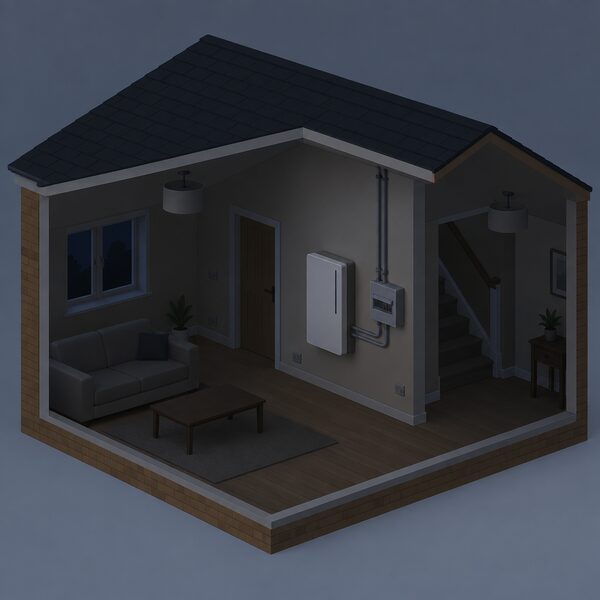
A grid-tied battery is not a standby generator. It is connected to the network, and when the network goes down, a standard installation shuts down with it. Keeping circuits live during an outage requires a specific backup provision, and the battery has to be installed with that in mind. The general position on what a battery can and cannot do in an outage is covered in battery backup in a power cut.
What NIE Networks does during an outage is separate from what a household's battery does. The company has an Emergency Response Plan that comes into effect when weather forecasts indicate that severe weather is likely. It suspends all normal activities and alerts NIE Networks and its partner organisations of the need to provide additional resources21. During Storm Éowyn, the plan was in effect from 23 January until power was restored to all homes and businesses, and NIE Networks expanded its contact centre into a second location in Belfast to increase the number of calls it could receive from people who had lost power21.
The restoration effort is organised geographically. Each area of Northern Ireland has a local incident centre staffed by engineers and administrative staff during severe weather, and a central control centre co-ordinates the restoration process and provides up to date information for customers22. Damage in severe weather can include trees blown down across electricity lines, broken poles, damaged transformers and blown fuses22. Helicopters are kept on standby to survey damage in more rural areas, and where possible four wheel drive vehicles are used and repairs are co-ordinated with Roads Service and local councils22.
For a household, the honest position is that a battery without backup provision adds nothing during an outage, and a battery with backup provision covers only the circuits wired to it. The restoration standard NIE Networks publishes is 24 hours, and compensation rules require a claim within one month of the day of the power interruption7. A battery sized for tariff arbitrage is not the same as a battery sized for outage cover, and the two purposes pull in different directions.
The Medical Care Register and how restoration is prioritised
NIE Networks holds a Medical Care Register for those who rely on electricity for healthcare needs23. The register exists because restoration cannot be simultaneous everywhere, and some customers need the supply back sooner than others.
Restoration is prioritised by hazard and by scale. Hazardous situations and damage affecting large numbers of customers are given priority22. That ordering is deliberate: a fault affecting a single property is fixed after a fault affecting a street, and a fault creating a danger is fixed before either.
The wider consumer protection framework sits with the Utility Regulator. The Code of Practice for Consumers in Vulnerable Circumstances sets out the expectations on suppliers and network operators for customers who need additional support23. The Medical Care Register is the network operator's part of that framework.
For a household that depends on mains electricity for medical equipment, the register is the mechanism that changes the restoration order. It does not guarantee a supply during an outage, and it does not make a battery redundant. A battery with backup provision and a place on the register are complementary rather than alternative arrangements, and neither one removes the case for a plan that assumes the supply can be lost.
Getting help: NIE Networks contacts, tools and support hours
The contact routes are split by purpose, and using the right one saves time.
| Purpose | Contact | Hours |
|---|---|---|
| Downed or dangerous lines | 9998 | Emergency |
| Customer helpline and general supply issues | 03457 643 6438 | 7.30am to 11.30pm, seven days a week, including public and bank holidays8 |
| Commercial installs and application help | Email to NIE Networks4 | Business hours |
| Household energy advice | Northern Ireland Energy Advice Service, 0800 111 445518 | 9am to 5pm Monday to Friday18 |
| Commercial Energy Saving Scheme | Power NI, 07551 008 477, energysaving@powerni.co.uk18 | Business hours |
NIE Networks maintains the meters at the properties of all customers across Northern Ireland no matter who the supplier is24. Different types of meter are required to be changed at different intervals24. Before a meter replacement visit, the area around the meter needs to be clear with good access, and the meter installer will ask for all electrical appliances to be turned off before power is switched off24.
On the planning side, consent to use an electric vehicle cross-pavement cable protector is handled by the Department for Infrastructure, with applications submitted to tdu@infrastructure-ni.gov.uk25. That route is relevant where a cable has to cross a footpath, which is a common arrangement for a battery or charger sited away from the house.
For a household, the practical point is that the connection process runs through the installer, not through the householder, and the installer's application channel is the ENA's Connect Direct website4. The householder's job is to choose the equipment, nominate the installer, and be available for the property checks. Everything after that is handled on the customer's behalf.
Sources25 cited
- The Planning (General Permitted Development) Order (Northern Ireland) 2015, legislation.gov.uk, 2015-02-25
- The Planning (General Permitted Development) Order (Northern Ireland) 2015, Part 2, legislation.gov.uk, 2026-09-17
- Extending Permitted Development Rights in Scotland: Sustainability Appraisal, Scottish Government, 2019-06
- Your connections process, NIE Networks, 2026-09-19
- What we do with your application, NIE Networks, 2026-09-19
- Connection charging announcement FAQs, NIE Networks, 2026-09-20
- How to find out if there's a power cut, Which?, 2026-06-04
- Additional works, NIE Networks, 2026-09-19
- The Planning (General Permitted Development) Order (Northern Ireland) 2015, Part 37, legislation.gov.uk, 2026-09-17
- Northern Ireland Building Regulations, Building Control NI, 2026
- Pre-planning advice for electric vehicle charging, Planning Portal, 2026
- Prior approval, Planning Portal, 2026-09-17
- Planning permission for stand alone wind turbines, Planning Portal, 2026-09-17
- Flue, chimney or soil and vent pipe, Planning Portal, 2026-09-17
- Solar Together Norfolk, South Norfolk and Broadland Council, 2026-09-17
- Summary of updates to ECO4 delivery guidance and measures table, Ofgem, 2025-08-07
- WHSHF wave 3 scheme guidance addendum, GOV.UK, 2026-06
- NISEP List of Schemes 2026-27, Utility Regulator, 2026-04
- Northern Ireland Sustainable Energy Programme list of schemes 2026-2027 published, Utility Regulator, 2026-04-01
- Plug-in solar interim product specification, GOV.UK, 2026-07
- Response to storms, NIE Networks, 2026-09-19
- How do you prepare for a storm, NIE Networks, 2026-09-19
- Code of Practice for Consumers in Vulnerable Circumstances, Utility Regulator, 2025-06
- Meter replacements, NIE Networks, 2026-09-19
- Apply to use an electric vehicle cross-pavement cable protector, nidirect, 2025-10-16
 Planning Permission in WalesDo you need planning permission for a home battery in Wales?
 Planning Permission in ScotlandDo you need planning permission for a home battery in Scotland?
 Planning Permission in EnglandWhen a domestic battery or its enclosure falls within permitted development in England, when an application is needed, and how the position differs for outbuildings, listed buildings and conservation areas.
 Home Energy Planning Rules in NIDo you need planning permission for solar panels or a heat pump in Northern Ireland?
 Planning Permission NIDo you need planning permission for solar panels in Northern Ireland?
 Planning Permission in NIDo you need planning permission for a heat pump in Northern Ireland?