

In this guide
Northern Ireland does not use the Priority Services Register that covers Great Britain. Instead, Northern Ireland Electricity Networks (NIE Networks) runs its own Customer Care Register, and a separate Medical Customer Care Register for customers dependent on life supporting equipment. Both are free to join, both are held by the network operator rather than by an electricity supplier, and both work on the same principle: the operator holds your contact details and your needs, so that when the power goes off it knows who you are and what is at stake.
Registration is by phone on 03457 643 643, online, by WhatsApp or Facebook Live Chat, or by downloading a form and returning it by post1. Registered customers get their calls given priority during a power cut, regular telephone updates while the supply is off, and at least three days' notice before a planned interruption, with the expected duration1. The Medical Customer Care Register currently holds 27,000 properties out of the 966,000 properties connected to the NIE Networks distribution system, and crews can be asked to prioritise restoration to those addresses2.
What the register does not do is supply power. NIE Networks states plainly that it will not provide a generator for a property during severe weather events2, and households on the Medical Customer Care Register are not exempt from planned emergency power cuts if a national rota is ever used3. Registration buys information and priority, not independence. That distinction matters for any household whose health depends on mains electricity.
Who qualifies: medical equipment, age and vulnerability
The NIE Networks Customer Care Register is aimed at households where a power cut is more than an inconvenience. Customers who have medical equipment in their homes, such as specialised mattresses, feeding systems or lifting equipment, can register1. The parallel Medical Customer Care Register is for customers who rely on electricity for their health needs, described elsewhere by NIE Networks as customers dependent on life supporting medical equipment6.
Alongside the network operator's registers sit the supplier-held Customer Care Registers. Every electricity and gas supplier in Northern Ireland must keep a Customer Care Register recording the details and special needs of customers who are of pensionable age, disabled (by virtue of being blind, partially sighted, deaf or hearing impaired) or chronically sick5. The Utility Regulator's code of practice for consumers in vulnerable circumstances confirms that electricity suppliers, gas suppliers and NI Water all hold Customer Care Registers, while NIE Networks holds a Medical Care Register for those who rely on electricity for healthcare needs8. Joining is a choice the consumer makes: each supplier register stores details of consumers who merit special treatment on account of age, disability or chronic illness, and consumers have to opt in9.
The equipment the registers are built around includes oxygen concentrators, patient vital signs monitoring systems and home dialysis5. The common thread across NIE Networks and NI Water is consumers who rely on electrical equipment or on a water supply for their day to day care5.
For comparison, the Great Britain Priority Services Register admits people who rely on electricity for medical reasons, use a stair lift, hoist or electric bed, have a specific communication need, or would find an unexpected power cut particularly distressing or difficult to cope with10. The Northern Ireland registers are described more narrowly around medical dependence and the statutory age, disability and chronic illness categories. Further detail on the GB scheme is set out on the Priority Services Register page.
What registered customers get during a power cut
The core benefit is communication. Registered customers can receive up to date information by phone during a power cut or a planned interruption to the supply1. NIE Networks states that it will then contact the customer regularly during the power cut with up to date information11, and the Consumer Council describes the same arrangement: adding details to the register allows NI Water and NIE Networks to prioritise your contact details if your supply goes off5.
Call handling is the second benefit.
"If you are registered on our Customer Care Register your call will be given priority."
In practice the caller either speaks directly to a call advisor or, if all advisors are busy, receives a call back11. For the Medical Customer Care Register, NIE Networks recognises the registered phone number when the customer calls, which supports more accurate estimated restoration times as well as prioritised restoration2.
None of this is a supply guarantee. The wider guaranteed standards apply to registered and unregistered customers alike: NIE Networks states it will restore electricity within 24 hours of a power cut, and its overall standards commit to restoring all customers within 24 hours where the cause is a fault on the distribution system12. Compensation claims under those standards must be made within one month of the day of the interruption14. The detail is covered on power cut compensation in Northern Ireland.
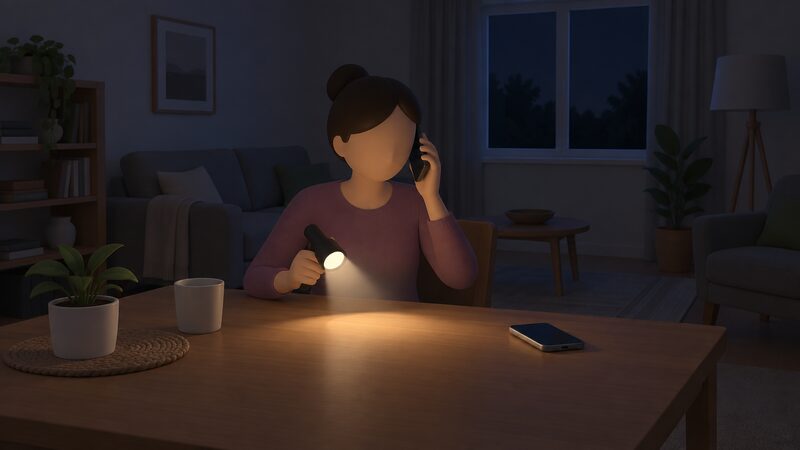
Planned interruptions: at least three days' notice

Where NIE Networks needs to switch off supply for planned work, registered customers are contacted at least three days beforehand and told the expected duration of the interruption1. The three day period is not a courtesy confined to the register: NIE Networks gives a minimum of three days' notice before turning off electricity for planned work to any customer15, and its guaranteed standards repeat that it will let customers know at least three days before a temporary interruption12. Which? records the same rule from the customer's side, noting that if supply is turned off for planned reasons you must get three days' notice17.
What the register adds is the method of contact. On the Big Network Rebuild programme, vulnerable customers receive a text message three days before the interruption plus a notification card in the post, and the dedicated customer service team telephones the number held on the Customer Care Register18. Three separate channels reduce the chance that a household with a communication need or limited mobility misses the warning altogether.
Notice is the single most useful thing a register can give a medically dependent household, because it converts an emergency into a scheduled event. Three days is enough time to charge a battery back-up, arrange a stay elsewhere, or confirm with a clinical team how equipment should be managed. NIE Networks' own advice to registered customers is to make sure any battery back-up is always fully charged11. Where an interruption arises from a fault rather than planned work, no notice is possible, and that is the gap a household's own backup arrangements have to fill. Options are compared on the backup power pillar page and in essential loads and backup circuits.
If compensation is in question for a planned interruption, the claim deadline is again one month from the day of the interruption14.
How to apply, and the alternative contact option
There is no single application window and no charge. NIE Networks lists the routes as signing up online, contacting the company via WhatsApp, Facebook Live Chat or the Customer Helpline, or downloading a registration form and returning it by post1. The Medical Customer Care Register can be joined by registering online19. The helpline number is 03457 643 64320.
| Route | Detail | Source |
|---|---|---|
| Online | Sign up form on the NIE Networks site; Medical register has its own online link | 1 |
| Telephone | Customer Helpline, 03457 643 643 | 1 |
| Available 7.30am to 11.30pm, 7 days a week, including public and bank holidays | 1 | |
| Facebook Live Chat | Listed as a contact channel for registration | 1 |
| Post | Downloadable registration form returned by post | 1 |
Two details are worth noting when filling in the form. First, the same form can be used to register for the NI Water Customer Care Register, by completing the separate section provided1. A single submission therefore covers the two utilities that matter most to a household reliant on electrically powered care equipment.
Second, an alternative contact can be named. NIE Networks allows customers to provide details of a relative, neighbour or friend as an alternative contact, to be used if the company is unable to speak with the customer directly1. During a long outage a landline may be dead and a mobile battery flat, so a nominated third party is often the only way the operator can pass on restoration information. GB operators use the same mechanism under different names, from nominated contacts who can be communicated with on the customer's behalf to carers registering on behalf of the person they care for10.
Written correspondence, including complaints about how the register has worked, goes to the Customer Relations Manager at NIE Networks, Carn Industrial Estate, Portadown, BT63 5QJ22.
Confidentiality: who can see your information
The register holds health and vulnerability information, and NIE Networks limits access to it.
"Only authorised NIE Networks staff will have access to the information."
That is a narrower statement than the GB position, where the regulator has set out a minimum set of customer details that energy companies must share between suppliers and network operators: customer contact name, telephone number and email address where available, address, details of any nominated person, details of any agreed password, and details of the customer's needs23. In Northern Ireland the NIE Networks register and the supplier-held Customer Care Registers are separate things, and registering with one does not populate the other. A household that wants both the network operator and its supplier to know its circumstances has to tell both.
The one deliberate crossover is NI Water, and that only happens if the customer completes the separate section of the form1. NIE Networks and NI Water jointly operate registers described by the Consumer Council as a Critical Care Register for consumers who rely on electrical equipment or on a water supply for day to day care5.
Historically the NIE Energy customer care register offered a wider bundle of supplier-side services: doorstep services, a password scheme, a special advice scheme, large print bills, Braille bills, provision for customers who are deaf or hard of hearing, and a carers contact24. Those are supplier functions rather than network functions, and they illustrate the split between billing support from a supplier and power cut support from NIE Networks.
The Medical Customer Care Register: 27,000 properties and priority restoration
The Medical Customer Care Register is the sharper of the two registers. It holds 27,000 properties, against 966,000 properties connected to the NIE Networks network2. That is a small fraction of the customer base, which is what makes prioritisation workable: if a registered property loses power, NIE Networks can arrange for crews to prioritise getting power back on as quickly as possible2.
During a major event the register is used as a restoration input. NIE Networks states that it checks the Medical Care Register to make sure that those who have the greatest need for electricity get it back as quickly as possible25. That sits alongside the general restoration rule that hazardous situations and damage affecting large numbers of customers are given priority26. The two principles can pull in different directions: a single registered farmhouse at the end of a long rural spur will not always be reached before a repair that restores a village, and NIE Networks does not promise otherwise.
| Register | Who it is for | What it adds |
|---|---|---|
| Customer Care Register (NIE Networks) | Customers with medical equipment in the home such as specialised mattresses, feeding systems or lifting equipment1 | Priority call handling, regular updates during a cut, at least three days' notice of planned work1 |
| Medical Customer Care Register | Customers dependent on life supporting medical equipment7 | Phone number recognition, accurate estimated restoration times, prioritised restoration2 |
| Supplier Customer Care Register | Customers of pensionable age, disabled or chronically sick5 | Supplier-side services including password and billing formats24 |
| NI Water Customer Care Register | Consumers with serious medical conditions5 | Prioritised contact if the water supply goes off5 |
The storm machinery behind those promises is substantial. NIE Networks has an Emergency Response Plan which comes into effect when weather forecasts indicate that severe weather is likely, suspending all normal activities and directing resources to Local Incident Centres in the affected areas27. Each area of Northern Ireland has a local incident centre staffed by engineers and administrative staff, with a central control centre co-ordinating restoration and providing up to date information for customers26. For Storm Éowyn, with the plan in effect from 23 January until power was restored to all homes and businesses, NIE Networks expanded its contact centre into a second location in Belfast to increase the number of calls it could receive from people who had lost power27.
Where the register stops: no generators, no exemption from rota cuts
Two limits are stated explicitly, and both matter more than the benefits for a household planning its own resilience.
The second limit concerns planned emergency power cuts. NIE Networks states that residential customers, including those on the NIE Networks Medical Customer Care Register, and businesses without backup generation that are not listed as protected by government, would not be exempt3. Only sites on the government's protected list are excluded. If a rota is ever used, the rota for power cuts is published on the NIE Networks website when a planned emergency power cut starts29. The mechanics are set out in more detail on rota power cuts.
A third limit is one of scope rather than policy. The registers are a communication and restoration priority service run by an electricity network company. They do not address clinical questions about how long a given piece of equipment can run without mains power, they do not replace an agreed plan with a healthcare provider, and they do not cover the fixed wiring inside the property. Where the fault is inside the home, NIE Networks recommends checking the property's trip switches first, and notes that lightning often affects supplies to individual properties or small numbers of properties, so if neighbours are not off the operator may need to be told30.
For a household, the honest summary is that registration removes uncertainty and shortens the queue. It does not remove the dependence on the grid, on NIE Networks as the single distribution operator for Northern Ireland, or on a working telephone to receive the updates.
Preparing for a power cut if you are on the register
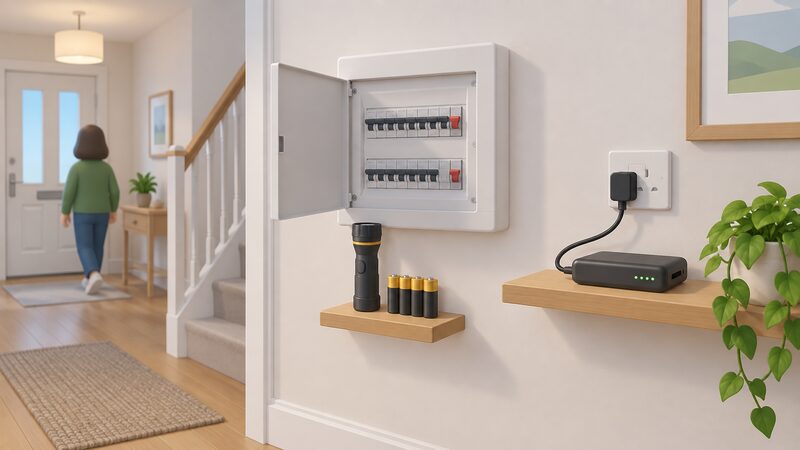
NIE Networks publishes a short list of preparations for customers who depend on electricity, and one of them is specific to the register: keep any battery back-up always fully charged11. The rest is general readiness: keep a torch and batteries in the house, know the location of the fuse box, be able to open electric gates, keep an electric vehicle battery charged, and join the medical care register if dependent on electricity for medical equipment31.
Food is the other routine concern. NIE Networks' emergency power cut guidance gives between 4 and 6 hours in the fridge and 15 to 24 hours in the freezer, if the doors can be kept closed28. Its general power cut advice is more cautious in tone, saying contents should be safe for many hours but that food should be disposed of if there is any doubt it appears to have defrosted32. Figures published by other operators are shorter, so the NIE Networks numbers should be read as the upper end of what a sealed appliance will hold. The subject is expanded on power cut food safety.
A short order of actions when the power goes:
- Check the property's trip switches, and whether neighbouring properties are also off30.
- Report the cut through nienetworks.co.uk, Powercheck, WhatsApp, Facebook or the helpline on 03457 643 6434.
- Keep fridge and freezer doors shut32.
- If lines are down or causing significant risk to the public, call 99933.
- If power is not restored within an hour of a scheduled restoration time, check Power Check and report the cut again29.
Updates during a large event are published on the NIE Networks website and social media channels as well as being telephoned to registered customers34. If a generator is used, NIE Networks advises care over siting it because of the risk of carbon monoxide poisoning, and that there should be plenty of air flow31. That is covered further on generator safety, and the equipment options for keeping a small medical load running are compared on portable power stations.
What this means for a household's independence
The Customer Care Register and the Medical Customer Care Register make a household better informed during an outage and, in the medical case, earlier in the restoration queue. They change nothing about the underlying dependence. Every registered property still relies on a single distribution network, on NIE Networks' crews reaching a fault, and on a phone line or mobile signal to receive the updates that are the register's main product. NIE Networks transports electricity to over 910,000 customers including homes, businesses and farms28, and during a widespread storm the register's 27,000 medical properties2 will still be competing with repairs that restore whole communities first.
Registration is free, it is reversible, and it costs a household nothing but the time to complete a form that also covers NI Water1. Genuine independence during a cut, whether for a feeding pump, an oxygen concentrator or simply a warm room, comes from equipment the household owns and keeps charged. The register tells you how long the wait will be; it does not shorten the wait to zero. Households comparing the arrangements across the UK will find the differences set out on power cuts in Northern Ireland and on who fixes a power cut.
Sources34 cited
- NIE Networks Critical Care Register, NIE Networks, 2026-09-20
- Should I get a generator from you? Medical Customer Care Register FAQ, NIE Networks, 2026-09-19
- Are any sites protected from the power cuts?, NIE Networks, 2026-09-20
- Power cuts: help, NIE Networks, 2026-09-20
- Electricity and gas consumer protection, Consumer Council for Northern Ireland, 2026
- Customer Care Register for vulnerable customers, NIE Networks, 2026-09-19
- Winter ready, NIE Networks, 2026-09-19
- Code of Practice for Consumers in Vulnerable Circumstances factsheet, Utility Regulator, 2025
- Customer care registers, Consumer Council for Northern Ireland, 2026
- Who can join the Priority Services Register, National Grid, 2026-09-17
- Critical Care Register for vulnerable customers, NIE Networks, 2026-09-20
- Customer standards, NIE Networks, 2026-09-20
- Overall standards, NIE Networks, 2026-09-19
- Guaranteed standards and claims, NIE Networks, 2026-09-19
- Planned power cuts, NIE Networks, 2026-09-20
- Planned work FAQs, NIE Networks, 2026-09-19
- How to find out if there's a power cut, Which?, 2026-06-04
- The Big Network Rebuild FAQs, NIE Networks, 2026-09-19
- How do I get registered on your Medical Customer Care Register, NIE Networks, 2026-09-20
- Cost of a new electricity connection FAQ), NIE Networks, 2026-09-19
- Unplanned power cuts FAQs, NIE Networks, 2026-09-20
- Claims and complaints, NIE Networks, 2026-09-19
- Priority Services Register review consultation, Ofgem, 2026
- NIE Energy Social Action Plan, Utility Regulator, 2020
- How do you prioritise faults in a severe weather event such as Storm Éowyn, NIE Networks, 2026-09-19
- Response to storms, NIE Networks, 2026-09-19
- How do you prepare for a storm, NIE Networks, 2026-09-19
- Emergency power cuts, NIE Networks, 2026-09-19
- How do I know if or when my power will be switched off, NIE Networks, 2026-09-19
- Severe weather and lightning, NIE Networks, 2026-09-19
- Power cut advice, NIE Networks, 2026-09-19
- Is there any action I should take when power is disconnected, NIE Networks, 2026-09-19
- Additional works and emergency contact, NIE Networks, 2026-09-19
- Will you provide updates to customers in an event, NIE Networks, 2026-09-20
 Power Cuts in Northern IrelandNorthern Ireland has a single electricity distribution network, run by NIE Networks, and its own reporting number, registers and compensation arrangements.
 Installer in Northern IrelandHow do you check an installer in Northern Ireland is properly registered, and who do you complain to if the work goes wrong?
 Utility Regulator NIWho sets your energy prices in Northern Ireland and who can you complain to?
 Energy Supply in NICan you get gas where you live in Northern Ireland, and what happens if your power goes off?
 Vulnerable Households EnergyIf someone in your home relies on powered medical equipment, or needs extra warmth because of a health condition, what help is available?
 Power Cuts in ScotlandWho do you call when the power goes out in Scotland, and how long should it take to come back on?